The Myth of 0% Financing: How Deferred Interest Can Cost You Hundreds
That no-interest financing offer at checkout could cost you hundreds. Learn how deferred interest works, why it differs from a true 0% APR offer, and five practical steps to avoid surprise credit card charges.

What you’ll need
Tap to tick things off before you start.
Why No-Interest Store Financing Can Be Misleading
When purchasing furniture, appliances, or electronics, you may encounter store financing advertised as no interest for 12 months. These promotions can make expensive purchases seem more affordable by spreading payments over time. However, the advertised benefit may depend on conditions that are easy to overlook. Some offers contain deferred interest provisions that can create unexpected charges. The Consumer Financial Protection Bureau warns that shoppers should understand promotional financing terms before accepting store credit.

What Is Deferred Interest Financing?
Deferred interest financing allows consumers to avoid paying interest on qualifying purchases when the promotional balance is completely repaid within a specified period. The lender calculates interest during that period but conditionally waives it when the repayment requirement is satisfied. This arrangement is common with retail credit cards used for furniture, appliances, and other major purchases. The important distinction is that the interest waiver depends on meeting the agreement's conditions, rather than being automatically guaranteed.

How Retroactive Interest Accumulates
Under deferred interest financing, interest generally begins accumulating from the original purchase date, even while the promotional balance appears interest-free. The issuer tracks these charges using the applicable interest rate and outstanding balances over time. If the required payoff condition is not satisfied, accumulated interest may be added to the account. Payments made during the promotion can reduce future interest accumulation, but they do not eliminate previously accumulated amounts unless the promotional waiver conditions are fulfilled.

Deferred Interest vs. True 0% Introductory APR
A true 0% introductory APR offer generally prevents interest from accruing on qualifying balances throughout the promotional period. If money remains unpaid afterward, the regular APR applies to that outstanding balance going forward. Deferred interest works differently because previously accumulated charges may become payable when the promotion expires. For example, leaving $100 unpaid under a true 0% APR offer does not ordinarily trigger interest for earlier promotional months. Deferred interest can produce that additional expense.

Why Minimum Monthly Payments Are Not Enough
Credit card minimum payments are typically calculated using a percentage of the balance, a fixed minimum amount, or a combination of both. These calculations generally prioritize meeting monthly payment obligations rather than eliminating promotional debt by a particular date. Consequently, paying every required minimum may still leave a significant balance when financing expires. Consumers should distinguish between the minimum needed to keep an account current and the larger amount needed to complete promotional repayment.

How to Calculate Your Monthly Payoff Amount
Consider a $1,200 appliance purchase with a 12-month deferred interest promotion. Dividing $1,200 by 12 produces a basic monthly repayment target of $100. For an additional safety margin, dividing the purchase amount by 11 produces approximately $109.10 per month, allowing repayment one month early. This simplified calculation assumes no additional purchases or fees affect the promotional balance. Confirm the exact expiration date and number of available payments before establishing a repayment schedule.

How Late Payments Can Jeopardize Your Promotion
Late payments can create consequences beyond ordinary fees. Depending on applicable rules and account terms, serious delinquency may jeopardize promotional financing benefits. The Consumer Financial Protection Bureau identifies payments more than 60 days late as a potential reason for losing deferred interest protections. Promotional cancellation can expose consumers to accumulated charges earlier than expected. Late payments may also affect credit reports when reported to credit bureaus. The exact consequences depend on the agreement and circumstances.

How High Store Card APRs Increase Your Costs
Store credit cards frequently carry relatively high annual percentage rates, making accumulated interest particularly expensive. The Consumer Financial Protection Bureau has previously described store card interest rates of approximately 25%, although actual rates vary by issuer and account. At a hypothetical 25% APR, a $2,000 balance maintained for an entire year could generate roughly $500 in simple interest. Actual deferred interest charges depend on daily balances, payment timing, account terms, and the calculation method.

How to Identify Deferred Interest in the Fine Print
Promotional financing disclosures often reveal their structure through specific wording. Phrases such as "no interest if paid in full" generally signal a deferred interest arrangement, while "0% introductory APR" typically describes a different offer. Review the purchase APR, promotional expiration date, interest calculation method, and conditions for retaining benefits. Also examine whether the promotion applies only to certain purchases. Written credit disclosures provide more reliable information than verbal explanations or prominent advertising claims.

How to Monitor Payments and Avoid Surprise Charges
Effective promotional balance monitoring involves more than scheduling payments. Automatic payments can reduce missed deadlines, but the configured amount must support complete repayment. Review monthly statements to verify that payments reach the intended promotional balance, especially when other purchases share the account. Track the expiration date separately from regular billing dates. After making the final payment, confirm that the promotional balance shows zero and retain the confirmation for your records before the promotion expires.

What Happens When Just $100 Remains Unpaid?
Imagine two shoppers who each finance a $1,200 appliance and have $100 remaining when their promotions expire. With a true 0% introductory APR, interest generally begins accruing only on the remaining $100 afterward. With deferred interest financing, the issuer may charge interest accumulated throughout the promotional period on the previously outstanding balance. The difference can be hundreds of dollars, depending on the APR and payment history. The Consumer Financial Protection Bureau highlights this distinction as an important consumer risk.

How Interest Is Calculated on a Declining Balance
Deferred interest is commonly calculated using outstanding balances that change as payments are credited. For example, at a hypothetical 24% APR, the approximate daily periodic rate is 0.0658%, calculated by dividing 24% by 365. A $1,000 balance would initially generate about $0.66 in daily interest. As payments reduce the balance, subsequent interest calculations generally decrease. Actual calculations depend on the issuer's agreement, billing method, transaction dates, and applicable rates.

Why Your Statement Balance Can Be Misleading
A store credit card statement may display several different figures, including the total account balance, promotional purchase balance, regular-interest balance, and accumulated deferred interest. These amounts serve different purposes. A declining total balance does not necessarily prove that a particular promotional purchase is nearly repaid. Some issuers also disclose estimated deferred interest separately. Examine each promotional balance individually and distinguish accumulated but conditionally waived interest from interest already charged to the account.

How Multiple Purchases Affect Payment Allocation
Using one store card for several purchases can complicate repayment. An account might contain a deferred interest furniture purchase, a regular-interest transaction, and another promotional purchase with a different expiration date. Payments are not necessarily divided equally among these balances. Depending on applicable rules, the issuer may allocate portions of each payment differently. As a result, sending additional money does not always mean the promotional balance you intended to reduce receives that entire amount.

Special Payment Rules Near the Promotional Deadline
Federal credit card payment allocation rules provide special treatment for deferred interest balances near expiration. Generally, during the final two billing cycles before a deferred interest promotion expires, payments exceeding the required minimum must be allocated first to the expiring deferred interest balance. Outside that period, excess payments generally go toward balances with the highest APR. Minimum payment allocation follows different rules. The Consumer Financial Protection Bureau explains these protections, which can affect how quickly promotional balances decline.

How to Compare Financing Offers Before Buying
A financing promotion should be evaluated alongside the actual purchase price and available alternatives. Compare the total amount financed, promotional conditions, standard APR, repayment period, and any applicable fees. A retailer offering promotional credit might charge more for the same appliance than a competing store. Consider whether paying cash, saving longer, or using another financing arrangement produces a lower overall cost. The most attractive advertised monthly payment does not necessarily represent the least expensive purchase.

What to Do When You Cannot Pay Before the Deadline
When full repayment appears unlikely, contacting the credit card issuer before expiration may clarify available options. Ask about the remaining promotional balance, potential accumulated interest, and whether any hardship arrangements exist. Alternative financing may reduce borrowing costs, but balance transfers, personal loans, and refinancing can introduce fees or additional interest. Compare total repayment amounts rather than monthly payments alone. A nonprofit credit counselor can also explain general debt management options without guaranteeing a particular outcome.

How to Handle Unexpected Deferred Interest Charges
If unexpected deferred interest appears on a statement, start by comparing the charge with the original agreement, promotional deadline, and payment history. Request an itemized explanation from the card issuer and ask whether a courtesy adjustment is available. If the charge appears incorrect, federal billing error procedures may provide dispute rights, subject to applicable requirements and deadlines. Consumers can also submit complaints through the Consumer Financial Protection Bureau. Preserve statements, correspondence, and payment confirmations throughout the process.

When Is Deferred Interest Financing Worth Using?
Deferred interest financing may offer value when a necessary purchase fits comfortably within a predictable repayment budget. Its usefulness depends on reliable income, available cash reserves, and the ability to eliminate the qualifying balance before expiration. Unexpected expenses or reduced earnings can undermine even carefully planned repayments. Consumers should also consider whether financing encourages purchases they would otherwise postpone. The potential savings are meaningful only when the promotional conditions are satisfied without creating additional financial strain.

Your Final Decision Checklist Before Accepting Financing
Before signing a promotional credit agreement, verify several essential details. Confirm whether the offer uses deferred interest, identify the exact expiration date, and determine the standard purchase APR. Check the amount financed, potential fees, and repayment conditions. Ask whether other balances could complicate payment allocation. Finally, consider whether the purchase remains affordable without relying on optimistic income assumptions. Keeping copies of the agreement and promotional disclosures creates a useful reference if questions arise later.

A $1,200 Appliance Financing Example
Consider a $1,200 refrigerator financed through a 12-month deferred interest promotion. Paying $100 monthly would eliminate the balance after 12 payments, assuming each payment reaches the promotional balance on time. However, a statement requiring only $25 monthly could create a false sense of progress. Twelve payments of $25 total just $300, leaving $900 unpaid. That remaining balance could trigger accumulated interest when the promotion expires. The example assumes no additional purchases, fees, or payment allocation complications.

How Financial Risks Compound
Deferred interest financing becomes especially risky when several problems occur together. An unexpected expense might reduce available repayment funds, causing a missed payment and leaving more principal outstanding. A high purchase APR can then increase accumulated interest exposure. If the promotional deadline passes before the balance is cleared, these pressures can converge into a substantial charge. The resulting expense may further strain the household budget, making subsequent repayment more difficult and potentially generating additional borrowing costs.

Understanding the 60-Day Late Payment Risk
A payment that becomes more than 60 days late can have particularly serious consequences for promotional credit. The Consumer Financial Protection Bureau explains that substantial delinquency may result in losing deferred interest benefits under applicable rules and account terms. Separately, late payments can generate fees and negative credit reporting. The 60-day threshold should not be interpreted as permission to delay payments. Even shorter delays can create problems, and issuers may apply specific contractual conditions.

What Happens When a Promotion Ends Early?
If promotional financing benefits are withdrawn before their scheduled expiration, the account may become subject to ordinary interest charges sooner than anticipated. Depending on the agreement and applicable rules, previously accumulated deferred interest may also become payable. The remaining principal does not disappear, and regular payment obligations continue. An early termination notice should identify the relevant account changes. Reviewing the revised terms helps clarify when interest begins appearing on statements and how future payments will be treated.

Why Store Credit Card Interest Rates Are Often High
Retail credit cards frequently carry higher purchase APRs than some general-purpose credit cards. These products often emphasize convenient checkout applications, retailer rewards, and promotional financing rather than competitive ongoing borrowing rates. The Consumer Financial Protection Bureau has previously identified rates around 25% in discussions of store card promotions, although actual APRs vary and can change. Because the standard rate determines potential borrowing costs, evaluating it matters even when the advertised promotion initially promises no interest.

How Hundreds of Dollars in Interest Can Accumulate
Imagine a $3,000 furniture purchase financed at a hypothetical 25% APR. If the entire balance remained outstanding for approximately one year, simple interest would total about $750. However, making regular principal payments reduces the balance used for later interest calculations. For illustration, equal monthly principal reductions could produce substantially less accumulated interest than leaving $3,000 unpaid throughout the year. Actual deferred interest charges depend on daily balances, payment dates, calculation methods, and contractual terms.

Why a Small Financial Mistake Can Become Expensive
A seemingly insignificant unpaid amount can have consequences far exceeding its face value. For example, leaving $5 outstanding at the end of a deferred interest promotion may trigger interest accumulated on much larger balances during earlier months. The resulting charge can disrupt money reserved for groceries, utilities, or other obligations. This disproportionate outcome explains why promotional financing requires precise completion rather than approximate repayment. Being almost finished is not necessarily sufficient under the agreement.

Build a Reliable Promotional Financing Routine
A consistent financial routine can make promotional credit easier to manage. Keep financing documents in one accessible location and maintain a calendar of upcoming obligations. Review available payment funds when preparing the monthly household budget, leaving room for essential expenses and unexpected costs. Compare actual repayment progress with the original schedule at regular intervals. If income or expenses change, reassess the remaining obligation promptly. Consistent recordkeeping makes problems easier to identify before they become urgent.

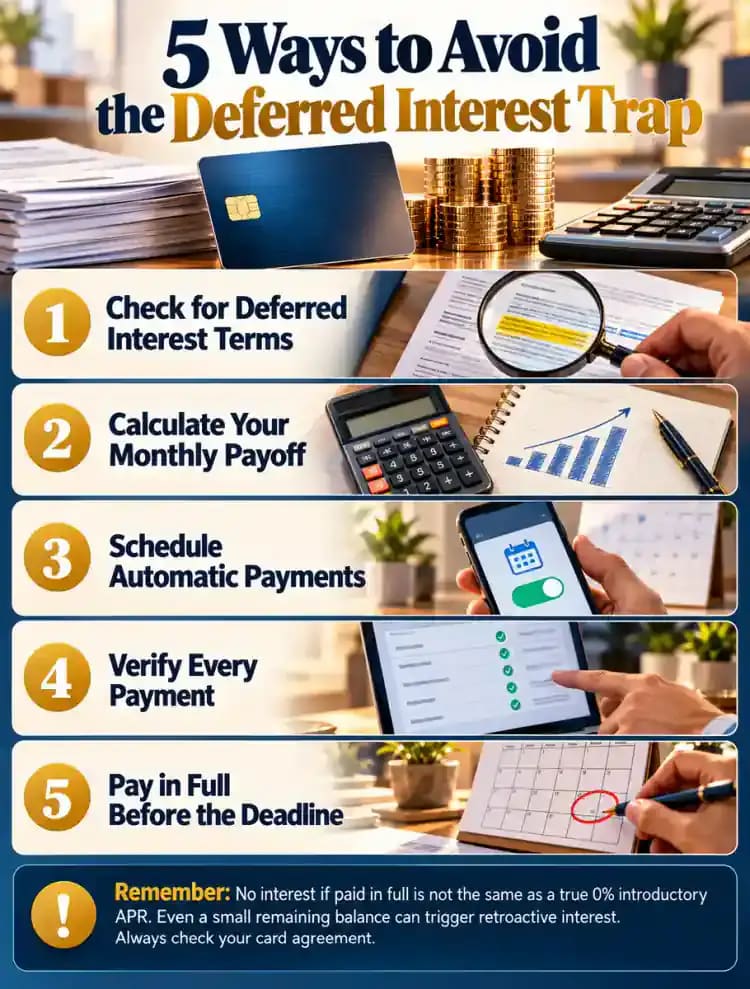
Five Actions That Protect Your Promotional Balance
Five practical actions can reduce exposure to unexpected deferred interest charges. First, identify whether the agreement contains conditional interest terms. Second, establish a repayment amount that clears the balance early. Third, automate payments when reliable funds are available. Fourth, verify that payments reach the intended promotional balance. Fifth, confirm the exact expiration date and ensure repayment is completed beforehand. Together, these actions address the main risks identified by the Consumer Financial Protection Bureau regarding deferred interest promotions.

Take Control of Your Financing Before Interest Hits
The most important goal when using deferred interest financing is completing repayment before the promotional deadline. Maintaining accurate records, understanding contractual conditions, and confirming the final promotional balance can help prevent avoidable charges. Once repayment is complete, retain the relevant statements and payment confirmations in case questions arise later. Promotional financing can provide convenience, but its value depends on disciplined management. Understanding the agreement transforms an attractive advertising promise into a financial decision based on measurable costs and obligations.

A furniture store offers 12 months of no-interest financing on a $1,200 purchase. You accept, make every minimum payment on time, and assume you are avoiding interest. Then the promotion expires with just $100 remaining, and an unexpected interest charge appears on your statement. What happened?
The answer may be deferred interest financing, a common feature of promotional store credit cards. Unlike a true 0% introductory APR offer, deferred interest financing allows interest to accumulate from the original purchase date. The issuer waives that accumulated interest only if you pay the entire promotional balance by the specified deadline. Leave even a small amount unpaid, and you could owe interest calculated on the balance throughout the promotional period, potentially adding hundreds of dollars to your purchase.
The Consumer Financial Protection Bureau warns consumers about these offers because the advertised promise of no interest can obscure an important condition: the balance must be paid in full on time. Making the minimum monthly payment usually will not accomplish that.
Fortunately, avoiding this problem does not require complicated financial knowledge. You need to identify the financing terms, calculate a realistic monthly payoff amount, monitor where your payments go, and confirm that your promotional balance reaches zero before the expiration date.
This guide explains how deferred interest differs from genuine 0% APR financing, which mistakes can trigger expensive charges, and how to establish a payment schedule that protects your budget. Before accepting any retail financing offer, understanding these distinctions can help you determine whether the promotion genuinely saves money.
Where people go wrong
Confusing Deferred Interest With a True 0% APR Offer. A true 0% introductory APR generally does not accumulate interest during the promotional period. Deferred interest financing does. If you miss the full payoff deadline, previously accumulated interest can become payable. Always inspect the actual promotional disclosure.
Paying Only the Minimum Monthly Amount. Minimum payments usually satisfy the account's monthly obligation without eliminating the promotional balance before expiration. Calculate your required payoff amount independently. For a $1,200 purchase over 12 months, paying just $25 monthly would leave a substantial balance.
Ignoring the Exact Promotional Expiration Date. Your promotional deadline may fall before your next regular statement due date. Assuming these dates match can leave an unpaid balance when the offer expires. Record the actual expiration date and arrange to pay everything off early.
Assuming a Small Remaining Balance Means Small Interest. Leaving $10 or $100 unpaid may trigger deferred interest accumulated over the promotional period, not merely interest on the remaining amount. The final charge depends on the agreement, applicable APR, balances, and payment history.
Missing Payments During the Promotional Period. Late payments can result in fees, credit damage, and potentially losing promotional benefits under applicable terms and rules. Being more than 60 days late can jeopardize deferred interest protections. Make required payments on time throughout the promotion.
Assuming Automatic Payments Guarantee Full Payoff. Automatic payments configured for the minimum amount will not necessarily eliminate your promotional debt. Even larger payments need verification. Check that the scheduled amount, processing date, and allocation to the promotional balance match your repayment plan.
Mixing Promotional Purchases With Other Card Balances. Additional purchases or multiple promotional balances can complicate payment allocation. Your extra payments may not always reduce the balance you intend. Review issuer rules and federal payment allocation requirements, especially during the final two billing cycles.
Waiting Until the Last Day to Pay. A payment initiated on the expiration date may not satisfy the issuer's applicable cutoff or processing requirements. Avoid relying on last-minute transfers. Schedule an early payoff and verify that the promotional balance actually reaches zero.
Questions people ask
Deferred interest financing is a promotional credit arrangement in which interest accumulates during a specified period but is waived if you pay the qualifying balance in full by the deadline. If you fail to meet that condition, the issuer can charge accumulated interest according to the agreement.
Fixed it?
Get one guide like this every Thursday.