Why High-Yield Savings Account Rates Change and How Variable APYs Work
High-yield savings account rates can rise or fall even when you do nothing. Learn how variable APYs work, how compounding affects your return, why Federal Reserve policy influences savings rates, and what to compare before choosing an account.

What you’ll need
Tap to tick things off before you start.
1. Start With the Meaning of a Variable Rate
A variable-rate savings account does not promise to pay the opening interest rate forever. The financial institution can change the rate as economic conditions, funding needs and competitive conditions change.
That distinction matters because the APY shown when you open an account is a snapshot of the account's current earning potential. It is not normally a guarantee of what the account will pay six months or one year later.
When consumers ask why high-yield savings account rates change, the simplest answer is that the account was designed to respond to changing interest-rate conditions.

2. Separate the Interest Rate From APY
The stated interest rate and annual percentage yield are related but are not always identical. The interest rate describes the rate applied to your balance, while APY incorporates the effect of compounding over a one-year period.
That makes APY especially useful for comparing deposit accounts. Two institutions could advertise similar nominal interest rates but compound interest differently, producing slightly different effective annual yields.

3. Understand Why APY Is Standardized
The Truth in Savings framework requires standardized disclosures so consumers can compare deposit products more consistently. The Consumer Financial Protection Bureau's Appendix A to Regulation DD describes how APY calculations are standardized.
Without a common method, one bank could emphasize daily compounding while another used monthly compounding, leaving consumers to perform their own conversions. APY creates a more comparable annual measure.

4. Know What the 365-Day Comparison Means
APY expresses the amount an account would earn over a standardized annual period based on the applicable rate and compounding assumptions. The CFPB's Regulation DD appendix provides the regulatory formulas used for these calculations.
For a variable-rate account, however, the calculation should not be interpreted as a prediction that the current rate will remain unchanged for the next year. If the institution changes the rate, your actual interest earnings will change as well.

5. See How Compounding Adds to Your Return
Compounding means earning interest not only on the original deposit but also on interest that has already been credited to the account. Over time, the interest itself begins producing additional interest.
With the same nominal rate, more frequent compounding can produce a slightly higher effective return. This effect is already incorporated into APY, which is one reason APY is generally more useful than comparing nominal rates alone.

6. Do Not Treat Today's APY as a One-Year Guarantee
Suppose an account displays a 4.50% APY today. That does not necessarily mean a deposit will earn exactly 4.50% during the next 12 months. A variable APY can move several times during that period.
If the rate decreases, the later portion of the year earns interest at the lower rate. If it increases, later balances can earn at the higher rate. Your realized return therefore depends on the sequence of rates that actually applies while your money remains deposited.

7. Recognize the Role of the Federal Reserve
Savings rates exist within the broader interest-rate environment. One of the most important forces shaping that environment is Federal Reserve monetary policy.
The Federal Reserve describes its monetary policy goals in terms of maximum employment and stable prices. To influence financial conditions in pursuit of those goals, it adjusts policy settings that affect the cost and availability of money and credit throughout the economy.

8. Learn What the Federal Funds Rate Does
A central reference point in US monetary policy is the federal funds rate. It relates to overnight lending of reserve balances among depository institutions.
Consumers do not normally borrow or lend directly at this rate, but changes in the federal funds rate influence a broad network of interest rates throughout the financial system. That is why Federal Reserve decisions can eventually affect mortgages, business credit, credit cards and savings accounts.

9. Follow the Interest-Rate Chain Reaction
When Federal Reserve policy changes, financial institutions reassess the economics of borrowing, lending and gathering deposits. Market interest rates can move, banks' funding calculations change, and competing institutions alter what they are willing to pay savers.
This transmission is not always instantaneous or perfectly uniform. One bank may adjust quickly while another waits. Some institutions may move rates aggressively because they want deposits, while others may have little reason to do so.

10. Understand Why Higher Policy Rates Can Support Higher Savings Rates
When the broader interest-rate environment rises, banks and other deposit-taking institutions may be willing to offer higher yields to attract or retain deposits. Those deposits can be valuable sources of funding.
This does not mean every institution increases savings rates by the same amount or on the same day. Deposit pricing remains a business decision influenced by competition, liquidity needs, customer behavior and the institution's broader balance sheet.

11. Understand Why Falling Rates Can Pull APYs Down
When broader interest rates fall, banks may have less economic incentive to continue paying unusually high deposit rates. Funding can become cheaper elsewhere, lending yields may decline, and competitors may also begin reducing their APYs.
As a result, high-yield savings rates can fall even if the account remains profitable and the institution remains financially healthy. A lower APY does not by itself indicate a problem with the bank.

12. Remember That Banks Do Not Move in Lockstep
The Federal Reserve influences the rate environment, but it does not dictate the exact APY on your individual savings account. Each institution establishes its own deposit pricing.
That is why two high-yield accounts can offer noticeably different APYs even though both operate in the same economy. One institution might be actively seeking deposits, while another already has sufficient funding and sees little reason to compete aggressively on rate.

13. Consider a Bank's Demand for Deposits
Deposit rates are partly a funding decision. A bank that wants additional deposits may offer a more attractive APY to encourage consumers to move cash into its accounts.
If the bank later reaches its funding objectives, it may no longer need to pay as aggressively. This can help explain why one institution reduces its rate while another institution continues offering a higher yield.

14. Look Beyond the Advertised Headline Rate
An attractive APY is important, but it is only one account characteristic. Fees, balance requirements and account conditions can reduce the practical value of a seemingly superior rate.
For example, an account charging a recurring fee could leave a small-balance saver worse off than a slightly lower-yield account with no recurring fee. The appropriate comparison is therefore not simply highest APY wins.

15. Check Whether the Rate Applies to Your Entire Balance
Some deposit products use balance tiers or special conditions. A promotional rate might apply only within a particular balance range, after completing certain activities, or for a limited period.
Read the disclosure carefully enough to determine what portion of your money actually earns the advertised APY. If the structure is tiered, calculate the likely effect on the balance you expect to maintain.

16. Distinguish Promotional Rates From Ongoing Variable Rates
A promotional APY can make an account appear especially attractive. Before moving money, determine whether the rate is an introductory offer and what happens after the promotional period ends.
An account offering the market's highest rate for a short period could later become ordinary. When comparing accounts, examine both the promotion and the underlying account terms.

17. Ask How Often Interest Compounds
Compounding frequency affects the relationship between the stated interest rate and the APY. Banks may compound interest daily, monthly or according to another disclosed schedule.
You usually do not need to calculate the annual effect manually because APY incorporates compounding. Still, knowing how the account works helps you understand when interest accrues and how the institution arrives at the advertised annual yield.

18. Examine Minimum Balance Requirements
Some accounts require a certain balance to earn the advertised APY, avoid fees or qualify for a particular tier. If you expect your savings balance to fluctuate, these requirements deserve attention.
A rate that looks excellent at $10,000 may be irrelevant if your normal emergency fund balance is $2,000 and the account pays a lower APY below the threshold.

19. Calculate the Effect of Fees
Interest earnings and account fees move in opposite directions. Interest increases your balance, while fees reduce it.
Suppose two accounts have nearly identical APYs, but one charges a monthly maintenance fee. Depending on your balance and whether the fee can be waived, the lower-fee account may generate better net results. Review the fee schedule rather than focusing only on the percentage printed in large type.

20. Confirm How Easily You Can Access the Money
Yield is only one reason people keep money in savings. Liquidity also matters, particularly for emergency reserves or near-term expenses.
Review transfer methods, transfer timing, ATM availability if applicable, withdrawal restrictions and any operational limitations. A slightly higher yield may provide little benefit if accessing the money is inconvenient when you actually need it.

21. Verify Deposit Insurance
Before chasing a high rate, determine how deposits are protected. Traditional bank deposits may qualify for Federal Deposit Insurance Corporation coverage, while qualifying credit union deposits may be insured through the National Credit Union Administration, subject to applicable rules and limits.
Coverage can become more complicated when balances are large or ownership categories differ. Consumers with amounts near or above insurance limits should review official coverage rules or seek qualified guidance rather than assuming all cash at an institution is automatically covered.

22. Compare APYs on the Same Day
Because variable rates can change, comparisons become less meaningful when the information comes from different dates. An account that topped a comparison table last month may no longer lead today.
When evaluating alternatives, collect current APYs from several institutions at roughly the same time. Record the date so you know exactly when the comparison was valid.

23. Do Not Chase Tiny Differences Automatically
A higher APY can increase earnings, but the practical difference may be modest depending on your balance. Moving money repeatedly for every small rate change can create extra administrative work without materially changing the dollars earned.
A useful comparison considers the rate difference, expected balance, fees, convenience, transfer time and how long you expect the difference to persist.

24. Convert Percentage Differences Into Dollars
Percentages are easier to evaluate when translated into approximate dollar amounts. If one account offers an APY that is 0.25 percentage points higher than another, the value of that difference depends heavily on the balance maintained.
On $1,000, the annual difference is small. On $100,000, it becomes much more noticeable. Actual earnings depend on changing rates, compounding, balance movements and account terms, but a rough dollar comparison can keep rate shopping in perspective.

25. Expect Rates to React to Economic Conditions
The Federal Reserve explains that monetary policy affects financial conditions as it works toward maximum employment and stable prices. Changes in policy influence borrowing costs, spending and broader economic activity.
Savings rates are one downstream part of this process. When the monetary environment changes substantially, deposit rates often follow, although the timing and size of individual bank adjustments can vary.

26. Understand What Happens When Rates Fall
Lower policy rates tend to reduce borrowing costs and can support spending and economic activity. For savers, however, lower market rates often mean deposit yields eventually move downward as well.
This tradeoff is a normal feature of the financial system. Conditions that make borrowing cheaper can simultaneously reduce the return available on cash deposits.

27. Understand What Happens When Rates Rise
Higher policy rates are generally associated with tighter financial conditions. Borrowing becomes more expensive, and consumers and businesses may become more cautious about spending or financing projects.
For depositors, a higher-rate environment can create more attractive savings yields as institutions compete for funding. Again, the relationship is influential rather than mechanical. Your bank decides its own rate.

28. Review Your Account Periodically
A variable-rate savings account does not require daily monitoring. Periodic reviews are generally more practical.
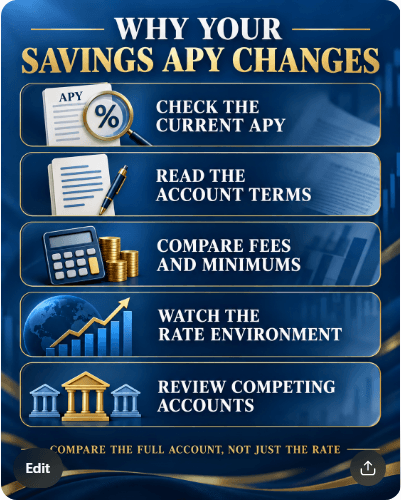
Check your current APY, recent interest credits, fees and any changes to account terms. Then compare the account with a few credible alternatives. The purpose is not to react to every minor fluctuation but to notice when your account becomes materially less competitive or no longer fits your needs.

29. Ask Better Questions Before Opening an Account
Before choosing a high-yield savings account, ask whether the APY is variable, whether any promotional period applies, how interest compounds, what balance is required, what fees apply and how easily funds can be transferred.
Also ask how rate changes are communicated and where the current rate can be verified. A financial institution may not promise a fixed schedule for changing a variable rate, but understanding the account's operating rules makes future changes less surprising.

30. Judge a Savings Account as a Complete Package
The most useful way to evaluate a variable-rate savings account is to combine yield, fees, access, balance rules, insurance protection and convenience rather than focusing on one percentage.
The CFPB's standardized APY rules make rate comparisons easier, while Federal Reserve materials explain why the wider interest-rate environment changes over time. Together, they show why today's attractive APY should be viewed as a current condition rather than a permanent promise.
A good savings decision therefore starts with understanding the account you actually have, monitoring meaningful changes and comparing alternatives using current information.

A high-yield savings account can look wonderfully predictable when you first open it. You deposit money, the bank advertises an attractive annual percentage yield, and it is tempting to mentally extend that rate into the future. Then the APY changes.
Nothing may have changed about your balance or how you use the account. The institution simply adjusts the rate. That is normal for many savings and money market accounts because their rates are variable rather than fixed.
Understanding why high-yield savings account rates change requires connecting three ideas: how APY is calculated, how banks decide what they can pay depositors, and how Federal Reserve monetary policy influences interest rates throughout the economy.
The Consumer Financial Protection Bureau's Regulation DD materials explain the standardized calculation used for annual percentage yield under the Truth in Savings framework. The Federal Reserve, meanwhile, explains how its monetary policy affects broader financial conditions, inflation and employment. Together, those mechanisms help explain why the number displayed beside your savings account can move even though the account itself appears unchanged.
This guide is general educational information, not individualized financial, legal or tax advice. Its purpose is to help you understand the mechanics so you can compare savings products more intelligently.
Where people go wrong
Assuming the opening APY is guaranteed. Variable-rate accounts can change their APYs. Treat the advertised yield as the account's current rate environment unless the institution explicitly provides a contractual guarantee.
Comparing nominal interest rates instead of APYs. APY incorporates compounding and is generally the more useful standardized figure for comparing deposit accounts.
Ignoring account fees. A monthly maintenance fee can offset part or all of the extra interest generated by a slightly higher APY, especially on smaller balances.
Missing promotional conditions. An unusually high rate may apply only for a limited period, specific balance range or qualifying activity.
Moving money for every small rate increase. A tiny APY difference may produce only a few additional dollars depending on the balance. Compare the potential benefit with inconvenience, transfer time and account conditions.
Assuming every bank follows the Federal Reserve immediately. Federal Reserve policy influences the rate environment, but financial institutions independently decide when and how much to change consumer deposit rates.
Overlooking deposit insurance. A high advertised yield should not replace checking whether the institution, account and balance qualify for applicable federal deposit insurance.
Using outdated comparison tables. Variable APYs can change quickly. Verify rates directly with institutions before moving money.
Questions people ask
The account likely has a variable rate. Banks can adjust savings APYs as market interest rates, Federal Reserve policy, funding needs and competitive conditions change. Your rate can therefore fall even when you have not changed anything about the account.
Fixed it?
Get one guide like this every Thursday.