What Is Escheatment? How to Find and Reclaim Unclaimed Money
Forgotten bank accounts, uncashed checks, and insurance payouts may be held by your state. Learn how escheatment works, where to search for unclaimed money, and how to file a claim for free.

What you’ll need
Tap to tick things off before you start.
What Is Escheatment and Why Does It Happen?
Escheatment is the legal process that transfers certain abandoned or unclaimed financial assets to state custody. When an institution loses contact with an account owner and legal requirements are met, it generally must report and surrender the property rather than retain it. As Investor.gov explains, these rules help protect investors and other financial consumers. Importantly, state custody does not automatically mean permanent confiscation. Rightful owners generally retain the ability to recover eligible property through established claim procedures.

What Types of Money and Assets Become Unclaimed?
Unclaimed property includes more than forgotten savings accounts. Common examples are inactive checking accounts, uncashed payroll checks, customer refunds, utility deposits, insurance benefits, and dividend payments. Certain stocks, bonds, and brokerage assets can also become unclaimed when their owners cannot be reached. Physical property, such as some safe deposit box contents, may qualify under specific state laws. USA.gov identifies bank accounts, insurance payments, and uncashed checks among the major categories worth investigating when searching for missing money.

How Long Before an Account Becomes Dormant?
A dormancy period is the legally defined interval during which an asset receives no qualifying owner activity. Many unclaimed property rules use periods of approximately three to five years, but requirements vary by state and property type. For example, an uncashed payroll check may follow different rules than a savings account. Activity that prevents dormancy also depends on applicable law. A simple online login may not qualify. Investor.gov recommends understanding how inactivity can affect financial accounts and investments.

What Happens When Money Is Transferred to the State?
Before transferring eligible property, financial institutions generally follow state notification requirements, which may include contacting owners at their last known addresses. If the property remains unclaimed, the institution submits a report identifying the asset and its recorded owner. Funds or other qualifying property are then transferred according to state procedures. The state records the property within its unclaimed property system. Owners generally preserve their right to submit claims, although specific asset treatment and recovery rules vary.

Where to Search for Unclaimed Money for Free
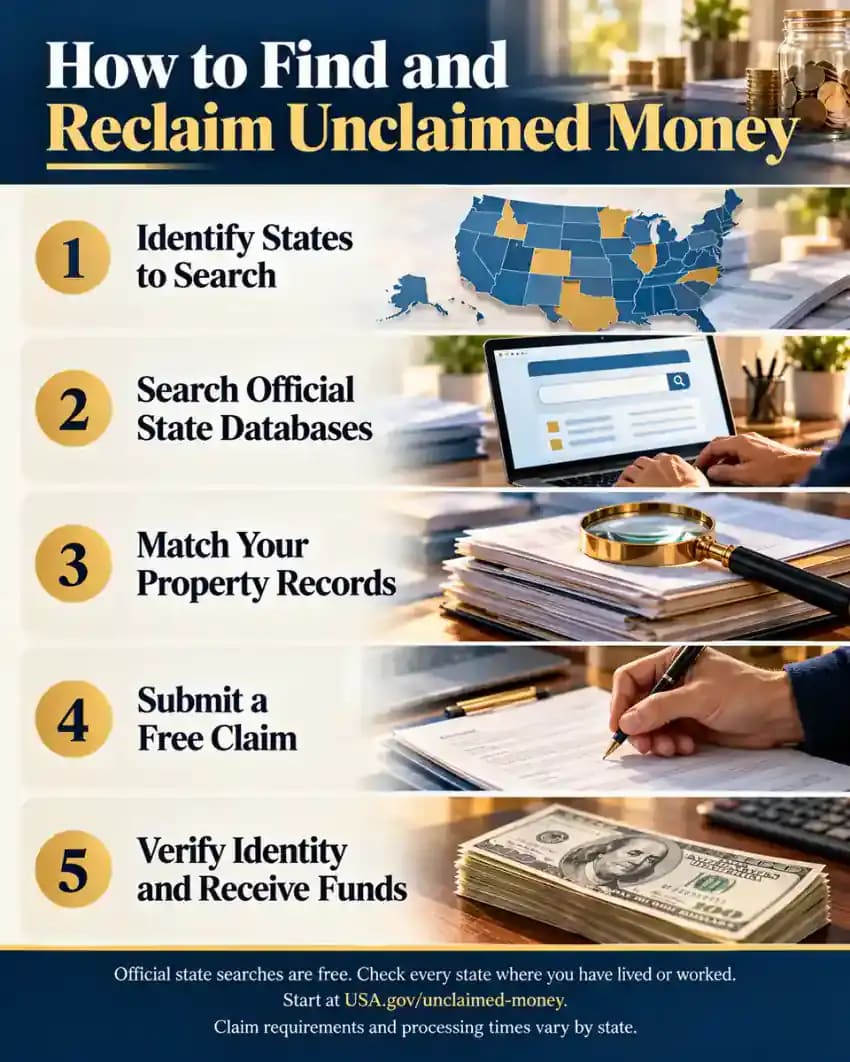
Start with the official USA.gov unclaimed money guide at https://www.usa.gov/unclaimed-money. It directs consumers toward appropriate government resources for locating missing assets. Search the unclaimed property programs of states where you currently live and previously resided. Property connected to former employers or financial relationships may appear elsewhere. Certain funds, including specific federal benefits and government payments, require searches through separate federal agencies. No single database contains every category of unclaimed money across the United States.

How to Find Your Property in State Databases
Enter your full name in the relevant state's official search tool, then repeat the search using former surnames, middle initials, and common name variations. Check previous addresses and business names when applicable. Review possible matches for clues such as the reporting institution, property category, and associated location. Some databases display only an estimated value or amount range. A matching name alone does not prove ownership, especially when several people share similar names or addresses.

How to File an Unclaimed Property Claim
After identifying a likely match, select the official claim option and follow the state's instructions. Most programs require personal identification and evidence connecting the claimant to the property, such as an old address or account record. Some claims can be completed online, while others require mailed documents or additional verification. Submit sensitive information only through verified government channels. Save the confirmation number and monitor the claim's status. Processing times depend on the state and case complexity.

How to Recover Money From a Deceased Relative
Unclaimed property belonging to a deceased person may be recoverable by an authorized estate representative or eligible heir. States typically require proof of death and documentation establishing the claimant's legal authority or entitlement. Depending on the circumstances, supporting records may include probate orders, estate appointments, or inheritance documents. A family relationship alone may not establish the right to receive funds. Complex estates, disputed claims, and missing legal records can require assistance from an estate attorney.

How to Avoid Unclaimed Money Scams and Recovery Fees
Official state unclaimed property searches are free, and consumers can generally submit claims directly without hiring recovery companies. Private finders sometimes offer assistance in exchange for a percentage of recovered funds. Be particularly cautious about unsolicited messages demanding upfront payments, account credentials, or sensitive documents. Scammers may impersonate government offices or invent nonexistent property. Verify website addresses independently and contact the state office using published government contact information. Never assume an unexpected recovery offer is legitimate.

How to Prevent Your Money From Becoming Unclaimed
Maintain a current inventory of bank accounts, investments, insurance policies, and retirement plans. Update your mailing address, email, and phone number whenever your contact information changes. Review accounts periodically and complete activity that qualifies under applicable dormancy rules. Deposit or cash outstanding checks promptly, and respond to legitimate institutional notices. Consider securely recording account details for authorized estate representatives. These habits reduce the likelihood that financial institutions will lose contact with you or classify assets as abandoned.

How Financial Institutions Identify Dormant Accounts
Banks, insurers, and brokerage firms monitor account records to identify assets without qualifying owner activity. Their systems may track transactions, customer communications, returned correspondence, and dates of last contact. When an account meets the applicable inactivity criteria, it may be classified as dormant. Investor.gov explains that financial institutions must follow escheatment requirements affecting inactive assets. An account's dormant status does not necessarily mean immediate transfer. Institutions must first determine whether additional legal conditions have been satisfied.

Why Escheatment Rules Vary by State
Unclaimed property laws are primarily administered at the state level, creating differences in how abandoned assets are classified and handled. States establish their own dormancy periods, reporting schedules, notification requirements, and procedures for particular property categories. Some jurisdictions also apply different monetary thresholds for specific administrative obligations. Consequently, identical account types may face different requirements depending on the governing state law. Businesses operating nationwide must account for these differences rather than applying one uniform escheatment policy.

What Happens When a Bank Tries to Contact You
Before reporting certain dormant accounts, financial institutions may be legally required to attempt contact with the recorded owner. These efforts, often called due diligence, commonly involve notices mailed to the last known address. Depending on applicable rules, electronic communication may also be permitted. A notice typically explains the property's inactive status and how to respond. Owners may need to confirm their interest or complete qualifying activity within a specified period to prevent the scheduled transfer.

How Companies Report Abandoned Property
Businesses holding reportable abandoned assets generally prepare unclaimed property reports for the appropriate state administrators. Reports commonly identify the property category, amount or quantity, owner information, and relevant account details. Companies must follow applicable reporting deadlines and prescribed submission formats. Financial records are reconciled to ensure reported liabilities correspond with the assets being remitted. States may require electronic filings, supporting certifications, or additional documentation. These procedures create an administrative record connecting reported property with its original holder.

Who Legally Owns Money After Escheatment?
When abandoned money enters a typical state unclaimed property program, the state generally assumes custodial responsibility rather than unrestricted beneficial ownership. The rightful owner retains a legally recognized interest that can support a future claim. Eligible heirs or authorized representatives may also have enforceable rights under applicable law. However, ownership must be established through the relevant procedures. Custodial protection does not guarantee that every asset will remain in its original form, and specific legal rights can differ by jurisdiction.

How States Safeguard Unclaimed Financial Assets
State treasury departments or designated unclaimed property administrators maintain accounting systems for assets received through escheatment. They record reported values, manage custodial balances, and apply procedures for handling different property types. Cash may be deposited into state-managed funds, while securities or tangible property can receive different treatment. Some assets may legally be sold or converted to cash. Recordkeeping, reconciliation, and government oversight support accountability, although investment appreciation, interest payments, and asset preservation are not universally guaranteed.

What Information States Keep About Unclaimed Property
State unclaimed property systems typically maintain records identifying the reported owner, last known address, reporting institution, and property category. Internal records may also include account references, reported values, and transfer dates. Public search results generally reveal less information to protect privacy and reduce fraudulent claims. Some databases display only partial addresses or general value ranges. Consequently, a public listing may contain enough information to identify a potential match without revealing every detail required to establish ownership.

Is There a Deadline to Claim Escheated Money?
Many state unclaimed property programs allow legitimate owners to recover eligible funds decades after the original transfer. Unlike ordinary payment deadlines, custodial claims commonly remain available for extended periods. However, it is inaccurate to assume every property category carries an unlimited recovery right. Particular assets, jurisdictions, or legal circumstances may involve exceptions or additional restrictions. The relevant state administrator can explain applicable rules. Earlier claims may also simplify verification because supporting financial records are more likely to remain available.

How State and Federal Unclaimed Money Programs Differ
Most ordinary abandoned financial accounts are handled through state unclaimed property programs, but certain federal assets follow separate administrative systems. Depending on the circumstances, missing federal tax refunds, unclaimed savings bonds, retirement benefits, or federally administered payments may require different agencies. USA.gov provides guidance on locating these categories. State searches do not automatically include federal records, and federal programs may have distinct eligibility requirements or deadlines. Understanding the responsible agency helps direct inquiries to the correct government administrator.
Which State Receives Your Abandoned Money?
Interstate priority rules help determine which state can receive abandoned intangible property. Generally, the first priority belongs to the state of the owner's last known address as recorded by the reporting business. If no qualifying address exists, the holder's state of legal domicile may have a claim under established rules. Certain property types and circumstances involve additional exceptions. Therefore, the state holding an asset is not always where the owner currently lives or where the original transaction occurred.

Why the State Does Not Automatically Return Your Money
State unclaimed property programs maintain records of reported assets, but identifying and locating every rightful owner can be difficult. People move, change names, close email accounts, or lose contact with former employers. Government agencies may conduct outreach, yet outdated information and limited records can prevent successful delivery. As USA.gov explains, consumers can search government resources for missing money. Owners generally must initiate a claim and establish their identity before property can be released.

How to Prepare Before Searching for Unclaimed Money
A little preparation makes searching for forgotten assets more efficient. Create a list of states where you have lived, including previous addresses and approximate dates. Add former employers, business names, financial institutions, insurance providers, and investment firms. Include previous legal names and other identifying variations. Old tax returns, pay statements, and bank correspondence can help reconstruct missing details. Organizing this information before beginning reduces overlooked possibilities and makes searches across multiple jurisdictions easier to manage.

How to Tell Whether an Unclaimed Property Listing Is Yours
A matching name in a state database is only a starting point. Compare available details, including previous addresses, reporting institutions, and property descriptions. A former bank or employer that you recognize can strengthen a potential match. However, common names and incomplete public records can produce misleading results. Some states deliberately withhold identifying information from public listings. The official claims process provides additional verification, and administrators may request supporting evidence before confirming that property belongs to a claimant.

What Happens After You Submit an Unclaimed Property Claim?
After submission, the state reviews the application and supporting documents to determine whether ownership has been established. Straightforward claims may move through automated verification, while complex cases require manual examination. Administrators can request additional records or clarification, extending the processing period. Approved claims generally proceed to payment or property delivery through the state's available methods. If a claim is denied, the notice may explain missing evidence or review options. Processing times vary considerably by jurisdiction and circumstances.

How Third-Party Unclaimed Money Finders Operate
Private recovery companies, sometimes called finders or locators, search public unclaimed property databases to identify potential owners. They may contact individuals and offer to handle recovery paperwork in exchange for a fee, often calculated as a percentage of recovered assets. Some states regulate finder contracts, compensation limits, and solicitation practices. These businesses do not necessarily possess exclusive access to government records. Their services are optional, and official state searches are available without paying a finder.

When Is Professional Help Worth Paying For?
Most routine unclaimed property claims can be handled through official state programs without professional representation. State administrators may explain documentation requirements and available procedures at no charge. More complicated situations can involve conflicting ownership claims, trusts, dissolved businesses, or estates requiring specialized legal authority. In those circumstances, a qualified attorney or other appropriate professional may help clarify procedural obligations. Professional fees should be weighed against the property's value, complexity, and assistance already available from government offices.

How to Build a Financial Account Inventory
A financial account inventory provides a central reference for identifying and managing assets. Record each institution's name, account category, ownership details, and customer service contact information. Include checking accounts, savings accounts, investments, insurance policies, and retirement plans. Note beneficiary designations where applicable and review the inventory periodically for accuracy. Store records securely using encrypted digital storage or a protected physical location. Avoid keeping passwords or sensitive identification numbers in an unprotected document accessible to others.

How to Make Financial Accounts Easier for Heirs to Find
Estate planning can reduce the likelihood that financial assets become difficult to locate after an owner's death. Maintain accurate beneficiary information and coordinate account records with relevant estate documents. A trusted representative should know where important financial information is stored and how authorized access can be obtained when necessary. Secure access instructions are preferable to distributing sensitive credentials. Clear documentation can help eligible heirs identify institutions, establish their authority, and avoid overlooking assets during estate administration.

Which Everyday Habits Help Prevent Dormant Accounts?
Routine account maintenance can prevent avoidable inactivity problems. Update mailing addresses, email accounts, and telephone numbers whenever they change. Review financial statements, respond to legitimate institutional notices, and resolve returned correspondence promptly. Complete transactions or other owner activity recognized under applicable state rules and institutional policies. Investor.gov highlights the importance of understanding account inactivity and escheatment risks. Deposit outstanding payroll, dividend, and refund checks promptly rather than allowing them to remain uncashed for extended periods.

Why Unclaimed Property Laws Protect Consumers
Unclaimed property laws establish a structured system for preserving financial interests when owners and institutions lose contact. Mandatory reporting prevents businesses from simply retaining qualifying abandoned balances as ordinary revenue. State custody creates centralized records and procedures through which legitimate owners can request recovery. These protections are not identical across jurisdictions, and asset handling can differ. Nevertheless, the underlying consumer protection principle remains consistent: forgotten financial property should remain identifiable and recoverable under applicable law rather than disappear without accountability.

You may have money sitting in a government database without knowing it. An old savings account, an uncashed paycheck, a forgotten security deposit, or an insurance payment could belong to you even if you have lost track of the original financial institution.
This happens because of a legal process called escheatment. When certain financial assets remain inactive or unclaimed for a period established by state law, banks, insurers, employers, and other businesses generally must transfer them to a state unclaimed property program. The state then holds the property for its rightful owner instead of allowing the reporting business to keep it.
The good news is that learning how to reclaim unclaimed money is usually easier than you might expect. Searching official state databases is free, and many straightforward claims can be submitted online. You generally need your name, previous addresses, and documents establishing your identity and connection to the property.
However, there are important details to understand. Dormancy periods differ by state and asset type. A bank account may follow different rules than an uncashed paycheck or insurance benefit. Searching only your current state can also mean overlooking money associated with an earlier address or employer.
This guide explains how escheatment works, where to search for abandoned assets, what documentation you may need, and how to avoid unnecessary recovery fees. You will also learn practical ways to keep your existing financial accounts from becoming dormant.
Start with the official government resources at https://www.usa.gov/unclaimed-money and search every state where you have lived or maintained financial accounts.
Where people go wrong
Searching Only Your Current State. Unclaimed assets may be reported to a state associated with your previous address or the reporting institution. Search every state where you have lived or maintained financial relationships, including locations connected to old jobs, bank accounts, and insurance policies.
Paying a Company to Find Your Money. Some private recovery services charge a percentage of funds they locate, even though official state searches are free. Start with government websites and submit claims directly whenever possible. Verify any unsolicited recovery offer before sharing personal information.
Assuming Every Dormant Account Has a Five-Year Deadline. Dormancy periods depend on state law and the type of property involved. Certain checks, deposits, and financial accounts may have shorter or longer periods. Check the applicable state's rules instead of assuming every asset follows a five-year schedule.
Ignoring Alternative Names and Old Addresses. A database might list property under a former surname, middle initial, abbreviated name, or outdated address. Searching just one version of your name can produce incomplete results. Try reasonable variations and compare matching records carefully before submitting a claim.
Submitting Incomplete Ownership Documentation. Finding a matching name does not automatically establish legal ownership. State administrators may request identification, address history, account records, or other evidence. Submitting incomplete or inconsistent documents can delay processing, so review the exact requirements before filing.
Assuming an Online Login Prevents Escheatment. Not every account login qualifies as owner activity under applicable state rules. Some institutions require a specific transaction or documented contact. Ask your financial institution what activity counts, and keep your contact information current to reduce the risk of dormancy.
Giving Sensitive Information to Unverified Websites. Unclaimed property scams may imitate government programs or request personal information through unsolicited messages. Verify the official website independently before providing identification documents or financial details. Never send sensitive records to an unknown person promising guaranteed access to forgotten funds.
Questions people ask
Escheatment is the legal process through which certain abandoned or unclaimed assets are transferred to a state government after a required period of inactivity. The state generally holds the reported property for its rightful owner. Common examples include dormant bank accounts, uncashed paychecks, insurance proceeds, and forgotten deposits.
Fixed it?
Get one guide like this every Thursday.