Unlimited PTO Explained: Why Companies Save Money and What Employees Lose
Unlimited PTO can reduce a company's vacation liabilities, but what does it mean for your paycheck? Learn how accrued vacation affects balance sheets, why payout rules vary by state, and what to ask HR before accepting an unlimited PTO policy.

What you’ll need
Tap to tick things off before you start.
How Traditional PTO Becomes an Employer Liability
Under a traditional paid time off policy, employees earn vacation hours as they work. For example, a company might award 10 hours of PTO each month, creating an accumulated balance of 120 hours annually before any vacation is taken. When employees earn leave that qualifies for future payment under applicable accounting rules, the employer incurs a financial obligation. This accumulated obligation represents compensation associated with work already performed, even though the employee has not yet used the vacation.

Where Vacation Liabilities Appear on a Balance Sheet
According to the U.S. Securities and Exchange Commission, a balance sheet presents a company's assets, liabilities, and shareholders' equity at a specific point in time. Qualifying unpaid vacation obligations are generally recognized as accrued compensation liabilities. Amounts expected to be settled within the operating cycle or next year are typically classified as current liabilities. Accountants estimate these obligations using eligible accumulated hours and applicable compensation rates. The resulting figures contribute to reported expenses and financial obligations.

How Unlimited PTO Changes Vacation Accrual
Traditional PTO gives employees a defined allowance that grows through an established accrual schedule. Genuine unlimited PTO operates differently: employees request paid vacation without earning a predetermined bank of hours. For example, someone might take three weeks one year and four weeks the next, subject to company requirements. Because no specific vacation balance accumulates, there is generally no corresponding obligation for unused future vacation. The distinction depends on how the policy actually operates, not simply its name.

Why Unlimited PTO Can Benefit Company Finances
Unlimited PTO can reduce an employer's future vacation accrual liabilities when the arrangement genuinely avoids earned leave balances. Companies may also simplify administrative processes by eliminating routine calculations of accumulating vacation hours. However, lower reported liabilities do not automatically translate into immediate cash savings. Employees still receive compensation while taking approved vacation, and previously earned obligations may remain payable. The financial advantage depends on policy design, employee vacation usage, accounting requirements, and the costs of administering the benefit.

What Federal Law Says About Paid Vacation
The U.S. Department of Labor explains that the Fair Labor Standards Act does not require employers to provide paid vacation. The FLSA also does not establish a general requirement to compensate departing employees for unused vacation. Instead, vacation benefits are ordinarily established through employment agreements, employer policies, and applicable state requirements. This distinction matters because a company's decision to offer vacation does not automatically create identical federal protections for every employee. Other leave laws may establish separate rights.

How State Laws Protect Earned Vacation
State laws can determine whether earned vacation constitutes protected compensation. California, for example, generally treats accrued vacation as wages and prohibits forfeiture of vested vacation benefits. Other states permit certain expiration or forfeiture arrangements when employers follow applicable rules and clearly communicate their policies. Some jurisdictions rely heavily on written employment agreements. These differences make geographic location important when evaluating vacation rights. Relevant factors may include where the employee works, policy language, and specific statutory protections.

What Happens to Unused PTO When You Leave
When employment ends, unused vacation may have different financial consequences depending on the policy and governing law. Under a traditional accrual arrangement, eligible earned hours may be payable through the final paycheck or another legally required payment. Genuine unlimited PTO typically produces no unused vacation balance to cash out. However, contractual promises, previously accrued benefits, or a policy that functions differently from its description can affect the result. Final payment requirements also vary by jurisdiction and termination circumstances.

How to Protect Vacation Earned Before a Policy Change
When an employer replaces accrued vacation with unlimited PTO, previously earned balances deserve separate attention. Employees can document their existing hours using pay stubs, payroll records, and earlier policy documents. A written transition notice should explain whether balances will be paid, preserved, or handled through another arrangement. The employer's chosen treatment must comply with applicable requirements. Keeping dated records and written HR explanations helps establish what benefits existed before the change and how the transition was communicated.

The Hidden Limits of Unlimited Vacation
Unlimited vacation does not necessarily mean unrestricted time away from work. Employers commonly require managerial approval, advance scheduling, and sufficient staffing coverage. Busy periods, project deadlines, and team responsibilities may reduce practical availability. Workplace culture can also discourage employees from requesting extended breaks, even without formal annual limits. Consequently, the amount of vacation employees actually take may differ substantially from the benefit's advertised flexibility. Approval consistency and realistic workload expectations are important indicators of its practical value.

How to Evaluate an Unlimited PTO Offer
Evaluating an unlimited PTO offer requires comparing more than the advertised vacation policy. Consider base salary, bonuses, retirement benefits, and the realistic amount of paid time employees receive. Review written eligibility requirements, approval procedures, and any restrictions affecting your position. Ask HR for typical vacation usage and clarification about how the benefit is administered. Comparing the complete compensation package provides a more meaningful assessment than treating unlimited vacation as automatically superior to a traditional allowance.

How to Calculate the Dollar Value of Unused Vacation
Estimating unused vacation value begins with the employee's hourly compensation and accumulated eligible hours. For example, 80 unused hours at $30 per hour represent $2,400 in potential gross compensation. For salaried employees, a simplified hourly estimate divides annual salary by 2,080 hours, assuming a 40-hour workweek over 52 weeks. An $80,000 salary produces approximately $38.46 per hour. Actual payout calculations may use different methods, and the estimated value does not establish a legal entitlement to payment.

How Unlimited PTO Affects Job Offer Negotiations
When a job offer replaces a defined vacation allowance with unlimited PTO, the compensation discussion can extend beyond base salary. Candidates may negotiate additional salary, a signing bonus, or a written commitment to a reasonable amount of vacation. A signing bonus provides immediate compensation but does not necessarily replace recurring benefits. Guaranteed vacation arrangements also require clear eligibility and approval terms. Employers differ in their flexibility, making written confirmation important before treating negotiated benefits as part of an offer.

Why Employees May Take Less Vacation Under Unlimited PTO
A defined vacation allowance gives employees a visible reference point for how much time off they can reasonably expect. Unlimited PTO removes that benchmark, potentially creating uncertainty about acceptable vacation usage. Some employees may worry that requesting extended breaks signals insufficient commitment or affects performance evaluations. Others may feel pressure to remain available because coworkers rarely take vacations. These outcomes are not universal, but the absence of clear expectations can make an apparently generous benefit difficult to use.

How Managers Shape the Real Value of Unlimited PTO
Managers strongly influence whether unlimited PTO functions as a meaningful employee benefit. Leaders who take vacation themselves, approve reasonable requests consistently, and arrange workload coverage demonstrate that time away is genuinely supported. Conversely, unpredictable decisions can create uncertainty and perceived favoritism. Effective teams establish transparent scheduling expectations, distribute responsibilities before absences, and avoid penalizing employees for approved leave. These practices help translate a flexible written policy into a dependable workplace benefit across different teams and departments.

Unlimited PTO for Remote and Multistate Employees
Remote employees working across state lines can face additional complexity when evaluating vacation protections. Applicable employment requirements may depend on where work is performed, the employer's operations, and relevant contractual arrangements. A company headquartered in one state cannot automatically assume its vacation rules govern every employee nationwide. Relocation may also change which requirements apply. Multistate employers often maintain location-specific policies or supplemental provisions to address these differences, even when the organization advertises one nationwide unlimited PTO program.

How Unlimited PTO Interacts With Sick and Family Leave
Unlimited vacation should not be confused with legally protected sick or family leave. The federal Family and Medical Leave Act provides eligible employees of covered employers with qualifying job-protected leave, generally unpaid. Separately, some states and localities require paid sick leave. Employer vacation policies cannot simply eliminate applicable statutory protections. Companies may operate separate systems for discretionary vacation, illness, parental leave, and other absences. Understanding these categories prevents confusion about eligibility, documentation, compensation, and employee protections.

Can an Unlimited PTO Policy Still Create Legal Liability?
Calling a policy unlimited does not automatically prevent employment-related liability. Courts and regulators may examine how the arrangement actually operates, including whether employees effectively earn vacation benefits or face restrictions resembling a fixed allowance. For example, California litigation has demonstrated that certain supposedly unlimited policies can raise disputes about accrued vacation compensation. Ambiguous contracts and inconsistent implementation may increase exposure. Employers therefore need policies that accurately describe and reflect workplace practices rather than relying exclusively on terminology.

What Investors Can Learn From Vacation Liabilities
The U.S. Securities and Exchange Commission explains that balance sheets help investors understand a company's financial position. Accrued vacation obligations can contribute to reported liabilities, particularly for organizations with substantial workforces. Analysts may examine these amounts alongside cash resources, operating expenses, and other short-term commitments. However, a smaller vacation liability does not automatically indicate superior financial performance. Meaningful comparisons require considering differences in workforce size, compensation levels, accounting policies, and employee benefit structures across companies.

How to Document and Challenge a PTO Dispute
A disagreement over vacation compensation is easier to evaluate when relevant records are organized. Useful documents include pay statements, vacation balance histories, employee handbooks, offer letters, and communications describing policy changes. Employees can request a written explanation of disputed calculations or denied benefits from HR. State labor departments may provide complaint procedures or information about wage claims. When substantial compensation or complicated contractual questions are involved, an employment attorney can explain the applicable legal framework and available options.

How to Make Unlimited PTO Work in Your Favor
Employees can make unlimited PTO more useful by planning vacations proactively rather than waiting for an ideal break in workload. Scheduling time away early, preparing project handoffs, and communicating availability expectations can reduce interruptions. Maintaining a personal record of vacation days also makes annual usage easier to assess. During time off, clear boundaries around messages and routine responsibilities support genuine recovery. Reviewing vacation patterns each year helps determine whether the policy delivers meaningful flexibility in practice.

How Vacation Liabilities Affect Corporate Acquisitions
When one company acquires another, the buyer examines outstanding employee compensation obligations during financial due diligence. Accrued vacation liabilities can represent payments or paid absences the buyer may need to honor after closing. These obligations can influence purchase price negotiations, working capital adjustments, and contractual protections. Buyers typically review payroll records, employee benefit policies, and applicable employment laws. However, switching to unlimited PTO before an acquisition does not automatically eliminate previously earned vacation obligations or existing contractual commitments.

Why PTO Accounting Does Not Always Match Cash Flow
Accounting expenses and cash payments do not always occur simultaneously. Suppose an employee earns $1,000 in qualifying vacation benefits during one accounting period but takes no vacation. The employer may recognize an expense and corresponding liability without paying additional cash at that moment. When the obligation is later settled, the liability decreases while cash or payroll settlement occurs. Consequently, reducing future vacation accruals can change reported financial results without immediately increasing the company's bank balance by an equivalent amount.

How Vacation Accrual Caps Affect Employee Compensation
Traditional vacation policies sometimes impose accrual ceilings that temporarily stop employees from earning additional vacation hours once their balances reach a specified limit. Carryover rules may separately restrict how much unused leave moves into another benefit year. These provisions affect the potential value of accumulated compensation. Their enforceability depends on applicable law. In contrast, genuine unlimited PTO ordinarily has no accumulating balance to cap or carry forward. Employees should distinguish lawful accrual limits from prohibited forfeiture of previously earned benefits.

The Difference Between Unlimited PTO and Flexible PTO
Unlimited PTO and flexible PTO are not necessarily interchangeable. Genuine unlimited vacation generally allows eligible employees to request paid time off without accumulating a fixed annual allowance. Flexible PTO may instead provide a defined number of days with greater freedom over scheduling. Discretionary leave arrangements can also contain approval conditions or specific eligibility restrictions. Because employers use these labels inconsistently, the written policy matters more than its marketing terminology. Understanding the underlying structure helps clarify what benefit employees actually receive.

How Unlimited PTO Affects New Hires and Probationary Periods
An unlimited PTO policy does not necessarily give new employees immediate access to unrestricted vacation. Employers may establish introductory waiting periods, require completion of initial training, or apply additional approval conditions during early employment. Some organizations permit limited vacation immediately while others restrict discretionary requests until eligibility requirements are satisfied. These conditions should appear in written benefit materials. New hires should distinguish the date employment begins from the date unlimited vacation becomes available under the employer's actual policy.

What Happens to Approved Vacation During a Layoff
Previously approved future vacation does not necessarily become payable when an employee is laid off. Scheduled leave differs from vacation compensation already earned under an accrual policy. An employer may cancel future scheduled absences when employment ends, while separately addressing protected earned balances. Severance agreements can establish additional payments or negotiated benefits independent of vacation accrual. The treatment of each category depends on applicable law and contractual terms. Employees should not assume approved vacation dates automatically represent compensation owed after termination.

How Unlimited PTO Can Affect Hourly and Salaried Workers Differently
Unlimited PTO programs are often designed around salaried employees, but compensation classification affects how paid absences must be administered. Nonexempt hourly employees generally require accurate tracking of hours worked and applicable overtime compensation under the Fair Labor Standards Act. Paid vacation ordinarily does not count as hours worked when calculating federal overtime. Salaried exempt employees face different salary-basis requirements. Employers must therefore consider wage rules, eligibility criteria, and payroll procedures when extending unlimited vacation arrangements across employee classifications.

How Employers Measure the Success of Unlimited PTO
Employers can evaluate unlimited PTO by examining more than the reduction in vacation liabilities. Useful measures include average vacation days taken, participation across departments, employee retention, reported burnout, and administrative workload. Comparing results before and after implementation may reveal whether the policy improves flexibility or creates unexpected problems. Differences between managers and employee groups also deserve attention. Because workforce conditions change over time, employers should interpret these indicators together rather than treating any single measure as proof of success.

Warning Signs of a Poorly Designed Unlimited PTO Policy
A poorly structured unlimited PTO policy may contain vague eligibility conditions, contradictory written rules, or inconsistent enforcement. Employees might receive conflicting explanations from managers and HR, encounter unexplained denials, or discover unwritten restrictions after requesting vacation. Particularly concerning situations include threats or adverse treatment connected to legally protected leave. Not every denied vacation request indicates unlawful conduct, but recurring inconsistencies warrant closer examination. Clear documentation, transparent expectations, and consistent administration are important features of a credible policy.

The Bottom Line: Who Benefits Most From Unlimited PTO?
Unlimited PTO creates different potential advantages for employers and employees. Companies may benefit from reduced future accrual liabilities and simpler vacation administration. Employees may gain scheduling flexibility but lose the opportunity to accumulate additional vacation compensation that could otherwise qualify for payout. Neither outcome is automatic. The actual financial trade-off depends on state law, policy design, employment terms, and how much vacation employees can realistically use. A valuable unlimited PTO arrangement balances employer efficiency with meaningful employee access to paid time away.

Unlimited paid time off sounds like an ideal workplace benefit. Instead of earning a fixed number of vacation days, you can theoretically take as much time away from work as you need, subject to company rules and manager approval. But unlimited PTO also changes how your employer accounts for vacation benefits, and that difference can affect your financial compensation.
Under a traditional vacation policy, employees accumulate paid leave over time. When that leave qualifies as an obligation under applicable accounting rules, employers record its estimated cost as a liability on their balance sheets. A properly structured unlimited PTO policy generally avoids creating the same accumulating vacation obligation because employees do not earn a defined bank of hours.
That distinction matters when you leave your job. Depending on state law and company policy, unused vacation earned under a traditional plan may result in an additional payment in your final paycheck. Under a genuine unlimited PTO arrangement, there is generally no unused vacation balance to cash out. However, switching policies does not automatically eliminate rights to vacation already earned.
Consider an employee earning $80,000 annually with 15 unused vacation days. Using a simplified 260-workday calculation, those days represent approximately $4,615 in potential gross vacation compensation if the employee is legally entitled to a payout. Whether that amount is actually payable depends on the applicable rules.
Before accepting an unlimited PTO offer or transitioning from an accrued vacation plan, examine the written policy, check your state's requirements, and ask how much vacation employees actually take. The important question is not whether vacation is advertised as unlimited, but what the benefit delivers in practice.
Where people go wrong
Assuming Unlimited PTO Means Unlimited Freedom. Unlimited PTO rarely means employees can take vacation whenever they want. Employers typically require advance notice, manager approval, and adequate work coverage. Evaluate the actual scheduling rules and workplace culture before treating the benefit as unrestricted time away.
Ignoring the Value of Accrued Vacation. Traditional vacation benefits can represent meaningful compensation when unused hours qualify for payout. Employees who compare job offers using salary alone may overlook this value. Calculate your existing balance and investigate applicable payout rules before accepting a replacement policy.
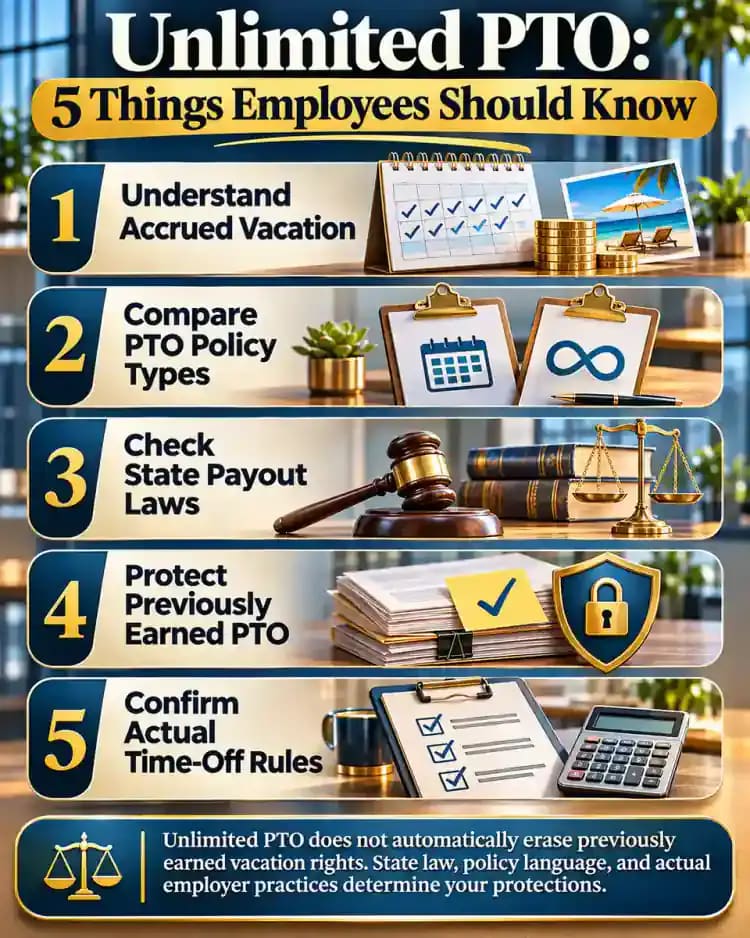
Believing Employers Can Automatically Erase Earned PTO. A transition to unlimited PTO does not necessarily eliminate previously accrued vacation rights. Some states protect earned vacation as wages. Obtain your balance and the transition terms in writing, and verify whether proposed forfeiture complies with applicable law.
Assuming Every State Has the Same Vacation Laws. Federal law generally does not require private employers to provide paid vacation, but state rules differ significantly. Some protect earned balances while others permit certain forfeiture arrangements. Check the jurisdiction governing your employment before assuming a payout is guaranteed or prohibited.
Confusing Accounting Savings With Immediate Cash Savings. Reducing an accrued vacation liability can improve reported financial obligations without immediately increasing available cash. Previously earned balances may also remain payable. Distinguish accounting recognition from actual cash payments when evaluating claims about why employers adopt unlimited PTO.
Failing to Ask How Much Vacation Employees Actually Take. An unlimited policy provides little practical value if employees rarely receive approval or feel pressured to remain available. Ask about typical annual vacation usage, busy-season restrictions, and management expectations. Real usage matters more than the advertised absence of a limit.
Waiting Until Resignation to Review Payout Rights. Discovering your vacation payout rights after giving notice can create unnecessary financial surprises. Review your balance, employment agreement, and applicable state requirements beforehand. Preserve relevant records and ask HR for written clarification before making decisions based on anticipated final compensation.
Questions people ask
Companies may adopt unlimited PTO to attract employees, offer scheduling flexibility, simplify administration, and reduce future accrued vacation liabilities. Because genuinely unlimited policies generally do not accumulate a fixed bank of vacation hours, employers may avoid certain accounting obligations. However, financial savings are not necessarily the only motivation.
Fixed it?
Get one guide like this every Thursday.