The True Cost of Buying a Car Privately: Hidden Fees, Taxes, and Financing
Buying a used car from a private seller can save money, but taxes, title fees, financing charges, inspections, and unexpected repairs can erase the savings. Learn how to calculate the real cost before you buy.

What you’ll need
Tap to tick things off before you start.
1. Understand Why the Asking Price Is Misleading
A private seller usually advertises the amount they want for the vehicle, not the amount you will spend to own and legally drive it. Taxes, title fees, insurance, inspections, repairs, and loan interest can all increase your total expense.
Two identical cars advertised for the same price can have dramatically different ownership costs. One may have excellent maintenance records and need nothing beyond routine servicing. The other may require expensive repairs immediately.
Start with total acquisition cost, not advertised price. That distinction should guide every comparison.

2. Calculate the Full Purchase Budget
Build a purchase budget before contacting lenders or negotiating with sellers.
A practical formula is:
Initial cash cost = Purchase price + applicable taxes + title and registration fees + inspection and reporting costs + immediate repairs + other required charges.
If financing is involved, separately calculate interest and lender charges across the repayment period. Also estimate recurring insurance, maintenance, and fuel expenses.
Do not automatically add your entire loan principal to the purchase price. Doing so counts borrowed money twice. Instead, distinguish the vehicle's acquisition cost from the additional cost of borrowing.

3. Recognize the Difference Between Private Sellers and Dealers
A private-party transaction takes place directly between individuals rather than through a commercial dealership. This often eliminates dealership-related charges, but it also changes how the transaction is managed.
You may need to verify ownership, arrange payment, organize financing, obtain insurance, and submit title paperwork yourself.
More importantly, some federal consumer protection requirements specifically apply to dealers rather than occasional private sellers. That does not mean individuals can legally misrepresent a vehicle without consequences. State laws, contract rules, and fraud protections may still apply.
The distinction is important because your protections depend on the circumstances and jurisdiction.

4. Know What the FTC Used Car Rule Covers
The Federal Trade Commission administers the Used Car Rule, found at 16 CFR Part 455. It requires covered used-car dealers to display a Buyers Guide on vehicles offered for sale.
The guide identifies whether a dealer offers a warranty and explains relevant warranty coverage or whether the vehicle is offered without dealer warranty protection, subject to applicable law.
The rule promotes transparency, but it does not guarantee that a dealer-sold vehicle is mechanically reliable.
Read the FTC Used Car Rule for the federal requirements.

5. Understand What a Buyers Guide Tells You
A dealership Buyers Guide is primarily a warranty disclosure, not a certification of vehicle quality.
When warranty coverage is offered, the document identifies key terms, including covered systems, duration, and the portion of repair costs the dealer agrees to pay.
This helps buyers understand potential repair responsibilities before committing.
A private individual generally has no obligation under the federal Used Car Rule to display that guide. Therefore, a private buyer cannot assume standardized warranty information will be provided.
Instead, request any warranty claims in writing and independently verify whether existing coverage can transfer to a new owner.

6. Identify the Consumer Protections That May Be Missing
The FTC Used Car Rule generally does not govern genuine sales between private individuals.
Consequently, private sellers ordinarily are not subject to its Buyers Guide requirements. However, state-specific disclosure obligations may still exist, including requirements involving mileage, titles, or known vehicle conditions.
A person who routinely sells vehicles may also qualify as a dealer under applicable law even if they present themselves as a private seller.
Do not confuse fewer standardized disclosures with the complete absence of legal protections. Verify state rules and investigate suspicious seller behavior before paying.

7. Understand What Buying As-Is Really Means
Many privately sold vehicles are offered as-is, meaning the seller does not promise to repair problems discovered after purchase.
When an enforceable as-is agreement applies, the buyer generally accepts significant responsibility for the vehicle's condition.
However, an as-is designation does not necessarily excuse fraud, invalidate express promises, or override mandatory consumer protections under state law.
Ask the seller directly whether any warranties or repair commitments are included, and document the answer.
Never treat a friendly conversation or verbal reassurance as a substitute for a written agreement describing the vehicle's condition and the transaction terms.

8. Estimate the Financial Risk of Unexpected Repairs
An attractive purchase price can quickly lose its appeal when expensive mechanical problems emerge.
Transmission issues, engine defects, cooling-system failures, or neglected maintenance may create significant repair bills. Even seemingly smaller problems involving tires, brakes, or batteries can consume money reserved for registration or insurance.
Consider a hypothetical $10,000 vehicle that needs $2,500 of repairs shortly after purchase. Its effective initial cost has increased substantially, even before taxes or financing.
Budgeting a repair reserve cannot eliminate mechanical risk, but it can prevent one breakdown from disrupting your entire financial plan.

9. Set a Financial Limit Before Negotiating
A purchase limit should reflect what you can reasonably afford, not merely the maximum amount a lender will approve.
Include your down payment, taxes, upfront fees, and reserve for unexpected expenses. Consider how insurance, regular maintenance, and monthly loan obligations fit into your existing budget.
A lender's approval primarily reflects its underwriting criteria, not whether the purchase supports your broader financial goals.
If an otherwise attractive vehicle requires exhausting your emergency savings, it may be financially less attractive than a cheaper option.
The purpose of a spending limit is to keep negotiation from turning into an emotional decision.

10. Arrange an Independent Pre-Purchase Inspection
A qualified independent mechanic can evaluate the vehicle before money changes hands.
Ask about the engine, transmission, brakes, steering, suspension, tires, fluid leaks, structural damage, and warning indicators. For some vehicles, specialized diagnostic equipment or inspections may be appropriate.
An inspection commonly costs money and cannot guarantee that every hidden defect will be discovered.
Nevertheless, identifying a costly problem before purchase gives you information to negotiate, request additional evaluation, or walk away.
A seller who refuses reasonable independent inspection without a credible explanation should be treated as a warning sign.

11. Understand Why Personal Cars Are Capital Assets
Federal income tax rules can become relevant when you eventually sell the vehicle.
The Internal Revenue Service generally classifies personal-use property, including privately owned cars, as capital assets.
According to IRS Topic No. 409, Capital Gains and Losses, the difference between an asset's adjusted basis and the amount realized on its sale generally determines a capital gain or loss.
This classification does not mean the buyer automatically owes federal income tax simply for purchasing a vehicle.
Ordinary vehicle purchases instead commonly involve applicable state or local sales and use taxes.

12. Understand IRS Topic No. 409
IRS Topic No. 409 describes capital gains, losses, holding periods, and general taxation rules for capital assets.
For a purchased personal vehicle, the starting tax basis generally reflects what the owner paid, subject to applicable adjustments. Special rules can apply to inherited, gifted, or business-use property.
A capital gain exists when the amount realized exceeds adjusted basis. A loss exists when it is lower.
The important distinction is that federal law does not treat gains and losses on personal-use property identically.
Keep purchase documentation because it may help establish your basis if the vehicle is eventually sold.

13. Learn When a Car Sale Creates a Taxable Gain
Suppose you purchase a personal-use vehicle for $15,000 and later sell it for $18,000.
Assuming your adjusted basis remains $15,000 and there are no adjustments to the amount realized, the hypothetical capital gain is $3,000.
That gain is generally subject to federal income tax rules even though the car was purchased for personal transportation rather than investment.
Whether a gain receives short-term or long-term treatment generally depends on the holding period.
Unusual vehicle markets, collectible cars, and appreciation in certain models can make this relevant even when most everyday vehicles depreciate.

14. Know How Vehicle Gains Are Reported
A taxable gain from selling a personal-use car generally must be reported on the appropriate federal income tax forms.
Depending on the circumstances, this commonly involves Form 8949 and Schedule D of Form 1040. Reporting requirements can differ when property has been used for business or other purposes.
Accurate records of purchase price, sale proceeds, and relevant basis adjustments matter.
Do not assume that a transaction involving cash or a private buyer is exempt from tax reporting.
For instructions and exceptions, consult current IRS materials or a qualified tax professional rather than relying on informal estimates.

15. Avoid Confusing Sale Proceeds With Taxable Profit
Receiving $12,000 for a used vehicle does not automatically mean you earned $12,000 of taxable income.
You must compare the amount realized with the asset's adjusted tax basis.
For example, if the vehicle's adjusted basis is $20,000 and the amount realized is $12,000, the transaction produces an economic loss rather than a gain.
Likewise, paying off an outstanding auto loan does not, by itself, determine your capital gain or loss. Loan balances and tax basis are different concepts.
Understanding these distinctions prevents confusion when comparing vehicle sale proceeds with your remaining debt.

16. Understand Why Personal Vehicle Losses Are Not Deductible
Imagine purchasing a car for $20,000 and selling it several years later for $11,000.
Assuming no relevant basis adjustments, the difference represents a $9,000 economic loss.
Under general federal rules described in IRS Topic No. 409, losses from selling personal-use property, including a personal car, are not tax deductible.
You ordinarily cannot claim that personal-use loss to reduce taxable income or offset taxable investment gains.
This treatment differs from certain qualifying investment or business losses. Mixed personal and business use can create additional complications requiring separate analysis.

17. Account for Depreciation as a Real Ownership Cost
Most ordinary vehicles lose market value as they age and accumulate mileage.
That depreciation affects the economic cost of ownership even when it does not appear as a monthly bill.
If a car loses $6,000 in value during three years of ownership, that decrease represents an economic cost separate from fuel, insurance, or maintenance.
However, depreciation is not a guaranteed fixed percentage. Reliability, demand, accident history, mileage, and market conditions all influence resale value.
When comparing vehicles, consider expected future resale value instead of assuming the lowest purchase price always produces the lowest long-term cost.

18. Explore Private-Party Auto Loan Options
Not every auto lender finances purchases from private individuals.
Some financial institutions restrict eligible vehicle ages, mileage, title types, purchase amounts, or seller arrangements. Others require additional documents or specific payment procedures.
Banks, credit unions, and certain online lenders may offer private-party financing, but approval and terms vary.
Ask whether a lender supports your intended transaction before applying.
You may need the VIN, vehicle details, seller information, proof of insurance, and title documents. Compare the cost of secured auto financing with other available borrowing arrangements without assuming they are interchangeable.

19. Compare Total Loan Cost, Not Just Monthly Payments
The Consumer Financial Protection Bureau's auto loan resources encourage borrowers to evaluate financing costs rather than focusing narrowly on monthly affordability.
A lower payment may come from a longer repayment period, not a better interest rate.
When comparing offers, review the amount financed, annual percentage rate, repayment period, finance charges, monthly payment, and total of payments.
Use comparable assumptions when evaluating different lenders.
A useful comparison asks two questions: Can I comfortably manage the required monthly payment, and what will this financing arrangement cost over its entire life?

20. Identify the Four Major Loan Cost Drivers
Four elements deserve particular attention: APR, loan term, amount financed, and fees or optional add-ons.
APR reflects the annualized cost of credit under applicable disclosure rules and can help compare offers. The loan term determines how long repayment continues. The amount financed reflects the principal covered by the agreement.
Fees and optional products can raise the amount you borrow or pay upfront.
Review the full contract because headline interest rates alone may omit meaningful costs.
A lender offering a slightly lower rate may still be more expensive if its associated charges substantially increase the total transaction cost.

21. See How Loan Length Changes Total Interest
Consider a hypothetical $15,000 loan at a fixed 8% annual rate, with monthly payments and no additional financing fees.
Over 36 months, the payment is approximately $470 and total interest is about $1,922.
Over 60 months, the payment falls to approximately $304, but total interest increases to approximately $3,249.
That longer arrangement reduces the monthly payment by about $166 while adding approximately $1,327 in interest.
These figures are illustrative, rounded amortization estimates rather than lender quotes. Actual terms, payment dates, fees, and calculation methods can affect results.
Lower monthly payments do not automatically mean lower borrowing costs.

22. Understand Why Private-Party Financing May Cost More
Some lenders consider private-party transactions less straightforward than conventional dealer purchases.
Vehicle age, mileage, condition, uncertain title status, and loan-to-value calculations may influence eligibility or pricing.
A lender might require a larger down payment, offer a different rate, limit the repayment term, or decline to finance a particular vehicle.
However, private-party loans are not universally more expensive. Your credit profile, lender policies, vehicle characteristics, and market conditions all matter.
Compare actual written offers rather than assuming dealership financing or private-party financing will always be cheaper.

23. Read the Financing Agreement Before Signing
An auto loan contract creates obligations that may continue long after the purchase excitement disappears.
Review the APR, payment schedule, total payments, amount financed, applicable fees, late-payment terms, and any relevant prepayment provisions.
Confirm whether optional insurance or protection products are included and whether they can be declined.
For secured financing, understand the lender's rights if payments are missed, including potential repossession under applicable law.
Request clarification when a quoted term differs from the written agreement. Do not sign until the contract reflects the financing arrangement you actually intend to accept.

24. Negotiate and Compare Multiple Lending Offers
The CFPB explains that consumers can compare lenders and negotiate aspects of auto financing.
Possible negotiation areas include interest rates, repayment terms, and certain charges, although lenders are not required to accept proposed changes.
Compare banks, credit unions, and reputable financing providers using consistent loan amounts and terms.
Ask about private-sale restrictions and whether the quoted rate depends on automatic payments or other conditions.
When shopping for loans, consider the possible credit-reporting effects of applications. Credit scoring models often apply special rate-shopping treatment to qualifying inquiries within defined periods, but the precise rules vary.

25. Watch for Fees and Optional Financing Products
Financing agreements may include lender-related charges or optional products that change the overall cost.
Examples can include loan administration charges, optional service contracts, or guaranteed asset protection products, depending on the lender and transaction.
Some products may provide useful coverage in specific circumstances, but their cost and exclusions must be evaluated independently.
If a $600 optional product is financed rather than paid upfront, it can also generate interest over the loan term.
Ask which charges are mandatory, which are optional, and whether removing an add-on changes the financing offer.

26. Research State and Local Purchase Costs
Vehicle tax and registration requirements depend heavily on where the car is titled and registered.
Potential obligations include sales or use tax, local taxes, title transfer charges, registration fees, inspection expenses, and additional jurisdiction-specific assessments.
Some costs are based on vehicle value, while others depend on vehicle age, weight, location, or registration category.
A private seller generally will not calculate every government charge on your behalf.
Before exchanging funds, use your state's official motor vehicle or revenue agency resources to estimate the required amounts. Avoid assuming another state's rules apply to your transaction.

27. Verify Requirements With Your State Motor Vehicle Agency
Your state Department of Motor Vehicles, Secretary of State, motor vehicle division, or equivalent agency is the appropriate starting point for official requirements.
Confirm which documents are needed to transfer ownership, the deadline for registration, accepted payment methods, and whether emissions or safety inspections are required.
Ask how private-party transactions are handled when the seller lives in another state.
Pay attention to temporary operating permits and insurance requirements if you plan to drive the vehicle home.
Official guidance is more reliable than assumptions based on another person's previous car purchase.

28. Budget for Sales Tax, Registration, and Title Fees
Consider a hypothetical private vehicle purchase with these initial expenses:
- Vehicle price: $12,000 - Assumed applicable vehicle tax: $840 - Title and registration: $250 - Independent inspection: $180 - Immediate repairs: $600
Illustrative initial cash cost: $13,870.
That is $1,870 above the seller's advertised price, before considering financing interest, insurance, fuel, or later maintenance.
The figures are examples, not estimates for any particular state. Actual tax treatment and charges vary.
Create a separate fund for costs payable to government agencies so the seller's payment does not consume your entire available budget.

29. Understand How States Determine Taxable Vehicle Value
Do not assume your vehicle sales tax will always equal the advertised purchase price multiplied by a single statewide rate.
Some jurisdictions generally use the reported transaction price, while others apply minimum taxable values, presumptive values, or additional verification requirements.
Trade-in credits, family transfers, gifts, and purchases involving out-of-state sellers may be treated differently depending on local rules.
Artificially understating a purchase price on the bill of sale can create tax and legal problems.
Use truthful documentation and check the official calculation method before deciding how much money to reserve for taxes.

30. Verify the Title, Resolve Liens, and Complete the Transfer
Before paying, confirm that the seller has authority to transfer the vehicle and that its VIN matches the paperwork.
Review the title for listed owners, lienholders, branding, and inconsistencies. A lien usually means another party holds a secured interest in the vehicle.
If money is still owed, coordinate with the lienholder and follow state-approved payoff and release procedures. Never assume the seller will clear a loan after receiving your money.
Prepare an accurate bill of sale, required odometer documentation, and any applicable title forms. Confirm insurance and registration obligations before driving.
Walk away from transactions where ownership cannot be satisfactorily verified.

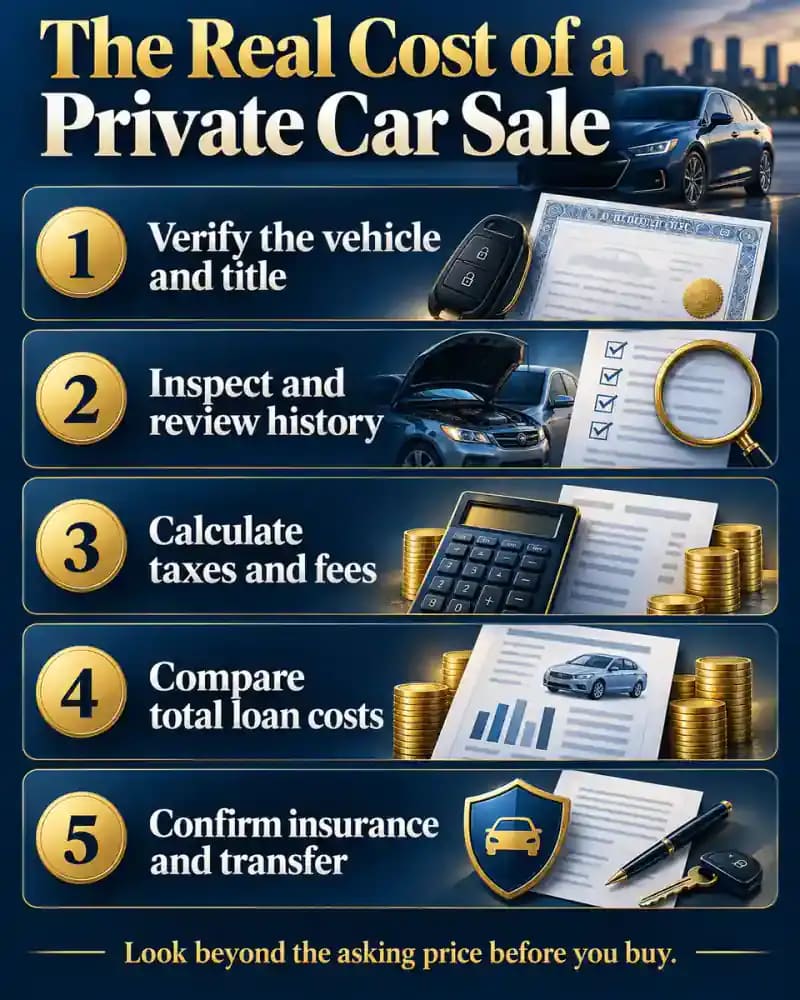
A used car advertised for $12,000 might look like an excellent deal. But what if you need another $900 for taxes, $250 for registration and title fees, $180 for an inspection, and $1,200 for immediate repairs? Suddenly, that affordable car costs considerably more than its advertised price.
That is the central challenge of buying a car from a private seller: the asking price is only one part of the transaction. Unlike most dealership purchases, you may need to arrange financing, verify ownership, organize inspections, and handle government paperwork independently.
Private-party purchases can offer legitimate savings, particularly when a seller prices a vehicle competitively. But those savings are not guaranteed, and a lower asking price does not automatically mean a lower total cost.
This guide explains the true cost of buying a car privately in the United States, including taxes, registration, financing, mechanical risks, and consumer protections. It also explains the Internal Revenue Service rules that may become relevant when you eventually sell the vehicle.
The objective is simple: know what you could actually spend before committing to a purchase. The information is educational and does not constitute individualized financial, legal, or tax advice.
Where people go wrong
Budgeting Only for the Seller's Asking Price. Ignoring taxes, title charges, registration, inspections, insurance, and repairs can leave you unable to complete or comfortably maintain the purchase. Build a full acquisition budget before negotiating.
Skipping the Independent Mechanical Inspection. A clean exterior or successful short test drive cannot establish the health of every major component. An inspection may reveal problems that materially change the vehicle's value.
Assuming Private Sales Carry Dealer Protections. The FTC Used Car Rule generally applies to covered dealers, not genuine occasional private sellers. Investigate the vehicle independently while remembering that state law and fraud protections may still apply.
Choosing a Loan Based Only on Monthly Payment. A longer repayment term may make monthly payments smaller while increasing lifetime interest charges. Compare APR, total payments, principal, fees, and term.
Paying Before Verifying Ownership. An unresolved lien, mismatched VIN, altered title, or seller without proper authority can complicate or prevent legal ownership transfer. Confirm title status and payment procedures before exchanging funds.
Assuming a Personal Vehicle Loss Is Tax Deductible. Federal tax rules generally do not allow deductions for losses on personal-use cars. Keep tax treatment separate from the real economic impact of depreciation.
Assuming the Purchase Price Determines Tax Everywhere. States may use transaction value, prescribed taxable values, or other rules. Obtain the applicable calculation from the government agency responsible for vehicle taxes.
Overlooking Insurance and Immediate Maintenance. Insurance premiums, tires, brakes, fluid services, and other near-term needs may materially increase ownership costs. Research these expenses before committing.
Questions people ask
It can be, especially when the seller offers a competitive price and the vehicle is well maintained. However, comparing asking prices alone is misleading. Include taxes, inspections, financing, repairs, warranties, and other relevant costs when evaluating both options.
Fixed it?
Get one guide like this every Thursday.