Traditional vs. Roth Retirement Accounts: How the Tax Differences Work
Traditional and Roth retirement accounts differ mainly in when taxes are paid. Learn how IRAs and 401(k)s handle contributions, withdrawals, RMDs, income limits and retirement tax planning.

What you’ll need
Tap to tick things off before you start.
Start With the Tax-Timing Question
The central difference between Traditional and Roth retirement accounts is tax timing. A Traditional account generally delays income taxation until retirement withdrawals occur. A Roth account generally requires you to contribute money that has already been taxed, while qualified withdrawals later can be tax-free. This is why comparisons should begin with a simple question: is the tax benefit occurring now or later? The answer affects both today's taxable income and retirement income planning.

Know the Accounts Being Compared
Traditional versus Roth is a tax-treatment distinction, not a single account comparison. You may encounter Traditional and Roth versions of both IRAs and workplace plans such as 401(k)s. Investor.gov describes IRAs as tax-advantaged retirement arrangements, while 401(k) plans are employer-sponsored plans funded primarily through payroll contributions. The underlying tax concept is similar across Traditional and Roth structures, but contribution rules, income restrictions and distribution rules differ between IRAs and employer plans.

Understand Pre-Tax Traditional Contributions
Traditional workplace retirement contributions are generally made on a pre-tax basis for federal income tax purposes. The contribution reduces the compensation currently subject to federal income tax, although payroll taxes and other rules can operate differently. Traditional IRA contributions work differently because contributions may or may not be deductible depending on the taxpayer's circumstances. The important distinction is that Traditional treatment aims to provide a current or potential tax benefit in exchange for taxation later.

See How Current Taxable Income Can Change
A pre-tax Traditional 401(k) contribution generally reduces federal taxable wages for the year of contribution. That can make Traditional workplace contributions particularly relevant to workers who want to lower current taxable income. A deductible Traditional IRA contribution may produce a similar income tax effect, but the deduction is not automatic for everyone. IRS rules determine whether a Traditional IRA contribution is deductible, partially deductible or nondeductible based on factors that can include income and workplace plan coverage.

Recognize That Tax Deferral Is Temporary
Traditional retirement accounts are often described as tax-deferred, not tax-free. Investment earnings such as interest, dividends and realized gains generally are not taxed annually while they remain inside the account. That allows the full account value to remain invested without yearly federal income tax drag inside the account. But taxes have usually been postponed rather than eliminated. When taxable distributions are eventually taken, amounts that have not already been taxed are generally included in ordinary income.

Understand Roth After-Tax Contributions
Roth contributions follow the opposite tax sequence. Contributions are generally made with money that has already been subject to income tax, so they do not provide the same current federal income tax deduction as deductible Traditional contributions. In exchange, Roth rules can allow qualified retirement withdrawals to avoid federal income tax. The saver gives up an immediate tax deduction in return for potentially valuable tax treatment in the future.

Focus on Qualified Roth Withdrawals
The defining advantage of Roth treatment is not merely that contributions have already been taxed. It is that qualified distributions can generally include both contributions and investment earnings without federal income tax. Qualification rules matter. Roth IRA and Roth workplace distributions are subject to statutory requirements, including rules involving age, holding periods and certain qualifying events. Because those details affect whether earnings are tax-free, investors should review current IRS rules before assuming every Roth withdrawal is automatically tax-free.

Compare Paying Taxes Now With Paying Later
At a high level, Traditional versus Roth can be framed as a choice between paying income tax later or paying it earlier. If the effective tax rate on a dollar is lower when it is eventually withdrawn than when it was earned, deferring the tax can be attractive. If the opposite is true, Roth treatment can become more attractive. Real retirement planning is more complicated because marginal brackets, deductions, credits, state taxes, Social Security taxation and other income sources can affect the actual result.

Avoid Treating Either Option as Universally Better
It is tempting to ask which account is better, but that framing oversimplifies the decision. Two people making the same contribution can reasonably choose different tax treatments because their income, tax rates, retirement plans and time horizons differ. Some savers also use both Traditional and Roth accounts to create tax diversification. The useful objective is understanding what each account does, then evaluating the tradeoffs rather than treating one label as automatically superior.

Learn How Traditional IRA Deductibility Works
Anyone with eligible compensation may be able to contribute to a Traditional IRA subject to applicable rules, but that does not mean every contribution is deductible. The IRS applies deduction phaseouts in certain situations when the taxpayer or spouse is covered by an employer-sponsored retirement plan. Income also matters. A contribution that is allowed but not deductible creates after-tax basis in the IRA, which introduces recordkeeping requirements and can affect the taxation of future distributions.

Understand Traditional 401(k) Payroll Treatment
Traditional 401(k) contributions generally come directly from payroll before federal income tax is calculated on that deferred amount. Investor.gov notes that 401(k) plans allow employees to direct a portion of wages into retirement investments. Because the contribution is automated through payroll, a 401(k) can make retirement saving operationally simple. The tradeoff is that taxable distributions are generally recognized as ordinary income when money comes out later.

Use Tax-Deferred Compounding Correctly
Tax-deferred growth means the account does not generally owe annual federal income tax on internal investment activity. That can support long-term compounding because dividends, interest and gains can remain invested. However, the benefit should not be described as free money. The account's future tax burden still matters, and investment performance is not guaranteed. Tax treatment improves the environment in which assets compound, but it does not remove market risk, fees or the possibility of loss.

Plan for Taxable Traditional Withdrawals
When money is withdrawn from a Traditional IRA or Traditional 401(k), the taxable portion is generally treated as ordinary income rather than as long-term capital gain. That means retirement withdrawals can influence a retiree's marginal tax bracket and total taxable income. They may also interact with other tax-sensitive items. This is one reason retirement planning involves more than simply estimating the size of an account balance. The after-tax value of withdrawals is what ultimately supports spending.

Think in Terms of Future Marginal Tax Rates
A commonly used framework compares your marginal income tax rate today with the rate likely to apply when retirement dollars are withdrawn. A high current marginal rate combined with a lower future marginal rate can strengthen the case for deferral. A lower current rate combined with a higher expected future rate can strengthen the case for Roth treatment. The uncertainty is that future income and future tax law are unknowable with precision, so this framework is a planning assumption rather than a forecast.

Understand Required Minimum Distributions
Traditional retirement accounts are generally subject to required minimum distribution rules once the account owner reaches the applicable age under current law. RMDs force a minimum amount to leave certain tax-deferred retirement accounts each year. The IRS calculates required distributions using account values and life-expectancy factors. Because Congress has changed RMD ages and related rules over time, retirees should verify the rules that apply in the relevant year instead of relying on an old age threshold.

Separate Roth IRA Rules From Traditional IRA Rules
Roth IRAs have a major distribution-planning distinction: the original owner is generally not subject to lifetime required minimum distributions. That allows funds that are not needed for spending to remain invested in the Roth IRA. Beneficiaries can face different distribution requirements, so the absence of lifetime RMDs for the original owner should not be interpreted as meaning inherited Roth accounts have no rules. Estate and beneficiary planning can become technical and may warrant professional guidance.

Do Not Assume Roth Means Immediate Tax Savings
Roth contributions typically do not lower federal taxable income in the year they are made. That is the cost of obtaining the Roth tax structure. For workers who are focused on lowering current taxable income, this can make Roth contributions feel less attractive than Traditional contributions. But the comparison should include the future benefit: properly qualified Roth withdrawals may create retirement income without adding to federal taxable income.

Understand the Value of Tax-Free Roth Growth
The longer a Roth account remains invested, the more important the treatment of investment earnings can become. If a contribution grows significantly over several decades, qualified Roth treatment can allow the accumulated earnings to be withdrawn without federal income tax. This does not guarantee that a Roth strategy will outperform a Traditional strategy because the taxes paid upfront also have an economic cost. A fair comparison must consider both sides of the tax equation.

Remember the Roth Qualification Rules
The phrase tax-free Roth withdrawal is accurate only when the distribution satisfies applicable requirements. Roth IRA distributions have ordering and qualification rules, and workplace Roth accounts have their own administrative framework. Contributions, conversions and earnings may receive different treatment. Early withdrawals can also trigger taxes or penalties depending on the facts. The IRS should be the reference point for current requirements whenever money may be withdrawn before normal retirement conditions are met.

Use Roth Assets for Tax Flexibility
One practical advantage of qualified Roth withdrawals is that they generally do not increase federal taxable income. A retiree holding both taxable Traditional accounts and Roth assets may therefore have more flexibility over where spending money comes from in a given year. That flexibility can be useful when managing taxable income, although withdrawal sequencing is highly individualized. The existence of multiple tax buckets does not automatically produce an optimal strategy, but it creates more planning options.

Know Why Roth IRA RMD Rules Matter
The lack of lifetime RMDs for a Roth IRA's original owner can matter to someone who may not need to spend all retirement assets. Instead of being required to pull money out on a statutory schedule, the owner can generally leave the account invested. That can also affect beneficiary planning. However, inherited-account rules have changed significantly in recent years, so legacy planning should be based on current law rather than outdated assumptions about beneficiaries receiving lifetime tax-free growth.

Review Your Workplace Roth 401(k) Option
Many employer plans now allow employees to choose between Traditional 401(k) and Roth 401(k) contributions. Both can exist inside the same workplace plan, and employees may be able to divide contributions between them as long as combined elective deferrals stay within the applicable annual limit. Plan availability is employer-specific, so the first step is reviewing the actual plan document or benefits portal instead of assuming both options are offered.

Check How Employer Matching Contributions Work
An employer match can materially affect retirement saving, but matching rules are governed by the plan. Historically, employer contributions were generally placed into a pre-tax account even when the employee made Roth contributions. Recent law expanded plan design possibilities, so employees should not assume that every match receives identical tax treatment. Review the plan's summary plan description or ask the administrator how matching contributions are credited, vested and taxed.

Respect the Annual Contribution Limits
Retirement accounts do not allow unlimited tax-advantaged contributions. The IRS establishes annual contribution limits for IRAs and separate limits for workplace plans such as 401(k)s. Those figures can change, and additional catch-up rules may apply to eligible participants. Checking the current year's IRS limit is essential before setting automatic contributions, especially for workers saving through multiple jobs or combining several retirement arrangements.

Treat Traditional and Roth IRA Limits as Combined
Traditional and Roth IRAs share an overall annual IRA contribution limit. You cannot contribute the full annual IRA limit to a Traditional IRA and then contribute the full limit again to a Roth IRA for the same year. If eligible, you can divide the total between the two. The IRS retirement-plan guidance explains the applicable IRA contribution rules, which should be checked each year because dollar limits and related thresholds can be adjusted.

Know That 401(k) Limits Are Separate From IRA Limits
The employee contribution limit for a 401(k) is separate from the IRA contribution limit. That means participation in a workplace 401(k) does not automatically prevent someone from also contributing to an IRA, assuming the IRA contribution rules are satisfied. However, workplace plan participation can affect whether a Traditional IRA contribution is deductible, and income can affect direct Roth IRA eligibility. These overlapping rules are why contribution eligibility and tax deductibility should be evaluated separately.

Check Roth IRA Income Eligibility
Direct Roth IRA contributions are subject to income limits. Eligibility is determined using modified adjusted gross income and filing status under IRS rules. Above certain income levels, the amount that can be contributed directly begins to phase out and may eventually reach zero. These thresholds change over time. High-income taxpayers sometimes discuss alternative Roth funding strategies, but those strategies can involve additional tax rules and should not be treated as a casual workaround.

Separate Contribution Eligibility From Deductibility
Traditional IRA rules create an important distinction: being allowed to contribute does not necessarily mean the contribution is deductible. If you or your spouse participates in an employer-sponsored retirement plan, income-based deduction limits can apply. Nondeductible Traditional IRA contributions can create basis that must be tracked, typically using IRS reporting requirements. Losing that historical basis information can lead to unnecessary taxation later, so accurate records are important.

Expect Retirement Tax Rules to Change
Contribution limits, Roth income thresholds, deduction phaseouts, required distribution ages and other retirement rules are not fixed forever. Congress can amend the tax code, and the IRS regularly publishes inflation-adjusted limits and implementation guidance. A retirement strategy extending 20 or 30 years therefore cannot rely on the assumption that today's law will remain unchanged. Use current rules for today's decisions while recognizing that future planning will need periodic review.

Build the Decision Around Practical Questions
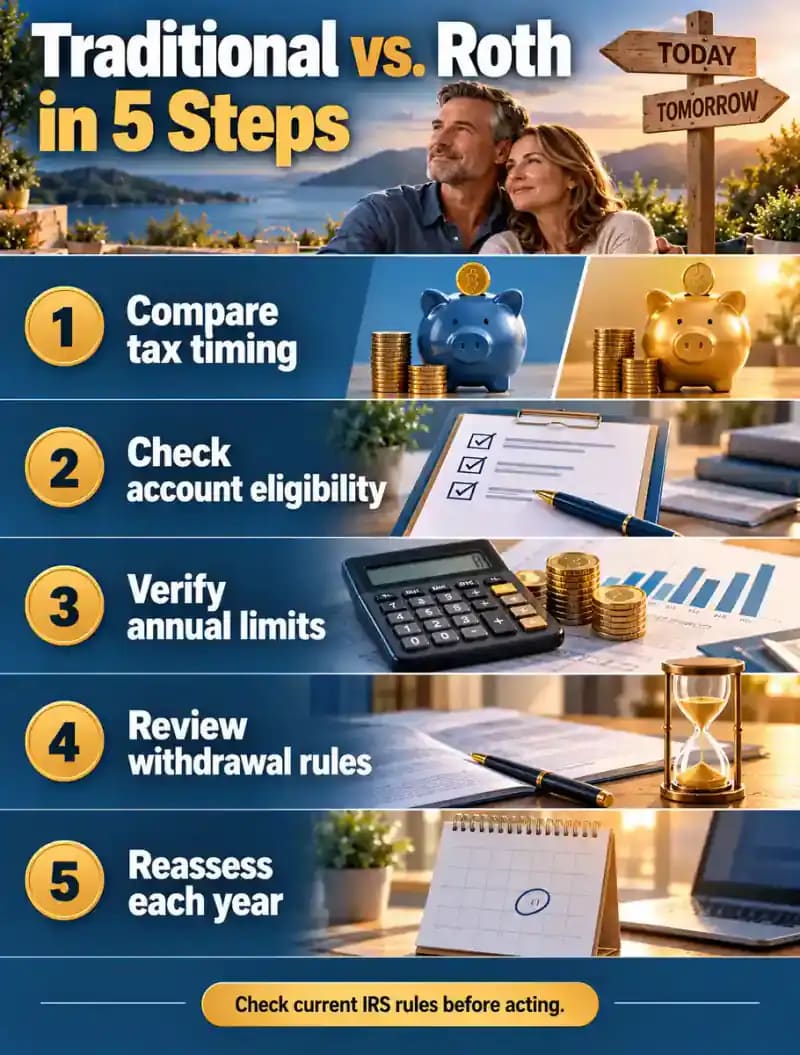
Before choosing how to divide new retirement contributions, ask several questions. What is your current marginal tax rate? What taxable income might you have in retirement? Does your employer offer both contribution types? Is there an employer match? Are you eligible for direct Roth IRA contributions? Would a Traditional IRA contribution actually be deductible? How valuable is current tax relief compared with future tax-free withdrawal flexibility? There is no need to predict the future perfectly. The objective is to understand which variables matter, use current IRS rules, and revisit the decision as your income and tax environment change.

Choosing between Traditional and Roth retirement accounts is fundamentally a decision about when you want retirement savings to be taxed. Traditional accounts generally provide a tax benefit before retirement and defer income taxes until money is withdrawn. Roth accounts generally reverse that sequence: contributions are made with after-tax money, but qualified withdrawals can be free from federal income tax.
That simple distinction affects much more than this year's tax return. It can influence taxable income while you are working, the amount of taxable income you recognize in retirement, whether required withdrawals apply, and how much flexibility you may have when coordinating retirement income from multiple sources.
Traditional and Roth choices exist in more than one type of retirement plan. An individual may encounter a Traditional IRA, Roth IRA, Traditional 401(k), Roth 401(k), or some combination of them. Investor.gov explains that IRAs provide tax advantages intended to encourage retirement saving, while workplace 401(k) plans allow employees to contribute part of their compensation toward retirement. The IRS establishes detailed rules governing contributions, deductions, distributions and eligibility.
There is no universally superior tax treatment. The relevant question is how each structure works and how its rules interact with your circumstances. Future tax rates, retirement income, access to a workplace plan, eligibility rules, employer matching contributions and withdrawal needs can all matter.
This guide explains the mechanics in practical terms. It is educational information only and is not individualized financial, legal or tax advice. Tax rules, contribution limits and income thresholds can change, so current IRS guidance should be checked before making a tax-sensitive retirement decision.
Where people go wrong
Assuming Roth is always better. Tax-free qualified withdrawals are valuable, but Roth contributions generally require giving up a current tax deduction. The better tax treatment depends on the comparison between taxes paid now and taxes that would otherwise be paid later.
Assuming Traditional contributions are always deductible. Traditional 401(k) contributions generally reduce current federal taxable wages, but Traditional IRA deductibility can be limited by income and workplace retirement plan coverage.
Ignoring qualified distribution rules. Roth earnings are not automatically tax-free in every withdrawal scenario. Qualification, holding-period and early-distribution rules can affect the tax result.
Using outdated contribution limits. IRA and workplace contribution limits can change. Always verify the applicable year's figures using current IRS guidance.
Forgetting that IRA limits are combined. Traditional and Roth IRA contributions generally share one overall annual IRA limit rather than providing two separate full limits.
Confusing contribution eligibility with deductibility. A Traditional IRA contribution can be permitted even when the contribution is not deductible. Those are separate questions under the tax rules.
Ignoring required minimum distributions. Many Traditional retirement accounts eventually become subject to RMD rules. Failing to plan for those withdrawals can affect taxable income and may create penalties if required distributions are missed.
Assuming employer matches are treated identically everywhere. Employer contribution treatment depends on plan design and current law. Confirm the actual matching and tax rules with the employer's plan administrator.
Questions people ask
The main difference is when federal income tax is generally paid. Traditional accounts usually provide tax deferral, with taxable withdrawals occurring later. Roth contributions are generally made with after-tax money, while qualified withdrawals can be tax-free.
Fixed it?
Get one guide like this every Thursday.