Term vs. Whole Life Insurance: Costs, Cash Value, and How to Choose
Term life insurance offers temporary protection at a generally lower initial cost, while whole life provides lifelong coverage and cash value. Compare premiums, renewal rules, benefits, and financial trade-offs before choosing a policy.

What you’ll need
Tap to tick things off before you start.
1. Understand What Life Insurance Actually Does
Life insurance transfers a defined financial risk from a household to an insurer. In exchange for premiums, the insurance company agrees to pay a specified death benefit when the insured person dies under the policy's covered conditions.
The payment may help beneficiaries manage living expenses, replace lost income, pay debts, or support education. Life insurance does not prevent financial loss, but it can provide funds when a household loses someone's financial contribution.
The central purpose is financial protection, not automatically wealth accumulation.

2. Recognize the Long-Term Commitment
A policy that appears affordable today can become unsuitable if its costs or coverage period do not match your future obligations.
For example, a family protecting income until children become financially independent may have a temporary need. Someone seeking funds for a lifelong dependent may face a substantially different planning horizon.
Term and whole life policies address these situations differently. Comparing only the first monthly payment ignores the duration of protection, future premiums, and potential consequences of canceling coverage.

3. Compare the Four Essential Policy Features
Before examining individual products, compare four contractual characteristics:
- Duration: How long does coverage remain active? - Premiums: What must you pay now and potentially later? - Death benefit: How much could beneficiaries receive? - Cash value: Does the policy accumulate money accessible during your lifetime?
A useful comparison holds the death benefit constant and then examines the differences in price, coverage duration, and guarantees. Additional features should be evaluated separately rather than treated as automatically valuable.

4. Learn Who Is Involved in the Contract
A life insurance policy is a legally binding agreement involving several roles. The insurer issues the contract and assumes the covered financial risk. The policy owner controls the policy and is generally responsible for ensuring premiums are paid.
The insured is the person whose death triggers the potential benefit, while the beneficiary is designated to receive the proceeds.
The owner and insured can be different people. Ownership matters because it may control beneficiary changes, cash value access, and policy surrender.

5. Understand the Insurer's Responsibilities
The insurance company promises specified benefits in exchange for compliance with policy conditions. These conditions commonly include timely premium payments and accurate information during underwriting.
Insurers evaluate factors such as age, health, coverage amount, and applicable underwriting classifications when determining eligibility and premiums.
A premium quote is not the same as an issued policy. Final coverage may depend on underwriting approval, payment, delivery requirements, and the contract's effective date. Read the issued terms rather than relying exclusively on a sales illustration.

6. Choose Beneficiaries Carefully
The beneficiary designation determines who is intended to receive the death benefit. Policies commonly allow primary and contingent beneficiaries, with additional rules depending on the insurer and applicable law.
Beneficiary information should be reviewed after major life changes such as marriage, divorce, childbirth, or a death in the family.
Naming minors, trusts, businesses, or multiple beneficiaries can introduce additional legal considerations. A qualified professional can explain ownership and designation consequences. Do not assume that a will automatically overrides the beneficiary designation on an insurance contract.

7. Understand How the Death Benefit Works
The death benefit is the amount payable under a covered claim, subject to the contract's conditions and any applicable adjustments.
For example, a $500,000 policy could provide substantial financial assistance to surviving beneficiaries. That figure is a contractual amount, not a prediction of how much protection any particular household needs.
Claims generally require documentation and insurer review. Exclusions, contestability provisions, outstanding policy loans, and other contractual terms may affect payment. A death benefit should never be described as unconditional.

8. Understand Why Policy Details Matter
Two policies with the same advertised death benefit may have different exclusions, renewal provisions, riders, premium guarantees, and surrender values.
State insurance regulations and individual contract language can also affect consumer rights.
The NAIC's consumer life insurance resources explain the importance of comparing policy types and evaluating personal coverage needs. Review the policy's benefit schedule, limitations, payment obligations, and definitions before committing.
Educational comparisons are useful, but only the actual contract establishes the insurer's obligations.

9. Know When Professional Guidance Is Useful
Straightforward coverage comparisons may be understandable without complicated projections. Permanent insurance, business-related coverage, trusts, and policy replacements generally require greater scrutiny.
A licensed insurance agent can explain contractual provisions and available products. An appropriately qualified financial professional can help evaluate insurance within broader financial objectives.
Ask how the professional is compensated, what products they can offer, and whether alternatives were considered. Compensation structures may create incentives that deserve transparency. Verify licensing through your state insurance department.

10. Learn How Term Life Insurance Works
Term life insurance provides coverage for a specified period. Common level-term durations include 10, 20, and 30 years, although availability varies.
If the insured dies during the active coverage period and the claim meets policy conditions, the insurer pays the applicable death benefit.
Term life typically has no cash value. This makes it comparatively simple: premiums purchase insurance protection for a defined interval rather than combining protection with cash accumulation.
Its simplicity and generally lower initial premium are major reasons consumers compare it first.

11. Match the Policy Term to the Financial Need
The appropriate coverage period depends on the duration of the obligation being protected.
A household with approximately 20 years remaining on a mortgage might examine a 20-year term. Parents may consider how many years their children are expected to depend on household income.
These are planning examples, not automatic policy recommendations. Multiple obligations may end at different times, and some may last longer than expected.
Choose a duration deliberately instead of assuming that the shortest available term represents the lowest overall financial risk.

12. Keep Term Coverage Active
Most level-term policies require premiums on a monthly, quarterly, or annual schedule. Coverage generally remains active when the owner fulfills the payment and contractual requirements.
Many policies include a grace period after a missed premium, but its duration and effect depend on the contract and applicable law.
Automatic payments may reduce administrative mistakes, although account changes and insufficient funds can still interrupt payment. Keep current contact information with the insurer and review notices promptly. Do not assume coverage remains active indefinitely after premiums stop.

13. Know What Happens When Term Coverage Expires
If the insured survives the selected term, ordinary term insurance generally ends without paying a death benefit or returning premiums.
Certain policies permit renewal, continuation at higher rates, or conversion into permanent coverage. Others terminate without those options.
A return-of-premium term policy is a separate variation and commonly costs more than standard term coverage.
The practical question is whether you will still need protection at expiration. If so, understand your available options well before the term ends.

14. Understand the Meaning of Pure Insurance
Term life is often described as pure insurance because its principal purpose is providing a death benefit during the covered term.
This does not mean premiums are wasted when no claim occurs. Insurance purchases protection against a financial event that may never happen during the contract period.
Auto and homeowners insurance operate under a similar general principle: the value of protection does not depend entirely on receiving a claim payment.
Term coverage separates the insurance decision from the choice of where to save or invest additional money.

15. Understand Why Term Policies Lack Cash Value
Ordinary term insurance does not accumulate a balance that policyholders can withdraw or borrow against.
Premiums support the insurer's cost of providing coverage, administrative expenses, and other business obligations. They do not create an individual investment account.
This distinction makes it important to avoid treating insurance premiums as savings deposits.
For consumers evaluating protection and long-term investing separately, term insurance may leave more room in the current budget for other goals. Whether those savings are actually invested is a separate behavioral and financial decision.

16. Learn How Whole Life Insurance Works
Whole life insurance is a form of permanent life insurance designed to remain active throughout the insured person's lifetime, provided contractual requirements are satisfied.
Unlike ordinary term insurance, whole life includes a cash value component that develops according to policy guarantees and, in some cases, nonguaranteed benefits.
Whole life policies generally require substantially higher initial premiums than comparable term policies because they combine longer-lasting protection with cash value accumulation.
Permanent does not mean maintenance-free. Missed payments, certain loan situations, or policy changes can still cause coverage to lapse or end.

17. Understand Lifetime Coverage Guarantees
Traditional whole life is designed to provide a death benefit whenever the insured dies, rather than only within a selected 20- or 30-year period.
That promise is conditional on maintaining the policy as required. Coverage may also have a contractual maturity age, with specific provisions governing what happens at maturity.
Unlike a newly purchased term policy, traditional whole life premiums and coverage guarantees are typically established at issue. Read the guarantees carefully because different whole life designs can use different premium structures.

18. Evaluate the Cost of Permanent Protection
Permanent insurance creates a much longer financial commitment than temporary coverage.
The higher premium can provide meaningful contractual benefits, but it also reduces money available for other household purposes. The opportunity cost matters, especially if maintaining premiums could crowd out emergency savings or debt repayment.
Before buying, compare total premiums under realistic payment schedules and consider whether those payments remain manageable during periods of reduced income.
A policy that is theoretically valuable but cannot be maintained may fail to accomplish the protection objective.

19. Understand How Whole Life Cash Value Grows
Whole life premiums support several components, including insurance costs, expenses, and the policy's contractual cash value structure.
Cash value generally accumulates gradually and may be small relative to premiums paid during the early years. Growth depends on the specific product's guaranteed schedule and any applicable nonguaranteed additions.
Cash value is not necessarily equal to total premiums paid, and it is not the same as the amount beneficiaries receive at death.
Request a year-by-year illustration showing guaranteed cash value, projected values, and any surrender charges.

20. Understand Tax-Deferred Cash Value Growth
Cash value inside a qualifying life insurance contract generally grows without annual federal income taxation of that internal accumulation.
However, tax-deferred does not mean tax-free under every circumstance. Surrender gains, withdrawals, policy loans, and certain contract classifications can produce different tax results.
For example, a policy classified as a modified endowment contract may face less favorable distribution rules.
Tax consequences depend on federal rules, state law, the transaction, and individual circumstances. Use an appropriately qualified tax professional to evaluate a specific policy transaction.

21. Separate Guaranteed Values From Projections
Whole life illustrations may contain guaranteed amounts alongside nonguaranteed projections, including dividends on participating policies.
Dividends are not guaranteed. They may vary with the insurer's experience and the policy's contractual provisions.
Ask the insurer to explain guaranteed cash values, guaranteed death benefits, and projected amounts separately. A favorable projection should not be mistaken for a contractual promise.
Also review the insurer's financial strength through reputable independent ratings and state insurance resources. Financial strength is relevant because insurance contracts can extend across decades.

22. Compare Level Premium Structures
Many traditional whole life policies use level premiums, meaning the scheduled premium stays constant during the required payment period.
Level-term insurance also generally offers fixed premiums during its initial level period. The distinction is not that term insurance always changes price while whole life never does.
Instead, compare how long the premium guarantee lasts and what happens afterward.
Some whole life variations have flexible or adjustable premium arrangements, so the phrase whole life alone does not replace reviewing the actual payment schedule.

23. Calculate the Long-Term Premium Commitment
Consider a purely hypothetical whole life premium of $300 per month paid for 30 years. The total scheduled outlay would be $108,000, excluding potential riders or other changes.
That calculation does not establish the policy's cash value, investment return, or death benefit. It simply illustrates the importance of adding up the financial commitment.
For a useful comparison, obtain actual illustrations for the same insured person and similar death benefit amounts. Examine affordability, guarantees, and policy values rather than relying on premium totals alone.

24. Compare Term and Whole Life Premium Costs
For the same insured person and comparable initial death benefit, term life typically costs substantially less at the beginning than whole life.
Actual prices depend on age, health, tobacco use, underwriting, insurer, coverage amount, and contract features.
Whole life's higher premium reflects permanent protection and its cash value structure. That does not automatically make it better or worse.
Compare quotes using matching coverage amounts, documented guarantees, and consistent assumptions. An inexpensive term quote and an expensive permanent policy may be designed to solve fundamentally different problems.

25. Understand Term Renewal and Conversion
Some term policies are renewable after the initial coverage period, often at substantially higher premiums based on attained age.
Other policies allow conversion to permanent coverage without new medical underwriting during a specified window, subject to contractual conditions.
Renewal and conversion are not universal rights. Eligibility may end at a stated age or date.
The NAIC life insurance overview explains renewable and convertible term provisions. Check these features before buying, not after health circumstances or coverage needs change.

26. Learn the Ways Cash Value May Be Accessed
Whole life cash value may be accessible through policy loans, withdrawals where permitted, or complete surrender. Available methods depend on the contract.
A policy loan usually uses the policy's value as collateral and accrues interest. Unpaid loan balances can reduce the death benefit and, in some circumstances, contribute to policy lapse or taxable consequences.
A withdrawal may reduce policy value and insurance benefits. Surrender generally terminates coverage.
Never assume that accessible cash is equivalent to a penalty-free bank balance.

27. Understand What Happens When You Surrender Whole Life
Surrendering a whole life policy means ending the contract in exchange for its applicable cash surrender value.
The payment may differ from the illustrated gross cash value because surrender charges, outstanding loans, and other contractual adjustments can apply.
Once fully surrendered, the policy no longer provides its death benefit. A taxable gain may also arise depending on the policy and transaction.
Before surrendering, request a current written calculation of the net proceeds and confirm the impact on beneficiaries and any replacement coverage.

28. Identify How Long Your Household Needs Protection
Begin with the financial consequences of the insured person's death rather than choosing an insurance product first.
Consider replacement income, housing costs, dependents, education expenses, final expenses, and available assets. Then identify approximately when those obligations might decline or disappear.
Temporary needs can sometimes align with term coverage. Continuing obligations may justify evaluating permanent coverage.
No single formula determines the correct death benefit or duration for every household. The purpose of this exercise is to connect coverage choices to identifiable financial risks.

29. Test Affordability Against Your Other Goals
Insurance premiums compete with other uses of household income, including emergency savings, retirement contributions, and debt repayment.
Evaluate whether the selected policy remains affordable under less favorable financial conditions, not only today's budget.
Ask whether a cash value component addresses a genuine planning requirement or simply sounds appealing. Compare guaranteed values with other financial options while accounting for taxes, risk, liquidity, and costs.
A policy should support a coherent financial plan rather than create a new financial obligation that undermines it.

30. Review the Contract Before Making a Commitment
Once you understand the differences, compare actual policy documents rather than general product descriptions.
Verify the premium schedule, coverage duration, beneficiary provisions, exclusions, renewal rights, guaranteed cash values, loan interest, surrender terms, and applicable riders.
If replacing existing insurance, confirm that new coverage is issued and effective before terminating the old policy. Replacing coverage may introduce new underwriting, contestability periods, costs, or loss of valuable provisions.
The strongest decision is one whose costs, limitations, and benefits you can explain clearly before signing.

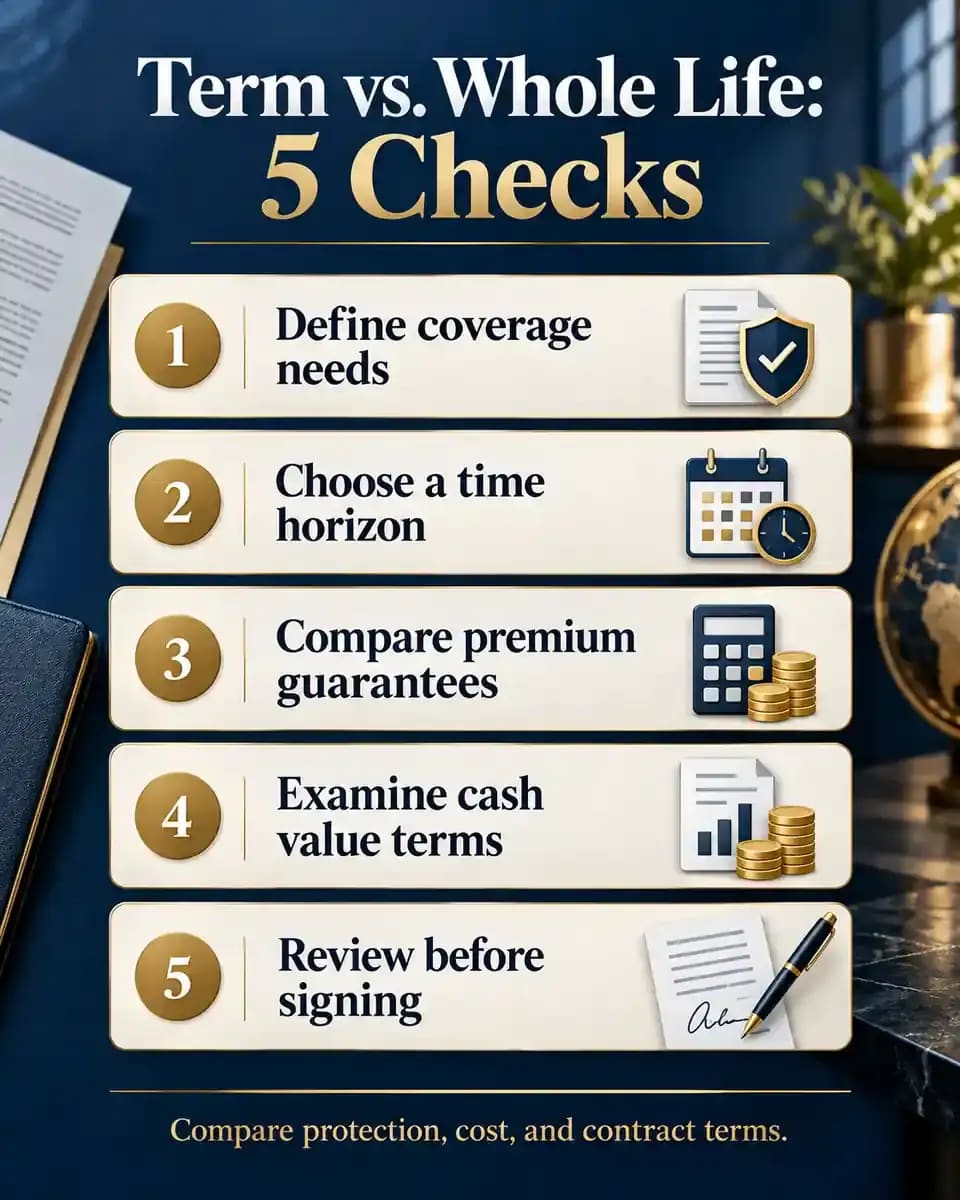
Choosing between term vs. whole life insurance can affect your household budget and financial protection for decades. Both products can provide a death benefit to beneficiaries, but they accomplish that purpose through very different contracts.
Term life insurance generally provides coverage for a defined period, often 10, 20, or 30 years. Whole life insurance is designed to provide permanent coverage and accumulate cash value. That added feature typically makes whole life considerably more expensive initially.
The important question is not simply which policy has the lowest premium. It is what financial obligation you need to protect, how long that obligation will last, and what you receive in exchange for the premiums.
The National Association of Insurance Commissioners (NAIC) explains that term insurance generally offers lower-cost protection for a specific period, while cash value policies can remain in force longer and provide additional financial features. The Consumer Financial Protection Bureau (CFPB) emphasizes the importance of understanding consumer financial obligations, and the SEC's Investor.gov provides broader investor education relevant to assessing financial products.
This guide explains the insurance contract, death benefits, policy duration, renewal costs, whole life cash value, tax considerations, and potential surrender consequences. It also provides a practical framework for comparing policies without confusing insurance protection with investment performance.
Important: This article provides general consumer education, not individualized financial, legal, insurance, or tax advice. Product provisions vary by insurer and state. Request the actual policy documents and guaranteed illustrations before making a decision.
Where people go wrong
Comparing Premiums Without Matching Coverage. A low-premium term policy and a high-premium whole life contract may provide different coverage durations and financial features. Compare equivalent initial death benefits, coverage conditions, and guaranteed periods before judging cost.
Assuming Term Premiums Always Increase. Many level-term policies maintain a fixed premium during the guaranteed term. Increases often become relevant at renewal or after the level period, depending on the contract.
Treating Whole Life Cash Value Like a Bank Account. Cash value may accumulate slowly and can be affected by fees, loans, surrender charges, and policy provisions. Accessible cash is not necessarily equal to premiums paid.
Believing Cash Value Is Automatically Added to the Death Benefit. In many traditional whole life contracts, beneficiaries receive the contractual death benefit rather than the death benefit plus a separate cash value balance. Product variations and riders can change this.
Assuming Tax-Deferred Means Tax-Free. Certain transactions involving surrender gains, withdrawals, loans, or modified endowment contracts may have tax consequences. Policy classification and transaction details matter.
Ignoring Renewal and Conversion Deadlines. Some term policies allow renewal or conversion only under specified conditions or before certain dates. Missing these provisions can limit future options.
Overestimating Nonguaranteed Whole Life Illustrations. Projected dividends and certain illustrated values are not guaranteed. Evaluate the guaranteed schedule separately from optimistic insurer projections.
Canceling Existing Coverage Too Early. Terminating an existing policy before replacement coverage becomes effective may leave a protection gap. New coverage can also involve different premiums, exclusions, and underwriting requirements.
Questions people ask
Term life insurance generally provides a death benefit for a selected period and does not accumulate cash value. Whole life is designed for permanent coverage and includes contractual cash value. Whole life usually has substantially higher initial premiums for comparable coverage.
Fixed it?
Get one guide like this every Thursday.