The Myth of the Tax Refund Windfall: Why a Big Refund Isn't Free Money
A large tax refund might feel like a bonus, but it often means you paid too much in taxes throughout the year. Learn how federal tax withholding works, why overpaying can hurt your cash flow, and how to adjust your W-4.

What you’ll need
Tap to tick things off before you start.
The Tax Refund Myth: Why a Big Refund Feels Like a Windfall
Every spring, a large tax refund can feel like an unexpected financial reward. Seeing thousands of dollars arrive in a bank account creates the excitement of receiving a bonus, even when the money was expected. This is the psychology behind the tax refund myth. People often mentally separate refunds from regular earnings, making them more willing to spend the money on vacations, electronics, or other major purchases. That emotional distinction can influence financial decisions more than the refund's actual size.

What a Federal Tax Refund Actually Represents
According to the Internal Revenue Service, a federal tax refund generally occurs when total tax payments and refundable credits exceed the amount of tax owed. Payments include federal income tax withheld from wages and estimated tax payments. Refundable credits, such as certain qualifying family-related credits, can also increase a refund even when little income tax was withheld. This distinction matters because a refund may combine previously paid money with tax benefits established by law. It is not necessarily entirely withheld earnings.

Why Your Tax Refund Arrives Months Later
Federal income taxes are calculated for a calendar tax year, but individual returns are generally filed during the following year. For example, taxes paid during 2026 are typically reconciled when taxpayers file their 2026 returns in 2027. The IRS must receive and process a return before issuing the resulting refund. Electronic filing with direct deposit is generally faster than paper filing, although processing delays can occur. Consequently, money overpaid early in the tax year may remain unavailable for many months.

The Hidden Cost of an Interest-Free Government Loan
Excessive withholding is often compared to giving the federal government an interest-free loan. The comparison reflects the opportunity cost of temporarily surrendering access to earnings. Money retained in a savings account might earn interest, while funds used to reduce expensive debt could avoid borrowing costs. Routine refunds generally do not compensate taxpayers for this lost opportunity, although the IRS may pay interest on certain delayed refunds. The financial impact depends on the amount overpaid, timing, and alternative uses.

How the Pay-As-You-Go Federal Tax System Works
The United States uses a pay-as-you-go federal income tax system. Instead of waiting until the annual filing deadline, taxpayers generally pay income taxes as they earn or receive taxable income. Employees usually make these payments through paycheck withholding, while people receiving income without withholding may need estimated tax payments. This approach distributes tax payments across the year and reduces reliance on one large payment at filing time. The IRS explains these collection methods through its official tax withholding guidance.

How Employers Calculate Federal Tax Withholding
Employers calculate federal income tax withholding using payroll information, IRS withholding tables, and the employee's Form W-4. The form communicates details such as filing status, multiple-job adjustments, dependent-related credits, other income, deductions, and additional withholding requests. Payroll calculations also consider wages and pay frequency. Employers then deduct the calculated federal income tax from each paycheck and remit withholding through the federal tax deposit system. Form W-4 influences withholding amounts but does not determine a person's final annual tax liability.

Over-Withholding vs. Under-Withholding: Finding the Balance
Consider three taxpayers who each owe $8,000 in federal income tax and have no refundable credits or other payments. The first has $10,000 withheld and receives a $2,000 refund. The second has $6,500 withheld and owes $1,500 when filing. The third has exactly $8,000 withheld and has no remaining balance. All three have identical tax liabilities, despite different filing outcomes. This example demonstrates why withholding accuracy matters more than the size of a refund or payment.

Is a Large Tax Refund a Good Forced Savings Strategy?
Some taxpayers deliberately withhold extra money because they find it easier to save when the funds never reach their checking accounts. This forced savings approach can discourage impulse purchases and create a predictable annual lump sum. However, it offers limited flexibility and generally earns no return during the withholding period. An alternative is automatically transferring part of each paycheck into a separate savings account. That approach can preserve spending discipline while keeping accumulated savings accessible when necessary.

How Excessive Withholding Can Strain Your Monthly Budget
Excessive withholding reduces the money available to cover regular household expenses. For families managing tight budgets, even modest differences in take-home pay can affect grocery purchases, utility payments, or transportation costs. Unexpected expenses create additional pressure when accessible cash reserves are limited. A household facing a car repair might rely on a credit card despite having substantial excess taxes withheld. If that balance carries interest, the borrowing cost can compound an already difficult cash flow problem.

How Earlier Access to Your Money Can Improve Financial Security
Receiving more of your earnings throughout the year can create opportunities to strengthen financial resilience. For example, an additional $75 per biweekly paycheck represents $1,950 across 26 pay periods. Those funds could gradually build an emergency reserve, reduce outstanding debt, or provide flexibility when expenses fluctuate. Earlier access also allows households to address smaller financial problems before they become larger ones. These benefits depend on maintaining appropriate tax payments and using the additional cash deliberately.

How to Tell Whether You're Withholding Too Much Tax
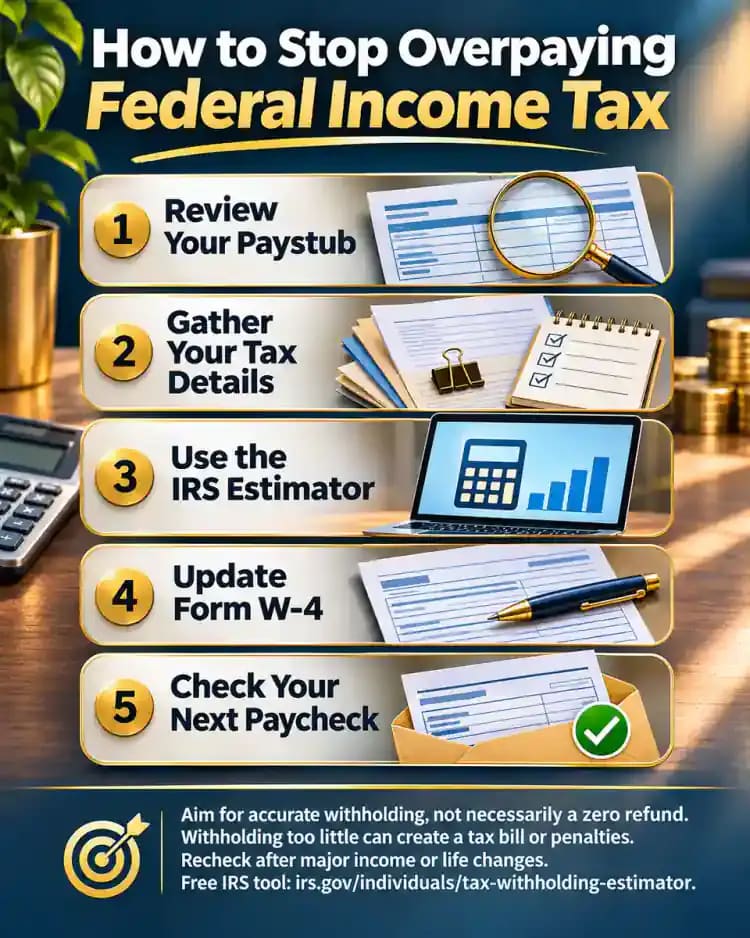
A consistently large refund may signal excessive federal income tax withholding, but refund size alone cannot confirm it. Start by examining your latest paystub, particularly federal income tax withheld and year-to-date totals. Compare those figures with your previous Form 1040, including total tax, payments, and refundable credits. If your income and circumstances remain similar, the comparison may reveal a pattern. Remember that bonuses, income changes, and tax credits can make previous returns unreliable predictors of current obligations.

What You Need Before Adjusting Your Tax Withholding
Accurate withholding estimates depend on complete financial information. Gather recent paystubs showing earnings and federal income tax withheld, along with your latest federal tax return. Identify your expected filing status, qualifying dependents, anticipated deductions, and tax credits. Include projected wages, bonuses, investment income, and other taxable earnings. Married couples may also need information from both spouses, particularly when both work. These details help distinguish taxable income from amounts that actually determine the final tax obligation.

How to Use the Free IRS Tax Withholding Estimator
The Internal Revenue Service provides a free Tax Withholding Estimator at https://www.irs.gov/individuals/tax-withholding-estimator. The tool asks about filing status, income sources, paycheck withholding, deductions, and applicable credits. After entering the requested information, users can review an estimate of their federal tax position, including a potential refund or balance owed. The estimator may recommend changes to withholding. Because results depend on the information supplied, accurate entries and realistic income projections are essential for meaningful guidance.

How to Update Form W-4 to Change Your Withholding
Employees generally change federal income tax withholding by submitting a new Form W-4 to their employer. The form includes filing status, adjustments for multiple jobs, dependent-related credits, other income, deductions, and optional additional withholding. Recommendations from the IRS Tax Withholding Estimator can help determine which entries need updating. Employers may accept the form through a payroll portal or another approved submission method. A revised W-4 changes future withholding instructions rather than changing the employee's underlying tax liability.

When Your Updated Withholding Takes Effect
An updated Form W-4 does not necessarily change the paycheck issued immediately after submission. Employers must implement revised withholding within applicable IRS timing requirements, and payroll processing schedules can affect when the change appears. Once processed, the adjustment should be reflected in the federal income tax withholding line of a subsequent paystub. Comparing that amount with earlier paychecks helps identify whether the expected change occurred. Unexpected results can be discussed with the employer's payroll or human resources department.

When Life Changes Require Another Withholding Review
Withholding calculations can become outdated when personal or financial circumstances change. Marriage, divorce, the birth of a child, or changes in dependent eligibility may affect filing status or available tax benefits. Starting another job, receiving a substantial raise, earning bonuses, or adding investment income can also change expected tax liability. The IRS encourages taxpayers to review withholding after major life events. Reassessing these changes helps prevent an earlier withholding estimate from becoming inaccurate as the year progresses.

How to Avoid Unexpected Tax Bills and Underpayment Penalties
Reducing withholding too aggressively can create a balance due when filing a federal tax return. In some circumstances, insufficient payments throughout the year may also trigger an estimated tax underpayment penalty. The IRS provides safe harbor rules that generally consider current-year tax liability, prior-year tax liability, and payments made during the year. Eligibility and thresholds vary with individual circumstances. Understanding these rules matters because having enough money to pay a tax bill at filing does not automatically eliminate penalties.

How to Put Additional Take-Home Pay to Work
When adjusted withholding increases take-home pay, a spending plan can help preserve the financial benefit. One approach is dividing the additional amount among emergency savings, existing debt payments, and predictable upcoming expenses. Automatic transfers can move money into a separate savings account before it becomes available for discretionary spending. For example, an extra $80 per paycheck could be allocated across several priorities. The important distinction is that increased cash flow creates opportunities, but spending habits determine whether those opportunities produce lasting improvements.

Big Tax Refund or Bigger Paychecks: Which Is Better?
Consider a taxpayer choosing between a $2,400 annual refund from excess withholding and approximately $200 more in monthly take-home pay. Assuming identical tax liability, both arrangements provide the same principal amount over the year. The refund delivers one larger payment, which some people find easier to save. Monthly access offers greater flexibility and the possibility of earning interest sooner. Neither arrangement automatically changes total federal income tax owed. The practical difference involves timing, financial discipline, and household priorities.

Build a Year-Round Tax Withholding Review Habit
A practical withholding routine can include reviewing paystubs early in the year, checking projections after major changes, and evaluating results before year-end. Keeping tax returns, payroll records, and income estimates organized makes those reviews easier. The IRS Tax Withholding Estimator provides a starting point for many common situations. Taxpayers with multiple income sources, complicated credits, or recurring payment problems may benefit from qualified professional guidance. The objective is reasonable payment accuracy rather than achieving a particular refund amount.

Why Accurate Tax Withholding Is the Real Goal
The goal of federal tax withholding is to pay approximately the right amount throughout the year, not to generate the largest possible refund. A substantial refund can indicate excess payments, while a large balance due may indicate insufficient withholding. Neither outcome alone measures financial responsibility. The Internal Revenue Service encourages taxpayers to review withholding against their expected tax liability. Reasonable accuracy helps balance access to earnings with the obligation to pay federal income taxes on time.

What to Do If You Discover Excessive Withholding Midyear
Discovering excessive withholding halfway through the year does not mean the entire overpayment can immediately be recovered. Federal income tax already withheld generally remains credited toward the year's tax liability. However, an updated Form W-4 can change withholding on remaining paychecks. For example, someone who has overpaid by June may need less withheld during subsequent months. The appropriate adjustment depends on projected annual income, previous payments, and remaining pay periods. Midyear corrections therefore require year-end calculations.

How to Coordinate Tax Withholding With Your Spouse
Married couples with two incomes face an additional withholding challenge because each employer calculates withholding using information submitted for that particular job. If both spouses select married filing jointly without accounting for the second income, their combined withholding may be insufficient. Form W-4 includes options for coordinating multiple jobs, while the IRS Tax Withholding Estimator can consider household earnings together. Coordinating both paychecks helps produce a more realistic estimate of the couple's combined federal income tax obligation.

What If You Have Freelance Income or a Side Hustle?
Freelance work, consulting, and side businesses often generate income without automatic federal tax withholding. That income can increase annual income tax liability and may also create self-employment tax obligations. Employees with side income may be able to increase withholding through their regular jobs, while others may need quarterly estimated tax payments. The IRS explains these payment methods through its pay-as-you-go guidance. Tracking business revenue, deductible expenses, and expected profit helps clarify the amount potentially subject to taxation.

How Tax Credits Can Change Your Refund
Tax credits reduce federal income tax liability, but their effect on refunds depends on whether they are refundable. Nonrefundable credits generally reduce qualifying tax liability to zero without creating an additional payment beyond that amount. Refundable credits can produce a refund even when the taxpayer owes little or no federal income tax. Certain family-related and earned income credits may qualify under applicable rules. Consequently, a refund larger than paycheck withholding does not necessarily indicate excessive withholding or a payroll calculation error.

Why State Income Tax Withholding Needs Separate Attention
Federal and state income tax withholding are separate systems. Updating federal Form W-4 generally does not change state income tax deductions from a paycheck. States that impose individual income taxes may use their own withholding certificates, calculation methods, and adjustment procedures. Some states follow aspects of federal rules, while others differ significantly. Employees can identify state withholding on their paystubs and consult the relevant state revenue agency for official instructions. Federal withholding accuracy does not guarantee accurate state tax payments.

How to Prevent Extra Paycheck Money From Disappearing
A larger paycheck does not automatically improve financial health. Without a spending plan, additional income can disappear through small purchases, subscriptions, restaurant visits, and other discretionary expenses. This gradual expansion of spending is commonly called lifestyle inflation. One practical control is treating the increased amount as already committed to a specific financial purpose before payday. Separating essential expenses from discretionary purchases also makes spending patterns easier to recognize. The objective is preventing additional cash flow from becoming unnoticed consumption.

Four Questions to Ask Before Changing Your Withholding
Before changing withholding, consider four questions. First, would greater access to earnings improve monthly cash flow? Second, have income, employment, or household circumstances changed enough to affect expected taxes? Third, does a current estimate indicate that withholding exceeds likely federal tax liability? Fourth, would additional paycheck income support meaningful financial goals rather than unplanned spending? These questions provide a practical decision framework. They also distinguish a genuine withholding imbalance from a simple preference for receiving a smaller refund.

How to Turn Better Cash Flow Into Long-Term Stability
Consistent access to earnings can make household finances more predictable. When income and recurring expenses follow a reliable schedule, families may find it easier to plan purchases, maintain emergency reserves, and avoid unnecessary borrowing. Predictability can also reduce uncertainty surrounding ordinary expenses such as utilities, transportation, and groceries. Financial stability develops through repeated habits rather than a single large payment. Maintaining an organized budget and periodically reviewing spending patterns can help translate improved cash flow into lasting financial resilience.

The Tax Refund Myth: Five Lessons Worth Remembering
Five principles explain the tax refund myth. First, refunds often return excess tax payments, although refundable credits can contribute. Second, federal income taxes are generally paid throughout the year. Third, unnecessary withholding can limit access to earnings. Fourth, employees can adjust future withholding through Form W-4. Fifth, the IRS Tax Withholding Estimator offers free guidance for evaluating payment accuracy. Understanding these principles helps separate refund excitement from sound financial planning and keeps attention on actual tax obligations.

Getting a $3,000 tax refund can feel like winning a small lottery. You might use it to pay off a credit card, book a vacation, or finally build an emergency fund. But here's the catch: much of that refund may be money you already earned and could have received in your paychecks throughout the year.
This is the tax refund myth. A large refund does not automatically mean you made a smart financial decision or discovered an unexpected government benefit. Often, it means your employer withheld more federal income tax than you ultimately owed. However, refundable tax credits and certain other payments can also contribute to a refund, so not every refund represents excess paycheck withholding.
Consider a simple example. If $2,600 of your annual refund comes from excess withholding and you receive 26 paychecks per year, that's approximately $100 per paycheck you could potentially have kept. Instead of waiting until tax season, you might have used that money to cover bills, reduce expensive debt, or build savings.
The solution isn't to eliminate your withholding or guarantee a zero-dollar refund. Withholding too little can leave you facing an unexpected tax bill and potentially an underpayment penalty. The goal is to estimate your actual federal tax liability and withhold an appropriate amount.
Fortunately, the IRS offers a free Tax Withholding Estimator, and employees can generally update their withholding by submitting a new Form W-4 to their employer. Understanding these tools can help you make a more informed choice between a larger annual refund and better cash flow throughout the year.
Where people go wrong
Treating a Tax Refund Like Free Money. A refund is not automatically a financial bonus. It often represents taxes you paid beyond your actual liability, although refundable credits can also contribute. Understanding where your refund comes from helps you evaluate whether your withholding needs adjustment.
Assuming a Bigger Refund Means Better Tax Planning. A larger refund does not prove that you paid less tax overall. Two employees with identical tax liabilities could receive different refunds simply because their employers withheld different amounts. Compare actual tax liability rather than refund size.
Reducing Withholding Without Running the Numbers. Increasing your paycheck by withholding less may seem attractive, but making arbitrary adjustments can create an unexpected tax bill. Use the IRS Tax Withholding Estimator and consider underpayment rules before changing your Form W-4.
Forgetting to Update Form W-4 After Life Changes. Marriage, divorce, a new job, additional income, or changes in dependents can affect your tax situation. Leaving outdated withholding instructions in place may result in significant overpayment or underpayment. Review your withholding whenever your circumstances change.
Using Tax Overpayment as Your Only Savings Strategy. Intentionally over-withholding can create a form of forced savings, but it limits access to your earnings and generally provides no interest. Consider automatic transfers into a dedicated savings account if you want discipline without sacrificing liquidity.
Ignoring the Cost of High-Interest Debt. Waiting for a large refund while carrying expensive credit card debt can be costly. Money unnecessarily withheld from your paycheck cannot reduce those balances during the year. Better withholding accuracy may free up funds for earlier debt repayment.
Failing to Check Paychecks After Updating Withholding. Submitting a new Form W-4 does not guarantee your desired result immediately. Payroll processing schedules vary, and unexpected income changes can affect your estimate. Check subsequent paystubs and review withholding again if your circumstances change.
Questions people ask
Not necessarily. A large refund can provide a useful lump sum, especially for people who struggle to save consistently. However, when it primarily results from excessive paycheck withholding, you lose access to that money during the year. The best approach depends on your cash flow, savings habits, and tax circumstances.
Fixed it?
Get one guide like this every Thursday.