Subscription Auto-Renewals: How Recurring Billing Works and How to Protect Your Money
Subscription auto-renewals can turn free trials and forgotten memberships into recurring expenses. Learn how negative option billing works, recognize dark patterns, review automatic debits, and reduce unwanted charges.

What you’ll need
Tap to tick things off before you start.
Understand the Negative Option Model
Many subscription auto-renewals use what regulators call a negative option structure. Instead of requiring you to approve every future purchase, the seller treats your failure to cancel as permission for the relationship to continue. This can include monthly subscriptions, annual memberships, introductory offers, and some free or discounted trials that later convert to paid service. The crucial difference from a one-time purchase is that the default is continuation. Once you enroll, future transactions can occur without a new buying decision each month.

See How the Default Changes Your Behavior
A one-time purchase normally ends after payment. A recurring subscription reverses that structure. Doing nothing means another billing cycle can happen. Canceling requires action. That distinction matters because even small amounts can continue for months when a service is forgotten. Businesses value recurring revenue partly because customers do not need to actively repurchase every billing period. For consumers, the practical lesson is simple: every recurring commitment deserves ongoing attention rather than being treated like a completed transaction.

Recognize Status Quo Bias
Status quo bias describes the tendency to leave an existing situation unchanged rather than take action. Subscription billing can benefit from that tendency. You may notice a $12 charge and think you will cancel later, only to forget before the next month. The charge itself may be small enough to avoid immediate attention. Over time, several forgotten subscriptions can become a meaningful household expense. The solution is not perfect memory. It is creating a repeatable review process that does not depend on remembering every service.

Separate Useful Subscriptions From Forgotten Ones
Not every automatic renewal is undesirable. Streaming services, software, security monitoring, cloud storage, gyms, and professional tools may provide ongoing value. The goal is to distinguish intentional recurring expenses from services you no longer use. When reviewing a charge, ask whether you used the service recently, whether you would deliberately buy it again today, and whether a cheaper alternative already covers the same need. That turns subscription management into a value decision rather than a reflexive cancellation exercise.

Know What Dark Patterns Look Like
Dark patterns are interface or process designs that steer people toward choices benefiting the business, sometimes at the consumer's expense. In subscription services, warning signs can include a prominent enrollment button paired with a difficult-to-find cancellation option, repeated retention screens, confusing wording, preselected choices, or important pricing information placed where users are unlikely to notice it. Not every poorly designed interface is intentionally deceptive, but unusual friction around leaving a service should make you slow down and document what happens.

Compare Signup With Cancellation
One useful test is to compare the two sides of the customer journey. If enrollment took seconds online but cancellation requires locating a hidden page, making a phone call, waiting for business hours, or navigating numerous retention prompts, the process contains significant cancellation friction. The FTC's vacated 2024 Click-to-Cancel rule specifically sought to address this asymmetry by requiring cancellation mechanisms comparable in ease to enrollment. Although that rule was vacated in 2025, the underlying design issue remains useful for consumers to recognize.

Read the Material Terms Before Paying
Before entering payment information, identify the price, billing frequency, length of any promotional period, renewal amount, cancellation method, and whether the plan renews monthly or annually. Screens that emphasize a low introductory price may make the later recurring price less noticeable. Take a screenshot or save the confirmation when the economics matter. Clear records can help you remember what you agreed to and provide useful documentation if the billing later differs from what was presented.

Treat Free Trials as Future Purchases
A free trial may be free only during the introductory period. Many trials are designed to convert automatically into paid plans unless canceled before a deadline. When you start one, record the conversion date immediately. Also record the regular price because that is the amount that matters once the promotion ends. If you would not knowingly pay the regular price, decide whether to cancel early rather than relying on a last-minute reminder.

Watch for Introductory Pricing
Some offers begin at a low rate and later increase automatically. The initial price may dominate the marketing while the continuing price appears in smaller disclosures. Before subscribing, determine both figures. A service costing $1 for the first month and $29.99 afterward is economically a $29.99 subscription after the promotion, not a $1 service. Compare the ongoing price with alternatives before allowing the promotional framing to drive the decision.

Do Not Assume Silence Means No Charge
With negative option billing, silence often has the opposite effect: the subscription continues. Deleting an app, ignoring emails, stopping use of the service, or removing a shortcut from your phone does not necessarily cancel the underlying account. Use the merchant's actual cancellation process and confirm that the account status changes. If the service gives you a confirmation number, email, or effective cancellation date, retain it.

Understand What Happened to Click-to-Cancel
The FTC announced its amended Negative Option Rule in October 2024. Among other provisions, it was designed to require clearer disclosures, informed consent, and a cancellation mechanism at least as easy as enrollment. Most major requirements were initially scheduled to become effective after a delayed implementation period. However, on July 8, 2025, the Eighth Circuit vacated the amended rule on procedural grounds before those major requirements took effect. Consumers should therefore not assume that the broad 2024 Click-to-Cancel requirements currently operate nationwide as originally announced.

Follow the FTC's New Rulemaking
The regulatory story did not end with the court decision. In March 2026, the Federal Trade Commission announced an advance notice of proposed rulemaking concerning negative option marketing. The agency requested information about practices that obscure subscription terms, enroll consumers without express informed consent, or deter cancellation. That process could eventually lead to new federal requirements, but proposed or exploratory rulemaking should not be confused with a currently effective final rule. For current legal requirements, consult official FTC materials and applicable state law.

Remember That Other Federal Laws Still Matter
Vacating the 2024 FTC amendment did not eliminate every federal consumer-protection rule affecting subscriptions. Existing federal statutes and regulations can still apply to deceptive practices, online negative option transactions, electronic fund transfers, and other conduct depending on the facts. The FTC retains authority to pursue certain unfair or deceptive practices under existing law. Subscription regulation is therefore broader than one rule, and the exact requirements can depend on how the offer was sold and how payment is collected.

Check State Automatic-Renewal Rules
States can impose their own automatic-renewal requirements, and those rules vary. Some address disclosure, consent, renewal reminders, cancellation methods, or changes in price and terms. This means a national subscription business may face requirements beyond federal law. Consumers should avoid assuming that one federal standard describes every right available in every state. If a dispute is significant, current guidance from the relevant state attorney general or consumer-protection agency can be useful.

Distinguish Bank Debits From Card Charges
Payment method matters. A merchant automatically pulling money from a checking account through an electronic fund transfer is not identical to a merchant placing a recurring charge on a credit card. Different legal rules, dispute procedures, deadlines, and card-network policies can apply. When investigating a recurring payment, first identify exactly where the money came from: checking account, debit card, credit card, digital wallet, app store, or another payment service.

Know the Authorization Rule for Bank Debits
For preauthorized electronic fund transfers from a consumer account, Regulation E generally requires authorization in a writing signed or similarly authenticated by the consumer, and the party obtaining authorization must provide a copy. The CFPB's current Regulation E materials also state that the authorization should be readily identifiable and its terms clear and understandable. This framework is particularly relevant when a company regularly withdraws money directly from a checking account.

Keep a Copy of Payment Authorization
When you authorize automatic withdrawals, save the agreement or confirmation showing the amount, frequency, merchant, account involved, and any instructions for changing or revoking authorization. The CFPB advises consumers to review authorization terms and retain a copy. Documentation becomes especially valuable if the merchant later withdraws a different amount, continues after authorization is revoked, or there is disagreement about what you approved.

Understand Your Ability to Stop Bank Debits
The CFPB states that consumers have the right to stop a company from taking automatic payments from a bank account even when they previously permitted them. Its consumer guidance recommends contacting the company to revoke permission and following up in writing. Depending on the circumstances, consumers can also contact their bank or credit union about stopping automatic payments. Canceling the payment method is not necessarily the same as canceling the underlying contract, so treat those as separate issues.

Use Stop-Payment Procedures Carefully
A bank or credit union may have procedures for placing a stop-payment order on certain preauthorized electronic transfers. Timing requirements can matter, so consumers dealing with an imminent debit should consult their financial institution's current instructions and the CFPB's official guidance rather than relying on general internet advice. Remember that stopping a transfer does not automatically resolve any valid contractual amount that may still be owed to the merchant.

Audit Every Financial Account
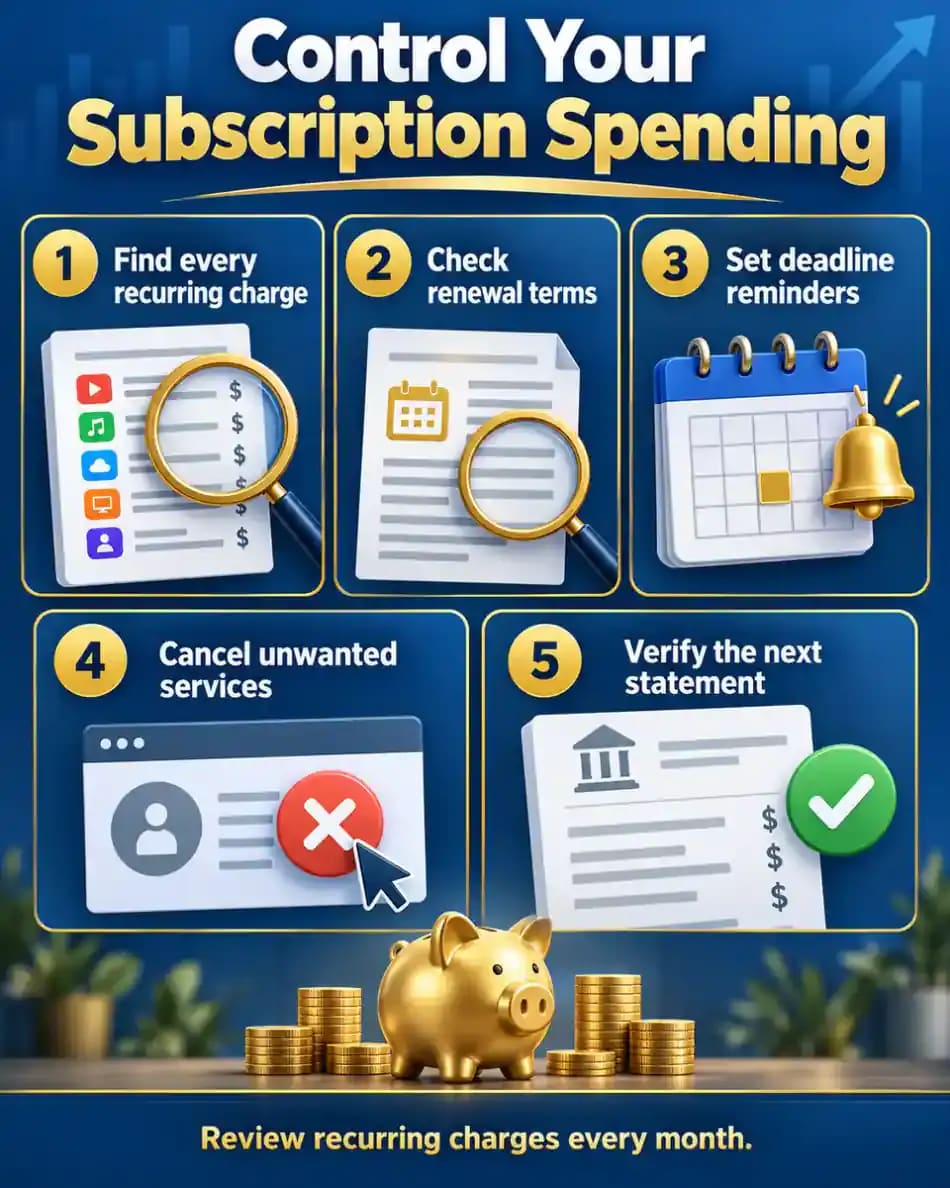
A subscription audit works only if it includes all places where recurring charges can hide. Review checking accounts, credit cards, debit cards, digital wallets, app stores, and payment platforms. Look for repeated merchant names at monthly, quarterly, or annual intervals. Annual services are particularly easy to miss because they appear only once per year. If you cannot identify a merchant, search your email for the exact billing descriptor before assuming the charge is unauthorized.

Search Your Email for Subscription Clues
Email can reveal subscriptions that are difficult to recognize from bank descriptors. Search terms such as receipt, subscription, renewal, membership, trial, invoice, recurring, billed, and payment can uncover enrollment confirmations and old renewal notices. Searching a merchant name may also reveal which account or email address was used. This is particularly helpful when a household has accumulated subscriptions over several years.

Calculate the Annual Cost
Monthly pricing can make recurring expenses look smaller than they are. Convert each subscription into an annual figure. A $19.99 monthly service costs about $240 over 12 months. Five services at that price approach $1,200 per year. Annualizing costs does not mean every subscription is wasteful. It simply puts recurring expenses on a scale that makes comparison easier and helps you decide whether the service provides enough value.

Create a Subscription Inventory
Build one list containing the merchant, service, price, billing frequency, payment method, renewal date, account email, and cancellation location. A basic spreadsheet is enough. The inventory reduces the chance that subscriptions disappear into separate statements and inboxes. It also makes future reviews much faster because you already know what should be present. Update the list whenever you add or remove a recurring service.

Set Trial and Renewal Reminders
For every trial or annual plan you intend to review later, create a calendar reminder several days before the renewal date. A second reminder can provide backup when the amount is significant. Do this when you subscribe, not after you receive the first unexpected charge. The objective is to move the decision from an easily forgotten future date into a system that prompts you automatically.

Cancel Through the Official Account
When possible, start with the merchant's authenticated website or app and locate subscription, membership, billing, or account settings. Avoid clicking cancellation links from suspicious emails. If the merchant requires another method, use its verified contact information. Work through the process until the account clearly shows cancellation, non-renewal, or an expiration date. Leaving midway through a retention flow may not complete the request.

Save Proof That You Canceled
Keep the confirmation email, screenshot, confirmation number, chat transcript, or other record showing when cancellation occurred and when service is supposed to end. If cancellation is handled by phone, make a note of the date, time, number called, and any reference number provided. Good records do not guarantee that every dispute will be resolved in your favor, but they make it much easier to explain what happened accurately.

Check the Next Statement
Do not assume the matter is finished immediately after cancellation. Review the next relevant statement and verify that the expected charge is gone. Some services legitimately remain active until the end of a prepaid billing period, while others may process charges based on contract timing. Compare what happens with the cancellation confirmation and the terms you received. If something does not match, investigate promptly.

Escalate Unresolved Charges Methodically
If a recurring charge continues unexpectedly, start by gathering the enrollment terms, statements, cancellation evidence, and correspondence. Contact the merchant through a documented channel and state the issue clearly. For bank-account debits, CFPB guidance explains procedures consumers can use when revoking authorization or dealing with automatic payments. Card issuers and payment platforms may have separate dispute processes and deadlines. Significant or complicated disputes may justify professional advice or contact with an appropriate consumer-protection agency.

Review Subscriptions Every Month
A short monthly review is more effective than a major cleanup every few years. Scan every account for new recurring charges, price increases, unfamiliar merchants, and services that are no longer being used. Compare the results with your subscription inventory. Monthly reviews also make unusual transactions easier to notice while the details are still fresh. Ten minutes of routine maintenance can prevent many small charges from becoming long-running expenses.

Build a Subscription Control System
The strongest defense against unwanted subscription auto-renewals is a system rather than memory. Before subscribing, understand the regular price and cancellation method. Record trials and renewal dates. Maintain one inventory of recurring services. Review financial statements each month. Save cancellation evidence. And when a merchant directly debits a bank account, understand the separate authorization and payment-stopping protections described by the CFPB and Regulation E. Federal and state rules can change, so verify current official guidance when a legal question matters.

Subscription auto-renewals are convenient when you genuinely want a service every month. The same mechanism can become expensive when a forgotten trial converts into a paid plan, a membership renews without being noticed, or canceling takes far more effort than signing up.
The business model is often described as a negative option arrangement: unless you take affirmative action to cancel, the relationship continues and another payment may be processed. That default can interact with ordinary human behavior such as forgetfulness, procrastination, and status quo bias. It can also become more problematic when companies use confusing interfaces, buried disclosures, difficult cancellation routes, or other design techniques commonly called dark patterns.
Federal regulators have repeatedly addressed these practices. The Federal Trade Commission announced a broad amended Negative Option Rule in 2024, widely known as the Click-to-Cancel rule. However, an important update is necessary: the U.S. Court of Appeals for the Eighth Circuit vacated that amended rule on July 8, 2025, before its major cancellation requirements took effect. In March 2026, the FTC opened a new rulemaking inquiry concerning negative option marketing practices. Other federal requirements and state automatic-renewal laws may still apply depending on the transaction and jurisdiction. Separately, Consumer Financial Protection Bureau guidance and Regulation E provide important protections for certain recurring electronic debits from consumer bank accounts.
This guide explains the mechanics behind subscription auto-renewals, what warning signs to watch for, and a practical system for keeping recurring expenses under control. It is general educational information, not individualized financial, legal, or tax advice.
Where people go wrong
Assuming deleting an app cancels billing. Removing software from a phone or computer usually does not close the underlying subscription account. Complete the merchant's actual cancellation process.
Waiting until the last day of a trial. Last-minute cancellation can fail because of forgotten deadlines, time-zone differences, billing cutoffs, or account access problems. Set an earlier reminder.
Looking only at checking statements. Subscriptions may be billed through credit cards, debit cards, digital wallets, app stores, or payment platforms. Review every payment channel.
Judging the service only by its introductory price. A heavily discounted first month can distract from a much higher continuing price. Evaluate the normal recurring cost.
Canceling without saving confirmation. Without records, it can be harder to establish when a cancellation request was completed or what effective date the merchant provided.
Confusing payment cancellation with contract cancellation. Stopping an automatic debit does not necessarily terminate an underlying contractual obligation. Treat the payment authorization and service agreement as separate questions.
Relying on outdated Click-to-Cancel information. The FTC's broad 2024 amended Negative Option Rule was vacated by the Eighth Circuit in July 2025. Check current FTC and state guidance rather than assuming those provisions are in force.
Ignoring small recurring charges. Small monthly expenses can become significant over a year, particularly when several forgotten subscriptions accumulate.
Questions people ask
A subscription auto-renewal is an arrangement in which a membership or service continues into another billing period unless the customer takes action to cancel or prevent renewal. The exact terms depend on the agreement.
Fixed it?
Get one guide like this every Thursday.