How Student Loan Interest Capitalization Works and How to Limit It
Student loan interest capitalization can raise your principal and future interest costs. Learn when it happens, how federal and private loans differ, and practical ways to limit the impact.

What you’ll need
Tap to tick things off before you start.
Start With Principal, Interest, and Balance
Your principal is the amount of loan principal currently outstanding. Accrued interest is interest that has built up but has not yet been paid or added to principal. Your displayed account balance may include both. Keeping those figures separate is essential because capitalization changes the principal itself. Before analyzing costs, write down principal and unpaid interest for each loan rather than relying only on one total balance.

Understand What Interest Capitalization Does
Student loan interest capitalization occurs when unpaid accrued interest is added to the loan's principal balance. The Consumer Financial Protection Bureau explains that after capitalization, future interest can be calculated using the higher principal. The interest rate may not change at all, yet the dollar amount of future interest can increase because the balance generating that interest is larger.

See Why It Can Feel Like Interest on Interest
Suppose a loan has $10,000 of principal and $500 of unpaid interest. Before capitalization, the principal is still $10,000. If the $500 capitalizes, principal becomes $10,500. Future interest is then based on that larger principal under the loan's rules. This is why capitalization is often described as paying interest on interest, even though the administrative step is simply adding accrued interest to principal.

Separate Accrual From Capitalization
Interest accrual and capitalization are not the same event. Accrual means interest is accumulating over time. Capitalization is the later event that moves some unpaid interest into principal. A loan can accrue interest for months without immediately capitalizing it. This distinction matters because borrowers sometimes assume that every dollar of unpaid interest instantly compounds, which is not how many student loans are administered.

Know Which Loans Accrue Interest in School
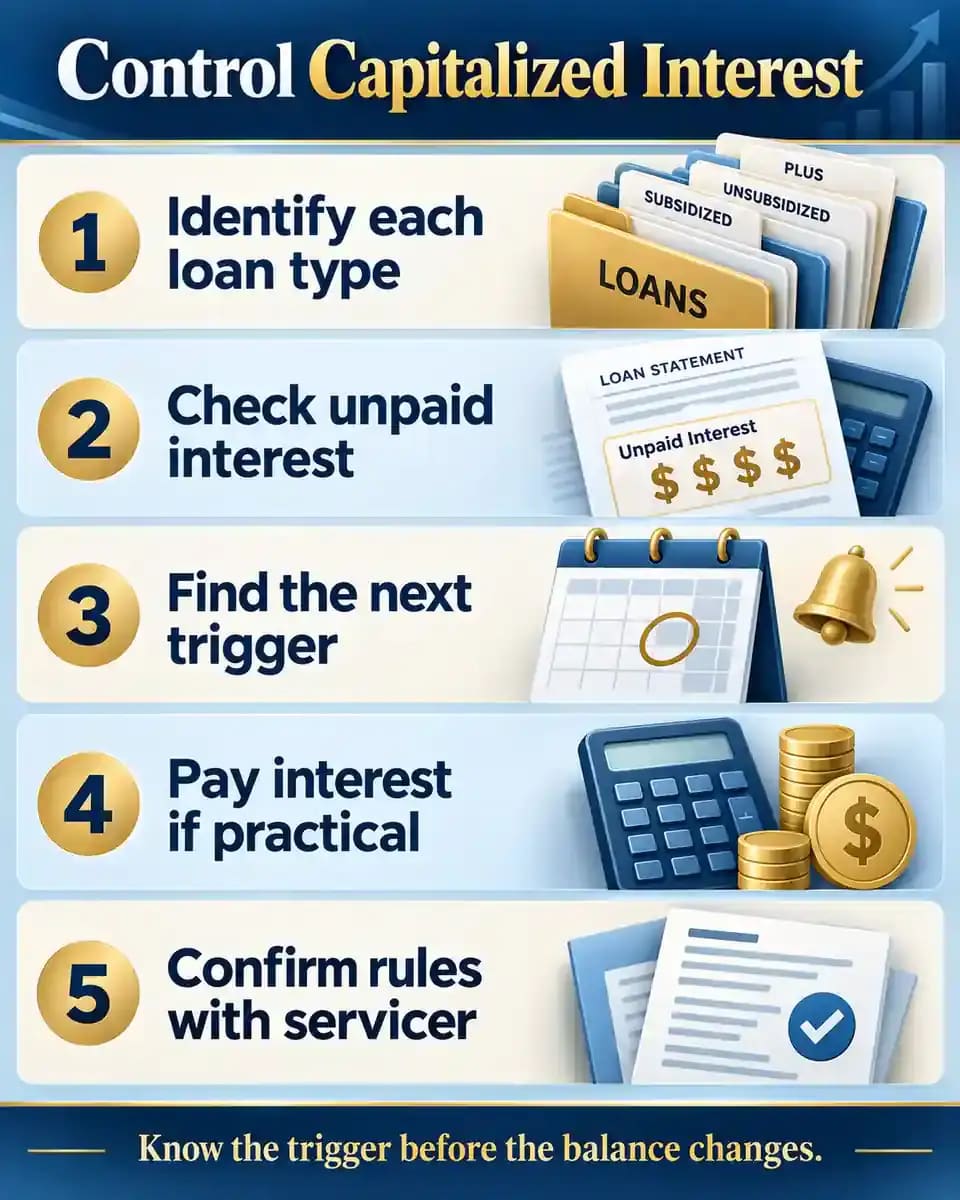
For federal Direct Subsidized Loans, the federal government generally pays interest during qualifying in-school periods and certain deferments. Direct Unsubsidized Loans generally accrue interest while you are in school, during grace periods, and during many payment pauses. Private loan rules vary by lender and contract. Identifying the exact loan type is therefore more useful than applying one blanket rule to every student loan.

Check How Your Payments Are Applied
When a payment is received, federal student loan servicing rules typically apply it first to outstanding interest and then to principal, after any applicable fees. Private lenders may have their own contractual payment rules. This order explains why a borrower can make a payment without seeing principal fall by the full payment amount. Review your servicer's payment allocation information if the movement in your balance looks unexpected.

Treat Grace Period Rules Carefully
Older explanations often say that all unpaid interest automatically capitalizes when a federal grace period ends. That is no longer a safe generalization for Direct Loans. Federal Student Aid currently explains that interest accruing during the grace period can be added to the outstanding balance without being capitalized into principal. Private loans and certain older federal loans may operate differently, so verify the rule for the exact loan you hold.

Watch Unsubsidized Loan Deferment
A key current capitalization trigger for federal Direct Unsubsidized Loans is the end of a qualifying deferment. Interest can continue to accrue during the deferment, and Federal Student Aid and the CFPB indicate that unpaid interest may capitalize when the deferment ends. Before the return to repayment, ask your servicer for the unpaid interest amount and the expected capitalization date.

Do Not Assume Forbearance Works the Same Way
Interest generally continues to accrue during federal student loan forbearance, including on subsidized loans. However, current Direct Loan rules removed several capitalization events that existed under older rules, and interest from a Direct Loan forbearance is not automatically capitalized merely because the forbearance ends. Older federal loans and private loans can differ. Ask your servicer what will happen before requesting or ending a forbearance.

Understand the IBR Capitalization Trigger
Income-Based Repayment, or IBR, has specific capitalization rules. CFPB guidance notes that unpaid interest on federal loans can capitalize if a borrower on IBR no longer qualifies to make payments based on income or leaves the IBR plan. Repayment programs have changed substantially over time, so do not assume a rule from another income-driven plan applies to IBR or vice versa.

Check Before Switching Repayment Plans
A repayment-plan change can alter payment amounts, forgiveness pathways, and treatment of unpaid interest. Before switching, ask the servicer whether the change will capitalize any accrued interest on your specific loans. Request the answer in writing or save the secure-message response. The right comparison is not only today's monthly payment but also the effect on principal, total interest, repayment term, and any forgiveness strategy you are pursuing.

Recognize Private Loan Differences
Private student loans are governed by the promissory note and lender policies rather than the same federal repayment framework. The CFPB notes that private loans may capitalize interest after events such as grace periods, deferment, or forbearance. Some private loans also have variable rates. Read the loan agreement and ask the lender exactly when accrued interest can be added to principal instead of assuming federal rules apply.

Find Your Next Transition Date
Capitalization is easiest to manage when you know the date before it happens. Review your account for the scheduled end of school status, grace period, deferment, forbearance, or repayment-plan transition. Then ask whether that event is a capitalization trigger for this particular loan. Put the date on your calendar several weeks early so you have time to verify the amount and consider a voluntary payment.

Request the Current Unpaid Interest Amount
Do not estimate blindly if the servicer can provide the actual figure. Ask for current principal, unpaid accrued interest, daily interest accrual, and the amount expected to capitalize at the next applicable event. Because interest accrues daily on many student loans, the number can change between the request and the event. A dated estimate is still much more useful than relying on the total balance alone.

Use the Daily Interest Formula
A simple-interest student loan commonly accrues interest using a daily rate. A rough calculation is principal multiplied by annual interest rate, divided by 365, then multiplied by the number of days. Servicers may use exact contractual methods and day counts, so treat your calculation as an estimate. The purpose is to understand scale and catch obvious discrepancies, not to replace the servicer's official payoff or interest figure.

Model a Capitalization Example
Imagine $20,000 of principal at 6 percent interest with $1,200 of unpaid interest. If that $1,200 capitalizes, principal becomes $21,200. At the same 6 percent rate, annualized interest on the new principal is about $1,272 rather than $1,200, before considering payments and daily timing. The extra cost begins small but can persist as long as the higher principal remains outstanding.

Understand Why Monthly Payments Can Change
Capitalization can affect the scheduled payment on plans that calculate payments from principal, interest rate, and remaining term. A larger principal may require a larger payment to amortize the debt over the same remaining period. On income-driven plans, the required payment can instead be based mainly on income and family size, so a higher principal may affect total cost more than the immediate monthly bill.

Distinguish Capitalization From Negative Amortization
Negative amortization occurs when required payments are not enough to cover all interest that accrues, causing unpaid interest to accumulate and the total amount owed to rise. Capitalization is different: it is the event that adds eligible unpaid interest to principal. A borrower can experience growing unpaid interest without an immediate capitalization event, so the account balance and principal balance should be reviewed separately.

Consider Voluntary Interest Payments
If payments are not required but interest is accruing, you may be allowed to make voluntary payments. Paying all accrued interest before a valid capitalization event can reduce or eliminate the amount that becomes principal. Paying only part of it can still reduce the capitalized amount. This is a cash-flow decision, not an automatic recommendation. Preserve money needed for essentials, required bills, and an appropriate emergency reserve.

Prioritize Required Payments First
Avoiding capitalization should not cause you to miss rent, utilities, insurance, taxes, minimum debt payments, or other essential obligations. An optional student loan interest payment can save future interest, but the benefit may be modest compared with the consequences of missing a required bill. Use capitalization prevention as one part of a broader budget rather than treating it as an emergency at any cost.

Compare the Cost of Paying Now Versus Later
If you have cash available, compare the amount of interest that may capitalize with the opportunity cost of using that cash. For example, paying $500 before capitalization prevents that $500 from entering principal, but it also reduces your cash by $500 today. The appropriate choice depends on liquidity, other debt, savings needs, and loan rules. Run the numbers without assuming that every optional prepayment is automatically best.

Keep Records of Servicer Answers
Student loan rules are complex, and servicing transfers can happen. Save statements, secure messages, payment confirmations, deferment approvals, and any explanation of expected capitalization. Note the date and representative when you call. Good records make it easier to reconcile a balance later and to document what you were told if you need to dispute servicing or submit a complaint.

Review the Account After a Status Change
After a deferment ends, a plan changes, or another major status transition occurs, log in and compare the new principal with your prior records. If principal increased, look for a transaction labeled capitalized interest or a similar account-history entry. Confirm that the amount matches the servicer's explanation. If something looks wrong, contact the servicer promptly rather than waiting for several statements.

Use Federal Student Aid for Federal Loans
For federal loans, StudentAid.gov is the authoritative starting point for loan types, repayment options, servicer information, and current Department of Education rules. USA.gov also directs borrowers to official federal student-loan resources. Because repayment programs can change through legislation, regulation, and litigation, use current official pages rather than relying solely on an old article, social-media post, or saved screenshot.

Use CFPB Guidance for Consumer Protections
The Consumer Financial Protection Bureau publishes plain-language explanations of student loan interest, capitalization, private loan issues, and servicing problems. Its guidance is especially useful when you need to understand terminology or prepare questions for a servicer. The CFPB also accepts complaints about student loan servicing. Use it as a consumer-protection resource, while relying on your loan documents and current program rules for loan-specific decisions.

Ask Five Specific Questions
When you contact the servicer, ask: What is my current principal? How much unpaid interest do I have? What event, if any, will next capitalize that interest? On what date is that expected? How much would I need to pay before that date to reduce or prevent capitalization? For federal loans, also ask the servicer to identify the legal or program rule supporting the answer.

Verify Subsidized and Unsubsidized Status
Borrowers with several federal loans can have a mix of subsidized and unsubsidized debt. That matters because interest treatment during school and deferment differs. Review each loan individually rather than treating a consolidated dashboard total as one homogeneous debt. If you are unsure, use StudentAid.gov or ask the servicer to identify the loan program and subsidy status for every loan in your account.

Recheck Rules Before Any Major Decision
Student loan policy has changed repeatedly, and a rule that was correct when you borrowed may not describe how a current Direct Loan is treated today. Before entering deferment, requesting forbearance, leaving IBR, consolidating, refinancing, or making a large optional payment, verify the current consequences. The most important question is not what usually happens, but what happens to your specific loan under current rules.

Know When to Escalate a Problem
If the servicer cannot explain a capitalization entry, gives conflicting answers, or applies a rule you believe is incorrect, request a written account history and written explanation. Federal borrowers can use Federal Student Aid complaint channels, and consumers can review CFPB complaint options. A nonprofit student loan counselor or attorney may be appropriate when the amount is substantial or the dispute involves legal rights.

Build a Simple Monitoring Routine
Once you understand your loans, review them at major transition points rather than obsessing over the balance every day. Keep a one-page list of loan type, principal, rate, unpaid interest, repayment plan, servicer, and next status date. That small system makes student loan interest capitalization predictable enough to plan for and helps you notice changes before they become expensive surprises.

Student loan balances do not always move the way borrowers expect. You can borrow one amount, make no new purchases, and still see the balance rise because interest continues to accrue. In some situations, unpaid interest is then added to the principal. That event is called student loan interest capitalization.
Capitalization matters because principal is the balance on which future interest is generally calculated. If unpaid interest becomes part of principal, future interest can accrue on a larger base. The Consumer Financial Protection Bureau describes capitalization as unpaid interest being added to principal, which can cause borrowers to pay interest on interest.
The exact rules depend on the loan. Federal Direct Loans, older federal loans, and private student loans do not always capitalize interest at the same events. Current federal rules also differ from older explanations that borrowers may still encounter online. For example, Federal Student Aid currently states that interest accruing during the grace period on Direct Loans may remain unpaid without being capitalized at the end of that grace period, while capitalization can still occur after deferment on an unsubsidized Direct Loan and in certain Income-Based Repayment situations. Private lenders may use different capitalization rules.
This guide explains the mechanics, shows why the timing matters, and gives you a practical process for checking your own loan records. It is educational information, not individualized financial, legal, or tax advice. Because student loan programs and regulations can change, verify current rules with your servicer, Federal Student Aid, the Consumer Financial Protection Bureau, and USA.gov before acting.
Where people go wrong
Assuming every unpaid interest dollar instantly compounds. Accrued interest can remain separate from principal. Compounding through capitalization occurs only when an applicable capitalization event adds eligible unpaid interest to principal.
Using old federal grace-period rules. Current Direct Loan treatment differs from many older explanations. Verify current Federal Student Aid guidance instead of assuming grace-period interest automatically capitalizes.
Treating federal and private loans as identical. Private loan contracts can use different capitalization triggers, interest rates, and repayment terms. Read the promissory note and lender disclosures.
Looking only at the total balance. The total amount owed can combine principal and unpaid interest. Track both figures separately so you can see whether principal actually increased.
Changing plans without checking interest treatment. A repayment-plan change can have consequences beyond the monthly payment. Ask whether accrued interest will capitalize and how the change affects repayment.
Draining savings just to prevent capitalization. Avoiding some future interest may not justify sacrificing essential cash reserves or missing higher-priority obligations. Compare the benefit with your broader finances.
Failing to save servicer documentation. Without statements, secure messages, and payment confirmations, it is harder to reconstruct what happened after a servicing transfer or disputed balance change.
Questions people ask
It is the process of adding eligible unpaid accrued interest to the loan's principal balance. After capitalization, future interest can accrue on the higher principal, which can increase the loan's total cost.
Fixed it?
Get one guide like this every Thursday.