Store Credit Card Deferred Interest: How It Works and How to Avoid Surprise Charges
Store credit card deferred interest can turn a no-interest promotion into an expensive purchase. Learn how retroactive interest works, how it differs from 0% APR, and how to pay off your balance before the deadline.

What you’ll need
Tap to tick things off before you start.
Understand What Deferred Interest Means
Deferred interest is a financing arrangement in which interest can accrue during a promotional period but is not charged if the qualifying balance is paid in full by the specified deadline.
The distinction is important: the promotion conditionally waives accrued interest rather than guaranteeing a zero interest rate throughout the period.
If you satisfy the promotional requirements, those deferred charges are generally waived. If you do not, the issuer may add the accumulated interest to your account under the agreement. This creates a significant difference between the advertised payment experience and the potential total cost.

Recognize Where These Promotions Appear
Deferred interest financing frequently appears with furniture, mattresses, appliances, electronics, and other expensive purchases. Similar arrangements may also be offered for certain healthcare or home improvement expenses.
Retailers promote these offers because smaller monthly payments can make larger purchases appear more accessible. However, approval for financing does not establish that the purchase fits your budget.
Before agreeing, distinguish the selling price from the total potential financing cost. Ask whether the promotion involves deferred interest, a genuine introductory 0% APR, or a different installment arrangement. These products do not necessarily operate under identical terms.

Look for the Conditional Language
The phrase no interest if paid in full is a major indicator of deferred interest financing.
Compare that wording with 0% introductory APR for 12 months. The statements may sound similar, but the word if introduces a requirement that can expose the customer to past accrued interest.
The CFPB specifically highlights this distinction in its guidance on special promotional financing offers.
Do not rely only on a countertop advertisement or a salesperson's explanation. The actual card agreement and promotional disclosure determine the applicable conditions.

Learn When Interest Begins Accumulating
Under a typical deferred interest arrangement, interest starts accruing from the original transaction date, even though those charges are not immediately posted as payable interest during the promotion.
The issuer tracks the amounts according to its agreement. If the promotion's payoff condition is satisfied, qualifying accrued interest is waived.
If the condition fails, the accumulated amount can become payable. Think of deferred interest as a conditional liability that disappears only when the required payoff is completed. It is not automatically equivalent to borrowing at a zero interest rate.

Understand Why a Small Balance Matters
Suppose you finance a $1,500 sofa and pay the balance down to $5 before the promotion expires. Under typical deferred interest terms, that remaining $5 can trigger accumulated interest from the promotional period.
The charge is not necessarily interest calculated on $5 alone. It reflects interest that accrued on the qualifying balance over time.
The precise amount depends on how the balance declined, the applicable rate, and the issuer's calculation method. Paying almost everything is therefore not the same as satisfying a paid-in-full requirement.

Understand How Retroactive Interest Is Calculated
Deferred interest is typically calculated using the outstanding qualifying balance over the promotional period, not by charging the regular APR once against the original purchase amount.
For example, if your financed balance declines steadily through monthly payments, interest calculations generally reflect those changing balances under the card's methodology.
This distinction prevents a common misunderstanding: triggering deferred interest does not necessarily mean paying a full year's interest on the entire original balance as though no payments occurred. Nevertheless, accumulated charges can still be substantial, especially when balances remain high for much of the promotion.

Treat the Expiration Date as a Firm Deadline
Deferred interest promotions generally require complete payment of the qualifying balance by a specific expiration date. That date might not match the regular monthly payment due date.
A payment submitted at the last moment might also encounter processing delays, funding problems, or an unexpected account issue.
The safer operational approach is to finish repayment early rather than planning to pay on the final day. Verify the expiration date in the issuer's account information and ask the issuer to clarify any ambiguity before relying on it.

Understand the Conditional Nature of the Offer
A deferred interest promotion is governed by financial terms rather than an informal promise made at checkout.
The CFPB explains that consumers must understand the conditions attached to a promotional interest arrangement, including when deferred charges may be imposed.
Consider the promotion a conditional financing contract. Confirm what happens if you miss the payoff deadline, pay late, return the merchandise, or dispute a transaction.
Never assume that an issuer will automatically waive a charge because the remaining balance is small. An issuer may provide assistance or adjustments, but such relief is not guaranteed.

Separate Deferred Interest From True 0% APR
Both financing arrangements can produce zero interest charges during an introductory period if their conditions are met. Their treatment of unpaid balances is the major difference.
With true 0% introductory APR, qualifying purchases generally accrue no interest during the promotional period. When the rate expires, the regular APR applies prospectively to the remaining balance.
With deferred interest, an unpaid qualifying balance at expiration may trigger interest accumulated from the original transaction date.
When comparing offers, identify the applicable promotional APR and determine whether past interest can be added after expiration.

Examine the Mechanics of a Genuine 0% APR Offer
A genuine introductory 0% APR arrangement temporarily sets the applicable annual percentage rate to zero for qualifying balances.
Suppose a borrower carries $600 throughout part of a 0% introductory period. No purchase interest accrues on that qualifying balance while the zero rate remains effective.
If $100 remains when the introductory period ends, interest generally starts accruing on the remaining balance at the applicable post-promotion rate, subject to the agreement.
Other costs, including annual fees, balance transfer fees, or nonqualifying transaction interest, may still apply. A 0% APR does not automatically mean every account activity is free.

See What Happens When a 0% APR Period Ends
Consider a $1,200 purchase with a 12-month introductory 0% APR. You pay $1,150 before the introductory period expires, leaving $50 outstanding.
Assuming the offer remains valid, the issuer does not retroactively charge promotional-period purchase interest. Instead, the post-promotion APR generally begins applying to the remaining $50 from the relevant date.
The exact interest amount depends on the APR, balance changes, and calculation method.
This prospective treatment generally makes the financial consequences of a small remaining balance much easier to anticipate than under deferred interest financing.

See What Happens When Deferred Interest Expires
Now consider the same $1,200 purchase under a 12-month deferred interest agreement. You also pay $1,150, leaving $50 at expiration.
If the agreement's payoff requirement is not met, the issuer may add accumulated interest from the original purchase date. That can be considerably more expensive than applying interest prospectively to $50.
Even when borrowers follow similar payment schedules, the two promotional structures can create different costs.
This is why the phrase attached to an advertised interest offer matters more than the size of the promotional number displayed in the store.

Compare a Realistic $400 Financing Example
The CFPB illustrates this distinction using a $400 television purchase, 12 months of financing, and payments of $25 per month.
After 12 payments, $300 has been repaid and $100 of principal remains.
In the CFPB's simplified comparison, a true 0% APR promotion produces no accumulated promotional interest. A deferred interest promotion with a 25% rate produces approximately $65 in accumulated interest.
The $65 figure is specific to that illustration and should not be treated as a universal formula. Actual charges depend on transaction dates, balances, compounding rules, and card terms.

Evaluate the Total Cost Before Financing
Interest is only one factor in a financing decision. The total cost can also include annual fees, late fees, lost discounts, and charges that apply to transactions outside the promotion.
Compare the financed purchase price with the retailer's cash price and any alternative financing options.
Ask whether the promotion encourages you to buy a more expensive product than originally planned.
A genuinely interest-free outcome is useful only when the underlying purchase is affordable. Saving interest on an unnecessary purchase does not make that purchase financially beneficial.

Understand the Difference Between Minimum and Payoff Payments
A minimum payment is the amount generally required to keep the account current under its billing terms. It is not necessarily designed to eliminate a deferred interest balance before expiration.
Minimums often represent a relatively small portion of the outstanding balance, subject to issuer-specific formulas and minimum dollar amounts.
The payment needed to meet a promotional deadline can therefore be substantially higher.
Treat minimum payment compliance and promotional payoff as two separate responsibilities. Meeting one requirement does not guarantee that you have met the other.

Avoid Relying on the Statement Minimum
Suppose a $1,800 purchase carries a 12-month deferred interest promotion. A hypothetical $45 monthly minimum would produce only $540 in payments over 12 months, assuming the minimum stayed unchanged.
That leaves $1,260 of principal unpaid, before considering any other transactions or applicable charges.
The problem is not that you failed to make payments. The problem is that those payments did not satisfy the promotion's full repayment condition.
Always calculate the amount needed to eliminate the promotional purchase balance independently from the minimum payment displayed on your statement.

Calculate a Monthly Payment That Clears the Balance
A basic payoff calculation is straightforward:
Promotional balance divided by the number of planned monthly payments = target monthly payment.
For a $1,800 balance paid over 12 equal installments, that produces $150 per month.
However, a safer approach is to build in a buffer. If you plan to pay the same balance over 10 months, the monthly target becomes $180.
This assumes no additional qualifying charges, fees, or payment allocation complications. Confirm the target with your account's actual promotional balance rather than relying only on the original receipt.

Respect Every Monthly Payment Due Date
Even if you intend to clear the balance early, you generally must continue making required monthly payments on time.
Missing a payment can lead to late fees, credit reporting consequences, and complications with promotional terms. Specific consequences depend on the agreement and applicable law.
Use reminders several days before each due date. If the due date does not match your paycheck schedule, ask whether the issuer permits a date change.
A promotional payoff plan must account for both the recurring billing schedule and the final promotion expiration deadline.

Understand the Risk of Being More Than 60 Days Late
Federal credit card rules generally restrict when an issuer may increase rates on existing balances. One important exception can involve payments that become more than 60 days late.
Certain promotional arrangements may also be terminated under their disclosed terms when serious delinquency occurs, potentially creating additional interest consequences.
However, do not assume that every deferred interest promotion automatically ends after exactly 60 days, or that shorter delays have no consequences.
Read the specific provisions addressing late payments, promotional eligibility, penalty rates, and reinstatement rights. Avoiding delinquency entirely is more reliable than trying to interpret the last permissible day.

Know What Can Happen After a Payment Default
If a promotional arrangement terminates early under applicable terms, previously deferred interest may become payable, and standard account interest rules may apply.
The issuer may also charge applicable late fees or restrict the account. Credit reporting consequences depend on the delinquency and reporting practices.
If a payment is missed, contact the issuer promptly. Ask whether the promotion remains active, what amount is required to protect it, and whether any hardship assistance is available.
Do not assume a late payment automatically destroys every promotional benefit, but do not assume the offer remains unchanged either.

Identify the Consumer Protections That Apply
U.S. credit cards are subject to federal consumer protection rules, including requirements concerning disclosures, billing practices, and payment allocation.
These protections do not eliminate deferred interest arrangements, but they can affect how issuers administer them.
The CFPB provides educational resources and a consumer complaint process for problems with financial institutions.
Whether a particular rule applies may depend on the product, agreement, transaction, and circumstances. An in-store installment loan, private-label credit card, and general-purpose credit card should not automatically be treated as legally identical.

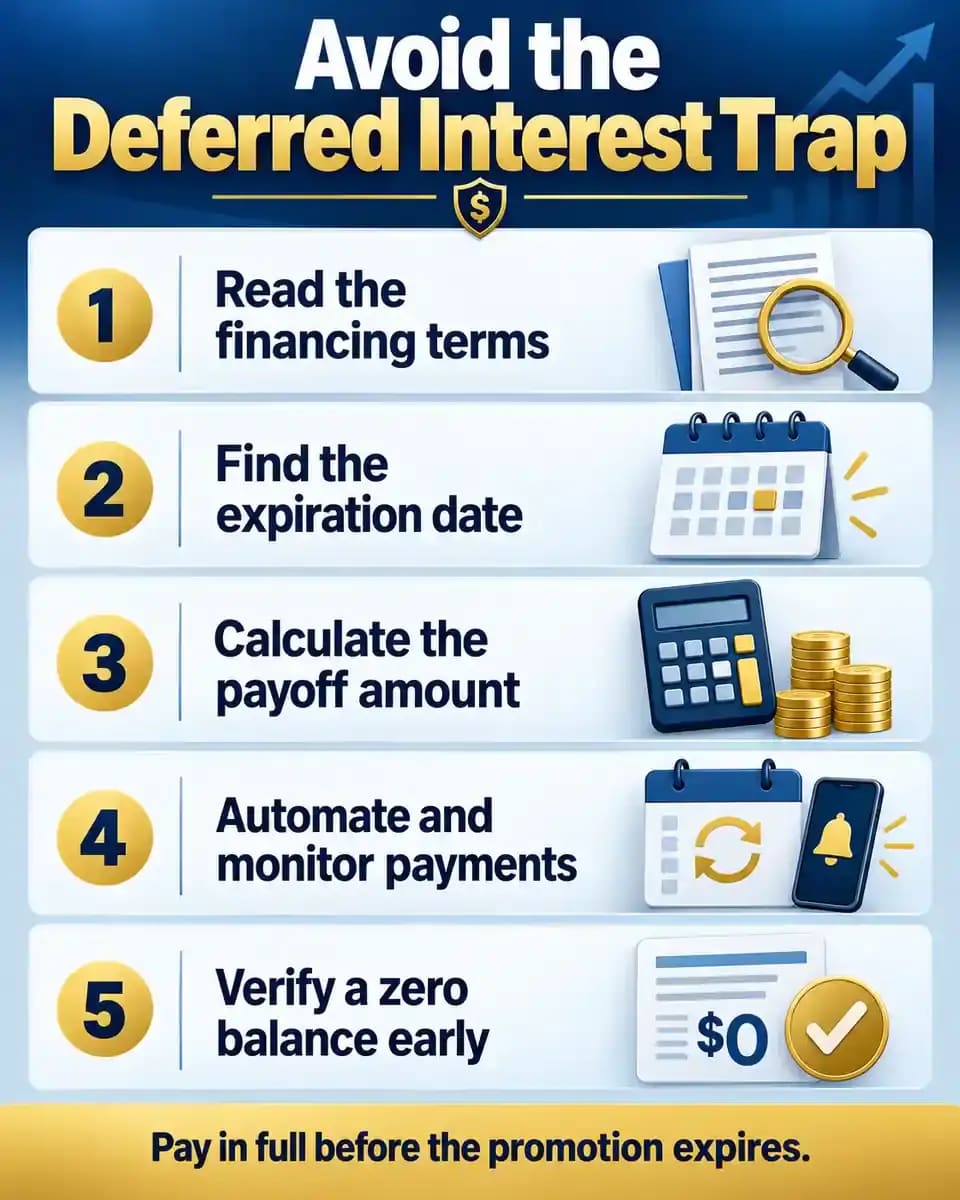
Read the Financing Terms Before Accepting
Before opening a store card, identify the promotional expiration date, purchase APR, regular APR, minimum payment method, fees, and conditions that could end the promotion.
Check whether the promotion applies only to one purchase or to multiple qualifying purchases. Determine whether balance transfers, cash advances, and later purchases receive different treatment.
Also review any annual fee and the issuer's payment allocation provisions.
If information is unclear, request the written disclosure and ask questions before completing the application. A favorable headline is never a substitute for understanding the account terms.

Pay Attention to the Regular APR
The regular APR matters because deferred interest is commonly calculated using the rate specified for the promotion, which can be relatively high.
For perspective, a 30% APR is equivalent to a simple annual rate of 30 cents per borrowed dollar before accounting for changing balances and the issuer's calculation method.
That is not a forecast of the amount charged on a particular deferred interest purchase.
Compare the disclosed APR with other financing options rather than assuming store credit is inexpensive because the initial advertisement emphasizes no interest.

Use Reliable Sources When Comparing Offers
Financial terminology can be confusing, especially when retailers use similar advertisements for different types of financing.
The CFPB's article, How to Understand Special Promotional Financing Offers on Credit Cards, offers an accessible comparison of true zero interest and deferred interest.
Use government educational resources to understand general rules, then review the actual issuer's disclosures to determine the conditions of your account.
An older educational example can remain helpful, but current agreements and applicable law control the treatment of an individual account.

Keep a Copy of Your Financing Agreement
Save the original promotional disclosure, account agreement, purchase receipt, and any confirmation identifying the promotional balance.
Electronic copies are convenient, but make sure they remain accessible if your account closes or a retailer changes its website.
These records can help resolve disagreements about the expiration date, applicable APR, or whether a payment was properly credited.
If you believe a charge is incorrect, contact the issuer promptly and review the card's billing error procedures. Applicable dispute rights may require written notice within specified time limits, so do not rely solely on an informal telephone conversation.

Build a Repayment Plan Before the Purchase
The best time to calculate affordability is before accepting promotional financing.
Start with the purchase amount, identify the available repayment months, and determine a monthly target that clears the balance early.
Then compare that amount with your actual household cash flow after housing, food, utilities, transportation, insurance, and other obligations.
If the payment requires unrealistic spending cuts or leaves no room for normal emergencies, the promotion may not be appropriate for your circumstances.
A shorter repayment plan is useful only if its required payments are sustainable.

Record the Exact Promotional Expiration Date
After the transaction, locate the promotional expiration date in your account or financing agreement. Do not confuse it with the next statement due date.
Add calendar reminders approximately 60 days, 30 days, and 14 days before expiration.
These reminders create opportunities to check progress and correct problems before the deadline becomes urgent.
If the issuer provides an expiration date that differs from your original paperwork, request clarification and preserve the response. Record the deadline accurately rather than estimating it by counting months from the shopping date.

Automate Payments and Add a Safety Buffer
Automatic payments can help make a promotional repayment schedule more consistent, provided sufficient funds remain available.
For example, a $2,400 promotional balance divided across 10 payments requires $240 per month, while spreading it across 12 months requires $200. The shorter schedule creates more room before a 12-month expiration.
Confirm that the automatic payment amount exceeds the minimum when necessary and is being directed to the intended balance.
Review the first processed payment rather than assuming setup was successful. Continue checking account balances even after automation is active.

Check Every Statement and Payment Allocation
A payment may not always reduce the deferred interest balance exactly as expected, especially if the card carries balances with different APRs.
Under federal rules, amounts paid above the minimum generally go toward the balance with the highest APR. Special rules ordinarily direct excess payments toward an expiring deferred interest balance during the two billing cycles immediately preceding expiration, subject to applicable exceptions.
The minimum payment itself may be allocated differently.
Check each statement for remaining promotional principal, payment application, fees, and expiration information. Contact the issuer if your repayment progress does not match your expectations.

Avoid Extra Purchases and Verify the Final Payoff
Additional purchases can create separate balances, potentially different APRs, and more complicated payment allocation. They can also affect grace-period treatment and interest on purchases outside the promotion.
Where practical, avoid using the same card for new spending until the deferred interest balance is eliminated.
Before expiration, confirm the exact amount needed to satisfy the promotion. Make the final payment early enough to allow processing, then verify that the promotional balance is zero.
Save the confirmation and review the next statement for unexpected charges. If a problem appears, contact the issuer without delay.
The objective is not simply to make regular payments. It is to satisfy the promotion's specific full-payment condition before it expires.

A new refrigerator costs $1,800. At checkout, the salesperson offers 12 months with no interest if you use the store's credit card. You could take the appliance home today and spread the payments across the year. It sounds like a reasonable way to manage a major expense.
But there is a condition that changes everything: You must pay the promotional balance in full before the offer expires.
With a store credit card deferred interest promotion, interest may accumulate in the background from the purchase date. If the qualifying balance is not paid off by the deadline, the issuer can add those previously deferred charges to your account. Even a small remaining balance can trigger a surprisingly large bill.
This is fundamentally different from a true 0% introductory annual percentage rate, or APR, promotion. Under a genuine 0% APR offer, interest does not accumulate during the introductory period. Once that period ends, the regular rate generally applies to the remaining balance going forward.
The Consumer Financial Protection Bureau (CFPB) explains this distinction and warns that deferred interest offers can be difficult for consumers to evaluate.
This guide explains the mechanics of deferred interest, compares realistic financing outcomes, identifies payment mistakes, and provides a practical 30-part process for evaluating and managing retail credit offers.
The examples are educational illustrations, not predictions of charges on a particular account. Actual results depend on the issuer's agreement, APR, payment allocation rules, billing dates, and other applicable terms.
Where people go wrong
Assuming Every No-Interest Offer Is the Same. Deferred interest and true introductory 0% APR offers handle unpaid balances differently. Check whether the agreement includes a paid-in-full condition and permits previously accrued interest to become payable.
Paying Only the Minimum. A required minimum payment may keep the account current without eliminating the promotional balance. Calculate a separate monthly payoff target based on the actual deadline.
Confusing the Due Date With the Expiration Date. The regular payment due date may fall after the promotion expires. Track both dates independently and complete the promotional payoff early.
Leaving a Tiny Balance Unpaid. Under typical deferred interest agreements, even a small unpaid qualifying balance can trigger accumulated interest. Verify the promotional balance has reached zero.
Making Extra Purchases on the Same Card. New purchases can complicate payment allocation and may carry different interest terms. Keeping promotional financing separate can make repayment easier to manage.
Ignoring the Regular APR. The underlying APR helps determine the potential cost of deferred interest. Compare disclosed rates and evaluate the downside before accepting financing.
Assuming Autopay Guarantees Success. Autopay can fail because of insufficient funds, setup errors, or an inadequate payment amount. Verify the amount, successful processing, and remaining balance.
Waiting Until the Last Day. Last-minute payments leave little room for technical errors or processing delays. Build a repayment buffer and check the account before expiration.
Questions people ask
Store credit card deferred interest is a financing arrangement in which interest may accrue during a promotional period but is waived if the qualifying balance is paid in full before the specified deadline. If the full-payment condition is not met, accumulated interest may become payable.
Fixed it?
Get one guide like this every Thursday.