Robo-Advisors vs. Target Date Funds: Which Automated Investing Strategy Is Right for You?
Robo-advisors and target date funds both simplify investing, but their fees, customization, and portfolio management differ. Learn how each works, what risks to consider, and how to compare them for retirement.

What you’ll need
Tap to tick things off before you start.
Why Automated Investing Deserves a Closer Look
Automated investing makes long-term portfolio management more accessible to people who lack the time, expertise, or interest to manage investments themselves. Two popular approaches are robo-advisors and target date funds. Both simplify investment decisions, but they operate differently and offer distinct levels of flexibility. Choosing between robo-advisors vs target date funds requires understanding what each approach actually delivers. Convenience alone does not establish suitability, especially when investment decisions can affect financial outcomes over several decades.

What You Need to Compare Before Investing
A meaningful comparison begins with five essential criteria: portfolio structure, personalization, expenses, risk characteristics, and investment timeline. Portfolio structure determines how assets are organized, while personalization reflects how closely investment decisions match individual circumstances. Fees influence the amount of returns investors retain, and risk characteristics reveal potential exposure to market declines. Finally, the investment timeline shapes expectations for portfolio behavior. Evaluating these dimensions consistently helps prevent superficial comparisons based only on convenience or advertised features.

Why Your Financial Goals Matter
Investment goals provide the foundation for determining whether an automated strategy is appropriate. Saving for retirement, building long-term wealth, and funding a major future expense can involve substantially different financial requirements. Risk tolerance describes the uncertainty an investor feels comfortable accepting, while risk capacity reflects their financial ability to withstand losses. These characteristics are not necessarily identical. Investor.gov emphasizes the importance of matching investments to financial objectives and personal circumstances rather than assuming one strategy suits everyone.

How Automated Investment Management Works
Automated investment management relies on several interconnected processes. Asset allocation determines how money is distributed among investments such as stocks and bonds. Diversification spreads exposure across holdings to reduce dependence on any single investment, although it cannot eliminate losses. Portfolio monitoring identifies changes in investment values and allocation percentages. Rebalancing then restores an intended allocation by adjusting holdings. These functions can operate through predefined fund rules or digital advisory systems, with implementation varying across providers and investment products.

The Investment Risks Automation Cannot Remove
Automation cannot protect investors from broad market declines or guarantee positive investment returns. Stock prices fluctuate, bond values respond to interest rates and other conditions, and diversified portfolios can still lose substantial value. Investors may receive less than their original investment when selling holdings. Automated adjustments manage portfolio exposure according to established rules, not perfect forecasts of future markets. As Investor.gov explains, target date funds involve investment risk, and automated advisory services do not eliminate the underlying risks of their holdings.

Start With Your Investment Timeline
The length of time before invested money is needed influences how much uncertainty a portfolio can reasonably accommodate. Retirement investing often spans decades, potentially allowing recovery periods after market downturns. Money intended for a nearer expense may face greater consequences from losses shortly before withdrawal. Retirement itself also represents a transition rather than necessarily the end of investing. Distinguishing the accumulation period from eventual withdrawals helps clarify why investment horizons matter beyond simply choosing a distant calendar year.

Why Choosing Investments Can Feel Complicated
Beginning investors encounter unfamiliar decisions about investment categories, portfolio proportions, and maintenance requirements. Stocks represent ownership interests in companies, while bonds generally represent debt obligations with different income and risk characteristics. Selecting an appropriate combination requires understanding how these assets behave under changing economic conditions. Investors must also consider which holdings provide meaningful diversification and when portfolio adjustments become necessary. The challenge is not merely selecting investments initially, but maintaining a coherent strategy despite changing markets and competing financial information.

What Automation Actually Takes Off Your Plate
Automated investment solutions can reduce the recurring administrative work associated with maintaining a portfolio. Depending on the product or service, they may execute investment purchases, track allocation drift, rebalance holdings, and implement scheduled changes to investment exposure. Some platforms also support recurring contributions or other account-level functions. These capabilities can encourage consistent implementation without requiring investors to review every market movement. However, automation does not replace the responsibility to review account information, update relevant circumstances, or understand the strategy being used.

One Investment Product or an Ongoing Service?
The fundamental distinction is between purchasing a pooled investment product and engaging a portfolio management service. A target date fund combines investors' money within one fund governed by a shared investment strategy. A robo-advisor generally provides digital advisory management for an individual account holding a selection of investments. Investor.gov describes robo-advisers as automated investment advisory programs, while FINRA explains target date funds as diversified products built around specified dates. This structural difference affects account ownership, management arrangements, and available customization.

How to Judge an Automated Investing Approach
A practical evaluation framework considers affordability, suitability, transparency, and required involvement. Affordability includes recurring expenses, possible account charges, and minimum investment requirements. Suitability concerns whether the investment approach matches stated objectives and financial constraints. Transparency means understanding the underlying holdings, management rules, and circumstances that trigger changes. Required involvement measures how much ongoing attention or decision-making remains necessary. Comparing official disclosures using these consistent questions creates a stronger basis for evaluating alternatives than relying on marketing claims or convenience alone.

What Is a Target Date Fund?
A target date fund is an investment product designed to simplify long-term portfolio management. Usually structured as a mutual fund, it typically holds several underlying funds representing stocks, bonds, and sometimes other asset classes. This fund-of-funds approach provides diversification through a single investment. According to Investor.gov, target date funds combine multiple investments into one professionally managed portfolio. However, diversification does not eliminate market risk, and the underlying investments determine the fund's actual exposure to potential gains and losses.

How Target Date Fund Allocations Change
Target date funds periodically adjust the proportions of stocks, bonds, and cash-related investments within their portfolios. When retirement remains distant, stocks commonly represent a substantial share. As the target year approaches, the fund generally reduces its equity allocation while increasing fixed-income holdings. These adjustments follow an established investment strategy rather than requiring individual investors to initiate trades. FINRA explains that allocation patterns vary among providers, meaning funds with identical target years can maintain significantly different investment mixes at any given time.

What the Retirement Year in a Fund Name Means
The year appearing in a target date fund's name generally represents an anticipated retirement date. For example, a 2050 fund is typically designed for investors expecting to retire around 2050, not necessarily on a particular day. That number serves as a planning reference rather than a guarantee of suitability. Investor.gov emphasizes that funds sharing the same target year may use different investment strategies. Retirement spending needs, existing savings, and risk tolerance cannot be determined from a calendar year alone.

Understanding a Target Date Fund's Glide Path
A glide path is the predetermined schedule governing how a target date fund's asset allocation evolves throughout its investment lifecycle. Rather than selecting a new strategy each year, the fund follows an established framework specifying its intended exposure to different asset classes at different stages. The schedule generally describes long-term allocation targets, although actual holdings can fluctuate with markets and portfolio management decisions. FINRA notes that examining a fund's glide path helps explain its investment strategy beyond its target year.

Why Target Date Funds Generally Become More Conservative
As retirement approaches, many target date funds place greater emphasis on investments traditionally considered less volatile than stocks. Bonds can provide interest income and may experience smaller price movements than equities, while cash equivalents generally prioritize liquidity and capital stability. However, conservative does not mean risk-free. Bond prices can fall when interest rates rise, issuers can default, and inflation can erode purchasing power. Cash holdings also face inflation risk, so a more defensive allocation cannot guarantee preservation of wealth.

Growth Potential Early and Risk Management Later
During the accumulation phase, investors often have decades before they expect to withdraw retirement savings. Greater stock exposure can provide opportunities for long-term capital appreciation, although substantial market declines remain possible. Closer to retirement, the investment horizon before initial withdrawals becomes shorter, increasing concern about recovering from losses. Target date strategies attempt to balance these competing priorities by emphasizing growth earlier and reducing equity exposure later. The objective is risk management across life stages, not the elimination of investment uncertainty.

To Retirement vs. Through Retirement
Target date funds generally follow one of two broad approaches to their retirement transition: to retirement or through retirement. The distinction concerns when the portfolio completes its planned shift toward its most conservative allocation. Some strategies reach that endpoint around the designated retirement year, while others continue evolving afterward. Investor.gov and FINRA identify this difference as an important consideration when evaluating target date funds. The label matters because retirement is a milestone, not necessarily the end of an investor's investment horizon.

How a To Retirement Glide Path Works
A to retirement glide path is designed to reach its final intended asset allocation at or near the fund's target retirement year. After that point, its strategic allocation generally remains relatively stable rather than continuing to become progressively more conservative. Portfolio managers may still rebalance holdings to maintain the established proportions. This structure creates a defined endpoint for scheduled allocation changes, but it does not freeze investment values. Stock and bond prices can continue fluctuating throughout retirement, even when allocation targets remain unchanged.

How a Through Retirement Glide Path Works
A through retirement glide path continues its planned allocation adjustments beyond the fund's named retirement year. A portfolio might retain meaningful stock exposure at retirement, then gradually reduce that exposure over another decade or longer. This approach recognizes that retirement savings may need to support withdrawals across an extended period. The exact duration and final allocation depend on the fund provider's methodology. Investors can examine fund disclosures to determine how long changes continue and what portfolio composition the strategy ultimately targets.

Why Glide Paths Affect Retirement Risk
Different glide paths can produce significantly different stock and bond exposures during retirement, influencing both portfolio volatility and potential long-term growth. Higher equity allocations may support purchasing power over decades but can magnify losses when withdrawals coincide with market declines, a concern known as sequence-of-returns risk. More defensive allocations may limit volatility while increasing exposure to inflation and longevity risks. Comparing allocation schedules, withdrawal horizons, and underlying holdings provides a clearer picture of retirement risk than comparing target years alone.

What Is a Robo-Advisor?
A robo-advisor is a digital investment advisory service that uses software to recommend and manage an investment portfolio. Rather than purchasing a single investment product, customers typically open an account through which the service manages holdings on their behalf. These holdings may include multiple investment funds representing different asset classes. Some providers also offer access to human advisors. As Investor.gov explains in its Robo-Adviser resource, automated investment services differ in their features, investment approaches, and levels of human involvement.

What a Robo-Advisor Asks About Your Finances
Before recommending investments, robo-advisors generally ask customers to complete an online financial questionnaire. Questions may cover investment goals, expected withdrawal dates, income, existing assets, and willingness to accept market losses. Some also examine investment experience, liquidity needs, and financial obligations. Responses help the software estimate an appropriate investment profile. However, questionnaires depend heavily on accurate self-reported information. Incomplete answers, misunderstood questions, or outdated financial details can produce recommendations that fail to reflect an investor's actual circumstances.

How Robo-Advisors Build and Maintain Portfolios
After assessing an investor's profile, a robo-advisor typically selects investments from a predefined collection of diversified portfolios. Many services use exchange-traded funds, or ETFs, to obtain exposure to domestic stocks, international stocks, bonds, and other asset classes. Portfolio construction follows allocation models intended to balance investment risk and growth potential. Once invested, the platform monitors holdings and implements its management rules. Investors should examine which assets are included, how often portfolios are reviewed, and whether the investment methodology can change.

How Automatic Rebalancing Works
Imagine a portfolio worth $10,000 with a target allocation of 60% stocks and 40% bonds. After market movements, suppose its value remains $10,000, but stocks represent $7,000 and bonds $3,000. The allocation has drifted to 70% stocks and 30% bonds. Rebalancing could involve selling $1,000 in stocks and purchasing $1,000 in bonds, restoring the original proportions. Actual robo-advisors may rebalance according to thresholds, schedules, or available cash flows. Trading can create transaction costs or taxable events.

Account Minimums and Access to Investment Management
Robo-advisors can make managed investment accounts accessible to people who cannot meet the minimum balances required by some traditional advisory firms. Certain platforms allow accounts with relatively small deposits, while others establish higher minimums for particular services or account types. Advisory charges, subscription fees, and available features also vary. A low opening requirement does not necessarily mean inexpensive ongoing management. Compare minimum initial deposits, recurring contribution requirements, account restrictions, and service availability before evaluating whether a platform is financially accessible.

How Personalized Are Robo-Advisor Portfolios?
Two investors approaching retirement at the same age might receive different robo-advisor portfolios. One may prioritize stability because of limited financial reserves, while another may accept greater volatility because of substantial outside investments. The software can translate these differences into distinct allocations. However, personalization usually operates within a provider's predefined investment models. Complex compensation arrangements, concentrated stock positions, unusual withdrawal needs, or changing family circumstances may exceed what standardized algorithms adequately address. Investors should understand the boundaries of automated personalization.

Robo-Advisors vs. Target Date Funds Side by Side
In the robo-advisors vs target date funds comparison, structure creates the central distinction. A target date fund packages investments into one product and adjusts allocations according to its established glide path. A robo-advisor manages an account using portfolio models informed by customer information. Fund investors select and monitor a product, while advisory clients generally receive account-level management. Both disclose holdings and investment policies, although reporting detail varies. Robo-advisors offer more configuration, whereas target date funds provide a standardized approach with fewer ongoing decisions.

When Simplicity Is a Valuable Feature
A target date fund can reduce the number of investment decisions required to maintain a retirement portfolio. Investors generally select an appropriate target year, purchase one fund, and receive an internally managed mix of investments. This arrangement may also simplify recurring contributions and portfolio oversight. However, convenience introduces trade-offs. Investors cannot independently adjust individual asset weights inside the fund, and the chosen year does not establish suitability. Reviewing the fund's objectives, holdings, and investment policies remains important despite its streamlined structure.

When Additional Customization May Matter
Greater portfolio flexibility may be useful when an investor has several objectives requiring different timelines. Retirement savings, a future home purchase, and other long-term goals may involve distinct risk capacities. Existing employer stock, retirement accounts, or substantial bond holdings can also affect the desired overall allocation. Some robo-advisors support separate goal portfolios, adjustable risk settings, or coordinated investment strategies. Others provide only limited choices. Their usefulness depends on whether these features address genuine planning needs rather than simply introducing unnecessary complexity.

How to Compare Total Costs and Make an Informed Choice
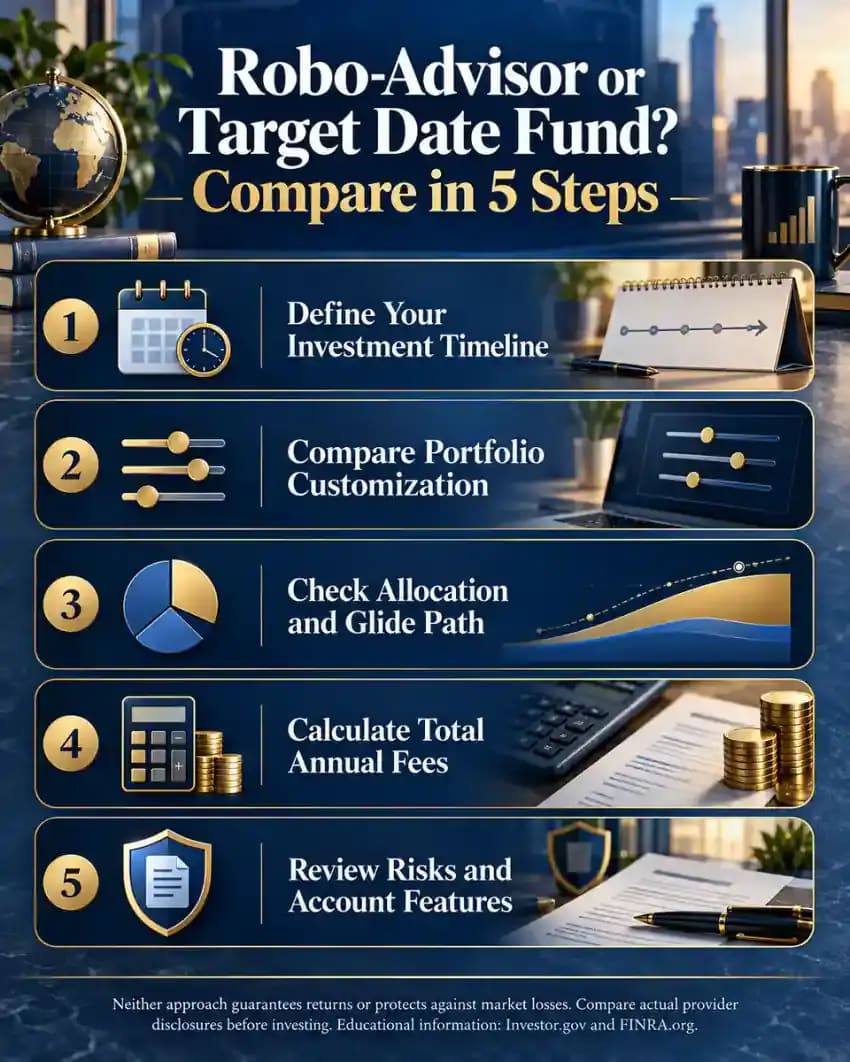
On $20,000, a hypothetical 0.15% target date fund expense ratio costs $30 annually; a robo-advisor charging 0.25% plus 0.10% in fund expenses costs $70. Compare total fees, account minimums, customization, withdrawal needs, and taxable-account implications. Check whether retirement glide paths stop changing at retirement or continue afterward. Investor.gov's Robo-Adviser and Target Date Funds resources, alongside FINRA's Save the Date: Target-Date Funds Explained, explain important considerations. Neither approach guarantees returns or prevents investment losses.

You want to invest for the future, but building and maintaining a diversified portfolio can feel like a second job. How much should you put into stocks? When should you add bonds? And who makes those decisions when the market changes?
Two popular approaches promise to simplify the process: robo-advisors and target date funds. Both can manage investment allocations automatically, but they are not interchangeable.
A target date fund combines investments into one product, generally adjusting its stock and bond allocations as a selected retirement year approaches. A robo-advisor is a digital investment management service that typically builds and maintains a portfolio based on information you provide about your goals, financial circumstances, investment timeline, and tolerance for risk.
The difference matters. Two people planning to retire in 2055 might hold the same target date fund, yet receive different robo-advisor portfolios because their financial situations are not identical.
Costs also deserve attention. Target date funds charge operating expenses, while robo-advisors commonly charge an advisory fee plus the expenses of their underlying investments. Even seemingly small recurring fees can reduce long-term investment returns.
Neither approach guarantees investment gains or prevents market losses. Automatic management does not eliminate the need to understand what you own.
This guide explains how both strategies operate, what their fees actually cover, how their portfolios change over time, and which questions can help you evaluate their suitability. The goal is not to identify a universal winner. It is to help you compare two different approaches using your own investment objectives.
Where people go wrong
Assuming Automated Investing Means Risk-Free Investing. Automation manages portfolio decisions, not market uncertainty. Both robo-advisors and target date funds can lose value during market downturns. Investors who mistake convenience for protection may select an allocation that exposes them to more volatility than they can reasonably tolerate.
Comparing Advisory Fees Without Underlying Fund Expenses. A robo-advisor's advertised management fee may exclude the expense ratios charged by its underlying ETFs or mutual funds. Comparing that fee alone with a target date fund's expense ratio can create a misleading impression of the total investment cost.
Choosing a Target Date Fund Based Only on Its Name. Two funds carrying the same retirement year can follow substantially different glide paths, investment strategies, and expense structures. Selecting a fund solely because its date matches your expected retirement year overlooks the actual risk and costs inside the portfolio.
Assuming Every Robo-Advisor Offers the Same Personalization. Digital advisory services vary considerably in their questionnaires, portfolios, investment choices, monitoring practices, and access to human support. Some offer only a limited range of standardized allocations. A personalized label does not automatically mean every relevant financial circumstance receives individual consideration.
Ignoring the Difference Between To and Through Retirement. Some target date funds reach their intended retirement-date allocation and largely maintain it, while others continue changing their asset mix afterward. Overlooking this distinction can lead to unexpected exposure to stocks, bonds, or other assets during retirement.
Assuming Rebalancing Prevents Investment Losses. Rebalancing restores a portfolio's intended allocation after market movements change its investment weights. It can help maintain a chosen risk profile, but it cannot stop market declines, guarantee higher returns, or eliminate losses across stocks and bonds.
Overlooking Investments Outside the Automated Portfolio. An automated portfolio may appear diversified on its own while duplicating exposures already present in workplace retirement plans or other accounts. Without considering the broader investment picture, investors can unintentionally concentrate risk or maintain an unsuitable overall asset allocation.
Questions people ask
A target date fund is an investment product that holds a diversified portfolio and generally adjusts its allocation according to a predetermined retirement timeline. A robo-advisor is an investment management service that typically recommends and maintains a portfolio based on information you provide. The main distinction is standardized fund allocation versus account-level advisory management.
Fixed it?
Get one guide like this every Thursday.