The Real Cost of Co-signing a Loan: Risks You Need to Understand Before You Sign
Co-signing a loan can affect your credit, borrowing power, cash flow, and relationships. Learn how liability, collections, ownership rights, and default risks work before you put your name on someone else's debt.

What you’ll need
Tap to tick things off before you start.
Understand What Co-signing Actually Means
Co-signing a loan means putting your own financial standing behind another person's debt. You are not simply telling the lender that the borrower is trustworthy. You are entering the credit agreement yourself and accepting repayment obligations defined by the contract.
The CFPB explains that a co-signer on a student loan agrees to repay the debt if the borrower does not. In practical terms, the lender gains another person it can look to for repayment. The exact legal language can vary, but the financial exposure is real from the moment you sign.
Before agreeing, read the contract from the perspective that you may personally have to make every remaining payment.

Know Why the Lender Wants Another Signer
Lenders generally ask for a co-signer when the primary applicant does not meet underwriting requirements on their own. The applicant may have a short credit history, weak credit, limited income, or another factor that makes repayment less certain from the lender's perspective.
Adding a financially stronger co-signer reduces the lender's risk because there is another legally responsible person connected to the debt. That fact should shape how you interpret the request. If the lender believes the borrower presents enough repayment risk to require another obligated party, the co-signer should evaluate that risk seriously as well.

Treat Yourself as a Borrower, Not a Backup
A common mistake is thinking of the co-signer as an emergency contact who becomes responsible only after every possible collection effort against the borrower has failed. That is not a safe assumption.
Your obligations come from the contract you sign. Depending on the agreement and applicable law, the creditor may have rights against you when required payments are not made. Do not assume the lender must first exhaust every remedy against the primary borrower.
When evaluating whether to sign, use a conservative assumption: you could eventually be responsible for the debt yourself.

Calculate the Full Exposure Before Signing
Do not evaluate a co-signing request using only the monthly payment. Look at the entire obligation. A $450 monthly car payment may sound manageable, but a multi-year loan can represent tens of thousands of dollars in principal and interest.
Review the financed amount, annual percentage rate, loan term, total scheduled payments, late charges, default terms, and any other amounts that could become due. For a variable-rate loan, understand that the payment may change.
The right question is not only whether you could cover one missed payment. It is whether your finances could withstand a sustained repayment obligation.

Run a Worst-Case Budget
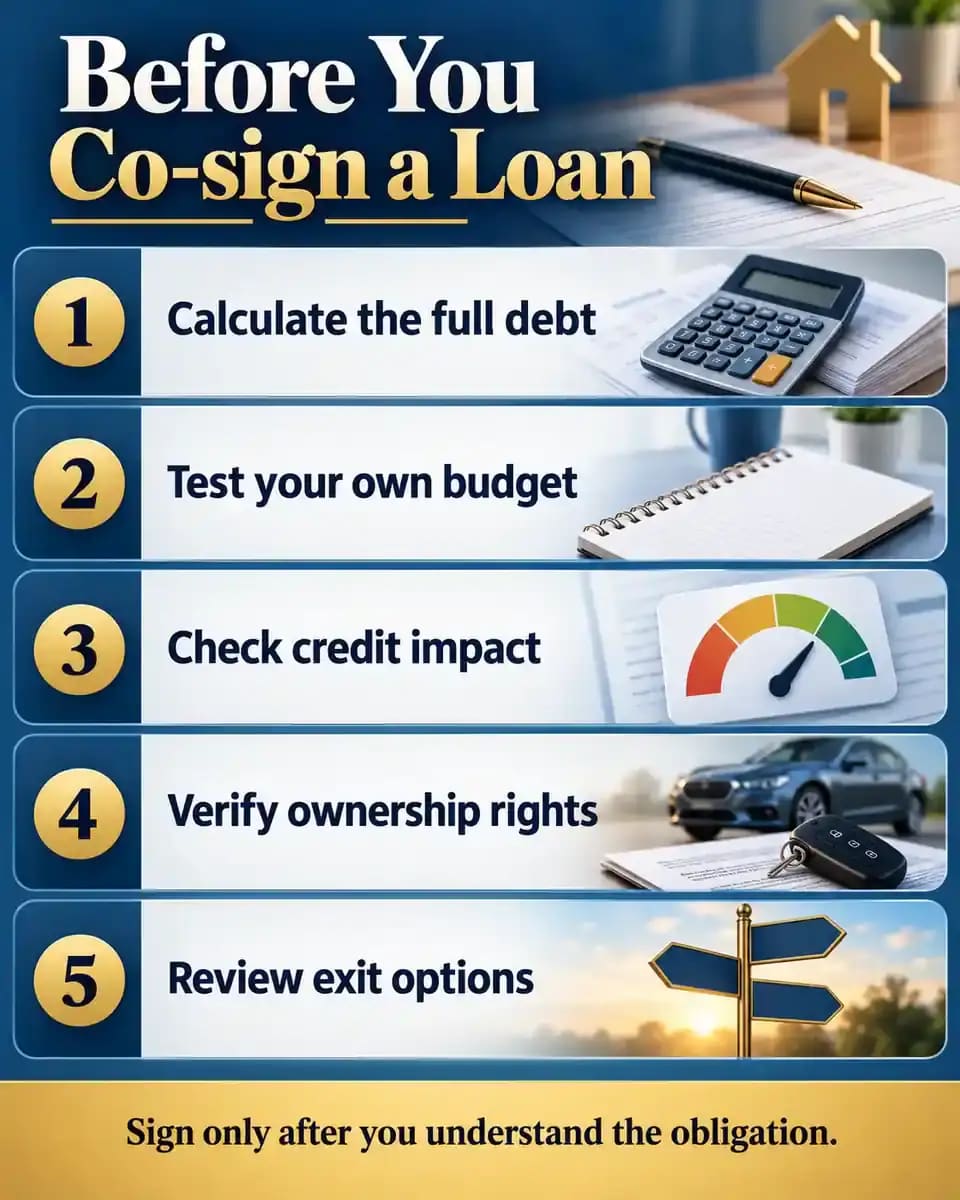
Before co-signing, add the loan payment to your own budget as though the borrower stopped paying next month. Then check what happens to housing costs, insurance, groceries, savings, retirement contributions, emergency reserves, and existing debt payments.
If making the payment would require you to use credit cards, miss your own obligations, drain emergency savings, or postpone essential expenses, the financial risk is significant.
This exercise does not predict that the borrower will default. It simply measures your capacity to perform the obligation you are being asked to accept.

Expect the Loan to Appear on Your Credit
Co-signed loans are commonly reported to consumer credit bureaus under both the borrower's and co-signer's identities. That means the account can become part of your credit history even when the primary borrower is making every payment.
Your credit reports may show the loan balance, payment history, account age, and status. Because the debt is associated with you, other lenders reviewing your credit may consider it when deciding whether to extend additional credit.
Check how the specific lender reports co-signed accounts and monitor your credit reports after the account opens.

Understand the Cost of Late Payments
If the primary borrower pays late and the delinquency is reported, your credit can also be affected. The CFPB specifically warns that late or missed payments on a co-signed loan can damage the co-signer's credit history.
Credit reporting depends on lender practices and reporting rules, so a payment that is only a few days late does not automatically mean a credit bureau will receive a delinquency entry. However, once a payment becomes reportable as late, the damage is not limited to the person who was expected to send the money.
The safest approach is to monitor the account before a missed payment becomes a serious delinquency.

Do Not Rely on the Borrower to Tell You About Problems
A borrower who is embarrassed, overwhelmed, or experiencing financial stress may delay telling a co-signer that a payment was missed. By the time you learn about the problem, late fees or credit reporting consequences may already be developing.
Ask the lender whether co-signers can receive account statements, payment notifications, online account access, or delinquency alerts. Also agree with the borrower on how payment status will be communicated.
Independent visibility is more reliable than waiting for bad news.

See How the Debt Can Affect Future Borrowing
Even a perfectly paid co-signed loan may influence applications for new credit. Mortgage lenders, auto lenders, banks, and other creditors examine existing liabilities when deciding how much additional debt they believe you can handle.
A co-signed loan can therefore matter when you later apply for financing of your own. The effect depends on the lender, loan type, underwriting standards, payment history, documentation, income, and other factors.
If you expect to finance a home, car, business, education, or major purchase, consider the timing before adding another long-term obligation.

Learn Why Debt-to-Income Ratio Matters
Debt-to-income ratio, commonly called DTI, compares recurring debt obligations with income. Lenders often use some version of this calculation when evaluating applications.
A co-signed payment may be considered part of your recurring obligations, although underwriting rules can vary and some lenders may allow exclusions when specific documentation shows another person has consistently made the payments.
Do not assume an exclusion will automatically apply. If future borrowing matters to you, ask the prospective lender how co-signed obligations are treated under its current underwriting standards.

Recognize That Default Changes the Situation Quickly
A loan usually moves from ordinary delinquency toward default according to the terms of the agreement and the lender's policies. Default can trigger more serious consequences such as acceleration of the debt, collection activity, repossession of collateral, or litigation.
The exact timeline depends on the loan and applicable law. There is no universal rule that every loan defaults after the same number of missed payments.
Read the default provisions before signing so you know what events can trigger stronger lender remedies.

Know That the Lender May Contact You Directly
Because a co-signer has contractual responsibility, the creditor may contact the co-signer when payments are not being made. Do not assume that every collection attempt must first be directed exclusively at the primary borrower.
The CFPB's consumer guidance emphasizes that a co-signer can be required to repay a loan when the borrower does not. The exact collection rights and procedures depend on the agreement, creditor, type of loan, and law.
If you receive a demand for payment, review it promptly rather than assuming it is merely informational.

Understand the Possibility of Collection Agencies
When a delinquent account is transferred or assigned for collection, a co-signer may also encounter collection communications. Collection practices are subject to federal and state rules, and the applicable protections can depend on who is collecting and the circumstances.
Keep copies of contracts, statements, notices, and correspondence. If you believe a collector is demanding an incorrect amount or misrepresenting the debt, consumer protection resources may help you understand your rights.
Do not ignore legitimate notices simply because you were not the person using the borrowed money.

Consider the Risk of Being Sued
Serious defaults can result in litigation. Whether a lender or debt collector can sue, what it must prove, and what remedies may follow depend on the contract and applicable law.
The important consumer-finance point is that co-signing can expose your own finances to legal collection efforts. The fact that you did not receive the car, tuition benefit, or loan proceeds does not automatically eliminate your contractual responsibility.
If you receive legal papers relating to a co-signed loan, do not treat them as routine collection mail. Deadlines can matter, and obtaining qualified legal advice may be appropriate.

Understand Repossession on a Co-signed Auto Loan
Auto loans illustrate why secured debt can create several layers of risk. If required payments are not made, a lender may have rights against the vehicle that secures the loan, including repossession when permitted by the contract and law.
A co-signer should not assume repossession eliminates personal liability. The vehicle is collateral, but its value may be lower than the remaining loan balance.
The CFPB specifically cautions prospective co-signers of car loans to understand both their repayment responsibility and the fact that signing the loan does not automatically mean they own the vehicle.

Learn What a Deficiency Balance Is
Suppose a repossessed vehicle is sold and the sale proceeds are less than the amount legally owed after permitted costs and adjustments. The remaining amount is commonly called a deficiency balance.
Depending on applicable law and the loan terms, the creditor may attempt to collect that remaining balance from obligated parties. That means a co-signer could face a situation in which the car is gone but money is still owed.
Before co-signing an auto loan, understand that vehicle depreciation can make this risk especially relevant during the early years of financing.

Separate Debt Responsibility From Ownership
One of the most important distinctions in co-signing is the difference between owing money and owning property. Signing a loan agreement does not automatically put your name on the title to the financed asset.
For a vehicle, ownership is generally reflected by title records rather than by the financing agreement alone. A person may therefore have substantial repayment responsibility while having little or no ownership control.
Never assume that because you are liable for the loan, you can automatically sell, use, transfer, or take possession of the property.

Verify the Vehicle Title Before Co-signing
If you are considering co-signing an auto loan, ask who will appear on the vehicle title and registration. Do not rely on verbal assumptions.
The CFPB warns that co-signing someone else's car loan does not necessarily give you ownership rights in the car. This creates an important asymmetry: you may be responsible for the debt while another person controls the asset.
If ownership or access to the vehicle matters to your decision, obtain clear information about title status and consider qualified legal advice about the consequences in your state.

Do Not Assume You Can Sell the Asset
A co-signer who starts making payments may understandably feel that they should be able to take control of the financed asset. Legally, that may not be true.
If you are not an owner, you generally should not assume that you can simply take a vehicle and sell it to repay the loan. Property rights, title status, security interests, possession, and state law can all matter.
This is why ownership questions should be resolved before the financing is signed, not after a dispute develops.

Apply the Same Logic to Student Loans
Student loans create a different version of the same risk. The co-signer helps support financing for someone else's education but does not receive the educational benefit or control the student's academic or career decisions.
According to the CFPB, a co-signer on a student loan agrees to repay the debt if the borrower does not. The borrower's future income, graduation outcome, employment situation, and other circumstances may affect their ability to repay, but those uncertainties do not automatically remove the co-signer's contractual obligation.
Evaluate private student loan co-signing as a real long-term debt commitment.

Ask Whether Co-signer Release Is Available
Some lenders may offer a process through which a co-signer can later be released from the obligation if specific requirements are met. These requirements can include a history of timely payments, credit qualification by the borrower, income verification, or other lender criteria.
Do not assume release is automatic. Ask whether a release program exists, when the borrower becomes eligible to apply, what standards are used, and whether approval is discretionary.
If release is an important part of your risk calculation, obtain the policy in writing before signing.

Check Whether Refinancing Is a Realistic Exit
Another possible path out of a co-signed obligation is refinancing the debt into a new loan that does not include the original co-signer. But refinancing requires the borrower to qualify under conditions available at that future time.
Income, credit score, interest rates, collateral value, lender standards, and market conditions can all affect whether refinancing is possible or worthwhile.
Treat refinancing as a potential future option, not as a guaranteed escape route. Your decision to co-sign should make sense even if refinancing never happens.

Review the Borrower's Actual Repayment Capacity
Trust matters in personal relationships, but repayment capacity is a financial question. Review how the borrower plans to make the payment, how stable the relevant income appears, and what existing obligations already compete for that income.
You do not need to turn the relationship into a formal underwriting department, but you should understand why the lender required a co-signer and what financial weakness the co-signer is being asked to offset.
A borrower can be responsible, honest, and well intentioned while still experiencing circumstances that make repayment difficult.

Discuss Job Loss and Emergency Scenarios
Before signing, discuss what would happen if the borrower lost income, became unable to work, faced a major emergency, or experienced another financial disruption. The purpose is not to predict disaster. It is to determine whether a backup plan exists.
Ask how many months of payments the borrower could cover from savings and when they would notify you if trouble began. Consider whether any relevant insurance or contractual hardship programs exist, but verify their actual terms rather than assuming coverage.
A plan made before a crisis is usually clearer than one negotiated after a missed payment.

Consider the Effect on Your Relationship
Co-signing converts a personal relationship into a financial relationship with contractual consequences. A parent, sibling, partner, or friend may become someone whose payment behavior directly affects your credit and cash flow.
If you have to make payments, disagreements can arise about reimbursement, spending priorities, communication, or responsibility. The financial stress can outlast the original loan problem.
Discuss expectations before signing, including who pays, when you will be notified of problems, how missed payments will be handled, and what happens if you have to step in.

Protect Your Own Emergency Fund
A co-signed debt should not be viewed in isolation from your own financial resilience. If covering the payment would consume the money reserved for rent, medical costs, home repairs, insurance deductibles, or unemployment, the obligation could transfer another person's financial emergency into your household.
Consider how many months of your normal expenses you currently keep in liquid reserves and what would remain if you had to support the co-signed loan.
Do not count retirement accounts or hard-to-sell assets as though they were ordinary cash reserves without considering the consequences of accessing them.

Read Every Default and Acceleration Clause
Loan contracts often contain provisions describing what happens after default. One important concept is acceleration, where circumstances defined in the agreement may allow the creditor to declare a larger portion of the outstanding debt immediately due.
Whether and when acceleration applies depends on the contract and law. Do not assume that your maximum near-term exposure is always one monthly payment.
Read the sections covering default, acceleration, late fees, collection expenses, collateral, notices, and dispute procedures. Ask questions about language you do not understand before signing.

Get Important Promises in Writing
Informal promises between you and the borrower can be useful for setting expectations, but they do not necessarily change the lender's rights under the loan agreement. If the lender makes representations about notices, release eligibility, account access, payment arrangements, or other important terms, request documentation.
Keep copies of the signed contract, disclosures, payment schedule, correspondence, and any later amendments.
Good documentation helps you understand the obligation and can be important if memories differ years later.

Monitor the Account and Your Credit
If you do co-sign, remain involved enough to detect problems early. Use lender alerts when available, periodically verify payment status, and review your credit reports for unexpected reporting.
Monitoring does not eliminate your liability, but it may give you more time to respond before a small problem becomes a serious delinquency or default.
If the borrower is uncomfortable with reasonable transparency on an obligation that also affects your finances, that is important information to consider before signing.

Make the Decision Using the Full-Risk Test
Before putting your signature on the agreement, reduce the decision to one practical test: would you still accept this obligation if you knew today that you might eventually have to make the payments yourself?
Then add the secondary effects. Could the debt interfere with your mortgage plans? Could late payments affect your credit? Could you owe money without controlling the asset? Could default lead to collections or legal expenses? Could the obligation create conflict with someone close to you?
The CFPB's guidance on student and auto loan co-signing supports the same core message: understand that you are accepting genuine repayment risk. Co-signing can sometimes help someone obtain financing, but it should be evaluated as a significant financial commitment rather than a ceremonial favor.

Co-signing a loan can look like a simple favor. A family member needs a car, a student needs help qualifying for private financing, or someone with limited credit history asks you to add your stronger financial profile to an application. The paperwork may take only minutes, but the obligation can last for years.
The most important fact to understand is that co-signing a loan is not the same as providing a reference or confirming that you trust the borrower. You are signing a debt agreement. Depending on the contract and applicable law, you may become legally responsible for repayment if the primary borrower does not pay as required.
The Consumer Financial Protection Bureau, or CFPB, warns consumers that co-signers can be required to repay debt and that missed payments can affect the co-signer's credit. The CFPB also cautions prospective co-signers of auto loans that they may be responsible for repayment without necessarily receiving ownership rights in the vehicle.
This guide explains how co-signing works, why lenders ask for co-signers, how the debt can affect your credit and future borrowing, what may happen during default and collections, and why liability and ownership are two separate issues. It is general consumer education, not individualized financial, legal, or tax advice. Loan contracts and state laws vary, so always read the actual agreement before signing.
Where people go wrong
Thinking You Are Only a Character Reference. A co-signer is part of the credit obligation. Treating the signature as a personal recommendation can cause you to underestimate the possibility of repayment responsibility.
Looking Only at the Monthly Payment. The real exposure can include years of payments, interest, late charges, collection costs, and potentially a remaining balance after collateral is sold.
Assuming the Lender Must Chase the Borrower First. Do not assume the creditor must exhaust every collection option against the primary borrower before contacting you. Review the actual contract and applicable law.
Assuming Liability Creates Ownership. Being responsible for an auto loan does not automatically put your name on the vehicle title or give you the right to sell or control the car.
Ignoring Your Future Mortgage or Loan Plans. A co-signed obligation may affect credit underwriting and debt-to-income calculations when you later seek financing for yourself.
Relying on Verbal Promises. Statements such as 'I will refinance you off the loan next year' are not guarantees. Refinancing and co-signer release usually depend on future qualification and lender approval.
Failing to Monitor Payment Status. Waiting for the borrower to mention a missed payment can leave you learning about the problem after fees, delinquency, or credit consequences have developed.
Using Emergency Savings as the Backup Plan. If covering the co-signed debt would wipe out the reserves protecting your own household, the financial risk may be larger than the monthly payment suggests.
Questions people ask
A co-signer generally accepts contractual repayment responsibility. The CFPB explains that a co-signer on a student loan agrees to repay the debt if the borrower does not. Exact rights and obligations depend on the loan agreement and applicable law.
Fixed it?
Get one guide like this every Thursday.