Protecting Your Wealth Beyond Standard Insurance Limits
A major liability claim could exceed your homeowners or auto insurance limits and put your savings at risk. Learn how umbrella insurance works, where coverage gaps arise, and how to evaluate additional protection.

What you’ll need
Tap to tick things off before you start.
Why Your Wealth Needs Liability Protection
Building wealth takes years of saving, investing, and making careful financial decisions. Unfortunately, a serious liability claim can threaten that progress. If you are legally responsible for an accident, compensation owed to another person could exceed your available insurance protection. Depending on applicable laws, uncovered obligations may affect savings, investments, or other assets. Liability protection helps manage this possibility by shifting certain covered financial risks to an insurer, supporting greater long-term financial stability.

Understanding Your Insurance Safety Net
Liability insurance works as a financial safety net when you become legally responsible for certain injuries or damage suffered by others. Standard homeowners and auto policies commonly provide the first layer of protection. Excess liability coverage adds another potential layer when qualifying claims surpass primary insurance limits. Umbrella insurance is one form of this additional protection. However, every layer operates under specific contractual conditions, meaning coverage depends on the policies involved and the circumstances of each claim.

The Foundation of Homeowners Insurance
Homeowners insurance provides a foundation for protecting one of the most important purchases many households make. A typical policy combines several forms of protection, including coverage for the dwelling, personal belongings, certain additional living expenses, and personal liability. These components address different financial consequences of covered events. The protection is not unlimited, and deductibles, exclusions, and coverage limits apply. Understanding this basic structure helps homeowners recognize what their policy is designed to accomplish.

Why Your Home Is a Major Financial Asset
For many Americans, homeownership represents a substantial portion of household wealth. A home's market value, outstanding mortgage balance, and accumulated equity all influence its place in a financial plan. Equity generally represents the difference between property value and debt secured by the home. Damage that reduces property value can therefore have consequences beyond immediate repair expenses. Protecting the property helps preserve an important asset while supporting the household's ability to maintain its long-term housing investment.

Why Mortgage Lenders Require Insurance
Mortgage lenders generally require homeowners insurance because the property serves as collateral for the loan. If a covered disaster damages or destroys that property, insurance proceeds can help fund repairs or rebuilding, subject to policy terms. This reduces the risk that the lender's security will lose substantial value. The Consumer Financial Protection Bureau explains that homeowners insurance is commonly required for this reason. Maintaining the required coverage is therefore an important part of meeting mortgage obligations.

What Homeowners Insurance Can Cover
The Consumer Financial Protection Bureau explains that homeowners insurance helps pay for property losses caused by unexpected events such as fires or burglaries. Depending on the policy, covered losses may include damage to the dwelling and certain personal belongings. Additional living expenses may also be covered when an insured event makes the home temporarily uninhabitable. Not every disaster qualifies, however. Flooding and earthquakes, for example, often require separate coverage, making policy exclusions especially important.

How Insurance Protects Mortgage Collateral
A mortgaged property serves as security for repayment of the loan. When covered damage occurs, an insurance settlement may provide funds to restore the building and preserve that security. Depending on the mortgage agreement and insurer's procedures, the lender may be named on claim payments or participate in releasing repair funds. This arrangement helps ensure insurance proceeds support property restoration. Importantly, receiving an insurance payout does not automatically eliminate the borrower's remaining mortgage obligations.

Property Coverage Versus Liability Coverage
Property coverage and personal liability coverage address fundamentally different risks. Property insurance generally helps repair or replace your own insured property after a covered loss. Liability insurance may respond when you are legally responsible for certain injuries or damage involving someone else. For example, a visitor injured on unsafe porch steps might pursue a liability claim. Whether the insurer pays depends on the circumstances and policy conditions. Recognizing this distinction prevents confusion about what each protection accomplishes.

Why Basic Liability Limits May Be Insufficient
Serious accidents can create financial claims far larger than the amounts associated with routine incidents. A severe injury may involve extensive medical treatment, rehabilitation, lost income, and other legally recoverable damages. Litigation and defense expenses can add complexity, although their treatment varies by policy. If the resulting covered liability exceeds the applicable insurance limit, the policy may not pay the entire amount. This possibility makes the size of a policy's liability limit an important consideration.

Where Standard Policy Protection Ends
Every insurance policy establishes boundaries through coverage limits, exclusions, definitions, and contractual conditions. A liability limit specifies the maximum amount available for covered obligations under the applicable policy provisions. Some claims may be excluded entirely, while others may be only partially covered. Once an applicable limit is exhausted, remaining amounts may become the insured person's responsibility, subject to law and other available coverage. Reviewing declarations pages alongside full policy language helps reveal where protection ends.

The Role of Risk Management
Financial risk management is the practice of recognizing potential losses and taking reasonable steps to reduce their impact. Investor.gov describes this process as identifying, assessing, and managing risks within a financial plan. The objective is not to eliminate every uncertainty, which is impossible, but to make potential setbacks more manageable. This approach considers both the likelihood of an event and its possible financial consequences, helping households make more informed decisions about protecting their long-term stability.

Identify and Assess Your Financial Risks
Effective financial planning begins with understanding what could go wrong and how much it might cost. Potential exposures include property damage, personal liability, investment losses, and interruptions to household income. Each risk can be examined by considering its probability, potential severity, and ability to disrupt existing financial commitments. A rare event with devastating consequences may deserve particular attention. This assessment provides a clearer picture of vulnerabilities before decisions are made about managing them.

Four Tools for Financial Risk Management
A comprehensive approach to financial risk management often uses four complementary tools: insurance, diversification, emergency savings, and legal planning. Investor.gov discusses these methods as ways to address different sources of financial uncertainty. Insurance can shift specified losses to an insurer, while diversification spreads investment exposure. Emergency savings provide accessible cash for unexpected expenses, and legal planning helps organize financial and ownership arrangements. No single tool addresses every risk, so understanding their distinct purposes is essential.

Diversification and Emergency Savings
Diversification and emergency savings address different financial challenges. Diversification spreads investments across assets or categories to reduce dependence on any single holding, although it cannot eliminate market losses. Emergency savings serve a more immediate purpose by keeping money accessible when unexpected expenses arise. A cash reserve may help cover urgent repairs, essential bills, or temporary income disruptions without requiring investment sales at an unfavorable time. Together, these approaches support both investment resilience and short-term financial flexibility.

Legal Planning and Insurance Risk Transfer
Legal planning and insurance serve complementary purposes in protecting financial interests. Legal arrangements can help clarify ownership, establish responsibilities, and organize how assets are held or transferred, subject to applicable laws. Insurance operates through a different mechanism: premiums purchase contractual protection against specified losses, shifting certain financial consequences to an insurer. Neither approach provides universal protection. Legal structures have limitations, and insurance policies contain conditions and exclusions. Qualified professionals can explain how these protections function in particular circumstances.

When Advanced Liability Protection Matters
Additional liability protection becomes worth examining when plausible claims could exceed the limits available under primary insurance policies. Individuals with substantial assets, frequent driving exposure, or other potential sources of third-party claims may want to understand this possibility. Umbrella insurance can provide an additional layer of coverage for qualifying liabilities, depending on policy terms and underlying insurance requirements. Its value lies in addressing certain high-cost events that might otherwise create significant financial obligations beyond standard coverage.

Building a More Resilient Financial Plan
Financial resilience improves when protective measures work together instead of operating independently. Insurance addresses specified insured losses, accessible savings support immediate cash needs, diversification reduces investment concentration, and legal planning organizes financial arrangements. A coordinated approach considers whether these protections align with household obligations, assets, and changing circumstances. Periodic reviews can identify mismatches, such as increased property values or new financial responsibilities. The goal is a flexible system that can better withstand different kinds of financial setbacks.

How Auto Liability Claims Can Exceed Coverage
Automobile liability insurance generally covers certain bodily injury and property damage claims when an insured driver is legally responsible for a crash. Policies typically establish separate or combined limits that restrict the insurer's payment obligations. A collision involving several vehicles, substantial property damage, or multiple injured people can generate claims above those amounts. State minimum insurance requirements do not necessarily reflect the potential cost of a serious accident, making primary auto liability limits important to understand.

The Financial Impact of Serious Injuries
A severe injury can create costs extending far beyond the initial emergency room visit. Medical treatment, surgery, rehabilitation, ongoing care, and lost earning capacity may all affect the value of a liability claim. Depending on the circumstances and applicable law, compensation may also involve pain and suffering or other damages. Legal defense introduces additional expenses, although policy provisions determine how those costs are handled. These factors explain why some injury claims become financially substantial.

What Personal Liability Can Mean for Your Assets
When a person owes damages that insurance does not cover, the unpaid amount may become a personal financial obligation. Depending on state law and the nature of the judgment, creditors may seek payment from certain bank accounts, investments, or other nonexempt assets. Some property receives legal protection, and collection procedures vary significantly by jurisdiction. Personal responsibility therefore does not mean every asset is automatically available to creditors. Understanding these legal boundaries is important when evaluating potential financial exposure.

The Danger of Assuming Full Protection
Having homeowners and auto insurance does not mean every serious liability claim will be fully covered. Policies protect against specified risks, subject to limits, exclusions, and other conditions. A catastrophic accident may generate obligations that extend beyond the protection purchased. Some circumstances might not qualify for coverage at all. The danger is confusing possession of an insurance policy with complete financial security. Understanding that distinction encourages realistic expectations about what standard insurance can and cannot accomplish.

Assessing Your Financial Vulnerability
Financial vulnerability depends on more than the dollar amount shown on an insurance policy. A useful assessment considers potential liability exposures alongside savings, investments, home equity, outstanding obligations, and existing coverage. It also distinguishes total wealth from assets that may receive legal protection. Comparing these factors can reveal whether a major claim might create a meaningful financial shortfall. This broader perspective helps explain why households with similar insurance policies may face substantially different levels of financial risk.

Can Future Earnings Be Affected by a Judgment?
A liability judgment can sometimes affect income earned after the underlying incident. If an unpaid judgment is legally enforceable, a creditor may seek wage garnishment through applicable collection procedures. However, federal law restricts garnishment amounts for many ordinary debts, and state laws may provide additional protections or exemptions. Certain types of income may also receive special treatment. These rules mean future earnings are not automatically available without limitation, but they can remain relevant to long-term liability exposure.

What Umbrella Insurance Actually Does
Umbrella insurance is additional personal liability protection designed to sit above qualifying primary policies, commonly homeowners and automobile insurance. Its purpose is to help cover certain third-party liability claims that extend beyond the underlying coverage. Depending on the contract, an umbrella policy may also cover some liabilities that a primary policy does not, subject to separate conditions. It has its own coverage limit, eligibility requirements, and exclusions. Umbrella insurance supplements primary protection rather than replacing it.

How Umbrella Coverage Responds to Major Claims
For a qualifying claim, umbrella coverage generally responds after the applicable underlying liability limit has been exhausted. For example, if covered damages exceed an auto policy's limit, the umbrella insurer may pay additional eligible amounts up to its own limit. Some umbrella policies also address certain claims not covered by primary insurance, potentially requiring the insured to pay a specified retention first. Coverage is never automatic merely because a claim is large. Policy definitions, exclusions, and required underlying limits determine the outcome.

What Umbrella Insurance Does Not Cover
Umbrella insurance primarily addresses covered liability claims brought by other people, not damage to the policyholder's own property. It generally will not pay to replace your roof, repair your car, or reimburse ordinary personal property losses. Common exclusions may involve intentional harm, certain business activities, and contractual obligations, although wording differs among insurers. Coverage can also depend on maintaining required underlying policies. Reading the actual contract is essential because an umbrella policy is not unlimited protection against every financial loss.

How State Laws Affect Asset Protection
Asset protection rules differ across states, affecting what creditors may collect after a judgment. Depending on the jurisdiction and circumstances, exemptions may protect some home equity, retirement assets, wages, or personal property. States also differ in judgment enforcement procedures, insurance regulations, and related legal requirements. Federal protections can apply to certain assets and income as well. Because these rules interact, the same financial situation may produce different outcomes in different locations. General insurance information cannot replace jurisdiction-specific legal guidance.

Why Your Protection Strategy Must Be Personal
A household's appropriate protection strategy depends on its circumstances rather than a universal coverage formula. Relevant considerations may include assets, dependents, driving habits, property ownership, income stability, and potential liability exposures. State laws and insurer requirements introduce further differences. Someone with several properties may face different risks from someone who rents and rarely drives. A licensed insurance professional can explain available policy options, while qualified legal or financial professionals can address questions requiring specialized personal guidance.

Reviewing Your Current Risk Management Plan
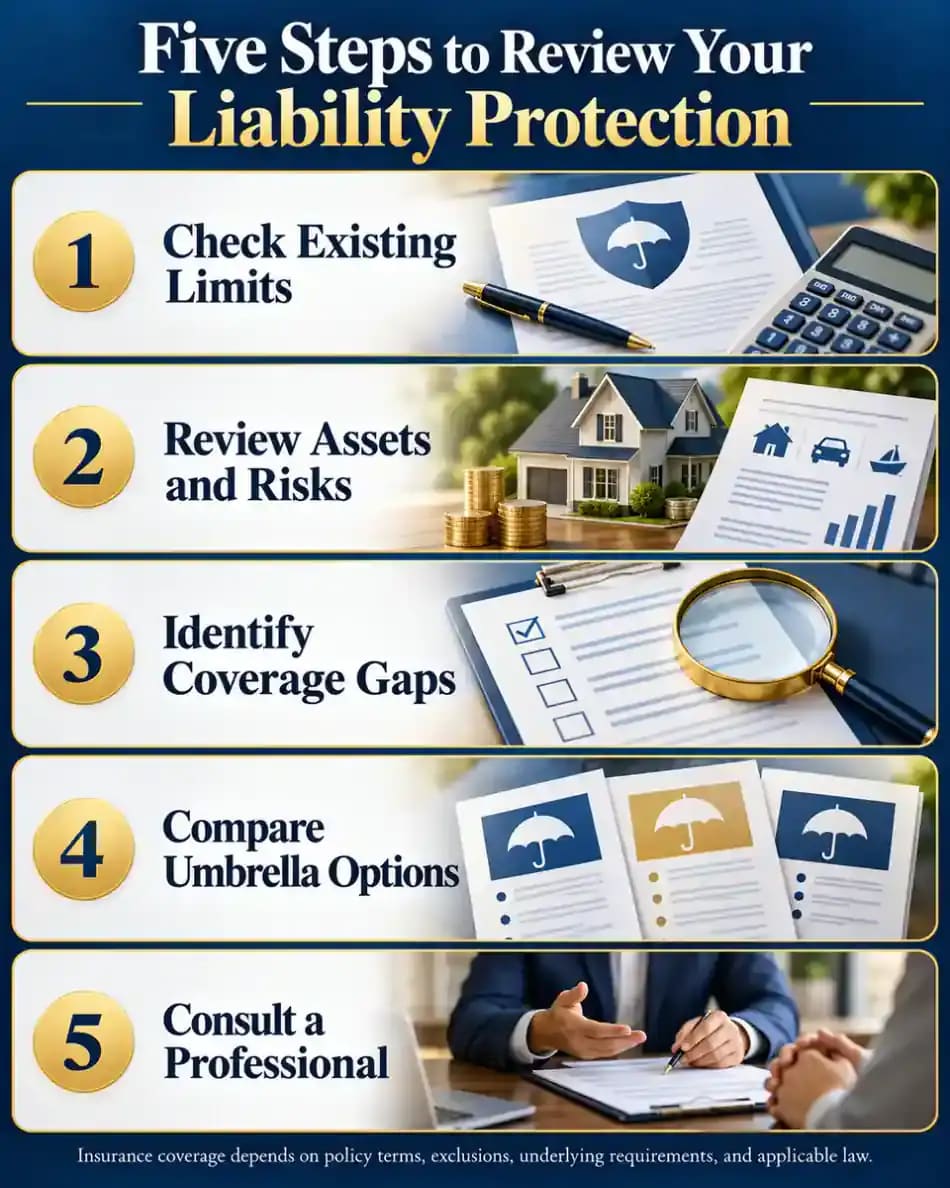
A practical risk management review begins by gathering current homeowners, auto, and any existing umbrella insurance documents. Record liability limits, policy renewal dates, major exclusions, and required underlying coverage. Next, develop a general inventory of assets, financial obligations, and activities that could create liability exposure. Compare this information with the protection already available, noting questions or apparent gaps. Investor.gov emphasizes identifying and assessing financial risks, making periodic reviews useful when assets, household circumstances, or insurance terms change.

Questions to Ask Before Buying Umbrella Insurance
Before purchasing umbrella insurance, ask what liability limits your homeowners and auto policies must maintain, which claims the umbrella policy covers, and what exclusions apply. Clarify the available coverage amounts, annual premium, deductibles or retained amounts, and how defense costs are handled. Ask whether household drivers, additional properties, or specific activities affect eligibility. A licensed insurance professional can explain competing policies, while a qualified attorney can address questions about applicable asset protection laws.

You have worked hard to build savings, invest for the future, and create financial stability. But what happens if a serious accident leads to a liability claim larger than your insurance will pay? Depending on the circumstances and applicable law, the uncovered amount could become a significant personal financial obligation.
Standard homeowners and auto insurance policies provide valuable protection, but they have limits. Homeowners insurance can help pay for covered property losses, while personal liability coverage can address certain claims involving injuries or damage to others. Mortgage lenders generally require homeowners insurance because it protects the property securing their loan.
The Consumer Financial Protection Bureau explains the relationship between homeowners insurance and mortgage requirements. Yet having the required policy does not mean every liability exposure is covered or that its limits are sufficient for a major claim.
Umbrella insurance offers another potential layer of protection. It generally provides additional personal liability coverage above qualifying underlying policies, subject to policy conditions, exclusions, and maximum limits. It does not simply pay for any loss that exceeds your existing insurance.
A sound approach starts with understanding your current coverage and identifying possible gaps. Investor.gov discusses risk management as part of financial planning, and complementary tools include insurance, diversification, emergency savings, and legal planning.
This guide explains how standard liability limits function, why major claims deserve attention, and how excess liability coverage fits into a broader financial plan. You will also learn what documents to review and which questions to discuss with qualified professionals. The information is educational and does not constitute individualized financial, legal, or tax advice.
Where people go wrong
Assuming Standard Insurance Is Unlimited. Homeowners and auto insurance policies have maximum liability limits. A sufficiently large covered claim can exceed those limits, potentially creating personal financial exposure. Check the declarations pages rather than assuming that having insurance guarantees complete protection.
Confusing Property Coverage With Liability Protection. Insurance that helps repair your home after a covered fire serves a different purpose from coverage for certain injuries to others. Treating both protections as interchangeable can hide important gaps in your financial risk management.
Ignoring Underlying Insurance Requirements. Umbrella policies commonly require specified minimum liability limits on underlying homeowners and auto coverage. Failing to maintain required insurance can create problems when a claim occurs. Confirm these requirements with your insurer before purchasing or renewing coverage.
Believing Umbrella Insurance Covers Every Loss. Umbrella insurance generally addresses eligible third-party liability claims, not ordinary damage to your own property. Exclusions and policy conditions still apply. Review covered activities, insured persons, and limitations instead of treating additional coverage as an unrestricted financial guarantee.
Choosing Coverage Based Only on Price. The cheapest policy may not provide the protection you expect. Different insurers can impose different requirements, exclusions, and conditions. Compare the actual coverage and total premium impact, including any necessary increases to underlying policy limits.
Overlooking State-Specific Asset Protections. State laws can affect which assets may be reached to satisfy a judgment and whether wages are subject to garnishment. Assuming identical protections nationwide can lead to misleading conclusions. A qualified attorney can explain applicable rules.
Failing to Revisit Coverage After Life Changes. Buying property, adding a driver, accumulating investments, or taking on new responsibilities may change your liability exposure. Reviewing insurance only when first purchased can leave outdated assumptions. Reassess coverage at renewal and after significant financial changes.
Questions people ask
Umbrella insurance is additional personal liability coverage that generally applies above qualifying underlying insurance limits. It may help with certain covered claims involving bodily injury, property damage, and other liabilities specified by the contract. Coverage is subject to exclusions, conditions, and the umbrella policy's own limits.
Fixed it?
Get one guide like this every Thursday.