The Real Difference Between PMI and Homeowners Insurance
PMI and homeowners insurance can both appear in your housing payment, but they protect different parties. Learn who each policy protects, when PMI may end, what homeowners insurance covers, and what to review.

What you’ll need
Tap to tick things off before you start.
1. Start With the Most Important Difference
The simplest way to understand PMI vs homeowners insurance is to ask who the policy is designed to protect. Private mortgage insurance generally protects the mortgage lender if the borrower defaults. Homeowners insurance primarily protects against covered losses involving the home, personal property and liability exposure. The Consumer Financial Protection Bureau explains that PMI may be required on certain conventional mortgages when the borrower makes a smaller down payment. Homeowners insurance, by contrast, helps protect the property that serves as collateral for the mortgage. Paying both premiums does not mean you receive the same protection from both.

2. Understand Why the Terms Are Easy to Confuse
A homeowner may see several housing costs bundled into one monthly mortgage payment. Principal, interest, property taxes, homeowners insurance and PMI can all be collected together through a mortgage servicer. That presentation makes the expenses look connected even though their legal and financial functions differ. Escrow is mainly a payment mechanism. It does not transform PMI into property insurance or homeowners insurance into mortgage default protection. When reviewing a mortgage statement, separate each charge by purpose rather than assuming every insurance-related line item protects you personally.

3. Know Exactly Who PMI Protects
PMI is generally purchased in connection with a conventional mortgage and is designed to reduce the lender's exposure when the borrower has relatively little equity at the beginning of the loan. If the borrower stops making payments and foreclosure eventually creates a covered loss, the mortgage insurance can reimburse the lender according to the policy terms. The borrower usually pays the premium, but the lender is the party receiving the core protection. This is why PMI should not be confused with personal income protection or a policy that makes your mortgage payments after a financial setback.

4. Know Who Homeowners Insurance Protects
Homeowners insurance is built around covered property and liability risks rather than mortgage default. A typical policy may insure the dwelling, certain other structures, personal belongings, additional living expenses after a covered loss and personal liability, subject to limits, deductibles, exclusions and policy language. The mortgage lender often has an interest in the policy because the home secures the loan, but homeowners insurance also provides protection directly relevant to the homeowner. The CFPB notes that mortgage lenders generally require homeowners insurance because they want the property securing the loan protected.

5. See Why Lenders May Require Both
A lender can face two different categories of risk. First, the borrower might default while the loan balance remains high relative to the property's value. PMI addresses part of that credit risk. Second, the physical property could suffer serious damage from a covered event. Homeowners insurance addresses that property risk. Requiring both can therefore serve different purposes within the same mortgage transaction. PMI does not rebuild a burned home, and homeowners insurance does not generally reimburse the lender simply because a borrower stopped making payments.

6. Understand the Common 20 Percent Down Payment Rule
For many conventional mortgages, PMI is commonly associated with down payments below 20 percent. That does not mean 20 percent is a universal legal requirement for buying a home. Rather, PMI can make lower down payment conventional financing possible by providing additional protection to the lender. Exact requirements depend on the lender, loan program and transaction. Government-backed mortgages follow different insurance or guarantee systems, so FHA mortgage insurance and VA loan rules should not automatically be treated as PMI.

7. Treat PMI as a Financing Cost
PMI is best understood as part of the cost structure of borrowing with a relatively small down payment. It may increase the monthly housing payment, but it can also allow a qualified buyer to finance a home sooner instead of waiting until a larger down payment has been accumulated. Whether that tradeoff makes sense depends on the borrower's circumstances, market conditions, loan pricing and alternatives. The important conceptual point is that the premium buys lender protection rather than additional homeowner property coverage.

8. Learn How PMI May Be Charged
PMI can be structured in different ways. Borrower-paid mortgage insurance is often included in the monthly mortgage payment. Some transactions may involve an upfront premium, a combination of upfront and monthly charges, or lender-paid mortgage insurance reflected indirectly through the loan's pricing. Because structures differ, do not rely on a generic online estimate to determine your actual cost. Review the loan documents and mortgage statement to identify how mortgage insurance is being collected and whether the pricing can change.

9. Know What Can Affect PMI Pricing
PMI pricing is not a single flat national rate. Factors can include loan-to-value ratio, borrower credit characteristics, mortgage type, occupancy, loan term and the insurance structure selected. A smaller down payment generally means the lender has more exposure at the beginning of the loan, which can influence pricing. Because underwriting models vary, two borrowers purchasing similarly priced homes could face different mortgage insurance costs. Your loan documents and lender disclosures are more reliable than broad averages when estimating your own expense.

10. Do Not Expect PMI to Make Payments for You
One of the most consequential misunderstandings is assuming PMI functions like unemployment protection, disability insurance or mortgage payment protection. It generally does not make your monthly mortgage payment because you lost a job, experienced a medical problem or encountered another personal financial hardship. If payments stop and a covered lender loss eventually occurs, PMI addresses the lender's insured risk. Borrowers facing difficulty making payments should contact their mortgage servicer promptly to ask about available assistance or loss mitigation options rather than assuming PMI will cover the payment.

11. Understand What Homeowners Insurance Usually Covers
A standard homeowners policy commonly contains several coverage sections. Dwelling coverage may pay for covered damage to the house. Other structures coverage can apply to structures such as a detached garage or fence. Personal property coverage can protect covered belongings. Loss-of-use coverage may help with additional living costs after certain covered losses. Liability coverage can help address covered claims when the homeowner is legally responsible for injury or property damage. Exact coverage varies materially by insurer, state, policy form, endorsement and exclusion, so the declarations page and full policy language matter.

12. Understand Why the Mortgage Company Cares About Property Coverage
The home is usually collateral for the mortgage. If a major covered event severely damages that collateral, both the borrower and lender have a financial interest in restoring the property. For this reason, lenders commonly require homeowners insurance and may specify minimum coverage requirements. Mortgage clauses can also give the lender certain rights concerning claim payments. This does not mean the homeowner lacks protection. It means both parties have an economic interest in preserving the property that supports the loan.

13. Keep Property Insurance in Perspective After Paying Off the Mortgage
Once a mortgage is fully repaid, the former lender generally no longer has the same contractual reason to require homeowners insurance. That does not eliminate the homeowner's exposure to fire, theft, liability claims, storm damage or other covered risks. A home can represent a substantial portion of household net worth. Going without insurance can mean retaining far more financial risk personally. Coverage decisions after a mortgage payoff should therefore be based on the risks, policy terms and owner's ability to absorb a major loss, not simply on the absence of a lender requirement.

14. Pay Attention to Liability Coverage
Homeowners insurance is not limited to repairing walls and replacing furniture. Many policies include personal liability protection, subject to exclusions and limits. A covered liability claim could arise if someone is injured on the property or if the insured becomes legally responsible for certain damage to another person. Medical payments coverage may also apply in some circumstances. Liability provisions vary, so homeowners should understand the policy limit, exclusions and whether additional liability protection is appropriate for their circumstances.

15. Recognize That Homeowners Insurance Has Exclusions
Homeowners insurance is not an all-risk promise that every form of damage will be paid. Policies contain exclusions, limitations, deductibles and conditions. Two important examples frequently discussed in consumer education are flooding and earthquakes. A standard homeowners policy typically does not provide the same protection as dedicated flood insurance or earthquake coverage. Other limitations can involve maintenance problems, wear and tear, certain water losses, business activity, high-value property and specific hazards. Review the actual policy rather than assuming a loss is covered because it happened at home.

16. Evaluate Flood Risk Separately
Flood risk deserves separate attention because standard homeowners insurance generally excludes flooding as defined by the policy. Properties outside the highest-risk mapped zones can still experience floods. Depending on the property and mortgage, separate flood insurance may be required or voluntarily purchased. Coverage may be available through the National Flood Insurance Program or private insurers, depending on location and eligibility. Homeowners should evaluate flood exposure using reliable local information and review coverage details such as waiting periods, building limits and contents coverage.

17. Evaluate Earthquake Risk Separately
Earth movement is another major category that standard homeowners policies commonly exclude or restrict. In areas with meaningful seismic exposure, homeowners may consider a separate earthquake policy or endorsement if available. Earthquake coverage can involve substantial deductibles and special limits, making it important to understand how the policy calculates the homeowner's share of a loss. The fact that a lender requires homeowners insurance does not necessarily mean every geographically relevant catastrophe is insured.

18. Learn the Homeowners Protection Act Framework
For many conventional residential mortgages, federal PMI cancellation and termination rules come from the Homeowners Protection Act of 1998, often called the HPA. The FDIC's compliance materials describe the law's cancellation, automatic termination and disclosure framework. The rules are technical and do not apply identically to every mortgage product. FHA loans, VA loans and certain other financing structures have different rules. Before relying on a particular threshold, confirm that the mortgage is actually covered by the relevant HPA provisions.

19. Understand the 80 Percent Borrower Cancellation Point
Under the HPA framework for qualifying conventional loans, a borrower may generally request cancellation of borrower-paid PMI when the principal balance reaches 80 percent of the home's original value, subject to statutory and lender requirements. The borrower may need to make the request in writing, maintain a satisfactory payment history, certify that there are no disqualifying subordinate liens and provide evidence that the property's value has not declined. Servicer requirements should be confirmed directly because the process can involve documentation and valuation standards.

20. Understand the 78 Percent Automatic Termination Point
For many HPA-covered mortgages, PMI must automatically terminate when the loan is scheduled to reach 78 percent of the property's original value, provided the borrower is current on the mortgage. This scheduled date is generally based on the original amortization schedule rather than a new market appraisal. The distinction between the 80 percent borrower-request threshold and 78 percent automatic termination threshold is important. A homeowner who qualifies to request earlier cancellation may otherwise continue paying PMI until the automatic termination requirements are reached.

21. Do Not Confuse Original Value With Current Market Value
The HPA uses specific concepts such as original value when establishing certain cancellation and termination rights. That can differ from today's market value. A home that has appreciated substantially may create additional cancellation possibilities under an investor's or servicer's policies, but appreciation-based removal is not identical to the statutory 80 percent calculation. Some lenders or mortgage investors may require a new appraisal, valuation fee, seasoning period or different loan-to-value threshold. Ask the servicer which rule is being applied and what evidence is required.

22. Monitor Your Principal Balance
If you pay PMI, tracking the unpaid principal balance helps you estimate when relevant thresholds may be approaching. The balance is usually shown on the mortgage statement or servicer portal. Remember that the portion of each payment reducing principal changes over time because amortizing loans allocate payments between principal and interest. Extra principal payments can change the balance faster, but homeowners should confirm how the servicer applies those payments and whether additional requirements still govern PMI cancellation.

23. Ask for the PMI Cancellation Information in Writing
A practical first step is to contact the mortgage servicer and ask for the specific conditions that apply to the loan. Request the scheduled cancellation or termination information and the procedure for submitting a cancellation request. Written instructions reduce the risk of relying on a vague phone explanation. Keep copies of correspondence, valuation reports and payment records. If the mortgage has been transferred to a new servicer, verify the current process instead of assuming the previous company's procedures still apply.

24. Be Prepared for a Property Valuation
If a PMI removal request depends on current property value rather than the original amortization schedule, the servicer may require an appraisal, broker price opinion or another approved valuation method. The borrower may be responsible for the cost. Do not order an appraisal independently before asking the servicer what type of valuation it accepts. A report from an unapproved provider may not satisfy the lender's requirements. Also remember that rising neighborhood prices do not automatically establish your home's accepted value for mortgage insurance purposes.

25. Review Homeowners Coverage Every Year
Home values, rebuilding costs, possessions and household circumstances change. An annual insurance review can help identify outdated limits, missing endorsements, changes in deductibles or new exclusions. Review the dwelling limit, personal property coverage, liability limit, loss-of-use protection and major endorsements. Ask how the insurer estimates replacement cost and whether special limits apply to categories such as jewelry, collectibles or electronics. The goal is not simply to find the cheapest premium, but to understand what protection the policy actually provides.

26. Compare Insurance Quotes on Equivalent Coverage
When comparing homeowners insurance prices, make the comparison as close to equivalent as possible. A lower premium can result from a higher deductible, lower coverage limits, narrower endorsements or different settlement terms. Compare dwelling limits, deductible structure, liability limits, replacement-cost provisions, exclusions and optional coverages before deciding that one quote is cheaper. Insurer financial strength, claims service and discount eligibility can also matter. Price alone is not a complete description of the policy.

27. Understand How Escrow Connects the Payments
Many mortgage servicers collect property taxes and insurance-related expenses through an escrow account. Each monthly payment includes an estimated amount that the servicer sets aside and later uses to pay bills when due. PMI may also appear within the monthly mortgage payment. This arrangement can make budgeting easier, but escrow does not guarantee that costs remain unchanged. If homeowners insurance premiums or property taxes rise, the required monthly escrow contribution can increase even when the mortgage interest rate and principal-and-interest payment remain unchanged.

28. Read the Annual Escrow Analysis
Mortgage servicers periodically analyze escrow accounts to determine whether expected deposits will cover projected tax and insurance bills. The resulting statement may identify shortages, surpluses and a new monthly payment amount. Review the document carefully rather than assuming every payment increase is caused by the mortgage rate. A higher homeowners insurance premium, property tax adjustment or shortage repayment can change the total payment. If an amount looks incorrect, compare it with insurance invoices, tax bills and the servicer's transaction history.

29. Keep Government-Backed Mortgage Rules Separate
The familiar PMI cancellation discussion primarily concerns conventional loans. FHA loans use mortgage insurance premiums under a different federal program, and the duration of FHA mortgage insurance can depend on factors such as origination date, loan-to-value ratio and loan term. VA loans generally use a federal guaranty structure rather than conventional PMI, although a VA funding fee may apply. USDA financing also follows its own guarantee-fee rules. Identifying the loan type is therefore essential before applying conventional PMI rules to a mortgage.

30. Build a Simple Annual Housing Insurance Check
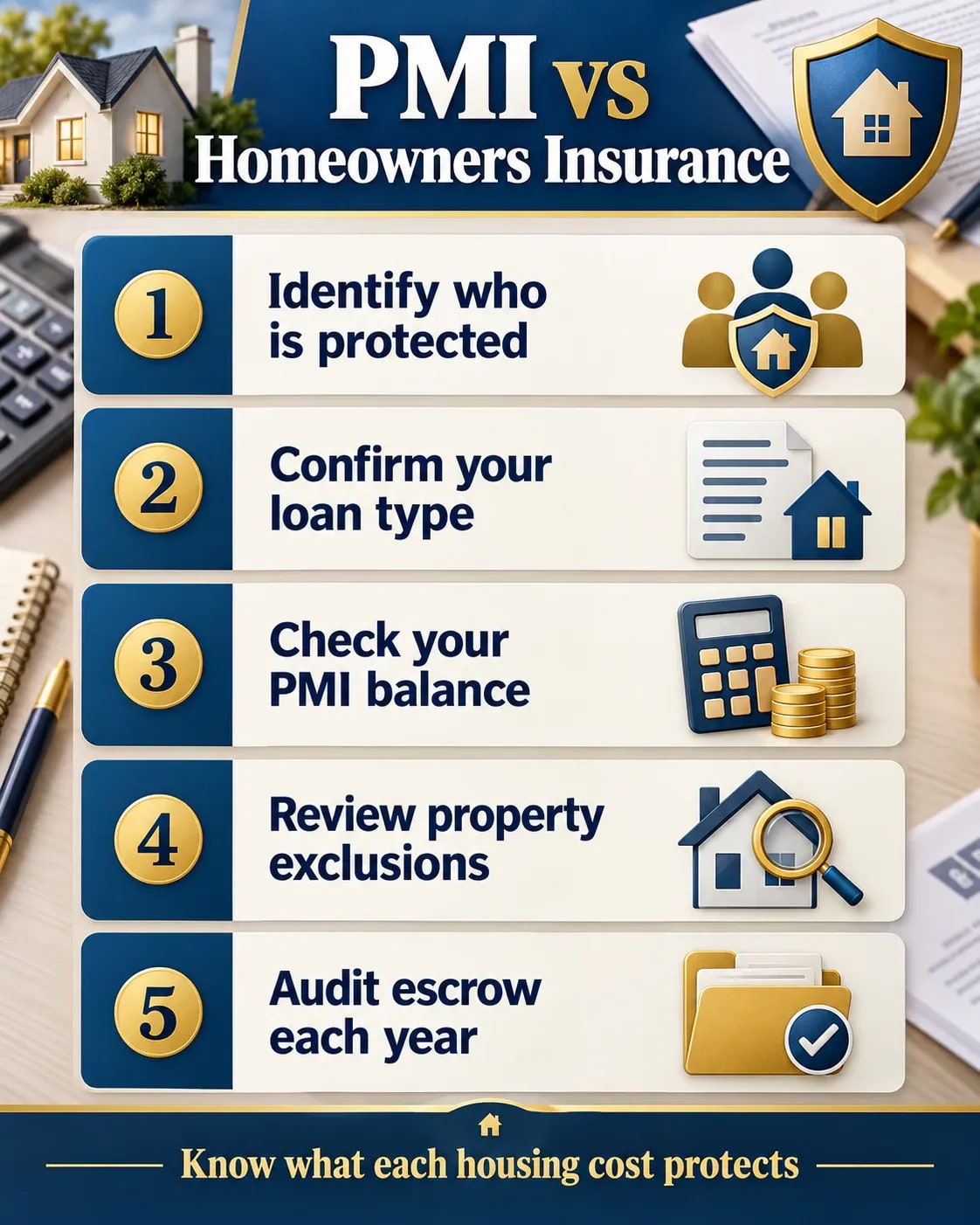
Once a year, review the mortgage balance, PMI status, homeowners declarations page, major exclusions and escrow analysis together. If you have conventional PMI, compare the current loan information with the servicer's cancellation requirements. For homeowners insurance, confirm that the policy reflects current rebuilding needs and significant risk exposures. Check whether separate flood or earthquake protection deserves attention. This routine will not eliminate every housing expense, but it makes it easier to recognize what you are paying for, who receives the protection and which costs may eventually change or disappear.

Private mortgage insurance and homeowners insurance are easy to confuse because both may appear as part of the cost of owning a financed home. They can even be paid through the same escrow account. But they solve completely different problems. PMI generally protects the mortgage lender against losses related to borrower default, while homeowners insurance protects the home, belongings and other covered interests against specified property and liability risks. The distinction matters because the rules governing each product are different, including when coverage is required, what triggers a payment and whether the cost can eventually disappear. This guide explains the mechanics in practical terms, including the conventional mortgage PMI rules described by the Consumer Financial Protection Bureau and the Homeowners Protection Act framework summarized by the FDIC. It is general educational information, not individualized financial, legal, tax or insurance advice.
Where people go wrong
Assuming PMI protects the homeowner. PMI primarily protects the mortgage lender against covered losses related to borrower default. It is not a substitute for property insurance or personal income protection.
Canceling homeowners insurance after PMI ends. PMI cancellation does not eliminate the need for homeowners insurance. They cover fundamentally different risks, and a mortgage lender may continue requiring property coverage.
Assuming every conventional PMI policy disappears at 80 percent. The 80 percent level is generally associated with the borrower's right to request cancellation on qualifying loans, subject to requirements. Automatic termination commonly uses a different threshold.
Applying conventional PMI rules to FHA or VA loans. Government-backed mortgages operate under different insurance, guarantee and fee systems. Identify the loan type before using conventional PMI cancellation rules.
Assuming homeowners insurance covers floods. Standard homeowners policies generally exclude flooding. Separate flood coverage may be needed or required depending on the property and mortgage.
Comparing insurance premiums without comparing coverage. A cheaper policy can have higher deductibles, lower limits or narrower protection. Compare equivalent policy terms before focusing on price.
Ignoring escrow statements. Changes in property taxes, insurance premiums or escrow shortages can raise the total mortgage payment even when the principal-and-interest portion has not changed.
Questions people ask
No. PMI generally protects the mortgage lender from certain losses related to borrower default. Homeowners insurance provides coverage for specified property and liability risks affecting the homeowner and the home.
Fixed it?
Get one guide like this every Thursday.