The Myth of No-Fee Foreign Transactions: What Your Credit Card Really Costs Abroad
A credit card with no foreign transaction fees can still cost more than expected abroad. Learn how exchange rates, card network conversions, and dynamic currency conversion affect what you pay - and how to spot unnecessary charges.

What you’ll need
Tap to tick things off before you start.
What No Foreign Transaction Fee Actually Means
A credit card advertised as having no foreign transaction fees generally means the issuer waives its standard surcharge on eligible international purchases. Some cards otherwise charge around 1% to 3%, depending on their terms. However, eliminating that surcharge does not guarantee the lowest possible dollar cost. The exchange rate used to convert a purchase still matters. Understanding no foreign transaction fee hidden costs starts with recognizing that a waived fee and a favorable conversion rate are different benefits.

How Currency Conversion Works on International Purchases
When you buy something priced in euros, yen, or another foreign currency, your U.S. credit card account usually needs the amount converted into dollars. For a transaction processed in local currency, the payment network generally applies its currency conversion procedure, although arrangements vary. The resulting dollar amount is sent through the payment system and recorded by your issuer. Visa and Mastercard provide currency conversion information, but their rates are not necessarily identical to publicly quoted market rates.

Foreign Transaction Fees Under Federal Regulations
The Consumer Financial Protection Bureau explains the treatment of certain foreign transaction charges under Regulation Z, Section 1026.4. Under the regulation's applicable provisions, charges imposed by an issuer or specified third parties and passed to consumers can qualify as finance charges. The rules address amounts exceeding a transaction value calculated using a qualifying conversion rate outside the relevant parties' control. Covered charges are subject to applicable disclosure requirements. Not every difference between exchange rates automatically constitutes a regulated fee.

How Exchange Rate Markups Increase Your Final Bill
An exchange rate markup increases the amount paid after converting currencies. Suppose a hypothetical benchmark converts 100 euros into $110, while another conversion produces $113. The $3 difference represents an additional conversion cost relative to that benchmark. However, identifying a legally defined foreign transaction fee requires examining the applicable conversion method, parties involved, and regulatory rules. An ordinary difference between a network rate and a market quotation is not sufficient evidence of an improper markup.

Who Controls Your International Credit Card Transaction?
Several organizations participate when you pay internationally. The merchant initiates the purchase, while its acquiring bank or payment processor handles the merchant's side. The card network connects participating institutions and routes transaction information. Your issuing bank authorizes the payment and bills your account. Other service providers may participate depending on the arrangement. Because responsibilities are divided, understanding which organization supplies a conversion rate or imposes a charge requires examining the specific transaction and payment terms.

Dynamic Currency Conversion: Why Paying in Dollars Can Cost More
Dynamic currency conversion occurs when a foreign merchant or ATM offers to charge your card in U.S. dollars instead of the local currency. This service typically uses a conversion rate offered by the merchant's payment provider, which may be less favorable than your card's normal rate. Selecting local currency generally avoids that particular conversion service. However, choosing dollars does not necessarily eliminate foreign transaction fees, and merchants should disclose applicable conversion details before you accept the offer.

Why Exchange Rates Change Between Purchase and Posting
A credit card purchase typically passes through authorization, clearing, and settlement before appearing as a finalized account charge. Authorization confirms that a transaction can proceed, while later processing establishes the posted amount. Currency exchange rates can change during that interval. Consequently, the rate applied to a purchase may differ from the rate available when you originally paid. Processing conventions vary by network and issuer, so the purchase date alone may not identify the applicable conversion rate.
How to Calculate the Actual Exchange Rate You Paid
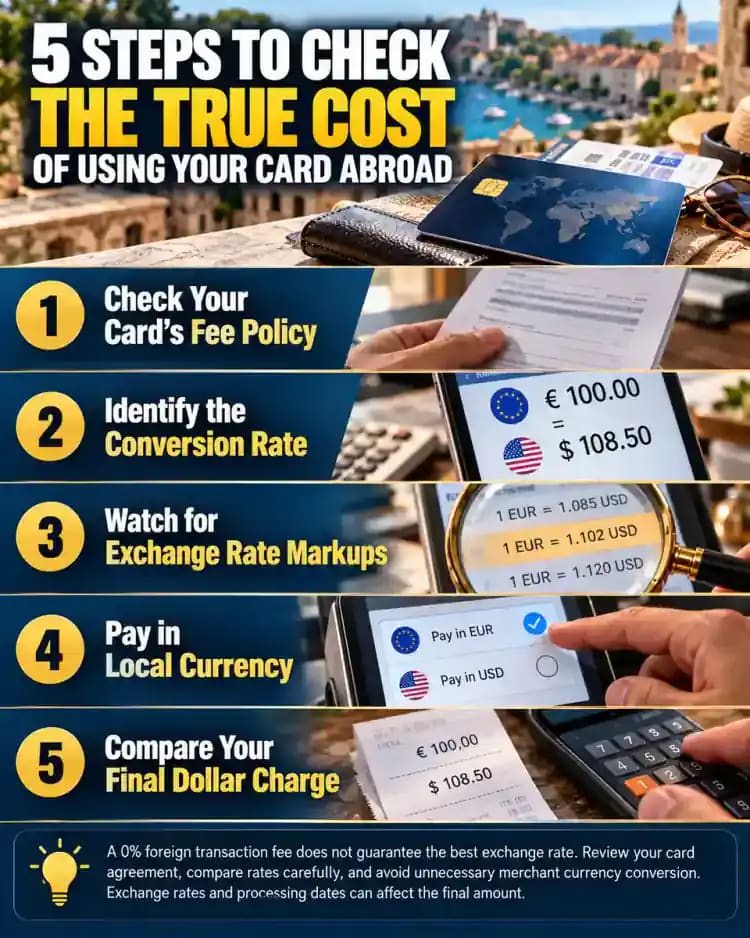
To estimate your effective exchange rate, divide the final posted dollar amount by the original purchase amount in foreign currency. For example, a 100 euro purchase posting as $112 produces an effective rate of $1.12 per euro. Compare that result with a relevant network conversion estimate for the processing period. Check whether separately listed fees affect the comparison. This calculation helps identify differences, but it cannot independently establish their cause or prove a regulatory violation.

How to Review Your Card Terms and Challenge Unexpected Charges
Find your current cardholder agreement through your issuer's website, mobile app, or customer service department. Examine foreign transaction fee provisions and currency conversion explanations. For an unexpected charge, ask which exchange rate was applied, when conversion occurred, and whether any additional fee was assessed. Keep receipts and written responses. If you suspect an error, contact the issuer promptly and follow its formal dispute procedures. The CFPB also accepts consumer complaints about unresolved financial product issues.

Your Pre-Travel Checklist for Avoiding Unnecessary Currency Costs
Before traveling, identify which cards waive foreign transaction fees and confirm their current terms. Check available credit, international acceptance, and account security settings. At checkout, recognize currency conversion offers and keep original receipts. Monitor posted purchases during your trip and afterward. For broader preparations, USA.gov provides official information about passports, travel documentation, and customs requirements. Keeping payment records organized and understanding your available options can reduce surprises without requiring expensive financial tools or services.

How to Compare Travel Credit Cards Beyond Foreign Transaction Fees
A 0% foreign transaction fee is only one factor in comparing travel credit cards. Examine annual fees, purchase APRs, rewards earning rates, redemption restrictions, and travel protections. For example, a card charging $95 annually must deliver enough value to justify that expense. Airport lounge access or travel insurance may be useful, but benefits often have eligibility conditions. Compare expected yearly costs against realistic rewards and benefits rather than assuming the most heavily advertised travel card offers the best value.

Visa vs. Mastercard: Do Currency Conversion Rates Differ?
Visa and Mastercard maintain separate currency conversion systems, so their exchange rates for the same currency pair can differ. Both provide online conversion calculators that help estimate international purchase costs. For a meaningful comparison, select the same currencies, transaction date, and any applicable bank fee assumptions. Calculator estimates may not match final posted charges because processing dates and issuer arrangements vary. Neither network consistently guarantees the better exchange rate across every currency, transaction, or period.

Foreign ATM Withdrawals and Cash Advance Charges
Withdrawing cash abroad using a credit card can trigger several charges unrelated to ordinary purchase fees. The ATM operator may impose a withdrawal surcharge, while your issuer may assess a cash advance fee. Cash advances commonly begin accruing interest immediately, without the grace period available for eligible purchases. Currency conversion can introduce additional differences. A card advertising no foreign transaction fees does not necessarily waive these expenses. Review the cash advance provisions before using an international ATM.

Foreign Currency Refunds and Exchange Rate Losses
A refund issued in foreign currency may produce a different dollar amount than the original purchase. Suppose an item costs 100 euros and initially posts as $110. If exchange rates move before the refund is processed, the returned amount might be $108 or $112. Issuer policies can also affect whether previously charged fees are refunded. A dollar difference does not automatically indicate an error. Compare the original purchase, refund currency, processing dates, and applicable card terms.

Online Foreign Purchases Can Carry International Costs
You do not need to leave the United States to encounter international card charges. Purchases from overseas retailers, digital subscriptions, and foreign service providers may qualify as international transactions under an issuer's policies. A website displaying dollar prices does not necessarily mean its payment processing occurs domestically. Conversely, a foreign currency price alone does not determine every applicable fee. Check the merchant's billing currency, payment terms, and your card agreement before completing unfamiliar international purchases.

How Much Can Small Currency Costs Add Up?
Small percentage differences become more noticeable as international spending increases. Consider a hypothetical trip involving $3,000 in purchases before additional conversion costs. An effective 1% extra cost adds $30, while 3% adds $90. On $8,000 in spending, those differences increase to $80 and $240. These examples illustrate the arithmetic, not typical charges or guaranteed savings. The actual amount depends on individual transactions, exchange rates, applicable fees, and the payment methods involved.

Credit Cards vs. Debit Cards for International Spending
Credit and debit cards can produce different financial consequences when used internationally. Credit cards generally charge purchases against a credit line, while debit cards withdraw money from a linked bank account. Fraud protections, reporting deadlines, account access, and reimbursement procedures can differ. Debit cards may be convenient for accessing cash, although ATM and international service fees can apply. Credit cards can offer purchase benefits but may generate interest when balances are carried. Compare each card's specific terms.

When an International Transaction Fee May Be a Billing Error
An unexpected international charge deserves examination, but it is not automatically a billing error. Warning signs include duplicate fees, charges inconsistent with disclosed terms, incorrect purchase amounts, or transactions you did not authorize. Compare the statement with your receipt and account agreement before contacting the issuer. Report suspected unauthorized activity promptly and ask about formal billing error procedures. Federal protections can depend on the transaction type, account category, and applicable reporting deadlines.

Consumer Protection Resources for International Card Charges
The Consumer Financial Protection Bureau provides educational resources about credit cards, finance charges, and consumer billing rights. Regulation Z addresses relevant disclosure requirements and certain billing protections for covered credit accounts. Consumers can also submit complaints through the CFPB when financial institutions fail to resolve concerns satisfactorily. Official regulatory information is available at consumerfinance.gov. These resources help explain general rights and complaint procedures, although eligibility, deadlines, and available remedies depend on the circumstances of each case.

The Bottom Line: What a No-Fee Credit Card Really Saves You
A card with no foreign transaction fees can eliminate a meaningful surcharge, particularly for frequent international spending. However, that benefit should not be confused with a promise of the lowest exchange rate or a completely cost-free payment experience. The actual dollar cost depends on conversion arrangements and the circumstances of each purchase. Understanding these distinctions makes advertised savings easier to evaluate. The most useful comparison considers the complete payment cost rather than a single advertised percentage.

How to Identify Fees Passed Through by Third Parties
A foreign transaction charge may originate with an organization other than your card issuer. Credit card networks, affiliated companies, and other processing participants can impose charges that an issuer may pass to cardholders. To investigate a questionable amount, request a breakdown identifying each fee, its source, and how it was calculated. Ask whether the charge represents an issuer fee or a third-party assessment. The CFPB's Regulation Z addresses the treatment of certain passed-through charges as finance charges.

Understanding Independent Currency Conversion Benchmarks
An independent currency conversion benchmark helps distinguish certain additional charges from the underlying value of a foreign currency transaction. Under the CFPB's Regulation Z, Section 1026.4, relevant rules refer to conversion rates outside the control of specified parties when determining particular finance charges. This regulatory concept differs from simply selecting a rate displayed by a search engine. Published market quotations may use different timestamps, sources, or methodologies. Therefore, an apparent rate difference does not establish a qualifying fee.

What Your Credit Card Statement May Not Show
Credit card statements commonly emphasize the final billed dollar amount, transaction date, merchant, and separately assessed charges. Depending on the issuer, they may not display the original foreign currency amount, exact conversion rate, or detailed processing history. These omissions can make international purchases difficult to reconstruct. Check the expanded transaction details in your banking app first. If information remains unavailable, request the original currency amount, conversion date, applied rate, and any associated processing charges from your issuer.

How Card Issuers Explain Exchange Rate Policies
Card issuers typically describe foreign currency transactions in their cardholder agreements, pricing disclosures, or account documentation. These materials may explain whether the payment network supplies the conversion rate and whether the issuer adds a separate charge. General advertising language does not necessarily contain every operational detail. Review the agreement applicable to your specific account, including any amendments. When wording is unclear, request an explanation of the conversion methodology and ask where the relevant policy appears in writing.

Foreign Transaction Fees on Recurring International Payments
Overseas subscriptions and recurring software payments can generate different dollar charges from month to month, even when the foreign currency subscription price remains unchanged. Exchange rate movements, processing dates, and applicable international transaction fees can influence each billing cycle. Some services also change billing currencies or payment processors. Review recurring charges using the original currency amount rather than comparing dollar totals alone. For unexpected increases, check subscription notices and contact the merchant or card issuer for clarification.

International Hotel Deposits and Currency Conversion
Hotels frequently place temporary authorization holds on credit cards to cover room charges, incidentals, or security deposits. An authorization is not necessarily the final amount billed. When the hotel completes the transaction, the posted charge may differ because of actual expenses, released holds, or currency conversion timing. Multiple pending entries do not automatically indicate duplicate charges. Compare the hotel's final invoice with settled transactions and allow for normal hold releases before identifying an unexplained billing difference.

How Foreign Currency Tips Affect Your Final Charge
Restaurant transactions sometimes begin with an authorization for the meal before a gratuity is added. Depending on local payment practices, the merchant may submit the final amount after including an approved tip. When that total is converted into dollars, the posted charge can exceed the initial authorization. Tips entered in local currency are generally part of the underlying purchase amount. Compare the signed receipt with the final transaction to distinguish an authorized gratuity from an unexplained adjustment.

Traveling With Cash: Currency Exchange and Customs Rules
Exchanging physical cash introduces costs that differ from card transactions. Banks and currency exchange counters may offer rates containing a spread between their buying and selling prices, sometimes alongside service fees. Compare the final amount of foreign currency received, not just advertised commission rates. USA.gov also provides guidance on U.S. customs declarations. Travelers generally must report transportation of more than $10,000 in combined currency and certain monetary instruments when entering or leaving the United States.

Where to Find Official U.S. International Travel Guidance
USA.gov maintains an official travel information hub at https://www.usa.gov/travel. It directs travelers to resources covering U.S. passports, renewal procedures, international travel documents, and customs requirements. Destination-specific entry rules may also require checking official foreign government information. These resources support travel preparation but do not determine individual credit card conversion rates or issuer charges. For card pricing questions, consult your financial institution and relevant Consumer Financial Protection Bureau materials instead of treating general travel guidance as financial regulation.

How to Keep Accurate Records of International Purchases
A simple transaction log makes international spending easier to verify. Record each merchant, original currency amount, purchase date, posted dollar amount, and any separately listed fee. Save electronic receipts, especially when a terminal offers currency conversion choices. Add the final posting date and note any issuer explanations or correspondence. A spreadsheet or secure notes app is sufficient for most travelers. Organize records by trip and avoid storing complete card numbers or other unnecessary sensitive financial information.

You are sitting at a restaurant in Paris, ready to pay a 100 euro bill. Your credit card advertises no foreign transaction fees, so you expect a straightforward conversion into U.S. dollars. But when the charge appears on your statement, the amount is higher than you anticipated. What happened?
A no-foreign-transaction-fee credit card eliminates a particular category of charges, but it does not guarantee that every international purchase will use the most favorable exchange rate. The final dollar amount can depend on the card network's conversion rate, when the transaction is processed, and whether you accepted a merchant's offer to convert the purchase into dollars.
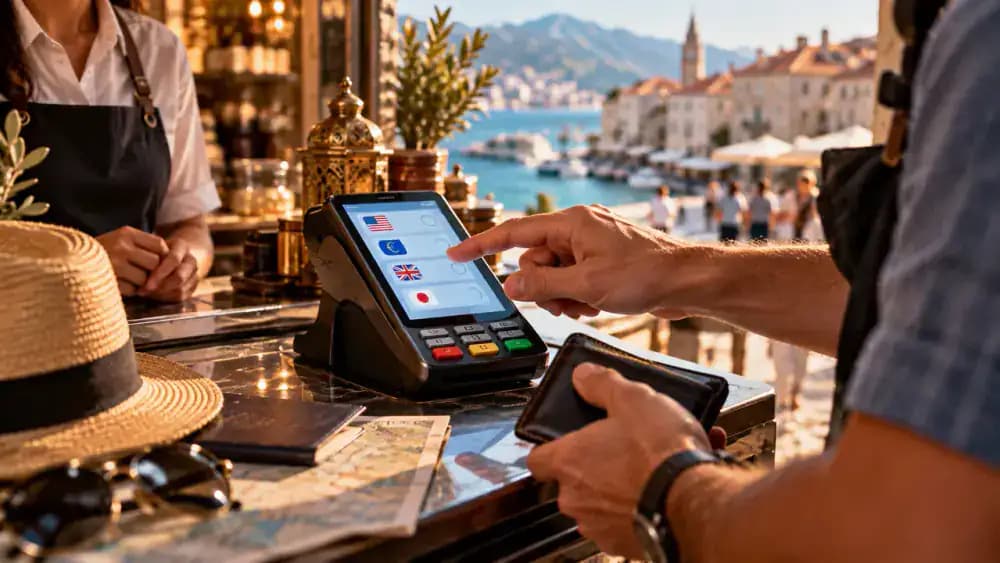
That last option is called dynamic currency conversion, or DCC. It often appears when a payment terminal asks whether you want to pay in U.S. dollars or the local currency. Choosing dollars may feel more convenient, but the merchant's conversion provider can apply a less favorable rate. Paying in local currency generally allows your card's normal conversion process to apply.
Federal rules also matter. The Consumer Financial Protection Bureau's Regulation Z, Section 1026.4, addresses how certain foreign transaction charges are treated as finance charges. However, an unfavorable exchange rate alone does not automatically establish that a legally defined foreign transaction fee was charged.
This guide explains how to distinguish disclosed fees from currency conversion costs, check your card agreement, compare exchange rates, and identify charges worth questioning. You can complete these checks without buying financial software or paying for professional advice.
Where people go wrong
Assuming Zero Foreign Transaction Fees Means Zero Conversion Costs. A card advertising no foreign transaction fees can still produce a dollar amount different from a rate you found online. Network conversion rates, processing dates, and merchant conversion services can affect the final price without necessarily creating a separate issuer fee.
Choosing U.S. Dollars at a Foreign Payment Terminal. When a terminal offers to charge you in dollars, the merchant's dynamic currency conversion provider may use a less favorable rate. Paying in the local currency generally avoids that conversion service and allows your card's normal exchange process to apply.
Comparing Exchange Rates from Different Dates. Exchange rates change throughout the day, and a transaction may be converted when it is processed rather than when you make the purchase. Comparing your posted charge against a rate from another date can create a misleading impression of excessive fees.
Ignoring Third-Party Charges. A card issuer may not be the only organization involved in an international transaction. Card networks and other parties can influence processing costs. Review your agreement and ask which entity applied a charge instead of assuming every difference originated with your bank.
Treating Every Exchange Rate Difference as an Illegal Fee. A difference between your card's exchange rate and a published market rate does not automatically prove a disclosure violation. Regulation Z contains specific rules for foreign transaction charges, and the applicable benchmark and source of any markup matter.
Checking Only for Separate Fee Lines. Some currency conversion costs affect the total amount rather than appearing as a separate statement entry. Compare the original foreign currency amount with the posted dollar charge, and request clarification when you cannot identify the conversion method.
Overlooking International ATM Charges. A credit card with no foreign transaction fees may still charge cash advance fees and interest on ATM withdrawals. The ATM operator might impose additional charges. Review cash advance terms before withdrawing money abroad with a credit card.
Questions people ask
No. It generally means the issuer does not assess its stated foreign transaction fee on qualifying purchases. Currency conversion still occurs, and the exchange rate can differ from rates displayed online. Merchant-provided dynamic currency conversion, ATM fees, and cash advance charges may create additional costs depending on the transaction.
Fixed it?
Get one guide like this every Thursday.