Municipal Bonds vs. Corporate Bonds: Taxes, Yields, and Credit Risk
Municipal bonds can offer tax-free interest, while corporate bonds often pay higher yields. Learn how taxes, credit ratings, default risk, and tax-equivalent yield affect your returns - and how to compare both options.

What you’ll need
Tap to tick things off before you start.
Municipal Bonds vs. Corporate Bonds: Key Differences
Municipal bonds and corporate bonds are fixed-income securities that allow investors to lend money in exchange for promised interest payments and principal repayment. Municipal bonds represent debt issued by government-related entities, while corporate bonds represent debt issued by businesses. According to Investor.gov, both provide potential income but carry investment risks. Their differences in taxation, typical yields, and issuer characteristics make direct comparisons important. Neither category guarantees returns, and individual securities can vary substantially within each market.

Who Issues Municipal and Corporate Bonds?
Municipal bonds are issued by states, cities, counties, and certain public authorities to finance projects such as schools, transportation systems, and water facilities. Their repayment sources may include taxes or revenue generated by specific services. Corporate bonds are issued by businesses seeking capital for expansion, equipment, research, or acquisitions. Companies generally repay debt using operating cash flow or other financing sources. Understanding an issuer's purpose and available resources helps explain how its borrowing obligations are supported.

How Municipal Bond Tax Exemptions Work
Interest on most municipal bonds is exempt from federal income tax, according to Investor.gov. Interest may also qualify for state and local exemptions, particularly when the investor resides in the issuing state. However, exemptions depend on the specific bond and applicable tax rules. Some municipal bonds generate federally taxable interest, while certain private activity bonds can create alternative minimum tax exposure. Profits from selling municipal bonds may also be taxable, making verification of each security's tax treatment essential.

How Corporate Bond Interest Is Taxed
Corporate bond interest is generally treated as ordinary taxable income in the United States. Federal income taxes apply, and state or local income taxes may also apply depending on the investor's jurisdiction. For example, $1,000 in annual interest subject to a 24% federal marginal rate would leave $760 after federal income tax, assuming no other adjustments. Additional applicable taxes could reduce that amount. Tax treatment can also differ for retirement accounts and certain bond structures.

Municipal vs. Corporate Bond Yields Explained
A bond's coupon rate describes its stated interest payments relative to face value, while its current yield compares annual coupon payments with its market price. Yield to maturity estimates annualized returns when a bond is purchased at its current price and held until maturity, assuming scheduled payments occur and other calculation assumptions hold. Bonds purchased at discounts or premiums can produce yields different from their coupons. Tax-exempt municipal bonds often offer lower quoted yields than comparable taxable corporate bonds.

How to Calculate Tax-Equivalent Yield
Tax-equivalent yield estimates the taxable return needed to match income from a tax-exempt bond. Use this formula: tax-exempt yield / (1 - applicable marginal tax rate). Suppose a municipal bond yields 3.5% and the applicable federal marginal rate is 24%. Dividing 3.5% by 0.76 produces approximately 4.61%. Under these simplified assumptions, a taxable bond must yield about 4.61% to match the municipal bond's after-federal-tax income. State taxes, fees, and other circumstances can change the comparison.

Credit Risk and Default: Which Bonds Are Safer?
Credit risk is the possibility that a bond issuer cannot make promised payments. Municipal issuers may rely on taxes or project revenues, while corporations typically depend on business finances. Both can experience financial distress and default. Investor.gov emphasizes evaluating bond creditworthiness rather than assuming safety from an issuer's identity. In corporate bankruptcy, bondholders generally rank ahead of shareholders, although secured and unsecured claims differ. Priority does not guarantee recovery, and losses can still be substantial.

Interest Rate, Inflation, and Liquidity Risks
Interest rate risk arises because existing fixed-rate bond prices generally fall when market yields rise. Longer-duration bonds are usually more sensitive to these changes. Inflation risk occurs when rising consumer prices reduce the purchasing power of future interest payments. Liquidity risk means investors may struggle to sell bonds promptly at favorable prices, especially in thinly traded markets. These risks affect municipal and corporate securities alike. Selling before maturity can therefore produce losses even without an issuer default.

How to Compare Bonds Before Investing
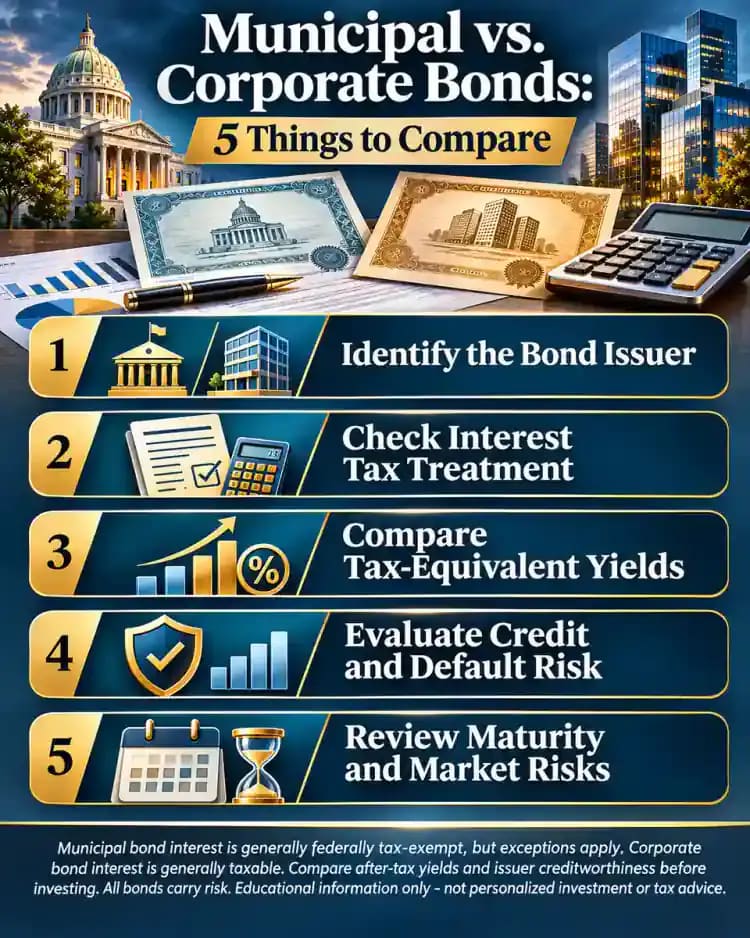
A useful bond comparison starts with five checks: issuer credit ratings, maturity date, stated yield, call provisions, and total transaction costs. Review official offering documents to identify repayment terms, collateral, and unusual conditions. Callable bonds deserve particular attention because early redemption can affect realized returns. Brokerage markups and bid-ask spreads also influence investment costs. Compare securities using consistent assumptions, including similar maturities and credit quality, and examine available issuer disclosures before drawing conclusions.

Which Bond Type Fits Your Investment Goals?
Choosing between municipal and corporate bonds depends on how potential income fits broader investment objectives. Marginal tax rates influence the relative appeal of tax-exempt interest, while account types can change the value of those exemptions. Investors also consider income requirements, investment horizons, and the balance between stability and return potential. Diversification across issuers and securities can reduce concentration risk, although it cannot eliminate losses. A qualified financial or tax professional can evaluate circumstances requiring personalized guidance.

General Obligation vs. Revenue Municipal Bonds
General obligation bonds are typically backed by a government's taxing authority, although specific pledges and legal protections vary. Revenue bonds instead rely primarily on income from designated projects or services, such as toll roads, airports, or water systems. According to Investor.gov, understanding these repayment arrangements is important when evaluating municipal securities. A revenue bond's financial strength depends partly on the project's ability to generate sufficient income, while general obligation bonds depend on the issuer's available governmental resources.

Investment-Grade vs. High-Yield Corporate Bonds
Corporate bonds are commonly classified as investment-grade or speculative-grade debt. Investment-grade ratings generally begin at BBB- from S&P Global Ratings and Fitch, or Baa3 from Moody's. Lower ratings indicate greater perceived credit risk and are commonly associated with high-yield bonds. Investors typically demand higher yields to compensate for increased uncertainty about repayment. However, an investment-grade rating does not eliminate default risk, and a speculative-grade rating does not mean default is inevitable. Financial conditions can change after issuance.

Understanding Bond Credit Ratings
Credit rating agencies such as Moody's, S&P Global Ratings, and Fitch assess an issuer's relative ability to meet debt obligations. Their ratings can change following financial deterioration, improving finances, or economic developments. Ratings are opinions about creditworthiness, not guarantees or predictions of investment returns. A rating downgrade may also influence a bond's market value. Investors can supplement ratings by reviewing financial statements, debt burdens, repayment coverage, and available issuer disclosures rather than relying exclusively on agency assessments.

How Bond Payments and Principal Repayment Work
Traditional fixed-rate bonds commonly pay interest every six months, although payment schedules vary. A $10,000 bond with a 4% annual coupon would typically distribute $200 twice yearly. Principal is generally repaid at maturity, assuming the issuer fulfills its obligations. Some bonds instead repay principal gradually through scheduled amortization. Zero-coupon bonds make no periodic interest payments and are generally purchased at a discount, with value realized at maturity. Actual returns depend on purchase price, repayment terms, and issuer performance.

What Happens When a Bond Is Called Early?
A callable bond allows its issuer to redeem the security before its scheduled maturity under specified conditions. Issuers may exercise this option when borrowing costs decline, replacing older debt with cheaper financing. Investors then receive the applicable redemption amount but lose expected future interest payments. Reinvesting those proceeds may produce lower income. Yield to call estimates returns if redemption occurs on a specified call date, while yield to worst highlights the lowest applicable calculated yield under relevant redemption scenarios.

Buying Individual Bonds vs. Bond Funds
Individual bonds provide direct ownership of specific debt securities with identifiable payment terms and maturity dates. Bond mutual funds and exchange-traded funds instead hold portfolios of securities, offering diversification without purchasing each bond separately. Funds charge operating expenses and generally do not promise repayment of an investor's original investment on a particular date. Their share prices fluctuate with portfolio values. Individual bonds also fluctuate in market value and can expose investors to concentrated issuer risk, particularly with limited holdings.

How to Buy Municipal and Corporate Bonds
Investors commonly purchase municipal and corporate bonds through brokerage accounts. New issues are sold when issuers first raise funds, while existing securities trade in secondary markets. Availability, minimum denominations, and transaction costs vary by security and brokerage. Many bonds trade in denominations of $1,000 or $5,000, although actual requirements differ. Before placing an order, investors can examine quoted prices, available quantities, settlement terms, and embedded dealer markups. A submitted order does not necessarily execute at the initially displayed price.

Where to Research Bond Issuers and Disclosures
The Municipal Securities Rulemaking Board operates EMMA, a public resource for municipal bond disclosures, trade information, and official statements. For corporate bonds, FINRA provides market information through its fixed-income resources, including reported transaction data. Issuer websites and regulatory filings may also contain audited financial statements, debt obligations, and material developments. Investor.gov offers educational explanations of bond features and risks. Comparing these sources helps distinguish an issuer's contractual promises from its actual financial condition and market trading history.

Building a Bond Ladder for Predictable Cash Flow
A bond ladder spreads investments across securities with different maturity dates rather than concentrating repayment in one year. For example, a five-year ladder might include bonds maturing annually from years one through five. As each bond matures, its principal becomes available for spending or reinvestment. This structure can provide scheduled cash flows and reduce dependence on a single reinvestment date. However, coupon payments differ, market values fluctuate, and defaults or early redemptions can disrupt expected cash flows.

When to Consult a Financial or Tax Professional
Professional guidance can be valuable when bond decisions involve substantial capital, complicated tax circumstances, or concentrated exposure to individual issuers. A qualified tax professional can clarify potential state exemptions, alternative minimum tax implications, and unusual security structures. A financial advisor can help evaluate investment objectives, portfolio concentration, and the consequences of different repayment schedules. Investors can also ask professionals to explain compensation arrangements, potential conflicts of interest, and applicable professional credentials before engaging their services.

How Economic Conditions Affect Bond Issuers
Economic downturns can weaken bond issuers by reducing the income available for debt payments. Corporations may experience declining sales, shrinking profit margins, and tighter access to financing. Municipal governments can face lower tax collections, weaker economic activity, and increased demand for public services. Rising borrowing costs may further strain both groups. However, the effects vary across industries and communities. Essential services and financially resilient businesses may withstand downturns better than issuers dependent on economically sensitive revenue.

Secured vs. Unsecured Corporate Bonds
Secured corporate bonds are backed by specified collateral, such as equipment, real estate, or other assets. Unsecured bonds, often called debentures, depend primarily on the issuer's contractual promise to repay. Creditor seniority also matters because senior debt generally receives payment priority over subordinated obligations. Collateral can improve potential recovery if an issuer defaults, but its value may decline or prove difficult to realize. Investors must examine security agreements and debt rankings to understand their actual legal protections.

What Bondholders Can Recover After Default
When a corporate issuer defaults, bondholders may negotiate restructuring terms or pursue claims through bankruptcy proceedings. Recovery depends on available assets, collateral rights, creditor seniority, and the company's financial condition. Some investors receive cash, replacement securities, or equity instead of full repayment. A recovery rate measures the proportion of a claim ultimately recovered. For example, recovering $4,000 on a $10,000 claim represents 40%. Bankruptcy proceedings can take years, and some creditors recover little or nothing.

How Municipal Governments Generate Repayment Revenue
Municipal governments collect revenue through property taxes, sales taxes, income taxes where authorized, and charges for public services. Utilities may generate fees from water, electricity, or wastewater customers. These collections help support operating expenses and eligible debt obligations. However, revenue sources differ substantially among jurisdictions and bond agreements. Local governments must also fund essential services, infrastructure maintenance, and employee compensation. Understanding how revenue is collected and legally allocated helps explain the financial resources supporting municipal debt.

Warning Signs of Municipal Financial Distress
Municipal financial problems often emerge gradually. Warning signs include persistent budget deficits, declining property values, population losses, shrinking tax collections, and growing pension or retiree benefit obligations. For revenue-supported debt, weakening customer demand or insufficient debt service coverage can indicate additional pressure. Repeated use of reserves to finance ordinary operations may also suggest structural imbalances. No single indicator establishes impending default, but several deteriorating measures together warrant closer examination of the municipality's financial sustainability.

How to Evaluate an Issuer's Financial Health
Evaluating an issuer requires examining financial capacity rather than relying on promised payments alone. For corporations, useful measures include operating cash flow, debt relative to earnings, interest coverage, and available liquidity. Municipal analysis may emphasize reserves, outstanding obligations, budget performance, and pledged revenue coverage. Audited financial statements provide historical evidence, while management projections introduce uncertainty. Comparing several reporting periods can reveal improving or deteriorating trends. Different industries and government structures require different benchmarks for meaningful financial comparisons.

Why Tax-Exempt Bond Yields Are Often Lower
Tax-exempt municipal bonds often offer lower stated yields because investors value income that generally avoids federal income tax. This advantage can increase demand, allowing qualifying government issuers to borrow at lower interest rates than otherwise comparable taxable borrowers. Corporate bond investors generally require compensation for taxable interest and issuer-specific risks. However, market pricing also reflects maturity, credit quality, liquidity, and available supply. Consequently, the yield difference between municipal and corporate securities changes as economic conditions and investor demand evolve.

How Your Tax Bracket Changes the Yield Comparison
Consider a municipal bond yielding 3.5% with interest fully exempt from federal income tax and a corporate bond yielding 4.5%. At a 12% federal marginal rate, the corporate bond's simplified after-tax yield is 3.96%. At 24%, it falls to 3.42%, and at 32%, it becomes 3.06%. These examples illustrate how higher marginal rates can increase the relative appeal of tax-exempt interest. They exclude state taxes, transaction costs, and differences in bond risk.

Comparing Bond Returns Across Different States
State residency can materially affect municipal bond returns. Many states exempt interest from their own qualifying municipal bonds while taxing interest from bonds issued elsewhere. Rules differ, however, and some states have no individual income tax. Consider two federally tax-exempt bonds with identical yields: their after-tax results may differ for a resident whose state taxes one issue but exempts the other. Special exemptions and bond-specific rules complicate comparisons, making the applicable state treatment important to verify.

Stress-Testing a Fixed-Income Portfolio
Stress-testing examines how hypothetical adverse conditions could affect a bond portfolio. A scenario involving rising interest rates can estimate potential market value declines, while issuer downgrades may reveal vulnerability to widening credit spreads. Inflation shocks test the purchasing power of expected payments. Unexpected cash needs highlight the consequences of selling securities during unfavorable markets. Comparing these scenarios across holdings helps identify concentrated exposures and potential weaknesses. Stress tests illustrate possibilities rather than predict future losses or guarantee resilience.

Municipal bonds vs. corporate bonds: Which investment actually puts more money in your pocket? The answer depends on more than the interest rate printed on a bond. Taxes, credit quality, maturity dates, and your financial circumstances can all change which option delivers better value.
When you buy a bond, you lend money to an issuer in exchange for promised interest payments and repayment of principal under the bond's terms. Municipal bonds are issued by state and local governments or related public entities, often to finance schools, roads, hospitals, and infrastructure. Corporate bonds are issued by businesses seeking capital for expansion, operations, acquisitions, or other commercial purposes.
The biggest practical difference is taxation. Interest on most municipal bonds is exempt from federal income tax and may also qualify for state or local exemptions. Corporate bond interest is generally taxable. That means a municipal bond paying 3.5% could potentially provide more after-tax income than a corporate bond paying 4.5%, depending on your marginal tax rate and the applicable exemptions.
But tax savings do not automatically make municipal bonds the better investment. Both categories carry credit risk, and their market prices can fall when interest rates rise. Liquidity, inflation, fees, and the issuer's financial condition also matter.
This guide explains how municipal and corporate bonds differ, how to calculate tax-equivalent yield, and what to examine before investing. You'll learn how to compare potential after-tax returns without overlooking the risks that could reduce your investment's value.
Where people go wrong
Comparing Interest Rates Without Accounting for Taxes. A corporate bond offering 5% may look more attractive than a municipal bond yielding 4%. However, income taxes can reverse that comparison. Calculate after-tax returns or tax-equivalent yields before deciding which investment actually provides more income.
Assuming Every Municipal Bond Is Completely Tax-Free. Not all municipal bond interest receives identical tax treatment. Certain bonds may generate federally taxable interest or trigger alternative minimum tax considerations. State exemptions also vary. Verify the specific security's tax status instead of assuming every municipal bond is exempt.
Treating Municipal Bonds as Risk-Free Investments. Government issuers can experience financial distress, revenue shortages, or defaults. Some municipal bonds depend on particular project revenues rather than broad taxing authority. Examine the issuer's financial condition, repayment sources, and credit ratings before committing money.
Choosing the Highest Yield Without Investigating Credit Risk. An unusually high bond yield may compensate investors for substantial default risk, poor liquidity, or unfavorable contractual terms. Higher promised returns are not guaranteed returns. Investigate why a bond offers more income before accepting the additional exposure.
Ignoring Interest Rate Risk and Maturity. Bond prices generally decline when market interest rates rise, with longer-duration bonds typically experiencing greater sensitivity. Investors who sell before maturity may realize losses even when the issuer remains financially healthy. Match bond duration and maturity to your expected cash needs.
Confusing Coupon Rate With Actual Investment Yield. A bond's coupon describes its stated interest payments, but your investment yield also depends on the price you pay. Purchasing above or below face value changes your potential return. Compare yield to maturity and relevant call-adjusted yields rather than coupon rates alone.
Overlooking Callable Bonds and Transaction Costs. Issuers may redeem callable bonds before maturity, potentially forcing reinvestment at lower rates. Brokerage markups, markdowns, and bid-ask spreads can further reduce returns. Check call provisions, yield to worst, and trading costs before comparing competing securities.
Questions people ask
Municipal bonds are issued by state and local governments or related public entities, usually to finance public services and infrastructure. Corporate bonds are issued by businesses to raise capital. Municipal bond interest is often exempt from federal income tax, while corporate bond interest is generally taxable. Both involve credit and market risks.
Fixed it?
Get one guide like this every Thursday.