Marginal Tax Rates Explained: Why a Higher Tax Bracket Does Not Tax All Your Income
Marginal tax rates apply different tax rates to different layers of taxable income. Learn why entering a higher federal tax bracket does not cause all of your income to be taxed at the higher rate.

What you’ll need
Tap to tick things off before you start.
1. Start With the Tax Bracket Myth
The most important misconception to remove is the idea that crossing into a higher federal income tax bracket causes all of your income to be taxed at the new rate. That misunderstanding can make a perfectly reasonable raise look financially dangerous.
Federal income tax brackets do not normally work like an on-off switch. Instead, they divide taxable income into layers. Each layer can be taxed at the rate assigned to that bracket. If part of your taxable income reaches a higher bracket, earlier portions remain subject to the rates that applied to those portions.
This distinction is the foundation for understanding marginal tax rates.

2. Understand Why the Myth Matters
Confusion about tax brackets can affect real decisions. Someone might decline overtime, avoid a bonus, or hesitate to accept a promotion because they assume the additional income will cause their entire salary to be taxed more heavily.
That can turn a misunderstanding into a financial cost. Before deciding whether additional work is worthwhile, separate the tax mechanics from other considerations such as commuting costs, child care, retirement contributions, benefit changes, or the value of your time.
The tax bracket itself should be evaluated using the actual marginal structure rather than fear of crossing a threshold.

3. Know What Progressive Taxation Means
USA.gov explains that the federal income tax system uses a progressive structure. In this context, progressive simply means that tax rates increase across specified ranges of taxable income.
Think of the structure as a staircase. As taxable income rises, additional dollars can move onto higher steps. Reaching a new step does not pull all of the earlier dollars onto that step.
This differs from a flat tax structure, where one rate would generally apply across the relevant tax base. Understanding that distinction makes the federal bracket system much easier to visualize.

4. Separate Gross Income From Taxable Income
Tax brackets apply to taxable income, not necessarily the salary number printed on your job offer. Gross income and taxable income are related, but they are not automatically identical.
Taxable income is determined after applying the rules relevant to the taxpayer and tax year. Depending on the situation, deductions can reduce the amount of income that is ultimately subject to the federal income tax brackets.
This is why someone cannot reliably identify a person's marginal bracket by looking only at annual salary. Filing status, deductions, and other tax rules also matter.

5. Picture Income as Stacked Buckets
One of the easiest ways to understand marginal tax rates is to imagine several buckets stacked vertically. Each bucket represents a tax bracket.
Income first fills the lowest applicable bucket. Once that bucket is full, additional taxable income flows into the next bucket. If income continues rising, later dollars may eventually flow into another bucket with a higher rate.
The important point is that income already sitting in the lower buckets stays there. Filling a higher bucket does not change the tax rate that applied to income in the buckets below it.

6. See What Happens in the First Bracket
Suppose the first portion of your taxable income falls into the lowest applicable federal bracket. Every dollar within that range is taxed according to the rate assigned to that bracket.
If your taxable income remains entirely within that first range, no dollars reach the next bracket. If your income rises enough to cross the threshold, the dollars already inside the first bracket remain taxed under the first bracket's rate.
Nothing retroactively changes simply because your final dollar landed above the threshold.

7. Watch the Next Dollars Move Higher
Once taxable income exceeds the upper limit of a bracket, only the excess moves into the next bracket. Those additional dollars are subject to the next marginal rate.
This is where many taxpayers misinterpret the phrase higher tax bracket. Being in a higher bracket does not mean the higher percentage suddenly applies to everything earned during the year. It describes the rate applied to the next portion of taxable income within that range.
The threshold determines where the next layer begins, not where all earlier income is reclassified.

8. Define Your Marginal Tax Rate
Your marginal federal income tax rate is the rate that applies to the next dollar of taxable income within your current bracket, assuming no other changes.
That makes the marginal rate useful when evaluating additional income. If you receive more taxable income, part of that income may be taxed at your existing marginal rate, and another part may enter the next bracket if it crosses a threshold.
The marginal rate is therefore a decision-making concept. It helps explain the tax treatment of additional taxable income, but it should not be confused with the percentage of your total income that you actually pay in federal income tax.

9. Distinguish Marginal Rate From Effective Rate
Your effective federal income tax rate is different from your marginal rate. An effective rate generally compares total federal income tax with a broader income measure used for the calculation.
Because taxable income can be spread across multiple brackets, the average rate paid across that income is often lower than the highest marginal rate reached.
For example, someone whose highest taxable dollars fall into a particular bracket does not generally pay that bracket's percentage on every taxable dollar. Earlier layers remain subject to their respective lower rates. That weighted combination produces a different overall percentage.

10. Use a Simple Hypothetical Example
Imagine a fictional tax system with three brackets: 10 percent on the first $20,000 of taxable income, 20 percent on the next $30,000, and 30 percent on taxable income above $50,000.
A person with $55,000 of taxable income would not owe 30 percent of $55,000. Instead, the first $20,000 would be calculated at 10 percent, the next $30,000 at 20 percent, and only the final $5,000 at 30 percent.
These numbers are intentionally fictional and are not current IRS brackets. The example exists only to demonstrate marginal taxation.

11. Calculate the Fictional Example Layer by Layer
Using the fictional brackets, the tax calculation would be separated into three pieces. The first $20,000 produces $2,000 of tax at 10 percent. The next $30,000 produces $6,000 at 20 percent. The final $5,000 produces $1,500 at 30 percent.
The hypothetical total is therefore $9,500. Applying 30 percent to the entire $55,000 would incorrectly produce $16,500.
That difference illustrates exactly why understanding marginal tax rates matters. The highest bracket reached is not a shortcut for calculating tax on all taxable income.

12. See Why a Small Raise Still Adds Income
Now imagine the same fictional taxpayer's taxable income rises from $55,000 to $56,000. Only the additional $1,000 is added to the highest bracket in this simplified example.
At a fictional marginal rate of 30 percent, that extra $1,000 would create $300 of additional federal income tax, leaving $700 before considering other taxes, withholding, benefits, or adjustments.
The person's existing $55,000 is not recalculated entirely at 30 percent. This is the central reason crossing a federal income tax bracket does not by itself erase the value of a raise.

13. Understand What a Bracket Threshold Really Does
A bracket threshold is simply the point where the tax rate applied to the next portion of taxable income changes. It is not a financial cliff for federal income tax brackets themselves.
If one additional dollar pushes taxable income across a threshold, that dollar can be taxed at the next rate while prior dollars continue to be treated according to the lower brackets.
This is why statements such as do not earn another dollar or you will lose money to the next bracket misunderstand the mechanics of progressive taxation.

14. Recognize That Paychecks Can Still Look Different
Although marginal brackets do not make your entire income subject to the highest rate reached, an individual paycheck may still change in ways that are not obvious from the tax brackets alone.
Employers withhold federal income tax using payroll rules and information from your Form W-4. A bonus, overtime payment, or irregular paycheck can have withholding that looks unexpectedly high. Withholding is a prepayment toward tax liability, not necessarily the final amount of federal income tax ultimately owed.
That distinction explains why a paycheck can feel heavily taxed even when the annual tax calculation works differently.

15. Do Not Confuse Withholding With Your Tax Rate
A common mistake is to divide tax withholding on one paycheck by gross pay and assume that percentage is your tax bracket. Payroll withholding can include federal income tax, Social Security tax, Medicare tax, state tax, local tax, and other deductions.
Your paycheck may also include health insurance premiums, retirement plan contributions, flexible spending contributions, garnishments, or other deductions that have nothing to do with federal marginal brackets.
To understand a raise accurately, examine each line item separately instead of treating the difference between gross and net pay as one tax percentage.

16. Account for Payroll Taxes Separately
Federal income tax is not the only federal tax workers may see on earnings. Payroll taxes such as Social Security and Medicare operate under their own rules and should not be confused with federal income tax brackets.
That matters when estimating take-home pay from additional wages. Even if you understand your federal marginal income tax rate, your actual increase in net pay can also reflect payroll taxes and other paycheck deductions.
The broader lesson is that marginal federal income tax explains one important piece of the calculation, not every dollar deducted from compensation.

17. Check Your Filing Status
Federal tax bracket thresholds vary by filing status. That means two taxpayers with the same taxable income may not necessarily encounter the same bracket boundaries if their filing statuses differ.
When reviewing brackets, make sure you are looking at the correct filing status and tax year. Using the wrong column can produce an inaccurate estimate even if the mathematical method is otherwise correct.
IRS Publication 17 and other official IRS materials explain filing rules and federal income tax concepts for individual taxpayers.

18. Remember That Deductions Affect Taxable Income
Deductions can reduce taxable income, which means they can affect how much income reaches higher federal tax brackets. The standard deduction is one familiar example, although individual circumstances and tax rules determine what applies.
This is another reason gross salary alone does not reveal final tax liability. Two workers earning the same gross pay might have different taxable income depending on their circumstances.
When estimating marginal tax exposure, use taxable income as the relevant concept rather than simply comparing gross annual salary with a bracket table.

19. Understand How Tax Credits Differ
Tax credits operate differently from deductions. A deduction generally affects the amount of income subject to tax, while a tax credit generally reduces tax liability under the rules governing that credit.
Credits can therefore change the final amount owed without changing the basic marginal bracket structure itself. Some credits have income limits, phaseouts, refundability rules, eligibility requirements, or other conditions.
Because credits can be highly situation-specific, use current official guidance or professional assistance when a credit materially affects a financial decision.

20. Look Beyond Federal Income Tax
A raise can increase net income under the federal marginal bracket system while still interacting with other taxes and costs. State income taxes may use different brackets, flat rates, deductions, or exemptions. Some local governments also impose income-related taxes.
Your compensation package may also change employee benefit costs or contributions. If a promotion requires relocation, increased commuting, professional licensing, or child care, those economic costs belong in the decision as well.
The federal bracket myth should be corrected, but a complete financial comparison should still consider the full set of relevant costs.

21. Watch for Benefit Cliffs and Phaseouts
There is an important distinction between tax brackets and income-based eligibility rules. Some tax benefits, credits, subsidies, public benefits, employer programs, or other financial arrangements can phase out or change as income rises.
These rules can create economic effects that are different from simply entering another federal income tax bracket. In some cases, an increase in income can reduce eligibility for a separate benefit.
That does not mean marginal tax brackets tax all prior income at a higher rate. It means another rule outside the basic bracket calculation may need to be considered.

22. Evaluate a Raise Using Incremental Income
When comparing a raise, focus first on the additional compensation rather than recalculating your existing salary as though every dollar suddenly changed tax rates.
Estimate how much additional taxable income the raise may create. Then identify which bracket or brackets that additional income may enter. From there, consider payroll taxes, state taxes, benefits, and other relevant adjustments.
This incremental approach mirrors the actual logic of marginal taxation and provides a clearer framework than simply multiplying total salary by the highest bracket reached.

23. Evaluate Overtime the Same Way
Overtime is frequently misunderstood because a larger paycheck can have larger withholding. The correct question is not whether overtime pushes the entire annual income into a higher tax rate. The more useful question is how the additional taxable earnings are treated at the margin.
Some overtime income may fall within the taxpayer's current bracket, while some could cross into a higher bracket. Either way, previous taxable income does not become fully subject to the higher marginal rate merely because overtime was worked.

24. Treat Bonuses as Additional Income, Not a Tax Penalty
Bonuses can create confusion because employer withholding procedures for supplemental wages may make a bonus paycheck appear heavily taxed. That does not necessarily mean the bonus itself is subject to some permanent special final tax rate.
Federal income tax liability is ultimately determined under the applicable tax rules for the year, based on the taxpayer's overall situation. Withholding is intended to prepay tax during the year.
When evaluating a bonus, distinguish the amount withheld from the final annual tax calculation.

25. Use Current IRS Information
Tax bracket thresholds, deductions, credits, and other rules can change. Avoid relying on screenshots, old articles, or tax charts unless you confirm the applicable tax year.
The Internal Revenue Service publishes official materials for individual taxpayers, including Publication 17, Your Federal Income Tax. USA.gov also directs taxpayers to federal tax information and government resources.
For planning purposes, match the information to the year you are evaluating. A correct bracket from a prior tax year can still produce the wrong estimate for a later year.

26. Ask the Right Questions Before a Job Change
A new job offer should be compared using more than gross salary. Start by identifying the difference in annual compensation, expected bonus, commission structure, retirement contributions, insurance premiums, and other benefits.
Then consider how the additional taxable income may interact with your federal marginal tax rate, state taxes, payroll taxes, and any income-sensitive benefits that matter to your household.
This produces a much more useful comparison than asking only whether the new salary enters a higher tax bracket.

27. Estimate Instead of Guessing
You can make a rough educational estimate by identifying expected taxable income, the applicable filing status, and the current federal bracket schedule. Calculate each layer separately instead of applying the highest marginal rate to the entire amount.
Then remember what the estimate leaves out. Your final return may also involve credits, additional income, investment activity, self-employment income, deductions, withholding, and other items.
An estimate is useful for understanding the mechanism. It should not be mistaken for a personalized tax return calculation.

28. Know When the Situation Becomes More Complex
Marginal bracket math is relatively straightforward, but real tax returns can become more complicated. Self-employment income, investments, capital gains, stock compensation, rental activity, multiple states, retirement distributions, dependents, business ownership, and major deductions can introduce separate rules.
If a decision involves a large amount of money or several interacting tax provisions, professional guidance may be worthwhile. The purpose of understanding marginal rates is not to replace tax preparation. It is to prevent a basic bracket misconception from distorting financial decisions.

29. Build a Better Take-Home Pay Checklist
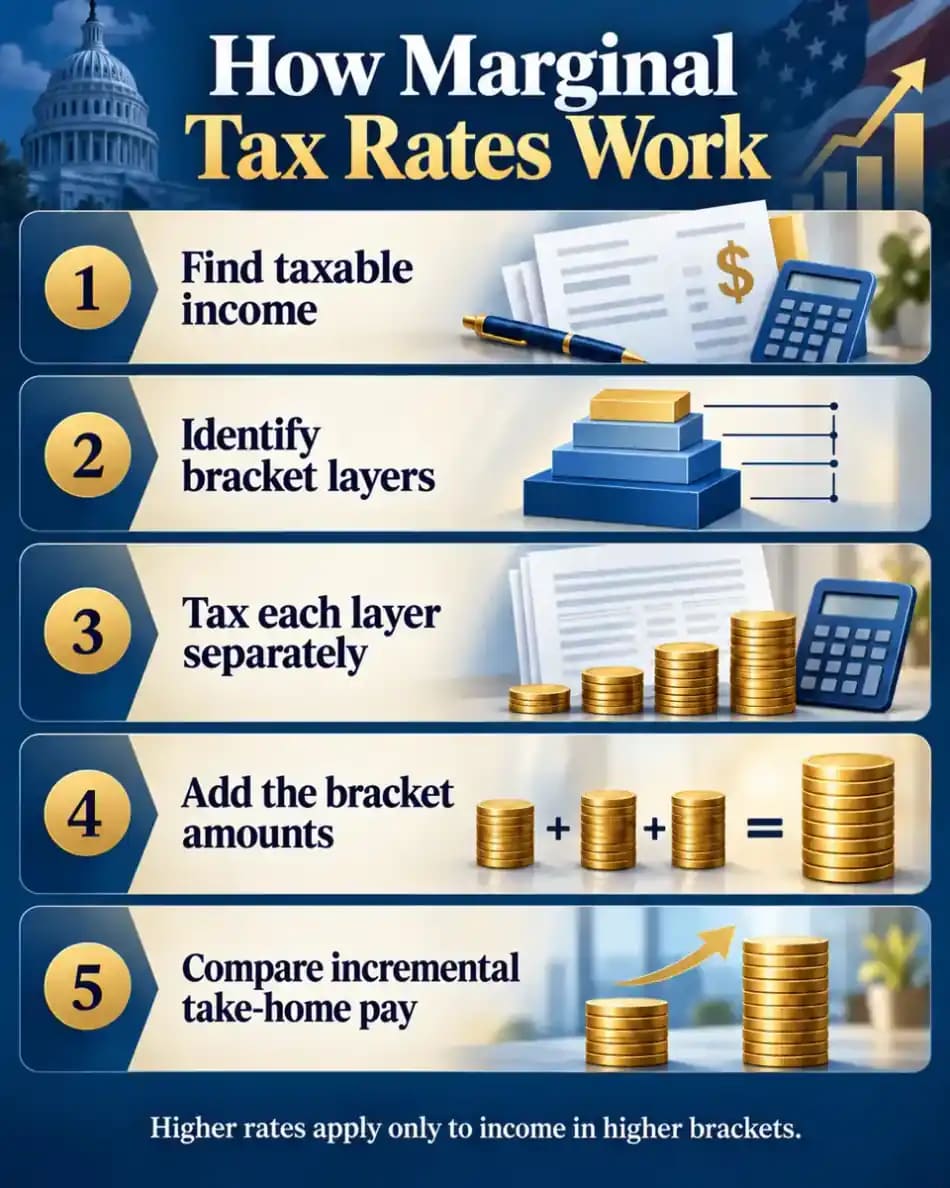
When evaluating more income, use a repeatable checklist. Identify the additional gross pay. Estimate how much may become taxable income. Determine which federal marginal bracket or brackets may apply. Add relevant payroll, state, and local taxes. Review benefit contributions and income-based phaseouts. Finally, compare the expected increase in net compensation with any new costs associated with earning it.
This framework is more reliable than the statement that entering a higher bracket makes a raise pointless. The bracket itself tells you only how a particular layer of taxable income is taxed.

30. Make Decisions Based on the Marginal Math
The practical lesson is simple: federal marginal tax rates are designed around income layers. Reaching a higher bracket does not ordinarily cause all taxable income to be taxed at the higher rate. Only the portion within that higher bracket receives that rate.
That knowledge can remove unnecessary fear from discussions about raises, overtime, bonuses, and career growth. At the same time, good planning requires attention to the rest of the financial picture, including deductions, credits, payroll taxes, state and local rules, benefit phaseouts, and withholding.
For current federal rules, consult IRS resources for the relevant tax year, including Publication 17, and federal tax information available through USA.gov. For decisions requiring analysis of your particular circumstances, consider a qualified tax professional.

A raise, promotion, bonus, or opportunity to work overtime should usually feel like good financial news. Yet one persistent tax myth causes many workers to worry that earning more could actually leave them with less money because they might move into a higher tax bracket.
That is not how the federal income tax bracket system works. The United States uses a progressive federal income tax structure. Different portions of taxable income can be subject to different rates. Moving into a higher bracket generally means that only the portion of taxable income above the relevant threshold is subject to that higher marginal rate.
Understanding marginal tax rates can make salary negotiations, overtime decisions, bonuses, and job offers much easier to evaluate. It also helps separate three concepts that are frequently confused: your marginal tax rate, your effective tax rate, and your total withholding from a paycheck.
USA.gov describes the federal income tax system as progressive, while the Internal Revenue Service provides detailed federal income tax guidance through resources including Publication 17, Your Federal Income Tax. Those official sources are better reference points than old bracket charts, social media claims, or rules of thumb because tax laws and thresholds can change from year to year.
This guide explains the underlying mechanics without attempting to calculate anyone's personal tax liability. Federal income tax is only one part of the picture. Payroll taxes, state taxes, local taxes, deductions, credits, benefits, and other rules can affect what ultimately appears in your paycheck or tax return.
Where people go wrong
Applying the Highest Bracket to All Income. The highest marginal rate you reach does not normally apply to every dollar of taxable income. Each bracket applies to the portion of taxable income within that bracket.
Using Gross Salary Instead of Taxable Income. Federal brackets are based on taxable income under the applicable tax rules, not simply the salary listed in an employment contract.
Treating Paycheck Withholding as Final Tax. Withholding is generally a prepayment toward annual tax liability. An unusually large withholding amount on one paycheck does not by itself establish your final tax rate.
Ignoring Payroll Taxes. Social Security and Medicare taxes follow separate rules from federal income tax brackets and can also affect the amount of additional wages that reaches your bank account.
Forgetting State and Local Taxes. State and local income taxes can use structures that differ from the federal system, so federal marginal rates are only one part of a take-home pay estimate.
Using Last Year's Brackets. Bracket thresholds and other tax rules can change. Always check official information for the tax year you are analyzing.
Ignoring Credits and Benefit Phaseouts. Tax credits, subsidies, benefits, and other income-sensitive programs can change as income rises. These effects are separate from the basic mechanics of federal marginal tax brackets.
Rejecting More Income Based on a Tax Myth. A promotion, bonus, or overtime opportunity should be evaluated using incremental after-tax income and relevant costs rather than the mistaken belief that a higher bracket taxes all previous earnings at the new rate.
Questions people ask
A marginal tax rate is the tax rate that applies to the next portion of taxable income within a particular bracket. In a progressive system, different portions of taxable income can be taxed at different rates.
Fixed it?
Get one guide like this every Thursday.