Is Renting Really Throwing Money Away? The True Cost of Renting vs. Buying
Is renting really throwing money away? Discover the hidden costs of homeownership, why mortgage payments do not always build wealth, and how to compare renting versus buying based on your finances and long-term goals.

What you’ll need
Tap to tick things off before you start.
Is Renting Throwing Money Away? Understanding the Myth
The idea that renting wastes money assumes every housing payment should create an asset. But housing is also a service: it provides shelter, privacy, security, and a place to live. Rent pays for those benefits without requiring ownership. Buying provides the same essential shelter while creating different financial obligations. The important distinction is between money spent on housing and money accumulated as wealth. An expense is not automatically wasteful simply because it does not create equity.

Renting vs. Buying: What the Housing Numbers Reveal
Federal Reserve housing data for 2025 reported a median monthly mortgage payment of $1,600 among homeowners with mortgages and a median rent payment of $1,200 among renters. The $400 difference illustrates contrasting household cash flows, not guaranteed savings from renting. These figures describe different populations and properties, so they are not a direct comparison of equivalent homes. Local rents, purchase prices, financing arrangements, and household characteristics matter more when evaluating a specific housing decision.

Why Many Americans Rent Instead of Buy
Renting is frequently a financial necessity rather than a preference against ownership. According to the Federal Reserve's survey of households in 2023, nearly two-thirds of renters cited difficulty affording a down payment, while 48% said they could not afford mortgage payments. Saving a substantial lump sum can be challenging even for households managing regular expenses successfully. Renting also accommodates people who prefer fewer ownership responsibilities or do not currently meet mortgage qualification requirements.

How Mortgage Payments Actually Build Home Equity
A mortgage payment generally includes principal and interest. Principal reduces the outstanding loan balance, directly increasing equity when the property's value remains unchanged. Interest compensates the lender for providing financing and does not reduce debt. With a typical fixed-rate amortizing mortgage, earlier payments allocate more money toward interest because the outstanding balance is larger. As that balance declines, more of each scheduled payment goes toward principal, gradually accelerating loan repayment over the mortgage term.

The Monthly Homeownership Costs That Never Build Equity
The Consumer Financial Protection Bureau identifies several expenses beyond mortgage principal. Interest pays for borrowing, while property taxes fund local government services. Homeowners insurance provides financial protection against covered losses, and mortgage insurance may protect lenders against borrower default. Homeowners' association fees support shared facilities and community services. Although these payments can provide valuable benefits, none directly reduces the mortgage balance. Their amounts vary by property, location, coverage, financing terms, and community requirements.

Closing Costs: The Upfront Price of Buying a Home
Buying a home generally requires cash beyond the down payment. The Consumer Financial Protection Bureau explains that buyer closing costs commonly range from 2% to 5% of the purchase price, excluding the down payment. For a $300,000 property, that equals approximately $6,000 to $15,000. Charges can include loan origination, appraisal, and title services. Unlike a down payment, these fees generally do not create home equity, although some prepaid amounts cover future expenses.

Maintenance, Repairs, and the Hidden Risks of Ownership
Homeowners usually bear the responsibility for maintaining their properties. Routine upkeep includes servicing heating systems, maintaining roofs, and addressing plumbing problems. Major failures can create unexpected expenses that strain household savings. Renters generally rely on landlords for repairs covered by applicable laws and lease terms, although responsibilities vary. Ownership therefore requires planning for both predictable maintenance and occasional emergencies. Repair spending may preserve a home's condition without producing an equivalent increase in resale value.

Do Homeowners Really Save Money on Taxes?
Homeownership can provide federal tax deductions, but eligibility does not guarantee additional savings. The IRS allows qualifying mortgage interest and certain property taxes as itemized deductions, subject to applicable limits. Taxpayers generally benefit only when itemizing produces a larger deduction than the standard deduction. Mortgage principal, homeowners insurance, utilities, and ordinary personal home repairs generally are not deductible. Tax rules can change, so current IRS guidance matters more than assumptions about automatic homeowner tax advantages.

Renting vs. Buying: Financial Risk, Flexibility, and Opportunity Cost
Renting generally preserves mobility and avoids concentrating substantial wealth in one property. Homeownership can offer residential stability, but market declines may reduce equity, and selling can take time. Purchasing also commits savings that could otherwise remain liquid or be invested in diversified assets. Those alternative investments involve risks and uncertain returns. The comparison therefore extends beyond housing payments to include flexibility, exposure to property market fluctuations, and the potential benefits of keeping financial resources accessible.

How to Decide Whether Renting or Buying Makes Financial Sense
A practical comparison starts with equivalent local properties and realistic ownership estimates. Calculate ongoing housing expenses, initial cash requirements, maintenance reserves, and potential selling costs. Compare those figures with rent over the expected length of occupancy. Then evaluate affordability, remaining emergency savings, and possible changes in property values. A break-even analysis can estimate when ownership becomes financially competitive, but results depend heavily on assumptions. Testing several scenarios produces a more useful decision framework than relying on slogans.

Rent Increases vs. Fixed Mortgage Payments
Renters may face higher housing payments when leases renew, depending on market conditions, lease provisions, and local regulations. Homeowners with fixed-rate mortgages generally maintain the same scheduled principal and interest payment throughout the loan term. However, their total housing expenses can still increase as property taxes, insurance premiums, and HOA assessments change. Adjustable-rate mortgages introduce additional uncertainty because interest rates can reset. Neither renting nor owning guarantees completely stable housing expenses over time.

The Real Cost of Tying Up Your Down Payment
A down payment converts accessible cash into home equity, making that money harder to use for other purposes. For example, a 20% down payment on a $300,000 property requires $60,000 upfront. That amount could otherwise remain in savings or be invested, although investment returns are uncertain. A larger down payment can reduce borrowing costs and sometimes eliminate mortgage insurance. The financial trade-off involves balancing lower debt against reduced liquidity and alternative uses for capital.

How Inflation Changes the Rent vs. Buy Equation
Inflation can affect renters and homeowners differently. Market rents may rise as landlords face increasing operating expenses and changing demand. Homeowners with fixed-rate mortgages repay principal and interest in nominal dollars, potentially making those payments less burdensome relative to rising incomes. However, property taxes, insurance, utilities, and other expenses can increase with inflation. Higher prices also reduce purchasing power when incomes fail to keep pace. Future inflation therefore affects both housing choices through different financial channels.

When Home Equity Becomes Accessible Money
Home equity represents the property's market value minus outstanding debts secured by it, but it is not equivalent to cash in a bank account. Owners may access equity through selling, cash-out refinancing, or home equity loans and credit lines. Each method introduces costs or limitations. Borrowing creates repayment obligations and may put the property at risk if payments become unaffordable. Selling requires finding a buyer, completing the transaction, and satisfying outstanding liens before receiving proceeds.

How Credit Scores Affect Renting and Buying
Credit history can influence access to both rental housing and mortgage financing. Landlords may review credit reports when evaluating applicants, while mortgage lenders assess credit alongside income, debts, assets, and employment information. Stronger credit profiles may qualify borrowers for more favorable mortgage terms, potentially reducing borrowing costs. Payment history, credit utilization, and reporting accuracy are important credit factors. Reviewing credit reports and correcting legitimate errors can improve financial preparedness before applying for either housing arrangement.

What Happens if Your Income Suddenly Drops?
Job loss or reduced earnings can make housing payments difficult regardless of ownership. Renters may face late fees, lease enforcement, or eviction proceedings, depending on applicable rules. Homeowners risk mortgage delinquency, damaged credit, and eventually foreclosure if problems remain unresolved. Mortgage servicers may offer qualifying borrowers temporary hardship assistance, while rental assistance programs vary by location. The Consumer Financial Protection Bureau provides resources explaining mortgage payment difficulties and available assistance. Early communication can help clarify potential options.

The Financial Trade-Offs of Renting a Larger or Better-Located Home
Housing comparisons can become misleading when the properties offer different benefits. A centrally located rental may cost more per square foot but reduce commuting expenses, transportation time, and vehicle dependence. A suburban house might provide additional space while increasing travel costs. Neighborhood amenities, school access, parking, and proximity to employment also influence overall value. Comparing properties with similar practical benefits helps distinguish genuine financial differences from changes in lifestyle, convenience, or housing quality.

How Life Changes Can Affect Your Housing Choice
Housing needs often change as households move through different life stages. Marriage, children, caregiving responsibilities, and retirement can alter preferred locations and space requirements. Career changes may create opportunities in other cities, while aging can increase the importance of accessibility and reduced physical upkeep. A property that fits current needs may become inconvenient later. Considering possible life transitions helps explain why a financially reasonable housing arrangement today might become less suitable over time.

Three Realistic Rent vs. Buy Financial Scenarios
Consider three illustrative situations. A renter staying two years may avoid significant purchase and resale transaction expenses. A homeowner remaining fifteen years may accumulate substantial equity through mortgage repayment, depending on market conditions. A renter who consistently invests money saved on housing could build financial assets outside real estate. Each outcome depends on assumptions about prices, rent, interest rates, appreciation, and investment returns. Changing those inputs can reverse which scenario produces greater wealth.

The Bottom Line: Renting Is Not Financial Failure
Renting does not indicate poor financial judgment, just as buying does not automatically guarantee wealth. Both arrangements provide valuable housing benefits while exposing households to different obligations and opportunities. The Federal Reserve's housing surveys illustrate that affordability and financial risk influence many Americans' choices. Ownership can offer stability and equity accumulation, while renting can support flexibility and financial resilience. A successful housing decision reflects sustainable expenses, realistic expectations, and personal priorities rather than pressure to achieve a particular ownership status.

How Income Levels Shape Homeownership Opportunities
Income strongly influences access to homeownership because purchasing requires sufficient earnings, savings, and borrowing capacity. According to the Federal Reserve's 2025 housing data, 33% of adults earning less than $50,000 owned their homes, compared with 86% of adults earning $100,000 or more. These figures describe an association, not proof that income alone determines ownership. Higher-income households generally have greater capacity to accumulate down payments, qualify for financing, and absorb substantial housing expenses without sacrificing essential needs.

What the Federal Reserve Says About Housing Affordability
Federal Reserve surveys help explain how Americans experience housing affordability. In its 2023 household survey, nearly two-thirds of renters identified down payment affordability as a reason for renting, while 48% cited difficulty affording mortgage payments. Additionally, 44% perceived homeownership as carrying greater financial risk. These responses describe participants' circumstances and perceptions rather than proving renting is universally safer. Survey results provide useful national context, but regional housing markets and individual household finances can differ substantially.

Why Unrecoverable Housing Costs Matter More Than You Think
An unrecoverable housing cost is money spent without directly creating an asset that can later be sold. Rent, mortgage interest, and many ownership expenses fit this description. However, unrecoverable does not mean worthless. Shelter provides comfort and security, insurance transfers certain risks, and property taxes support public services. The distinction matters because wealth accumulation and everyday consumption serve different purposes. Measuring financial efficiency requires recognizing the benefits received alongside the money that cannot be recovered.

Renting and the Value of Predictable Housing Expenses
A rental agreement typically establishes the monthly rent and lease duration, making near-term housing expenses easier to anticipate. Landlords generally handle major building repairs, subject to lease provisions and applicable laws. This arrangement can reduce exposure to sudden property maintenance bills. However, renters may still pay utilities, insurance, parking charges, and other variable expenses. Security deposits and potential lease renewal changes also affect budgets. Predictability is therefore a practical advantage of renting, not an absolute guarantee.

When Homeownership Becomes a Financial Burden
Owning an appreciating asset does not necessarily mean having enough money for daily expenses. A household may possess substantial home equity while struggling to cover mortgage payments, food, transportation, and healthcare. This situation is sometimes described as being house-rich but cash-poor. High housing obligations can also crowd out retirement contributions and essential savings. The Consumer Financial Protection Bureau emphasizes evaluating total housing payments against overall financial commitments. Sustainable ownership depends on manageable cash flow, not property value alone.

Why Home Repairs Do Not Always Increase Property Value
Not every dollar spent improving a property produces an equivalent increase in market value. Replacing a failing furnace or repairing a damaged roof often restores expected functionality rather than creating additional value. Cosmetic renovations may improve buyer appeal, but resale returns depend on local preferences, project quality, and market conditions. Maintenance and improvements also serve different purposes: one preserves existing condition, while the other changes features. Neither guarantees full recovery of its cost when the property sells.

Understanding the True Cost of Selling a Home
Selling a home involves expenses beyond finding a buyer. Potential charges include negotiated real estate agent compensation, title services, transfer taxes, legal services, and transaction-related fees. Sellers may also spend money on cleaning, staging, moving, or preparing the property for inspection. Outstanding mortgage balances and other liens generally must be satisfied from sale proceeds. These deductions reduce the cash received at closing. Actual costs depend on location, negotiated agreements, financing obligations, and transaction circumstances.

How to Build Wealth Without Owning a Home
Homeownership is one possible wealth-building strategy, but it is not the only one. Renters can accumulate assets through workplace retirement plans, individual retirement accounts, diversified investments, and regular savings. Consistent contributions and compound growth may build substantial balances over time, although investment returns fluctuate and losses are possible. The key distinction is behavior: renting does not automatically create investable savings. Building wealth outside real estate requires maintaining a sustainable savings rate and consistently directing available money toward financial goals.

Financial Questions to Ask Before Signing a Mortgage
Mortgage commitments deserve careful examination before signing. The Consumer Financial Protection Bureau provides guidance on reviewing Loan Estimates and Closing Disclosures, which describe financing terms and transaction charges. Important questions concern the interest rate, annual percentage rate, payment schedule, potential adjustments, and prepayment penalties. Buyers also need to understand required insurance and estimated escrow payments. Testing affordability against reduced income or rising expenses can reveal vulnerabilities that a lender's approval alone may not identify.

Making a Housing Decision That Fits Your Financial Future
A sound housing decision begins with clear priorities and realistic financial boundaries. Consider whether expected housing expenses leave sufficient room for essentials, savings, and unexpected events. Evaluate how each arrangement supports employment plans, family responsibilities, and longer-term goals. Financial assumptions should remain flexible because income, property markets, and personal circumstances can change. Renting and buying are tools for meeting housing needs, not measures of success. The strongest choice is one that remains sustainable under plausible future conditions.

Is renting throwing money away? It is a question that comes up whenever someone compares paying a landlord with making mortgage payments. The familiar argument is simple: renters pay for someone else's property, while homeowners build wealth. But that comparison leaves out some of the most important costs of owning a home.
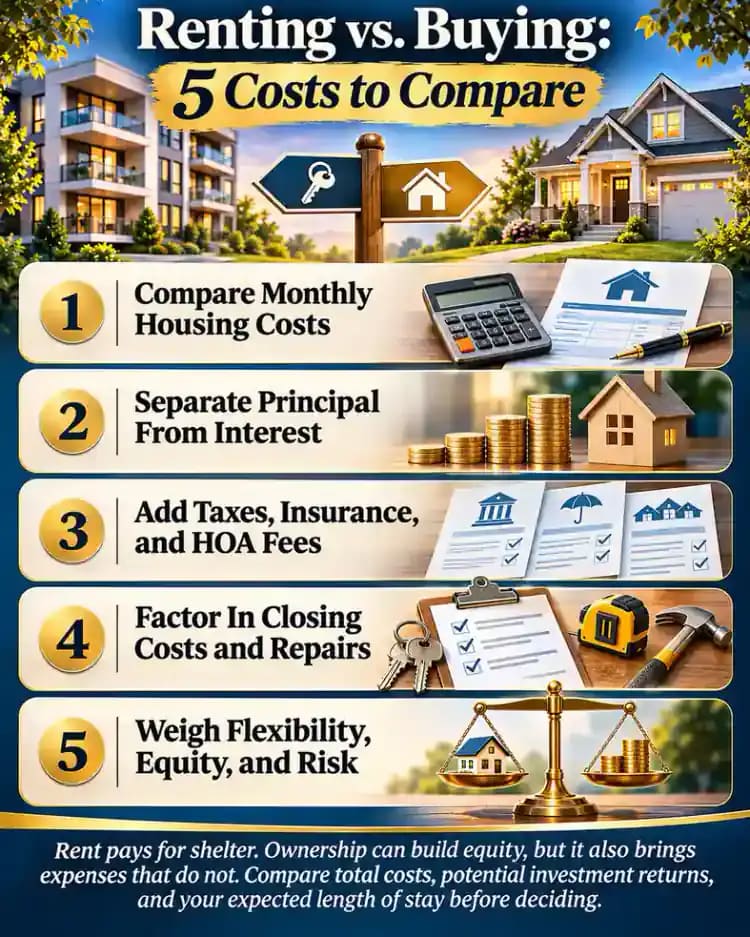
Rent and mortgage payments both provide something essential: a place to live. The difference is how those payments are structured, what financial risks you accept, and whether part of your spending creates equity. Rent generally covers your right to occupy a property, while homeowners must account for mortgage interest, property taxes, insurance, repairs, maintenance, and sometimes homeowners' association fees.
Only the principal portion of a mortgage payment directly reduces your loan balance. Other expenses may protect your investment or support essential services, but they do not automatically increase your home equity. Buying also requires upfront cash, including a down payment and closing costs, and selling can introduce additional expenses.
That does not mean renting is always better. Homeownership can provide stability, control over your living space, and opportunities to build wealth through principal repayment and property appreciation. However, appreciation is never guaranteed, and ownership creates financial obligations that renters can often avoid.
The smartest decision depends on your local housing market, income, savings, expected length of stay, and tolerance for financial uncertainty. This guide explains the real costs of renting versus buying and gives you a practical framework for comparing both options without relying on misleading financial slogans.
Where people go wrong
Comparing Rent With Only the Mortgage Principal and Interest. A mortgage quote often excludes major ownership expenses. Comparing that number directly with monthly rent understates the actual cost of buying. Include property taxes, homeowners insurance, mortgage insurance when required, HOA fees, and an allowance for maintenance before deciding.
Assuming Every Mortgage Payment Builds Wealth. Only the principal portion directly reduces your mortgage balance. Interest, taxes, and insurance are ongoing expenses rather than equity contributions. Review an amortization schedule to understand how your payments are divided, especially during the early years of the loan.
Ignoring Closing Costs and Future Selling Expenses. Buying and eventually selling a property can involve substantial transaction costs. If you move after only a few years, those expenses may outweigh some financial benefits of ownership. Include both purchase and sale costs when calculating your potential break-even point.
Treating Home Appreciation as Guaranteed. Home values can rise, remain flat, or decline depending on market conditions. Assuming steady appreciation can make an expensive purchase appear safer than it is. Test your calculations using multiple scenarios, including zero appreciation and a potential decline in value.
Overestimating the Tax Benefits of Homeownership. Mortgage interest and eligible property taxes do not automatically produce additional tax savings. Federal benefits generally depend on itemizing deductions and meeting applicable limits. Compare the potential itemized deductions with your standard deduction before including tax savings in your calculations.
Buying Without a Dedicated Repair Reserve. A manageable mortgage payment does not guarantee affordable homeownership. Roof repairs, plumbing problems, and HVAC replacements can create major unexpected bills. Maintain accessible emergency savings and budget for routine upkeep instead of assuming every month will have predictable expenses.
Assuming Renting Is Always Financially Inferior. Renting can preserve savings, reduce exposure to major repair bills, and provide flexibility when relocating. The financial advantage depends partly on what you do with the money you avoid spending on ownership. Compare realistic alternatives rather than assuming one option always wins.
Questions people ask
No. Rent pays for housing, just as many homeownership expenses pay for shelter and related services. Although renting does not directly build property equity, it can preserve cash and reduce certain financial risks. Whether renting or buying creates better long-term results depends on total costs, investment choices, and personal circumstances.
Fixed it?
Get one guide like this every Thursday.