How to Maximize Your Health Savings Account (HSA) for Long-Term Wealth
Your Health Savings Account can do more than pay medical bills. Learn how HSA eligibility, contribution limits, triple tax advantages, investment options, and withdrawal rules can help you prepare for future healthcare costs.

What you’ll need
Tap to tick things off before you start.
Why Your HSA Deserves a Second Look
Medical expenses can disrupt even a carefully planned household budget. Doctor visits, prescriptions, deductibles, and unexpected treatments create financial pressure today, while future healthcare needs remain uncertain. A Health Savings Account (HSA) can help eligible Americans prepare for both situations. Rather than viewing it exclusively as a way to pay current medical bills, consider its potential role in building resources for future care. Understanding that broader purpose is the starting point for learning how to maximize your HSA.

What a Health Savings Account Actually Is
An HSA is an individually owned, tax-advantaged account established through a qualified trustee or custodian, such as a bank or approved financial institution. Under IRS rules, it operates as a tax-exempt trust or custodial account intended for qualified medical expenses. Unlike ordinary employer-controlled benefit accounts, the HSA belongs to the individual account holder. Contributions and distributions follow federal requirements, while the provider handles account administration. This ownership structure makes understanding your custodian's terms and responsibilities particularly important.

Why HSA Funds Do Not Expire Each Year
One important HSA feature is that unused money carries forward indefinitely. There is no requirement to empty the account each December. Your balance also remains yours when you switch employers, leave the workforce, or change health plans. This differs from many traditional flexible spending arrangements, which generally impose annual spending restrictions, subject to permitted carryovers or grace periods. The IRS confirms that HSA funds remain available until used, making the account useful across different stages of life.

The Difference Between Spending and Investing Your HSA
An HSA can serve three distinct purposes. Spending funds cover qualified medical bills as they arise. Cash savings provide accessible money for unexpected healthcare needs. Investments offer potential long-term growth through assets such as mutual funds or exchange-traded funds, depending on your provider. Each approach involves different tradeoffs between convenience, liquidity, and market risk. Investor.gov emphasizes understanding investment characteristics before committing money. A practical HSA strategy recognizes these functions without assuming every dollar should be invested.

How HSA Compounding Works Over Time
Compounding occurs when investment earnings generate additional earnings over time. For example, $5,000 growing at a hypothetical 6% annually would reach approximately $8,954 after 10 years without further contributions. Reinvested gains drive that increase, but actual returns fluctuate and losses are possible. Inflation can also reduce what future savings will purchase. Market investments are not guaranteed to outperform rising healthcare costs. Investor.gov encourages evaluating risk and time horizon rather than treating projected growth as a promise.

Who Can Contribute to an HSA?
The IRS generally requires HSA contributors to have qualifying High Deductible Health Plan coverage, no disqualifying additional health coverage, and no Medicare enrollment. You also cannot be eligible to be claimed as someone else's tax dependent. Eligibility is normally determined monthly, based on your circumstances on the first day of each month. Certain exceptions and special rules apply. Importantly, losing contribution eligibility does not automatically prevent you from spending money already held in your HSA.

Understanding HSA-Eligible Health Plans
A qualifying High Deductible Health Plan (HDHP) must satisfy federal deductible and out-of-pocket requirements, not simply advertise a large deductible. For 2026, the IRS sets minimum annual deductibles at $1,700 for self-only coverage and $3,400 for family coverage. Maximum annual out-of-pocket expenses are $8,500 and $17,000, respectively, excluding premiums. These plans often feature lower premiums but greater upfront cost exposure, although pricing varies. Confirm HSA eligibility through official plan documents rather than relying on marketing terminology.

Other Health Coverage That Can Affect Eligibility
Additional insurance can affect HSA eligibility even when your primary plan qualifies. Coverage through a spouse's general-purpose health Flexible Spending Account (FSA), for example, may make you ineligible to contribute. However, certain limited-purpose arrangements covering dental or vision expenses are permitted. The IRS also allows specific coverage categories, including certain accident, disability, and disease-specific policies. Because coordination rules can be complicated, review every applicable benefit arrangement against IRS Publication 969 before assuming overlapping coverage is harmless.

2026 HSA Contribution Limits Explained
For 2026, the IRS sets standard HSA contribution limits at $4,400 for self-only coverage and $8,750 for family coverage. These increased from $4,300 and $8,550, respectively, in 2025. The limits include combined contributions from individuals, employers, and other contributors. Your permitted amount may be lower if eligibility or coverage changes during the year, subject to special rules. IRS Revenue Procedure 2025-19 establishes the 2026 amounts. Track contributions carefully to avoid exceeding your applicable annual limit.

The Extra HSA Contribution Available at Age 55
Eligible HSA owners who are at least 55 by year-end can generally contribute an additional $1,000 annually. This catch-up allowance applies separately to each eligible spouse age 55 or older, but HSAs cannot be jointly owned. Each spouse must maintain a separate account to make their respective catch-up contribution. Medicare enrollment and partial-year eligibility can restrict contributions. The additional allowance helps older savers strengthen healthcare reserves, although the same eligibility and contribution tracking requirements still apply.

How Employer Contributions Affect Your Limit
Employer HSA contributions count toward the same annual limit as your personal deposits. For example, if your 2026 self-only contribution limit is $4,400 and your employer contributes $1,000, only $3,400 of contribution room remains, assuming full-year eligibility and no catch-up allowance. Contributions from other sources also count. The IRS recommends tracking total deposits carefully. Review pay statements and account transactions regularly, particularly when changing employers, to ensure combined contributions stay within your applicable limit.

What Happens When You Contribute Too Much
Contributions exceeding your applicable HSA limit can trigger a 6% annual excise tax on excess amounts remaining in the account, subject to IRS calculation rules. Generally, correcting excess contributions and associated earnings before the applicable tax filing deadline, including extensions, can prevent that excise tax. Withdrawn earnings may still be taxable. Corrections require specific reporting and timing, so simply transferring money out is insufficient. IRS Publication 969 explains these rules. Complex situations may warrant professional tax guidance.

The Triple Federal Tax Advantage of an HSA
An HSA offers three major federal tax benefits. Eligible contributions receive favorable tax treatment, earnings within the account generally accumulate without federal income tax, and distributions for qualified medical expenses are tax-free. Together, these advantages distinguish HSAs from many conventional savings arrangements. However, the benefits depend on following IRS requirements, and state taxation can differ. California and New Jersey, for example, generally do not follow federal HSA tax treatment completely, making location relevant when evaluating overall benefits.

How HSA Contributions Receive Tax Benefits
Eligible personal HSA contributions are generally deductible for federal income tax purposes, even without itemizing deductions. Employer contributions are generally excluded from an employee's federal taxable income. Contributions made through a qualifying employer cafeteria plan also typically avoid federal income tax and Social Security and Medicare payroll taxes. However, personal contributions made outside payroll generally do not reduce those payroll taxes. IRS Publication 969 explains these distinctions. Understanding the contribution method helps clarify the tax treatment of each deposit.

How HSA Investments Can Grow Tax-Free
Interest, dividends, and capital gains earned inside an HSA generally accumulate free from federal income tax while remaining in the account. This allows eligible investment earnings to stay available for potential reinvestment rather than creating annual federal income tax liabilities. However, tax advantages cannot prevent investment losses. Mutual funds and other securities can decline substantially during difficult markets. Investor.gov emphasizes understanding investment risk, diversification, and time horizons. Certain states may also tax HSA earnings differently.

When HSA Withdrawals Are Tax-Free
HSA distributions are generally free from federal income tax when used for qualified medical expenses incurred after the account was established. Eligible expenses may belong to you, your spouse, or qualifying dependents under applicable IRS rules. Keep receipts showing dates, amounts, and medical purposes because account administrators do not necessarily verify eligibility. Expenses reimbursed through insurance or another arrangement cannot be reimbursed again through your HSA. Amounts claimed as itemized medical deductions also cannot receive duplicate tax benefits.

How to Find an HSA That Supports Investing
Not every HSA provider offers the same investment capabilities. Some limit balances to cash, while others provide mutual funds, ETFs, or brokerage options. Compare available investments, minimum cash requirements, administrative charges, customer service, and online account features. Employer-selected custodians are not necessarily your only option. Eligible funds can generally move between HSA custodians through properly handled transfers. Before switching, examine transfer procedures, potential fees, and whether investment holdings must be liquidated to complete the move.

Choosing Between HSA Cash and Investments
Cash balances offer accessibility and relative stability, making them useful for medical expenses that may arise soon. Investments provide potential long-term growth but expose account values to market declines. Selling investments during a downturn to cover healthcare bills can lock in losses. Consider expected medical spending, insurance deductibles, emergency reserves, and investment time horizon when evaluating the balance. A cash allocation sufficient for foreseeable needs may reduce pressure to sell investments at an unfavorable moment.

Mutual Funds and ETFs Inside an HSA
Mutual funds and exchange-traded funds (ETFs) pool investors' money to hold collections of securities. Depending on their holdings, they can provide diversification across companies, industries, or asset classes. However, diversification does not eliminate market risk. Asset allocation determines how investments are distributed among stocks, bonds, and other holdings. Investor.gov recommends understanding investment objectives, expense ratios, and risks before selecting funds. Broad market funds can simplify diversification, but their suitability depends on individual circumstances and available choices.

How Investment Fees Can Affect HSA Growth
HSA investment costs can include monthly maintenance charges, trading commissions, advisory fees, and fund expense ratios. These expenses reduce the money available for growth. For example, a 1% annual fund expense ratio represents approximately $100 on a $10,000 investment balance, although actual expenses change with asset values. Over decades, recurring charges can compound into meaningful differences. Compare provider disclosures and investment prospectuses carefully. Low costs matter, but investment quality, available services, and risk deserve consideration too.

Should You Pay Medical Bills Out of Pocket?
Paying current medical bills with regular income or personal savings can leave HSA investments untouched, potentially allowing more time for growth. However, this strategy requires sufficient household liquidity. Using credit cards, depleting emergency reserves, or delaying necessary treatment could create costs that outweigh potential investment gains. Compare expected medical expenses with available cash, insurance deductibles, and other financial obligations. Paying directly from your HSA remains a reasonable option when preserving household financial stability is more important than investment growth.

How Delayed HSA Reimbursement Works
Federal HSA rules generally permit reimbursement of qualified medical expenses long after payment, provided the expenses were incurred after your HSA was established. The IRS does not impose a specific deadline for requesting reimbursement. For example, an eligible $500 expense paid personally in 2026 could potentially be reimbursed years later. Keep receipts, proof of payment, and documentation establishing eligibility. Expenses already reimbursed by insurance or another source, or claimed as itemized medical deductions, cannot receive duplicate tax benefits.

Which Medical Expenses Qualify for HSA Funds?
IRS Publication 502 generally defines eligible medical care as expenses related to diagnosing, treating, preventing, or alleviating disease and addressing bodily functions. Common qualifying expenses include prescription medications, dental procedures, eyeglasses, contact lenses, hospital treatment, and certain mental health services. Acupuncture and medically necessary ambulance transportation may also qualify. IRS Publication 969 explains how medical expense rules apply to HSAs. Eligibility depends on the circumstances and purpose of each expense, so verify unfamiliar purchases against official guidance before reimbursement.

Medical and Wellness Costs That Usually Do Not Qualify
Not every product associated with health qualifies for HSA reimbursement. IRS Publication 502 generally excludes elective cosmetic procedures, ordinary vitamins taken for general wellness, and expenses primarily intended to maintain overall health. Most health insurance premiums are also excluded. Exceptions can include certain long-term care insurance premiums, COBRA coverage, and qualifying health coverage during unemployment. Cosmetic procedures may qualify when correcting certain injuries, diseases, or congenital abnormalities. Check applicable exceptions before treating an otherwise excluded purchase as eligible.

The 20% HSA Penalty Before Age 65
Non-qualified HSA withdrawals before age 65 generally trigger ordinary federal income tax plus an additional 20% tax. For example, withdrawing $1,000 for an ineligible purchase could result in $200 of additional tax, beyond ordinary income taxes. IRS Publication 969 explains exceptions to the additional tax for distributions made after the account holder becomes disabled or dies. These exceptions do not automatically make non-qualified distributions income-tax-free. Understanding the consequences helps prevent avoidable costs when accessing HSA funds.

How HSA Withdrawal Rules Change at Age 65
Beginning at age 65, the additional 20% federal tax no longer applies to non-qualified HSA distributions. However, withdrawals used for non-medical purposes generally remain subject to ordinary income tax. Qualified medical distributions continue to be federally tax-free regardless of age. This distinction provides greater withdrawal flexibility without making the account equivalent to unrestricted tax-free savings. IRS Publication 969 explains these age-related rules. Retirees should distinguish between qualified and non-qualified spending when evaluating the potential tax consequences of withdrawals.

Using Your HSA for Healthcare in Retirement
Retirement can bring changing healthcare expenses, making an existing HSA balance useful for qualified medical spending. Eligible costs may include prescriptions, dental treatment, vision care, and certain Medicare premiums. Medigap premiums generally do not qualify. Some long-term care insurance premiums may qualify within IRS age-based limits, while certain long-term care services can also qualify. Medicare enrollment generally prevents further HSA contributions, but existing funds remain available. IRS Publications 969 and 502 provide guidance as retirement healthcare needs evolve.

A Simple System for Saving Medical Receipts
Create a secure digital folder for each year and store medical receipts, invoices, payment confirmations, and insurance explanations of benefits. Record the expense date, provider, patient, amount paid, and any reimbursement received. A separate spreadsheet can help prevent duplicate claims. IRS Publication 969 requires account holders to substantiate qualified distributions when necessary. Maintain secure backups and retain records long enough to support future withdrawals or tax examinations. Consistent organization makes expense verification easier, particularly when reimbursement is delayed.

Four Questions to Ask Before Investing Your HSA
Before investing HSA funds, consider four practical questions. First, do you currently meet IRS contribution eligibility requirements? Second, does your account provider offer suitable investments with reasonable costs? Third, can your household budget cover foreseeable medical expenses without weakening emergency reserves? Fourth, can you maintain reliable documentation for future qualified reimbursements? These questions help connect investment opportunities with financial readiness. Investor.gov emphasizes understanding investment risks and time horizons rather than assuming that long-term market appreciation is guaranteed.

Build a Practical Long-Term HSA Strategy
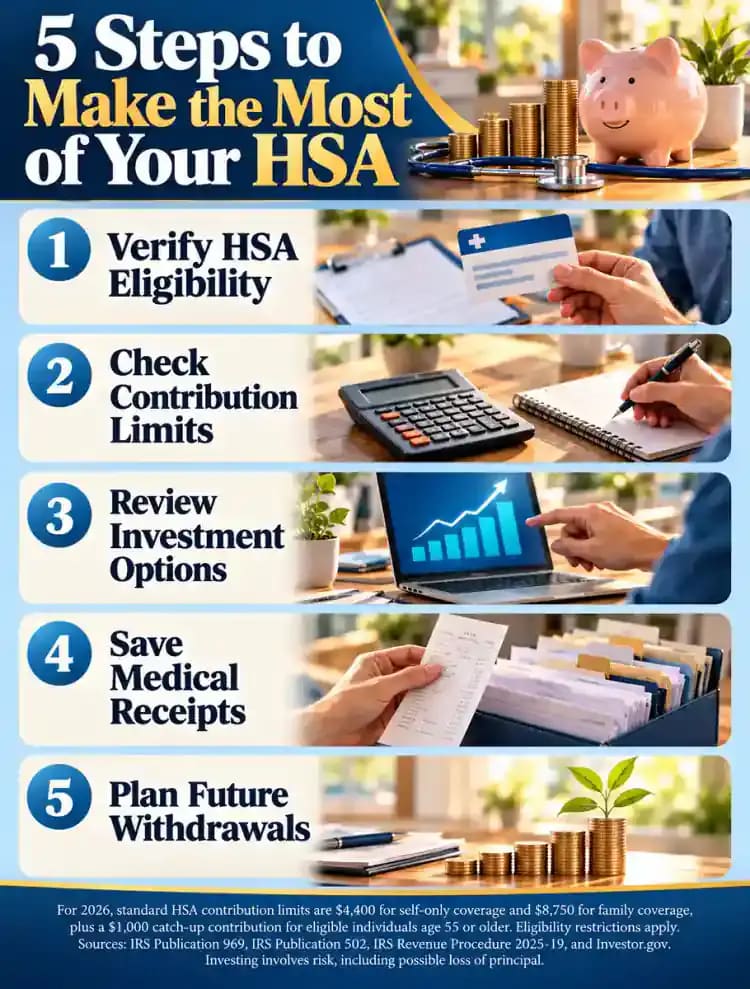
Review your HSA strategy at least annually and whenever major circumstances change. Confirm contribution eligibility, verify current IRS limits, and reconcile personal and employer deposits. Evaluate expected medical expenses before adjusting cash reserves or investments. Check account fees, investment allocation, qualified withdrawals, and recordkeeping practices. IRS Publications 969 and 502 explain account and medical expense rules, while Investor.gov provides investment education. A flexible review process can help align HSA decisions with changing healthcare needs and long-term financial priorities.

What if the money you set aside for medical bills could also help you prepare for healthcare expenses decades from now? A Health Savings Account (HSA) offers that possibility, combining everyday medical spending with potentially valuable long-term investment opportunities.
Unlike many workplace health spending arrangements, an HSA does not require you to spend your balance before the year ends. Unused money carries forward, remains yours when you change jobs, and may be invested if your account provider offers suitable investment options.
The biggest attraction is the HSA's triple federal tax advantage: eligible contributions receive favorable tax treatment, account earnings grow tax-free, and withdrawals for qualified medical expenses are generally tax-free. State tax treatment can differ, and investments can lose value.
Eligibility matters. You generally need qualifying High Deductible Health Plan coverage and must satisfy additional IRS requirements. For 2026, the standard contribution limits are $4,400 for self-only coverage and $8,750 for family coverage. Eligible individuals age 55 or older can contribute an additional $1,000. These limits are subject to eligibility and contribution rules, including adjustments for certain partial-year situations.
This guide explains how HSAs work, how to evaluate investment options, which expenses qualify, and why documentation is essential. It also explores when paying current medical bills out of pocket might preserve HSA funds for future use, without assuming that strategy works for every household.
The goal is simple: help you make informed HSA decisions using guidance from the Internal Revenue Service (IRS) and Investor.gov, while recognizing the importance of cash reserves, healthcare needs, and individual circumstances.
Where people go wrong
Treating Your HSA Like a Use-It-or-Lose-It Account. Unlike many flexible spending arrangements, HSA balances generally roll over from year to year. Spending everything unnecessarily can eliminate opportunities for future tax-advantaged growth. However, preserving the balance should not come at the expense of essential healthcare or emergency savings.
Contributing Without Confirming Eligibility. Enrollment in a plan with a high deductible does not automatically establish HSA eligibility. Other coverage, Medicare enrollment, dependent status, and applicable plan requirements matter. Review IRS rules before contributing, particularly when your insurance changes during the year.
Overlooking Employer Contributions. The annual HSA contribution limit generally includes deposits from your employer and other contributors, not just amounts you contribute personally. Ignoring these deposits can create excess contributions and potential tax consequences. Track total contributions and review applicable limits throughout the year.
Keeping Every Dollar in Cash Without Reviewing Investment Options. Holding an entire HSA balance in low-yield cash may limit long-term growth. However, investing funds needed for near-term medical expenses introduces market risk. Review your cash needs, investment choices, fees, and time horizon before deciding how much to invest.
Assuming Every Health-Related Purchase Qualifies. Not every product marketed for wellness qualifies for tax-free HSA reimbursement. General vitamins, elective cosmetic procedures, and most insurance premiums are typically excluded, subject to specific exceptions. Check IRS Publication 502 and applicable HSA rules before requesting reimbursement.
Taking Non-Qualified Withdrawals Without Understanding Taxes. Non-qualified HSA distributions generally become taxable income. Before age 65, they also usually trigger an additional 20% tax, unless a statutory exception applies. At age 65, the additional tax no longer applies, but ordinary income tax generally remains.
Losing Medical Receipts. Without adequate documentation, proving that an HSA distribution reimbursed an eligible expense can become difficult. Keep dated receipts and reimbursement records, especially when delaying reimbursement. Expenses generally must have been incurred after the HSA was established and cannot be reimbursed twice.
Investing Money Needed for Immediate Healthcare Costs. Long-term investing can offer growth potential, but market declines may leave less money available when medical bills arrive. Avoid assuming every HSA dollar belongs in investments. Consider liquidity, deductible exposure, emergency reserves, and anticipated medical spending before selecting investments.
Questions people ask
A Health Savings Account is a tax-advantaged account for eligible medical expenses. Unused funds carry forward indefinitely, and some providers allow investments in mutual funds or ETFs. Investment growth can accumulate over time, although returns are not guaranteed and market losses remain possible.
Fixed it?
Get one guide like this every Thursday.