How to Keep Credit Cards Active Without Paying Interest
An unused credit card can be closed by its issuer, potentially affecting your credit score. Learn how inactivity policies work, why you never need to carry a balance, and how small purchases can help keep accounts open.

What you’ll need
Tap to tick things off before you start.
Why Unused Credit Cards Deserve Attention
An unused credit card might seem harmless, especially when its balance is zero. However, credit card issuers can close accounts that remain inactive for extended periods. Such closures may happen even when customers have consistently paid their bills and maintained excellent credit. Issuers generally consider inactivity when managing unused credit lines and account risk. Understanding how to keep credit cards active starts with recognizing that an open account is not necessarily guaranteed to remain open indefinitely.

How Inactivity Can Affect Your Credit Score
Simply leaving a credit card unused does not automatically lower your credit score. The more significant concern is what happens if the issuer eventually closes the account. Closure can change the credit information used in scoring, potentially producing a lower score even without missed payments. According to the Consumer Financial Protection Bureau, closing an existing credit card could reduce your credit score. However, the actual outcome depends on your broader credit profile and the scoring model involved.

What You Need to Understand First
Keeping a credit card active involves more than occasionally making purchases. Several connected topics determine whether maintaining an account makes financial sense: credit reporting, credit utilization, account fees, payment behavior, and issuer policies. Common misconceptions about carrying balances can also lead consumers toward unnecessary expenses. Understanding these subjects separately makes it easier to distinguish genuine financial risks from avoidable costs. The goal is to maintain useful credit accounts without creating debt or paying interest unnecessarily.

Make Credit Decisions Based on Facts
Keeping every credit card open is not automatically the best financial decision. An account may offer useful benefits, but it can also involve expenses, administrative responsibilities, or spending temptations. A sensible evaluation considers the card's ongoing costs, available benefits, account history, and relevance to household finances. Someone who rarely uses a costly rewards card may reach a different conclusion from someone maintaining a free account. The objective is informed account management, not preserving accounts at any price.

What Your Credit Report Contains
A credit report documents your borrowing and repayment history. According to the Consumer Financial Protection Bureau, credit reports generally include information about credit accounts, payment activity, outstanding balances, and the types of credit you use. They may also identify account opening dates, credit limits, inquiries, and certain public records. Credit reporting companies collect information from lenders and other sources. Because different companies may receive different information, their reports do not always contain identical account details or updates.

How Credit Scores Use Reported Information
A credit report and a credit score serve different purposes. The report contains underlying financial information, while a scoring model analyzes selected data to produce a numerical estimate of credit risk. Different models, including FICO and VantageScore, can interpret reported information differently. Scores may also vary depending on which credit reporting company's data is used and when it was updated. Consequently, one consumer can have several legitimate credit scores rather than a single universal number.

Why Lenders Review Credit Scores
When consumers apply for mortgages, auto loans, personal loans, or credit cards, lenders often review credit scores as part of their underwriting process. These scores help estimate the likelihood that borrowers will meet repayment obligations. A stronger credit profile may support more favorable borrowing terms, although approval and pricing depend on additional considerations. Lenders can also evaluate income, existing obligations, employment information, collateral, and internal lending standards. A credit score is an important input, not an automatic lending decision.

The Five Major Credit Scoring Factors
Credit scoring commonly considers five broad categories: payment history, amounts owed, length of credit history, new credit, and credit mix. Payment history reflects repayment behavior, while amounts owed examines outstanding debt relative to available borrowing capacity. Credit history length concerns the age of accounts. New credit includes recent applications and account openings. Credit mix considers experience with different account types. Their relative importance varies across scoring models, so no single percentage breakdown applies universally to every consumer.

What Happens When a Credit Card Closes
A credit card account can close because its owner requests closure or because the issuer decides to terminate it. Both situations can affect credit scores, but neither guarantees a particular result. The Consumer Financial Protection Bureau cautions that closing an existing card may lower a score. Closure can change available revolving credit, while positive account history may remain on credit reports for years. Importantly, issuer-initiated closure does not automatically mean the consumer missed payments or violated an agreement.

Understanding Credit Utilization
Credit utilization measures how much revolving credit you are using compared with your available revolving credit limits. Calculate it by dividing reported revolving balances by the corresponding credit limits and multiplying by 100. For example, a reported balance of $500 against a $5,000 limit represents 10% utilization. Individual-card utilization measures one account, while overall utilization combines relevant revolving accounts. Scoring models generally consider reported balances, which may differ from your current balances when credit reports are updated.

How Losing a Credit Limit Changes Utilization
When a credit card closes, its credit limit generally stops contributing to your total available revolving credit. If balances on your remaining cards stay unchanged, the same amount of debt now occupies a larger share of your available credit. The calculation is straightforward: divide total reported balances by total reported credit limits, then multiply by 100. The Consumer Financial Protection Bureau explains that closing a card can consequently hurt your credit score, although the actual impact varies by credit profile.

A Realistic Credit Utilization Example
Suppose your credit cards have combined limits of $10,000 and reported balances totaling $2,000. Your utilization is 20%, calculated as $2,000 divided by $10,000. Now imagine closing an unused card with a $5,000 limit. Your remaining available limits total $5,000, but your reported balance remains $2,000. Utilization therefore increases to 40%. That is twice the original percentage, despite no additional borrowing. This example demonstrates the mathematical effect, not a guaranteed change in your credit score.

Why the Age of Credit Accounts Matters
The length of your credit history is one consideration in widely used credit scoring models. Depending on the model, calculations may examine your oldest account, newest account, and average account age. An established credit card provides a longer record of how you have handled borrowing obligations. Consistent on-time payments can strengthen that historical picture. However, age is only one component of creditworthiness. A longstanding account does not erase missed payments or other negative information elsewhere in your credit report.

Should You Keep Your Oldest Credit Card?
An older credit card may be worth retaining because it represents an established relationship and a potentially useful record of responsible payments. However, closing that card does not automatically erase its history. Closed accounts in good standing can generally remain on credit reports for up to 10 years, and some scoring models continue considering their age during that period. The potential benefit of keeping the card open therefore depends on more than its opening date. Closure does not necessarily create an immediate age-related penalty.

The Benefits and Limits of Keeping Accounts Open
Keeping credit cards open can preserve borrowing flexibility and potentially support certain credit scoring factors. Still, more open accounts are not automatically better. Cards may carry fees, require continued security monitoring, or create opportunities for unnecessary spending. Even rarely used accounts can experience unauthorized transactions, making alerts and statement reviews important. Issuers also retain discretion to reduce credit limits or close accounts under applicable rules. A balanced approach considers these practical responsibilities alongside possible credit profile benefits.

How Credit Card Inactivity Rules Developed
Historically, some credit card issuers imposed inactivity fees when customers stopped making purchases for extended periods. These charges created a financial consequence for leaving an otherwise available account unused. During the late 2000s, federal policymakers examined credit card practices involving fees, pricing transparency, and consumer protections. The Credit Card Accountability Responsibility and Disclosure Act of 2009 helped establish a framework for subsequent regulatory changes. Those reforms eventually restricted certain penalty fees, changing how issuers could financially penalize consumers for account inactivity.

The Federal Reserve's 2010 Credit Card Rule
On June 15, 2010, the Board of Governors of the Federal Reserve System announced final rules addressing unreasonable credit card penalty fees. The Regulation Z amendments implemented provisions of the Credit Card Accountability Responsibility and Disclosure Act of 2009. Importantly, the rules prohibited inactivity fees based on a consumer's failure to use an account for new purchases. The relevant amendments became effective August 22, 2010. This action established a clear federal restriction on a practice that previously allowed issuers to penalize nonuse.

Why Credit Card Inactivity Fees Are Prohibited
Federal credit card regulations prohibit issuers from charging penalty fees simply because consumers fail to use their accounts for new purchases. Leaving a covered credit card untouched in a drawer therefore cannot, by itself, justify an inactivity penalty. However, the prohibition does not guarantee that the issuer must keep the account open indefinitely. Companies may still close dormant accounts when permitted by applicable law and contractual terms. The distinction is important: protection against a fee is not protection against every consequence of inactivity.

What Federal Consumer Protections Actually Cover
Federal consumer protections distinguish prohibited inactivity penalties from charges allowed under credit card agreements and applicable regulations. Issuers may still impose legitimate charges associated with services, payment behavior, or account features. Separate regulatory requirements govern fees such as late payment charges, cash advance fees, and balance transfer fees. Consumer protections also establish disclosure and notice obligations for certain account changes. However, they do not eliminate every issuer management decision. Understanding these boundaries prevents the mistaken assumption that federal protections make all credit card activity cost-free.

Why Annual Fees Still Apply
Annual credit card fees are generally membership charges tied to specific card products, rather than penalties for insufficient spending. Consequently, an issuer may charge the disclosed annual fee even when a card has not been used for months. The amount can appear on a billing statement without any new purchases. If the charge remains unpaid, it may produce additional financial consequences. Monitoring statements, checking fee disclosures, and maintaining payment notifications are therefore important practices even when an account is reserved exclusively for occasional use.

When an Annual Fee Is Not Worth Paying
An annual fee deserves scrutiny when a credit card sits mostly unused. Compare its yearly cost with benefits you actually redeem, such as travel credits, purchase protections, or rewards. Do not assign full value to perks you rarely use. If the benefits fall short, ask the issuer whether a product change to a lower-cost card is available. Confirm whether the change preserves your account history, credit limit, and existing rewards before making a decision.

Advantages of No-Annual-Fee Credit Cards
A no-annual-fee credit card can make long-term account maintenance less expensive because there is no yearly membership charge. This can be particularly useful for an older card that receives limited use. However, no annual fee does not mean every transaction is free. Interest, late payment fees, balance transfer fees, foreign transaction fees, and cash advance charges may still apply. Review the card's pricing disclosures, since keeping the account open does not guarantee it will remain open indefinitely.

The Myth That Carrying a Balance Builds Credit
You do not need to carry credit card debt from one month to the next to build credit. Paying interest is not a requirement for establishing payment history or demonstrating account activity. Credit scoring models evaluate information reported about your accounts, including payment behavior and amounts owed, rather than rewarding interest payments. The Consumer Financial Protection Bureau explains how credit reports support credit scoring. Leaving a balance unpaid simply to improve credit is an unnecessary expense.

Why On-Time Payments Matter More
Payment history is an important component of credit scoring, making due dates more meaningful than whether a card carries debt between billing cycles. Consistently meeting at least the required minimum payment helps avoid delinquency, although paying only the minimum can create interest costs. Missing a due date may trigger fees, and sufficiently late payments may be reported to credit bureaus. Calendar alerts and account notifications can reduce oversights, but no payment routine guarantees a particular credit score.

How Paying in Full Helps Avoid Interest
The statement balance reflects charges and adjustments included when a billing cycle closes. Paying that amount by the due date generally avoids interest on purchases when the account qualifies for a purchase grace period. The current balance may include newer transactions not yet due. Existing revolving balances can affect grace-period eligibility, while cash advances generally begin accruing interest immediately. Review your card agreement and statements carefully, because paying the statement balance does not necessarily eliminate previously accrued interest.

Why Small Purchases Can Be Enough
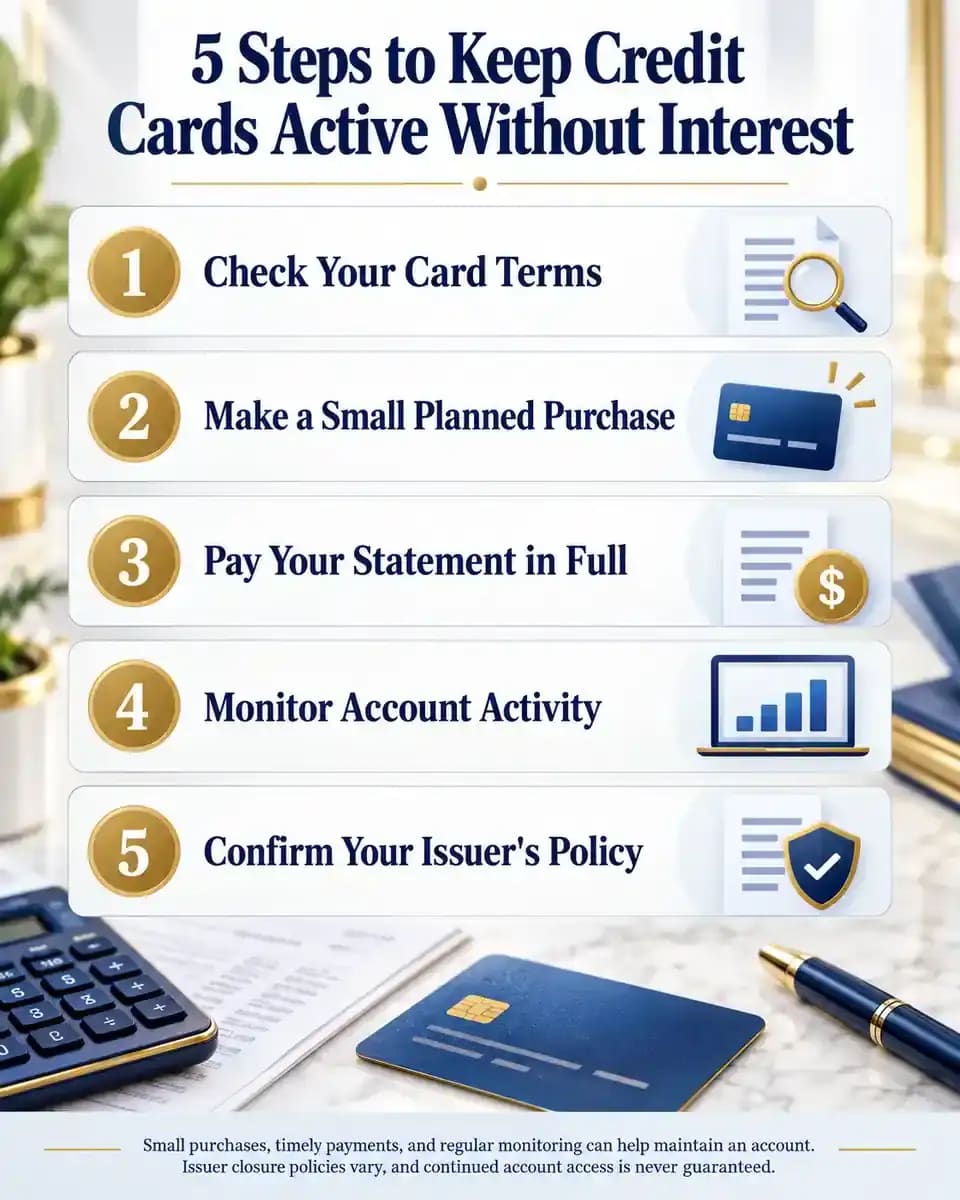
Keeping a credit card active usually does not require expensive purchases. An ordinary low-cost transaction, such as coffee or a grocery item, can demonstrate that the account is being used. Spending more provides no inherent advantage for preventing inactivity-related closure. However, issuers establish their own activity definitions and account review practices, so no transaction amount or schedule guarantees continued availability. Choosing something already included in your usual spending avoids creating an unnecessary expense merely to maintain card activity.

Responsible Card Activity Without Additional Debt
A responsible maintenance approach starts with purchases already covered by your household budget. Treat the credit card as a payment method, not an extension of available income. After transactions post, review statements for unexpected charges, duplicate purchases, and unfamiliar merchants. Enable transaction alerts where available and report suspected fraud promptly through the issuer's official channels. Keeping spending within available cash and resolving billing issues early helps make occasional account activity manageable rather than another source of debt.

Create a Simple Card Activity Routine
Two practical routines can help make card activity predictable. Occasional purchases offer flexibility but require remembering to use the card periodically. Small recurring charges generate regular transactions without repeated shopping decisions, although subscriptions can change prices or renew unexpectedly. Choose a method that fits your spending habits and the issuer's policies. Set calendar reminders to review activity and confirm that payments actually posted. An attempted purchase or scheduled payment should never be assumed successful without verification.

Automate a Small Recurring Payment Safely
Start with an existing recurring expense, such as a modest subscription, rather than purchasing a new service solely for card activity. Update its payment method, then check that the first charge processes correctly. If the issuer supports it, configure autopay for the full statement balance from a checking account. Confirm sufficient funds before withdrawals and verify each payment afterward. Continue monitoring transactions, expiration dates, and notifications, since declined charges or failed bank transfers can disrupt the arrangement.

Build Your Account Maintenance Checklist
Create a simple record for each card covering its last purchase, next planned activity, statement review date, and annual fee renewal. Check the cardholder agreement and ask the issuer how inactivity is defined, whether closure notices are provided, and whether account closure policies may change. Record any stated inactivity timeframe without assuming it guarantees protection from closure. Revisit the checklist regularly, verify that accounts remain open, and update your records whenever terms, fees, or contact information change.

That credit card sitting untouched in your wallet might seem harmless. You are not spending money, accumulating debt, or paying interest. But there is one detail many cardholders overlook: your credit card issuer may eventually close an account that remains inactive for too long.
An unexpected closure can affect your credit score, particularly when you carry balances on other cards. Closing an account reduces your available credit, potentially increasing your credit utilization ratio. This matters because credit scoring models consider how much of your available revolving credit you use.
Here is the reassuring part: keeping a credit card active does not require expensive purchases, carrying a balance, or paying interest. A small, occasional transaction may be enough to demonstrate activity, although each issuer determines its own inactivity policies.
Federal consumer protections also matter. In 2010, the Board of Governors of the Federal Reserve System approved rules banning credit card inactivity fees. However, that protection does not prevent issuers from closing unused accounts, and legitimate annual fees can still apply.
In this guide, you will learn how inactivity affects credit accounts, how utilization changes after a closure, and why old accounts can remain valuable. You will also discover practical ways to maintain activity, set up payments, monitor statements, and ask issuers the right questions.
We will reference guidance from the Consumer Financial Protection Bureau and the Federal Reserve while separating established rules from issuer-specific practices. The goal is simple: help you manage existing credit cards responsibly without creating unnecessary debt or expenses.
Where people go wrong
Carrying a Balance to Build Credit. Paying interest does not improve your credit score simply because you carried a balance. You can demonstrate responsible credit use without revolving debt. For purchases covered by a grace period, paying the statement balance in full by its due date generally avoids interest.
Assuming Unused Cards Stay Open Forever. A credit card with no outstanding balance can still be closed for inactivity. Issuers establish their own account management policies, and some may close accounts without advance notice. Confirming the issuer's expectations is more reliable than assuming an unused card will remain available indefinitely.
Closing Your Oldest Card Without Checking Utilization. Closing an older card can reduce available credit and potentially increase utilization. Positive closed accounts can remain on credit reports for years, so account age effects are not necessarily immediate. Evaluate the card's fees, benefits, balances, and credit limits before deciding.
Ignoring Annual Fees on Unused Cards. Federal rules prohibit credit card inactivity fees, but they do not eliminate legitimate annual membership fees. An unused premium card may continue generating charges. Review statements and compare the ongoing cost with the account's practical value before keeping it solely for credit history.
Setting Automatic Payments Without Monitoring Them. Automatic payments can reduce missed deadlines, but insufficient checking account funds, expired payment instructions, or unexpected charges can create problems. Verify that the payment arrangement works correctly and continue reviewing statements, due dates, account alerts, and available checking account balances.
Spending Extra Money Just to Generate Activity. Maintaining credit card activity should not become an excuse to make unnecessary purchases. A modest planned expense can serve the same purpose without increasing your budget. The objective is to demonstrate occasional legitimate use, not to maximize transactions or spending.
Following a Universal Six-Month Inactivity Rule. There is no single inactivity deadline that applies to every credit card issuer. Some accounts may remain open for extended periods, while others may be reviewed sooner. Ask your issuer directly and treat general timing recommendations as planning habits rather than guarantees.
Questions people ask
There is no universal minimum frequency. Some issuers may review accounts after several months without purchases, while others use different criteria. Making a small purchase every few months can be a practical precaution, but it does not guarantee the account will remain open. Ask your issuer about its specific policy.
Fixed it?
Get one guide like this every Thursday.