How Federal Student Loan Income-Driven Repayment Plans Actually Work
Learn how federal student loan income-driven repayment plans calculate monthly payments using your income, family size, and federal guidelines. Compare IBR, PAYE, ICR, and RAP, and understand what the end of SAVE means for borrowers.

What you’ll need
Tap to tick things off before you start.
What Are Income-Driven Repayment Plans?
Income-driven repayment plans help eligible federal student loan borrowers manage monthly payments based on their financial circumstances. Unlike standard repayment, which primarily uses loan balances, interest rates, and repayment periods, these plans consider income and other qualifying factors. According to the Consumer Financial Protection Bureau, income-driven repayment can make payments more affordable for borrowers with limited earnings. However, lower monthly payments may extend repayment and increase total interest costs over time, depending on the plan.

How Adjusted Gross Income Affects Your Payment
Adjusted gross income, or AGI, is an important starting point for calculating many federal student loan payments. The Internal Revenue Service defines AGI as gross income minus certain qualifying adjustments. It differs from gross salary, which measures earnings before deductions, and take-home pay, which reflects money received after payroll withholding and other deductions. Most taxpayers can find AGI on line 11 of Form 1040. Traditional income-driven repayment calculations generally use AGI to assess repayment obligations.

How Tax Deductions Can Lower Your AGI
Certain tax adjustments can reduce adjusted gross income and potentially lower income-driven student loan payments. Examples include deductible traditional IRA contributions, qualifying student loan interest, and eligible educator expenses. Some pretax workplace retirement contributions also reduce wages included in AGI. The Internal Revenue Service establishes eligibility requirements, deduction limits, and income restrictions for these benefits. Not every deduction reduces AGI, so tax deductions and repayment calculations should be evaluated separately rather than assuming identical results.

How Family Size and Poverty Guidelines Affect Payments
Family size influences traditional income-driven repayment calculations because federal poverty guidelines establish income protection thresholds. The Department of Health and Human Services publishes these guidelines annually, with different amounts for different household sizes. Alaska and Hawaii have separate, higher guidelines than the contiguous states and Washington, DC. Repayment plan rules determine which household members count toward family size. Larger qualifying households generally receive higher protected income thresholds, potentially reducing the amount used to calculate payments.

How to Calculate Discretionary Income
Traditional income-driven plans calculate discretionary income by subtracting a plan-specific percentage of the applicable federal poverty guideline from adjusted gross income. For example, suppose AGI is $50,000 and the applicable poverty guideline is $20,000. Under a formula protecting 150% of that guideline, $30,000 is excluded, leaving $20,000 in discretionary income. A 10% annual payment rate would produce approximately $166.67 monthly. This hypothetical example excludes additional eligibility rules and payment caps.

IBR, PAYE, and ICR: Comparing Repayment Formulas
Income-Based Repayment generally charges 10% or 15% of discretionary income, depending on borrower history, with repayment periods of 20 or 25 years. PAYE generally charges 10% and provides a 20-year forgiveness timeline. ICR uses the lesser of 20% of discretionary income or an income-adjusted 12-year payment, with a 25-year timeline. Federal Student Aid also specifies eligibility restrictions and payment caps. PAYE and ICR are scheduled to end by July 1, 2028.

RAP and SAVE: Understanding the 2026 Changes
Federal repayment options changed substantially in 2026. A court order ended the SAVE Plan in March, requiring affected borrowers to select another eligible plan. The Repayment Assistance Plan, or RAP, uses 1% to 10% of adjusted gross income, divided into monthly payments, with qualifying dependent reductions and a $10 minimum. RAP generally provides a 30-year repayment period. Federal Student Aid advises SAVE borrowers to review servicer notices and transition deadlines.

Which Federal Student Loans Qualify?
Repayment eligibility depends on loan type and disbursement date. Most eligible Direct Loans can enter RAP, while IBR, PAYE, and ICR generally apply to qualifying loans disbursed before July 1, 2026. Federal Family Education Loan Program loans may qualify for certain plans, sometimes through consolidation. Parent PLUS loans face significant restrictions, including limitations involving consolidation dates. Federal Student Aid recommends reviewing individual loan records because consolidation can affect eligibility and other repayment benefits.

How to Apply and Recertify Your Income
Borrowers can review available repayment options through StudentAid.gov using their Federal Student Aid account. The application process may require tax information, alternative income documentation, and household details. Traditional income-driven plans generally require annual recertification, although eligible borrowers may authorize automatic updates using federal tax information. RAP follows its applicable income verification requirements. Loan servicers communicate deadlines and process repayment changes. Missing required updates can affect payment amounts, eligibility, or repayment status.

How to Choose the Best Repayment Plan for Your Budget
Choosing a repayment plan requires comparing more than the initial monthly payment. A lower bill may improve short-term affordability while extending repayment and increasing total interest. Forgiveness eligibility, repayment duration, changing earnings, and household circumstances also affect long-term outcomes. Federal Student Aid's Repayment Calculator can help borrowers evaluate available options and estimated costs. Comparing multiple income scenarios provides a clearer picture of whether a plan remains manageable as financial circumstances change over time.

What Happens When Your Income Drops?
A job loss, reduced working hours, or significant pay cut can make an existing student loan payment difficult to afford. Federal Student Aid allows borrowers enrolled in eligible income-driven repayment plans to request an early payment recalculation instead of waiting for annual recertification. Updated income documentation, such as recent pay stubs or unemployment information, may be required. A lower payment is not automatic, so borrowers should continue following their current repayment instructions until changes are confirmed.

How Marriage and Tax Filing Status Affect Payments
Marriage can affect income-driven repayment calculations because some plans consider a spouse's earnings. For traditional income-driven plans, filing federal taxes jointly generally means combined household income is considered, while filing separately may allow calculations using only the borrower's income. The Internal Revenue Service establishes the tax consequences of each filing status, including differences in deductions and credits. Potential student loan savings should therefore be evaluated alongside overall household taxes rather than considered independently.

What Happens When Your Family Size Changes?
Changes in household composition can affect student loan payments under plans that consider family size. Having a child, gaining an eligible dependent, or experiencing another qualifying household change may alter the information used in repayment calculations. Federal Student Aid applies specific definitions of family size that do not always match tax dependency rules. Borrowers can report qualifying changes through the appropriate repayment update process. Accurate household information helps prevent incorrect payment calculations.

Can Your Monthly Student Loan Payment Be $0?
Some borrowers qualify for a $0 monthly payment under traditional income-driven repayment plans when their calculated discretionary income is sufficiently low. A required $0 payment can count toward applicable forgiveness requirements when other conditions are satisfied. However, not every repayment plan permits zero-dollar payments. The Repayment Assistance Plan generally requires a minimum monthly payment of $10. Federal Student Aid determines eligibility using the borrower's qualifying financial information and applicable repayment rules.

What Happens to Unpaid Student Loan Interest?
Student loan interest generally accrues on outstanding principal unless an applicable subsidy or other rule prevents it. When income-driven payments are smaller than monthly interest charges, unpaid interest may accumulate. Capitalization occurs when qualifying unpaid interest is added to principal, potentially increasing future interest costs. Federal Student Aid identifies capitalization triggers that vary by repayment circumstances. Some plans provide interest protections, so borrowers should distinguish interest accrual from capitalization when evaluating balance growth.

How Student Loan Forgiveness Works Under IDR
Eligible borrowers may receive forgiveness of remaining federal student loan balances after completing the required repayment period under an income-driven plan. Traditional plans generally use 20-year or 25-year periods, while RAP generally requires 30 years. Qualifying payment counts depend on applicable rules, including treatment of certain deferments and forbearances. Federal Student Aid tracks eligibility and discharge requirements. Forgiveness can also create federal or state income tax consequences depending on the applicable law.

How Income-Driven Repayment Interacts With PSLF
Public Service Loan Forgiveness, or PSLF, provides a separate forgiveness pathway for eligible Direct Loan borrowers working full-time for qualifying employers. The program generally requires 120 qualifying monthly payments while meeting employment and repayment conditions. Eligible income-driven repayment plans can help borrowers make qualifying payments based on income. Federal Student Aid recommends using the PSLF Help Tool and submitting employment certification regularly. Maintaining accurate employment and payment records helps identify missing qualifying months.

Can You Switch Repayment Plans Later?
Federal student loan borrowers can generally request a different repayment plan when their current arrangement no longer meets their needs, provided they satisfy eligibility requirements. Switching may change monthly payments, repayment duration, and interest treatment. Leaving certain plans, including IBR, can involve additional procedural requirements. Federal Student Aid explains that qualifying payment history may remain relevant, although consolidation and other changes can affect credited progress. Available options also depend on current federal repayment rules.

How to Fix an Incorrect Student Loan Payment
An unexpected student loan payment amount may result from outdated income records, incorrect household information, or servicing errors. Borrowers can compare their account details with submitted documentation and request an explanation from their loan servicer. Keeping copies of applications, payment notices, and communication records helps establish discrepancies. If the issue remains unresolved, the Consumer Financial Protection Bureau accepts complaints about student loan servicing. Federal Student Aid also provides channels for submitting account concerns.

How to Keep Your Repayment Strategy on Track
Federal student loan repayment requires ongoing attention because payment amounts, account information, and program requirements can change. A practical monitoring routine includes reviewing monthly statements, confirming successful payments, checking account notifications, and maintaining copies of important documents. Calendar reminders can help track upcoming deadlines and financial reviews. Federal Student Aid publishes official repayment updates, while loan servicers communicate account-specific changes. Regular monitoring helps borrowers identify problems before they create unexpected financial obligations.

How Annual Poverty Guideline Updates Affect Your Payment
Federal poverty guidelines change annually, potentially affecting discretionary income calculations under traditional income-driven repayment plans. The Department of Health and Human Services publishes updated thresholds reflecting household size and geographic location. When guidelines increase, the amount of income protected from repayment calculations may also rise, potentially lowering monthly payments. However, updated guidelines do not necessarily trigger immediate payment changes. Their effect depends on the repayment plan, applicable calculation rules, and timing of the next payment determination.

Why Your Loan Balance Does Not Always Determine Your Payment
Under traditional standard repayment, monthly payments primarily reflect the outstanding loan balance, interest rate, and repayment term. Income-driven repayment plans use different calculations that emphasize qualifying income and other financial factors. Consequently, borrowers with substantially different loan balances may receive similar monthly payment amounts when their financial circumstances are comparable. A borrower owing $20,000 could potentially have the same required payment as someone owing $80,000. However, their total repayment costs and remaining balances may differ considerably.

How IBR Rules Differ for Older and Newer Borrowers
Income-Based Repayment distinguishes between borrowers based on their federal loan history. Under Federal Student Aid rules, qualifying new borrowers on or after July 1, 2014, generally pay 10% of discretionary income over a 20-year repayment period. Other eligible borrowers generally pay 15% over 25 years. New borrower status can also apply when someone had no outstanding federal loan balance before receiving a qualifying new loan. IBR payments remain subject to the applicable standard repayment cap.

Understanding the ICR Alternative Payment Calculation
Income-Contingent Repayment uses two calculations and generally selects the lower resulting monthly payment. The first equals 20% of discretionary income divided into monthly installments. The second uses a hypothetical fixed 12-year repayment amount adjusted by an income-dependent factor. Federal Student Aid applies specific rules to determine these figures, so the second calculation is not simply a standard 12-year payment. Comparing both amounts explains why ICR payments can differ from those under other traditional plans.

How RAP Adjusts Payments for Eligible Dependents
The Repayment Assistance Plan incorporates eligible dependents differently from traditional income-driven repayment plans. Rather than increasing a poverty-guideline income exclusion, RAP generally reduces the calculated monthly payment by $50 for each qualifying dependent claimed on the borrower's federal tax return. For example, two eligible dependents could reduce a calculated payment by $100. However, the final required payment generally cannot fall below $10 monthly. Federal Student Aid verifies dependent information through applicable documentation and tax records.

What Happens When Your Income Increases?
A salary increase, promotion, substantial bonus, or other earnings growth may eventually raise required payments under income-driven repayment plans. Traditional plans generally review updated financial information during scheduled recertification, although applicable reporting requirements can vary. An increase in adjusted gross income may produce a larger discretionary income calculation. Some plans limit payments through specified caps, while others use different formulas. Consequently, higher earnings do not necessarily produce identical payment increases across repayment plans.

How Variable Income Affects Repayment Calculations
Self-employed borrowers, freelancers, and seasonal workers may experience substantial income fluctuations throughout the year. Income-driven repayment calculations generally rely on qualifying income information, but recent tax returns may not accurately represent current earnings. Federal Student Aid allows alternative income documentation in certain circumstances, subject to applicable requirements. Supporting records may include recent payment statements or other acceptable earnings evidence. Because irregular income can complicate verification, consistent financial recordkeeping helps borrowers explain changes accurately.

How to Prepare for a Repayment Plan Transition
Changing repayment plans can create temporary uncertainty about payment amounts and due dates. During application processing, a loan servicer may place eligible borrowers into administrative forbearance, depending on applicable federal rules. However, borrowers should not assume payments are automatically suspended. Federal Student Aid recommends reviewing official transition notices and account information. Interest treatment and forgiveness credit during processing periods can vary. Confirming the effective date of a new plan helps avoid unintended delinquency.

How Income-Driven Repayment Affects Your Credit
Income-driven repayment does not automatically damage a borrower's credit because monthly payments are smaller than standard repayment amounts. What matters is whether the borrower meets required payment obligations and avoids delinquency or default. Timely qualifying payments can support a positive repayment history, while missed payments may negatively affect credit reports. The Consumer Financial Protection Bureau explains that payment history is an important credit factor. Loan balances and account status can also influence credit evaluations.

Where to Verify Official Repayment Rules and Deadlines
Federal Student Aid at StudentAid.gov is the primary official resource for federal student loan repayment eligibility, applications, and program updates. The Department of Education publishes regulatory announcements, while the Consumer Financial Protection Bureau provides independent consumer guidance and complaint resources. The Internal Revenue Service explains relevant tax definitions and filing rules. Borrowers can access federal repayment information and applications without paying private enrollment companies. Checking official publication dates helps distinguish current requirements from outdated guidance.

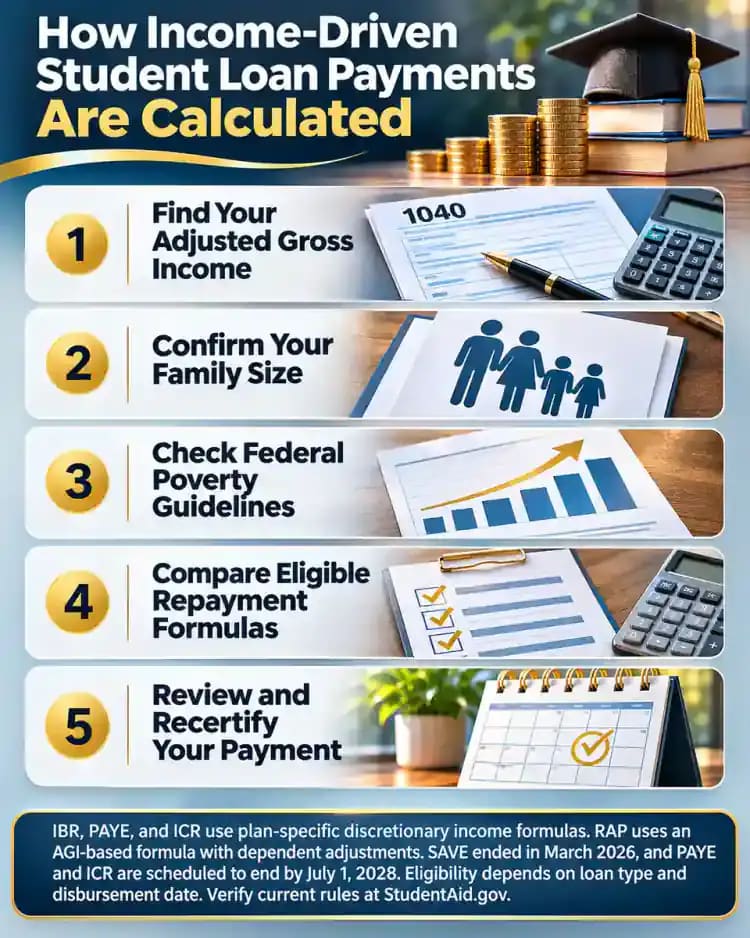
If your federal student loan payment feels too high for your budget, an income-driven repayment plan could make your monthly bill more manageable. Instead of calculating payments primarily from your loan balance, these plans consider your income and, depending on the plan, your family size or number of dependents.
The starting point for many income-driven repayment plans is your adjusted gross income, or AGI. You can usually find this number on line 11 of your federal Form 1040. Unlike your gross salary, AGI reflects certain qualifying income adjustments. For traditional income-driven plans, your AGI helps determine your discretionary income after accounting for a specified percentage of the federal poverty guideline.
The calculation depends on which repayment plan you qualify for. Income-Based Repayment (IBR), Pay As You Earn (PAYE), and Income-Contingent Repayment (ICR) use different formulas and eligibility requirements. The Repayment Assistance Plan (RAP), introduced in 2026, uses an income-based payment formula with adjustments for eligible dependents rather than the traditional discretionary income calculation.
Federal repayment rules have also changed significantly. The SAVE Plan ended in March 2026, and PAYE and ICR are scheduled to disappear no later than July 1, 2028. Your loan type and disbursement dates can determine which options remain available.
Before choosing a plan, check your loan details at StudentAid.gov, compare estimated payments using the federal Repayment Calculator, and review how each option affects total interest and potential forgiveness. A lower monthly payment can provide immediate relief, but it does not automatically mean a lower overall repayment cost.
Where people go wrong
Using Gross Salary Instead of Adjusted Gross Income. Your annual salary is not necessarily the income figure used to calculate your payment. Traditional income-driven plans generally rely on adjusted gross income, which reflects qualifying adjustments. Using gross salary can produce an inaccurate estimate of your monthly obligation.
Assuming Every Repayment Plan Uses the Same Formula. IBR, PAYE, and ICR use different discretionary income calculations, while RAP follows a separate income-based formula. Comparing plans using a single percentage can produce misleading results. Always calculate payments under each plan you actually qualify for.
Ignoring Loan Disbursement Dates. Your loan history matters as much as your current finances. Loans first disbursed on or after July 1, 2026, face different repayment eligibility rules. Check every loan before assuming older income-driven plans remain available to you.
Assuming the SAVE Plan Is Still Available. SAVE ended in March 2026 following a federal court order. Borrowers who remain associated with SAVE must review their transition requirements and select another eligible plan. Ignoring servicer notices could result in unexpected payment changes.
Missing Income Recertification Requirements. Traditional income-driven repayment plans generally require annual income and family size updates. Missing applicable deadlines can change your payment or repayment status. Check whether automatic recertification is enabled and monitor messages from your federal loan servicer.
Choosing the Lowest Payment Without Comparing Total Costs. A smaller monthly payment can improve cash flow but may extend repayment and increase total interest costs. Compare estimated repayment periods, interest treatment, remaining balances, and forgiveness eligibility before deciding which plan offers the greatest financial benefit.
Assuming Parent PLUS Loans Qualify Automatically. Parent PLUS loans have special restrictions and generally cannot enter income-driven repayment directly. Certain loans consolidated before July 1, 2026, may have limited options. Verify the applicable rules before consolidating, switching plans, or relying on estimated payments.
Questions people ask
Traditional income-driven repayment plans generally calculate payments using your adjusted gross income, family size, applicable federal poverty guidelines, and a plan-specific percentage of discretionary income. RAP uses a different formula based on adjusted gross income and eligible dependents. The exact payment depends on your plan, loan eligibility, and financial circumstances.
Fixed it?
Get one guide like this every Thursday.