How Credit Card Interest Actually Accrues Every Day
Credit card interest often builds day by day, not just at the end of the month. Learn how average daily balance, APR, daily periodic rates, grace periods and payment timing affect what you pay.

What you’ll need
Tap to tick things off before you start.
Start With the Right Mental Model
Credit card interest is usually not best understood as a single fee calculated once per month. Many issuers track account balances throughout the billing cycle and use those daily figures to determine interest.
Think of your balance as a moving number. A purchase can push it higher. A payment can pull it lower. If the issuer uses an average daily balance method, every day contributes to the final interest calculation.
That is why the balance shown on the due date does not tell the whole story. A cardholder who owed $2,000 for most of the month and paid $1,500 near the end of the cycle may have a much higher average daily balance than someone who made the same $1,500 payment near the beginning.

Understand the Billing Cycle
A billing cycle is the period covered by a credit card statement. It commonly lasts about a month, but the exact number of days can vary.
During that period, purchases, refunds, fees, payments and other activity change the account balance. The statement closing date marks the end of one cycle, while the payment due date usually arrives later.
Do not confuse the closing date with the due date. The closing date determines which activity appears on that statement. The due date determines when the required payment must arrive.

See Why the Ending Balance Is Not Enough
A common assumption is that interest is based only on whatever balance remains at the end of the cycle. With average daily balance calculations, that assumption can be wrong.
Suppose a balance is $3,000 for 25 days and then falls to $500 for the final five days. The ending balance is only $500, but the account carried much more debt for most of the month.
The calculation is designed to reflect that history. The issuer does not simply ignore the earlier $3,000 because the customer made a late-cycle payment.

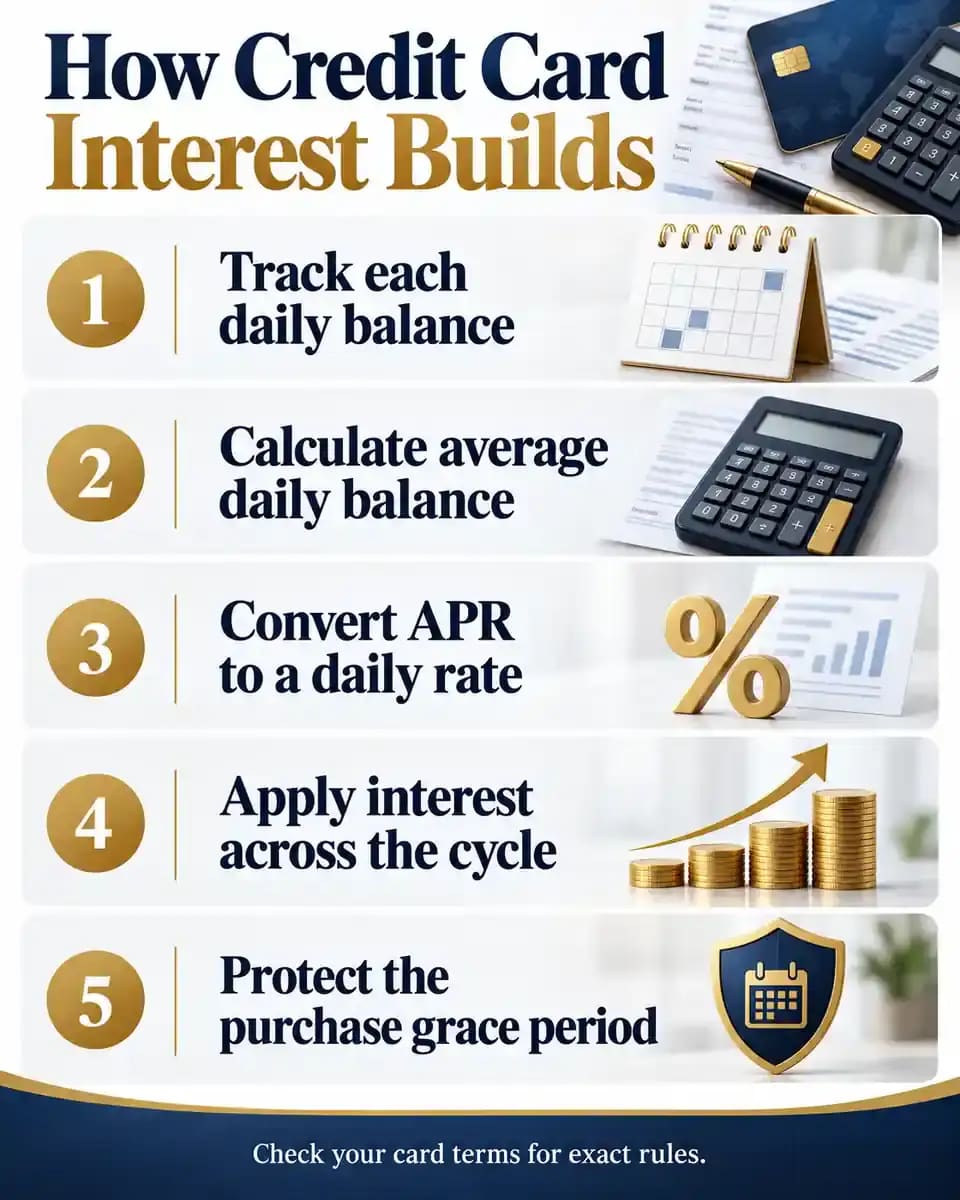
Learn the Average Daily Balance Method
The Consumer Financial Protection Bureau describes the average daily balance method as a common way credit card issuers calculate interest.
The basic process is straightforward. The issuer determines the relevant balance for each day of the billing cycle, adds those daily balances together and divides the total by the number of days in the cycle.
The result is the average daily balance. That figure becomes one of the core inputs used to calculate finance charges.

Follow a Simple Average Balance Example
Imagine a 30-day billing cycle. Your balance is $1,000 for the first 10 days, $1,500 for the next 10 days and $500 for the final 10 days.
The balance-days are $10,000, $15,000 and $5,000. Together they equal $30,000. Divide that by 30 days and the average daily balance is $1,000.
Notice that the card ended the cycle at $500, yet the average balance was twice that amount because the earlier higher balances still counted.

Recognize How Purchases Raise the Average
A purchase made early in the billing cycle can affect many days of the calculation. If you charge $1,000 on day two, that extra balance may remain in the account for most of the month.
If the same purchase occurs on day 28, it influences only a few daily balances before the cycle closes.
This does not mean consumers should manipulate ordinary purchases around interest calculations. It simply explains why transaction timing changes the arithmetic when a balance is already accruing interest.

See Why Early Payments Can Reduce Interest
Payments work in the opposite direction. When a payment reduces an interest-bearing balance early in the cycle, that lower balance can remain in effect for more days.
Suppose two borrowers each pay $1,000 during the same cycle. One pays on day five and the other on day 25. If both are already carrying interest-bearing balances, the earlier payment generally reduces more daily balances.
That can lower the average daily balance and therefore reduce the interest charged, assuming the issuer's calculation method works this way.

Know What APR Actually Represents
APR stands for annual percentage rate. It expresses the borrowing rate on an annual basis, but credit card interest may be calculated much more frequently.
A 24 percent APR does not usually mean the issuer waits until the end of a year and adds 24 percent to the balance. Instead, the annual rate can be converted into a periodic rate and used in the issuer's daily interest process.
Different balance categories may have different APRs, so always distinguish the purchase APR from rates for cash advances, promotional transfers or other categories.

Convert APR Into a Daily Periodic Rate
A common approach is to divide the APR by 365 to estimate the daily periodic rate. For example, a 24 percent APR divided by 365 is about 0.06575 percent per day.
In decimal form, that is approximately 0.0006575. Multiplying that rate by an interest-bearing balance estimates one day's interest before issuer-specific adjustments.
Some issuers may use 360 days or apply different rounding methods. Your cardholder agreement controls the actual calculation.

Estimate One Day of Interest
Using the previous example, assume a $2,000 interest-bearing balance and a daily periodic rate of about 0.06575 percent.
Multiplying $2,000 by 0.0006575 gives approximately $1.32 in interest for that day. That may sound small, but daily charges can accumulate across weeks and months.
This example is intentionally simplified. Actual statements may use average balances, compounding conventions, transaction timing rules and rounding procedures specified by the issuer.

Understand How Daily Charges Accumulate
Once a daily rate is applied repeatedly, the cost of borrowing becomes easier to see. A seemingly small daily charge can build into a substantial monthly finance charge.
The effect becomes more expensive when new purchases are added while an old balance remains unpaid. More principal means more balance exposed to the daily rate.
This is one reason high-APR revolving debt can become difficult to reduce when monthly payments barely exceed new charges and interest.

Do Not Assume Every Issuer Uses 365
The broad mechanics are common, but calculation details are not identical across every product. Some issuers may divide an APR by 365, while others may use 360 or another disclosed convention.
Rounding practices can also differ. Even small differences in daily calculations can alter the final finance charge.
For accuracy, use examples only as teaching tools. When checking an actual account, rely on the issuer's disclosed formula, current APR and statement data.

Separate Purchases From Other Balance Categories
A credit card account can contain more than one type of balance. Purchases, cash advances and balance transfers may each have separate APRs and separate interest rules.
A promotional transfer might temporarily carry a low rate while purchases accrue at a much higher rate. Cash advances commonly have different terms and may begin accruing interest immediately.
Never treat the account as though one APR applies to everything unless the statement clearly confirms that.

Learn What a Grace Period Does
A grace period is generally the time between the end of a billing cycle and the payment due date during which eligible purchases can avoid interest if the required balance is paid in full.
The Consumer Financial Protection Bureau explains that grace periods are common on purchases, but they are not guaranteed on every card or every type of transaction.
When a grace period applies and you satisfy its conditions, purchases can effectively receive short-term interest-free financing.

Know Which Balance Usually Needs to Be Paid
Consumers often confuse the minimum payment, statement balance and current balance.
The minimum payment is the smallest amount required to keep the account current, but paying only the minimum usually does not preserve an interest-free purchase grace period when a statement balance remains unpaid.
The statement balance reflects charges included when the billing cycle closed. The current balance may also include activity that occurred after the statement closed. Check your card's exact terms to determine what must be paid to maintain the grace period.

See How Paying in Full Can Avoid Purchase Interest
Assume you begin a billing cycle without a carried purchase balance, make ordinary purchases and then pay the full statement balance by the due date.
If the card provides a qualifying purchase grace period and all terms are satisfied, those purchases generally avoid interest.
That is one of the most valuable features of a conventional credit card. The card functions as a payment tool rather than an expensive revolving loan when the eligible statement balance is consistently paid in full.

Do Not Assume a Grace Period Exists
A grace period is not a universal feature that applies automatically to every card and transaction.
The CFPB notes that credit card companies are not required to provide a grace period. Many cards do offer one for purchases, but cash advances and some other transactions may follow different rules.
Before relying on an interest-free window, confirm that the account agreement actually provides it and understand the conditions required to keep it.

Understand What Happens Without a Grace Period
If a purchase is not protected by a grace period, interest may begin accruing from the transaction date according to the card's terms.
That changes the economics significantly. Waiting until the due date no longer guarantees that the purchase remained interest free.
This is especially important when dealing with transaction categories that often have separate rules, such as cash advances.

Understand How a Grace Period Can Be Lost
When a consumer does not pay the required statement balance in full, the purchase grace period may be lost under the issuer's terms.
Once that happens, the unpaid balance can continue generating interest and new purchases may also begin accruing interest from their transaction dates.
This is one of the most expensive misunderstandings in credit card use because someone may think only the leftover portion of the previous statement is generating interest.

See Why New Purchases Can Become Expensive
Suppose you carried $400 from the previous statement and then spent another $1,200 during the new cycle. If your grace period is no longer active, those new purchases may start accruing interest as they post.
The result is a rapidly expanding interest-bearing balance. Groceries, fuel, subscriptions and other routine spending are no longer simply waiting for the next due date.
They may be increasing the balance used in daily interest calculations immediately.

Recognize Residual or Trailing Interest
A consumer can sometimes pay what appears to be the full statement balance and still see a small interest charge later. One reason can be interest that accrued between the statement closing date and the date the payment was received.
This is often called residual or trailing interest. Whether and how it appears depends on the account terms and timing.
If an unexpected interest charge remains after a payoff, review the statement details or contact the issuer rather than assuming the charge is automatically an error.

Know That Restoring the Grace Period May Take Time
Paying off a carried balance does not always mean the grace period returns instantly.
Depending on issuer terms, the cardholder may need to pay balances in full for one or more billing cycles before purchase grace-period treatment is restored.
Because this varies, the only reliable answer comes from the specific cardholder agreement or the issuer's explanation of account terms.

Read the Interest Charge Calculation Section
Your monthly statement contains more information than the amount due. Look for the section describing interest charges, APRs or balance subject to interest.
The statement can show how balances are grouped by rate category and what interest was charged for each category.
This is the most useful area for understanding why the finance charge differs from what you expected.

Compare APR Categories on the Statement
Federal disclosure rules require credit card statements to provide important rate and fee information, and statements commonly separate balances subject to different APRs.
You may see separate rows for purchases, cash advances, promotional balances or balance transfers.
When one category generates a surprisingly high charge, identify its APR and balance before assuming the entire account was charged at the same rate.

Look for the Balance Subject to Interest
The balance subject to interest can be more informative than the statement's ending balance because it reflects the issuer's calculation method.
On cards using average daily balance, this figure may correspond closely to the average amount exposed to the periodic rate.
If the number looks unexpectedly high, revisit the timing of large purchases and payments during the cycle.

Check the Daily Periodic Rate
Some statements or card agreements disclose the daily periodic rate directly. If yours does, compare it with the purchase APR to understand how the annual rate is being translated into daily charges.
If the daily rate is not obvious, the cardholder agreement may explain the divisor and calculation method.
Avoid reverse-engineering a final finance charge from APR alone when multiple balance categories or unusual transactions are involved.

Use Payment Timing Intentionally
If you are carrying an interest-bearing balance, earlier payments can be more effective than the same payment made later because they reduce the balance for more days.
This does not change the requirement to make at least the minimum payment by the due date. It simply adds another consideration: interest reduction.
Someone paid twice per month, for example, may choose to make partial payments as cash becomes available rather than allowing funds to sit unused until the due date. Whether that approach fits a household budget is a separate decision.

Stop Adding New Debt When Interest Is Already Accruing
One of the hardest cycles to escape is continuing to spend on a card that has lost its grace period while also trying to pay down the old balance.
Each new purchase can undermine progress by increasing the balance exposed to interest.
When practical, separating current spending from an interest-bearing revolving balance can make repayment easier to track. The best approach depends on available cash flow, account terms and broader financial circumstances.

Audit Your Statement With Three Questions
A useful monthly review can be surprisingly simple.
First, did you pay the previous statement balance in full, or are you carrying an interest-bearing balance? Second, what APR and periodic rate apply to each category? Third, does the account currently have a purchase grace period, and what are the conditions for keeping or restoring it?
Those three questions reveal most of the mechanics behind ordinary purchase interest.

Use the Card Agreement as the Final Authority
General formulas are useful for understanding the system, but the cardholder agreement determines how a specific account works.
The Consumer Financial Protection Bureau's educational materials provide a strong framework for understanding average daily balance calculations and grace periods, yet issuers can differ in daily-rate conventions, rounding, transaction categories and restoration of grace periods.
Whenever your estimate and the actual statement disagree, verify the applicable APR, balance category, daily periodic rate, number of days, transaction dates and grace-period status. Understanding those pieces turns a mysterious finance charge into a calculation you can investigate.

Credit card interest is easy to underestimate because the number most people see first is an annual percentage rate. The actual charge on many cards is much more granular. Interest may be calculated using balances recorded throughout the billing cycle, with a daily periodic rate applied as those balances change.
That means two people with the same APR and the same ending balance can potentially owe different amounts of interest if their purchases and payments happened on different days. It also means paying earlier can matter, not merely paying before the due date.
The Consumer Financial Protection Bureau explains that many issuers use an average daily balance method to calculate credit card interest. The CFPB also notes that a grace period may allow consumers to avoid interest on purchases when the required balance is paid in full by the due date, although card terms vary and grace periods are not universal.
This guide explains the mechanics without relying on shortcuts. You will see how the average daily balance is built, how APR becomes a daily rate, why purchase timing matters, what can happen after a grace period is lost and which parts of a monthly statement deserve close attention.
This is general consumer education, not individualized financial, legal or tax advice. Always check the cardholder agreement and current statement for the exact rules that apply to a specific account.
Where people go wrong
Assuming interest is calculated only on the due date. Many cards use balances recorded throughout the billing cycle, so interest calculations can reflect daily activity rather than only the final balance.
Paying only the minimum to preserve a grace period. The minimum payment keeps the account current but generally does not replace the requirement to pay the qualifying statement balance in full when maintaining a purchase grace period.
Waiting until the last moment to pay a carried balance. When interest is already accruing, an earlier payment can reduce more daily balances than the same payment made late in the cycle.
Assuming every transaction uses the purchase APR. Cash advances, balance transfers and promotional balances may have separate APRs and different interest rules.
Assuming every card has a grace period. Grace periods are common for purchases but are not guaranteed for every credit card or transaction category.
Continuing to spend after losing the grace period. New purchases may begin accruing interest from their transaction dates, making payoff harder.
Ignoring trailing interest. Interest can sometimes accrue between a statement closing date and the date a payoff is received, creating a small later charge.
Using a generic APR formula as the final answer. Issuer-specific day counts, rounding practices, transaction timing and balance categories can produce a different result from a simplified estimate.
Questions people ask
Many credit card issuers calculate interest using balances tracked throughout the billing cycle. A daily periodic rate derived from the APR is applied according to the issuer's disclosed method, often using an average daily balance.
Fixed it?
Get one guide like this every Thursday.