How Bank Wire Transfers Work: Fedwire, SWIFT, and Your Money
Where does your money go when you send a bank wire? Follow the step-by-step path of domestic Fedwire and international SWIFT transfers, understand settlement times and fees, and learn how to protect yourself from costly wire fraud.

What you’ll need
Tap to tick things off before you start.
What Is a Bank Wire Transfer?
A bank wire transfer is an electronic payment that moves funds between financial institutions using secure payment instructions. Instead of transporting physical cash, banks update account records to reflect money leaving the sender and reaching the recipient. Understanding how wire transfers work is particularly useful when making large or time-sensitive payments. Common examples include home purchases, escrow deposits, business invoices, and international family payments. Wire transfers can involve accounts at the same bank or different banks.

How a Domestic Wire Transfer Works Step by Step
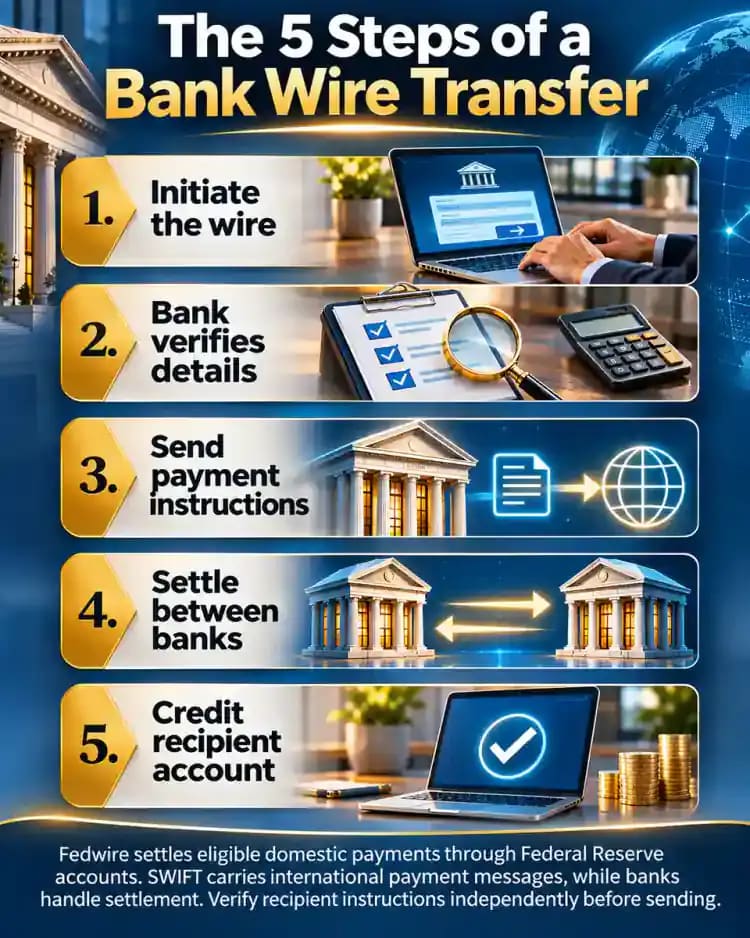
A domestic wire begins when the sender provides the recipient's banking information and authorizes the payment. The sending bank verifies the customer's identity, checks available funds, and prepares a payment instruction. That instruction travels through an appropriate interbank payment system, where the participating institutions complete settlement. Finally, the receiving bank processes the incoming payment and credits the intended account. Bank-specific verification requirements and processing schedules can affect how quickly these stages are completed.

How Fedwire Settles Money Between US Banks
The Federal Reserve Banks operate the Fedwire Funds Service, a real-time gross settlement system for eligible payments between participating financial institutions. Each payment settles individually rather than being combined into a batch. Settlement occurs through corresponding debits and credits to accounts maintained at Federal Reserve Banks. According to the Federal Reserve, processed Fedwire payments receive immediate, final, and irrevocable settlement. This finality reduces uncertainty between institutions, although customer account crediting remains a separate banking process.

Fedwire vs. ACH: Speed, Settlement, and Use Cases
Fedwire and the Automated Clearing House, or ACH, support different payment needs. Fedwire settles qualifying payments individually with immediate finality during operating hours. ACH generally uses batch-based processing and supports scheduled settlement, including certain same-day payments. Banks commonly use wires for urgent, high-value transactions, while ACH handles payroll, bill payments, and recurring transfers. ACH payments may also have different return procedures. The appropriate option depends on transaction urgency, available services, costs, and payment requirements.

How SWIFT Handles International Wire Instructions
SWIFT, the Society for Worldwide Interbank Financial Telecommunication, provides standardized messaging services used by financial institutions worldwide. When a bank initiates an international wire, it may send a secure SWIFT message identifying the recipient, destination institution, and payment details. Crucially, SWIFT does not hold customer deposits or settle funds itself. It communicates instructions that participating banks use to arrange payment. This distinction explains why successful message transmission does not necessarily mean the recipient has received the money.

Why International Wires Need Correspondent Banks
Not every bank maintains a direct financial relationship with every foreign institution. When banks lack a suitable direct connection, they may rely on correspondent banks to facilitate international payments. These intermediaries maintain accounts with other institutions, allowing payment obligations to be settled through established banking relationships. A transfer may pass through several institutions before reaching its destination. Each additional participant introduces another processing stage, making the payment route more complex than a direct relationship between two banks.

Wire Transfer Fees, Exchange Rates, and Delivery Times
Wire transfer costs depend on the sending bank, destination, currency, and payment route. Charges may include outgoing fees, receiving fees, intermediary deductions, and currency conversion markups. Domestic wires often arrive within the same business day, while international transfers commonly require additional business days. Cutoff times, holidays, compliance reviews, and receiving bank procedures can affect delivery. Before authorizing payment, compare the total expected cost and the amount the recipient should receive, not just the advertised sending fee.

Are Wire Transfers Reversible? Your Legal Rights
Completed wire transfers are generally difficult to reverse because interbank settlement may be final. However, cancellation and error resolution rights depend on the transaction and applicable law. Regulation E does not automatically protect every wire payment, particularly certain consumer-authorized transfers involving fraud. The Consumer Financial Protection Bureau explains that qualifying international consumer remittances have specific disclosure, cancellation, and error resolution protections. Many covered remittances allow cancellation within 30 minutes, subject to legal conditions and exceptions.

How to Recognize and Avoid Wire Transfer Scams
Wire fraud frequently involves impersonation or business email compromise. Criminals may access legitimate email accounts, forge messages from trusted professionals, or claim that payment instructions have suddenly changed. These tactics are especially dangerous during real estate transactions. Warning signs include unexpected account changes, unusual urgency, and requests to bypass established procedures. Verify instructions through an independently confirmed phone number, never one supplied in a suspicious message. Confirm the recipient's identity and banking information before authorizing payment.

Your Final Checklist Before Sending a Wire
Before submitting a wire, confirm the recipient's legal name, account number, bank details, and required routing or international identifiers. Ask your bank about total charges, processing deadlines, expected delivery, and available account verification procedures. For international consumer payments, request information about applicable cancellation and error resolution rights. Review the final authorization details carefully and retain your confirmation. If you discover an error or suspect fraud afterward, contact your bank immediately and request assistance.

What Happens After Your Bank Sends the Wire?
After your bank accepts a wire request, it typically provides a confirmation showing the payment amount, date, recipient information, and transaction reference. However, confirmation that a request was submitted does not necessarily mean the receiving bank has credited the money. Banking systems may display statuses such as pending, processing, completed, or rejected. These labels vary by institution. A completed sending-bank transaction may still require additional action before the recipient can access the funds.

How to Track a Domestic or International Wire
If a wire has not arrived, the sending bank can often investigate using its transaction records. Domestic Fedwire payments may have an IMAD or OMAD reference associated with network processing. International SWIFT payments may carry a Unique End-to-End Transaction Reference, or UETR, supporting tracking through participating institutions. Ask your bank which reference identifies the payment and whether a trace is available. Tracking visibility depends on the network, participating banks, and their reporting capabilities.

Why a Wire Transfer Might Be Delayed or Rejected
A wire can be delayed when payment information is incomplete, account identifiers are incorrect, or a bank needs additional verification. Financial institutions may also review transactions for sanctions compliance, suspicious activity, or other regulatory concerns. Insufficient available funds can prevent initiation, while receiving bank restrictions may interrupt delivery. Rejected payments may be returned through banking channels, but processing time varies. A delay alone does not establish fraud or confirm that money has disappeared.

Understanding Routing Numbers, SWIFT Codes, and IBANs
Different banking identifiers serve different purposes. A US routing number identifies a financial institution for domestic payment processing, while an account number identifies the customer's account. SWIFT or BIC codes identify institutions involved in international financial messaging. Many countries also use International Bank Account Numbers, or IBANs, which follow standardized country-specific formats. Not every destination requires an IBAN. Banks may request additional local identifiers, so payment instructions must match the requirements of the receiving country.

Sending a Wire for a Home Purchase
Home purchases frequently involve substantial payments to escrow or settlement accounts. The closing agent typically provides payment instructions, while the buyer's lender or settlement team may establish funding deadlines. Because property transactions involve multiple parties, coordination is essential to prevent closing delays. Criminals sometimes impersonate settlement professionals and substitute fraudulent banking details. Buyers should independently confirm the designated escrow account through an established contact number and understand when the closing agent expects cleared funds.

Sending Money to Family in Another Country
International family payments may involve tuition support, living expenses, medical bills, or other personal needs. Before choosing a provider, consider whether the recipient needs money deposited into a bank account, delivered to a digital wallet, or collected as cash. Available methods depend on the destination country. Currency selection also matters because the recipient may prefer local funds. The Consumer Financial Protection Bureau provides information about consumer remittances and disclosures that can help compare available services.

What to Do If You Entered Incorrect Wire Details
If you discover an incorrect account number or recipient detail after submitting a wire, notify the sending bank immediately. Explain the error and ask whether the payment remains pending or has already been processed. Depending on its status, the bank may attempt an amendment, cancellation, or recall. Successful recovery is not guaranteed, particularly after settlement. The receiving institution may need to cooperate, and additional investigation can take time. Preserve your payment confirmation and all subsequent communications.

How Banks Investigate Wire Transfer Errors
When a payment problem is reported, the sending bank may review transaction instructions, processing records, and available settlement references. It can contact intermediary or receiving institutions to determine where the payment was processed and whether corrective action is possible. Customers may be asked to provide confirmations and supporting correspondence. For qualifying international consumer remittances, the Consumer Financial Protection Bureau explains that specific error resolution procedures apply, including investigation obligations and applicable response deadlines under federal regulations.

When Should You Choose a Wire Transfer?
Wire transfers can be appropriate when a payment requires reliable interbank settlement or must satisfy a specific transaction deadline. However, other methods may offer practical advantages. ACH transfers often suit recurring payments, checks may accommodate less urgent transactions, and credit cards can provide purchase dispute mechanisms. Payment applications may be convenient for smaller personal transfers. Consider the recipient's accepted methods, transaction amount, urgency, costs, and available protections. A faster payment method is not automatically the safest choice.

The Bottom Line: Move Money With Confidence
Understanding how wire transfers work helps consumers make more informed decisions about moving money between banks. A dependable process starts with knowing the intended recipient, understanding the bank's payment requirements, and recognizing that processing speed does not eliminate transaction risk. Expectations should reflect the destination, banking arrangements, and available customer support. When questions arise, a financial institution can explain its procedures and applicable options. Informed authorization and careful communication remain essential to responsible electronic payments.

How Banks Authenticate Wire Transfer Requests
Before releasing a wire transfer, banks typically verify that the person requesting it has authority over the account. Authentication may involve passwords, one-time security codes, biometric identification, or confirmation through a registered device. High-value payments can trigger additional questions or manual approval. Some institutions also require separate authorization for business accounts. These controls help prevent unauthorized instructions, but successfully authenticating a customer does not establish that the intended recipient is legitimate or trustworthy.

What Happens During Bank Compliance Screening?
Banks screen wire transfers to meet applicable financial regulations and identify potentially suspicious activity. Reviews may include checking names against sanctions lists, examining unusual payment patterns, and evaluating transactions under anti-money laundering programs. International payments can require additional information about recipients, destinations, or transaction purposes. A flagged payment may undergo manual review before processing continues. These checks do not automatically indicate wrongdoing. They help institutions comply with legal obligations and manage financial crime risks.

Understanding Fedwire Operating Hours and Bank Cutoffs
Fedwire operating hours are different from the deadlines banks establish for customers submitting payments. The Federal Reserve Banks operate the Fedwire Funds Service according to a published business-day schedule, while participating institutions may impose earlier internal cutoffs. A wire requested after a bank's deadline may not be processed until its next available processing period. Weekends, holidays, and institutional procedures also affect scheduling. Customers should confirm their bank's specific submission deadline rather than assuming network availability guarantees immediate processing.

How Receiving Banks Credit Wire Transfers
After an incoming wire reaches the receiving institution, the bank identifies the intended beneficiary using the payment instructions and its internal account records. It then determines whether the payment can be posted to the designated account. Additional verification, account restrictions, or internal processing procedures may affect availability. Interbank settlement and customer account crediting are distinct events. A receiving bank may have completed its settlement obligations before the beneficiary sees the deposit reflected in an available balance.

What Happens When a Wire Transfer Is Returned?
A receiving institution may return a wire when it cannot apply the payment, such as when the destination account is closed or required information is invalid. The return generally travels through banking channels back toward the sending institution. Returned amounts may differ from the original payment because applicable charges or currency conversion can affect the proceeds. The sending bank must then process the incoming return and credit the customer's account. Return timing depends on the institutions involved.

How Currency Conversion Works in International Wires
International wires sometimes require converting the sender's currency into the currency accepted by the receiving bank. Conversion may occur at the sending institution, an intermediary, or the destination bank, depending on the payment arrangement. Providers can apply an exchange rate that includes a spread above a reference market rate. Conversion timing also matters because rates fluctuate. For qualifying consumer remittances, the Consumer Financial Protection Bureau explains disclosure requirements concerning applicable exchange rates and recipient amounts.

Why Banks Sometimes Use Multiple Intermediaries
An international payment may require several intermediary institutions when no single correspondent bank provides the necessary account relationships or currency access. One institution might maintain the required currency account, while another provides access to the destination banking system. Each participant handles its portion of the payment according to established financial arrangements. These routes reflect the structure of international banking rather than physical movement of cash. More intermediaries can increase operational complexity and introduce additional processing dependencies.

How to Document a Large Wire Transfer
Accurate records help establish what was authorized and provide useful information if questions arise later. Retain the bank's payment confirmation, transaction reference, transfer amount, date, recipient details, and stated payment purpose. Supporting invoices, contracts, and relevant correspondence may also be important. Store these records securely because they can contain sensitive financial information. Retention requirements vary by institution and transaction type. A clear documentation trail can simplify payment reconciliation, communication with banks, and subsequent transaction reviews.

How to Escalate an Unresolved Wire Transfer Problem
When routine customer service cannot resolve a wire problem, request the bank's formal complaint or dispute procedure. Provide a written explanation, transaction identifiers, supporting records, and the outcome requested. Keep copies of submissions and responses. The Consumer Financial Protection Bureau accepts complaints about eligible consumer financial products and services, including certain money transfer issues. Other regulators may have jurisdiction depending on the institution. Significant unresolved losses or complex disputes may warrant advice from a qualified legal professional.

Five Principles for Safer Bank Wire Transfers
Five practical principles can reduce avoidable wire transfer risks. First, independently verify the recipient and payment instructions. Second, understand exactly what transaction you are authorizing. Third, review the complete cost, including potential intermediary charges. Fourth, distinguish payment submission from settlement and recipient availability. Fifth, report suspected mistakes or fraud immediately. These habits cannot eliminate every risk or guarantee recovery, but they create a more disciplined approach to high-value electronic payments and informed communication with financial institutions.

Sending a wire transfer can feel surprisingly risky, especially when you are moving thousands of dollars for a home purchase, paying an overseas supplier, or transferring money to family abroad. You enter a few banking details, authorize the payment, and watch the money leave your account. But where does it actually go, and when does the recipient receive it?
Understanding how wire transfers work starts with two important names: Fedwire and SWIFT. Both help banks coordinate electronic payments, but they serve different purposes. Fedwire is a Federal Reserve payment system that settles eligible domestic transfers between participating financial institutions. SWIFT is a secure international messaging network that communicates payment instructions without moving the money itself.
For a domestic wire, your bank verifies the payment, sends instructions through an appropriate payment network, and arranges settlement. International transfers may involve additional banks, currency conversion, and multiple processing stages. These differences affect how quickly your payment arrives, how much you pay in fees, and what happens when something goes wrong.
The biggest concern is security. Once a wire settles, reversing it can be extremely difficult. Criminals exploit this by sending convincing fake payment instructions, particularly during real estate transactions and other large purchases.
This guide explains the journey your money takes, the differences between Fedwire and SWIFT, the costs and consumer protections worth understanding, and the practical checks you should complete before authorizing a transfer. The goal is simple: help you send money confidently without confusing transaction speed with guaranteed safety.
Where people go wrong
Trusting Wire Instructions Received by Email. Fraudsters can impersonate real estate agents, attorneys, and businesses by compromising email accounts or sending convincing fake messages. Never assume emailed banking details are legitimate. Call the intended recipient using an independently verified phone number before sending money.
Assuming SWIFT Actually Transfers the Money. SWIFT securely communicates standardized financial messages, but it does not hold deposits or settle payments. International transfers depend on banks and their account relationships to move funds. Confusing messaging with settlement can create unrealistic expectations about speed and tracking.
Entering the Wrong Routing or Account Number. An incorrect account number or routing number can delay a transfer, cause rejection, or potentially direct funds to the wrong destination. Some banks process payments using account identifiers without confirming name matches. Independently verify every required detail before authorization.
Assuming Every Wire Can Be Canceled. Fedwire settlement is final once processed, and recovering a completed payment generally requires additional cooperation or intervention. Certain qualifying international consumer remittances have specific cancellation rights. Never assume your bank can reverse a wire simply because you made a mistake.
Ignoring Intermediary Fees and Exchange Rates. International wires may involve sending fees, intermediary bank charges, receiving fees, and currency conversion costs. Focusing only on the advertised transfer fee can underestimate the total expense. Ask how much the recipient is expected to receive before authorizing payment.
Confusing Bank Settlement With Recipient Availability. A payment can settle between banks before the receiving institution makes funds available to its customer. Compliance reviews, account verification, bank operating hours, and local processing procedures may affect availability. Confirm the expected crediting timeline when timing is critical.
Assuming Fraud Losses Are Automatically Reimbursed. Wire transfers do not necessarily provide the same dispute protections as credit cards. If you personally authorize a payment after being deceived, reimbursement may be unavailable. Report suspected fraud immediately, request a recall, and document every communication with your bank.
Questions people ask
A wire transfer moves funds electronically between financial institutions through payment instructions and account adjustments. Your bank verifies your request, sends the payment through an appropriate network, and arranges interbank settlement. The receiving bank then credits the beneficiary. The exact process depends on whether the transfer is domestic or international.
Fixed it?
Get one guide like this every Thursday.