The Hidden Costs of Credit Card Travel Portals: What Travelers Should Check Before Booking
Credit card travel portals can make points easy to redeem, but third-party booking rules, changing reward values, interest costs, refund problems and lost loyalty benefits can reduce the value of a trip.

What you’ll need
Tap to tick things off before you start.
Understand What a Credit Card Travel Portal Actually Is
Credit card travel portals operate much like online travel agencies. Instead of booking solely with an airline, hotel or rental company, you place an intermediary between yourself and the provider. The portal may allow you to pay with points, cash or a combination of both. That arrangement can be convenient, but it also means the portal's rules can become part of your reservation. Before focusing on the rewards, understand that you may be creating a three-party transaction rather than a simple purchase directly from the company providing the trip.

Recognize the Extra Layer Between You and the Provider
The biggest structural difference is control. If you book directly with an airline, the airline normally controls the reservation. If you use a portal, some changes may need to be processed through the portal even though the airline operates the flight. The same issue can arise with hotels. This becomes important when plans change because the employee standing at an airline counter or hotel desk may not have the authority to modify a third-party reservation in the same way they could modify a direct booking.

Read Both Sets of Booking Terms
A portal reservation may involve conditions from both the booking platform and the travel provider. Do not assume that reading only the airline or hotel's policy tells you everything that applies. Look for cancellation deadlines, change procedures, refund eligibility, fees and rules governing points. If one set of terms says a reservation can be canceled but another specifies that changes must be processed through the original booking channel, that distinction can determine how much work is required when something goes wrong.

Identify Who Controls Changes to the Reservation
Before paying, determine who you would contact to change the trip. A useful question is simple: if I need to move this flight or cancel this hotel tonight, who can actually do it? A portal customer service representative may have access to the reservation but still be restricted by agreements with the airline or hotel. Knowing the responsible party in advance can prevent a stressful round of calls during a disruption.

Understand the Merchant of Record
The merchant shown on your transaction can matter operationally. In some portal arrangements, the portal processes your payment rather than the hotel or other provider receiving your card payment directly. That can affect who is able to issue a refund. A hotel employee may agree that a refund is appropriate but still be unable to return money that the hotel never charged directly to your card. Check your confirmation and transaction details so you know where the payment actually went.

Expect Customer Service to Be More Complicated During Disruptions
The weaknesses of a third-party arrangement are often easiest to see during cancellations, storms, schedule changes and sold-out situations. A portal may tell you that the provider must authorize a change, while the provider may tell you that only the original booking channel can modify the reservation. The result can be a customer service loop. This does not happen with every portal booking, but the possibility should be included when comparing convenience against flexibility.

Do Not Treat Points as Having a Fixed Value
Credit card points do not necessarily have one universal dollar value. Their value may change depending on the issuer, card, transfer partner and redemption method. A point used through a portal might produce a different result than a point transferred to an airline program or redeemed for another benefit. The right comparison is not simply how many points a trip costs. Compare what those points are worth under the alternatives that are realistically available to you.

Calculate the Value You Are Getting Per Point
A basic calculation can make a portal redemption easier to evaluate. Divide the comparable cash price by the number of points required. If a $600 trip costs 60,000 points, the simple redemption value is about one cent per point. That figure is not automatically good or bad because programs differ, but it gives you a consistent basis for comparison. Use the cash price you could actually book elsewhere, not an inflated reference price displayed only inside the portal.

Compare the Portal Cash Price With the Direct Price
Never assume the portal shows the same price as the airline or hotel. Search the exact trip directly before booking. Match the date, room type, fare class, baggage allowance, cancellation rules and included benefits. A portal that requires fewer clicks may still cost more. Even a modest price difference can materially reduce the apparent value of a points redemption if the portal's underlying cash price is higher than the direct booking price.

Compare the Entire Fare or Room Package
Price alone can be misleading. A lower fare may exclude checked bags, seat selection or flexible changes. A hotel rate may be prepaid and nonrefundable while a slightly more expensive direct rate allows cancellation. Compare the economic value of the whole booking. The cheapest number on the screen is not necessarily the lowest-cost choice once restrictions and likely extras are included.

Check for Reward Devaluation
The CFPB has reported consumer frustrations involving changes in the value of credit card rewards. A balance that once seemed sufficient for a particular type of trip may later buy less. Programs can change redemption rates, award structures or promotional rules subject to their terms. This makes it risky to think of points as equivalent to cash stored in a bank account. Review current redemption values when you are ready to use them rather than relying on assumptions from months or years earlier.

Watch for Promotional Conditions
A large welcome offer or promotional multiplier can look straightforward until the eligibility rules are examined. The CFPB has highlighted complaints involving unexpected promotional conditions. Before changing spending behavior because of a promotion, read the requirements, exclusions and deadlines. Confirm which purchases count, whether returns affect eligibility and when rewards are supposed to post. Saving a copy of the offer can also help if the promotion later becomes difficult to verify.

Consider the Risk of Redemption Problems
Having enough points does not guarantee that every desired itinerary will be available on the expected terms. Travelers may encounter inventory restrictions, technical errors or difficulty applying rewards. Before transferring points or making irreversible arrangements, verify that the desired reservation is actually bookable. If an award requires multiple steps, understand which steps can be reversed and which cannot.

Know That Rewards Can Be Revoked Under Program Rules
The CFPB has also identified complaints involving the revocation of rewards. Credit card programs generally contain rules governing account closure, suspected misuse, returned purchases and other circumstances that can affect rewards. Consumers should understand those provisions before assuming a points balance is permanent. If you are planning a major redemption, review the current program agreement rather than relying entirely on marketing language.

Calculate the Cost of Carrying a Credit Card Balance
Rewards are much less valuable if earning them contributes to revolving credit card debt. Interest can accumulate rapidly when a balance is carried from month to month. A cardholder earning one or two cents of reward value per dollar spent can easily pay substantially more than that in financing costs if the purchase remains unpaid. Evaluate rewards separately from the cost of borrowing. Spending extra merely to earn travel points generally does not improve the math when interest is being charged.

Separate the Reward From the Purchase Decision
A useful discipline is to first ask whether you would make the purchase without the points. Rewards can create the feeling that additional spending is productive because it moves you closer to a flight or hotel stay. Economically, however, spending $100 to earn a small amount of points still means spending $100. Treat the reward as a secondary benefit of necessary spending rather than the primary reason to buy.

Review Cancellation Rules Before Booking
Find the cancellation policy before clicking the final purchase button. Determine whether the reservation is refundable, whether points return automatically, whether cash portions are refunded and whether there are deadlines or fees. A flexible direct booking and a restrictive portal booking are not equivalent even if they appear to offer the same room or flight. Flexibility has economic value, especially when travel is booked far in advance.

Check the Rules for Voluntary Changes
A cancellation initiated by the traveler can be treated differently from a disruption caused by the airline or hotel. If you voluntarily change dates, the portal may have procedures, fees or restrictions in addition to the provider's rules. Determine how a voluntary change is processed and whether the portal must handle it. This is particularly important for complex or expensive itineraries where a small schedule change could affect several reservations.

Check What Happens if the Airline Cancels
Airline cancellations can trigger rights and procedures that differ from voluntary changes. The U.S. Department of Transportation oversees important aspects of airline consumer protection, and airline-specific complaints may be directed there when appropriate after attempts at direct resolution. With a portal booking, however, the practical process of rebooking or returning money may still involve the intermediary. Keep both the airline's notice and the portal's communications if a cancellation occurs.

Know How Hotel Problems Differ From Airline Problems
Hotel disputes can involve a different chain of responsibility. USA.gov advises consumers with hotel or motel complaints to begin by addressing the problem with hotel management. With a portal reservation, hotel staff may be able to fix a room problem while still lacking authority to refund money processed by a third party. Separate the service issue from the payment issue so you know which organization can address each part.

Check Whether You Will Earn Hotel Loyalty Credit
Many hotel programs treat third-party reservations differently from direct bookings. Depending on the program and rate, a portal reservation may not earn hotel points, elite qualifying nights or other loyalty credit. Policies differ, so review the rules for your specific program. If status benefits matter to you, the value of a direct booking may exceed a small portal discount or modestly better points redemption.

Verify Elite Status Benefits
Room upgrades, breakfast, late checkout and other elite benefits are not always guaranteed on third-party reservations. Some properties may recognize status anyway, while others may follow program terms more strictly. If a benefit has significant value to you, confirm how the hotel program treats the booking channel before paying. Avoid assigning a dollar value to a benefit unless you have a reasonable expectation of actually receiving and using it.

Check Airline Mileage and Status Earning
Flights booked through travel portals can sometimes earn airline miles normally, but earning depends on factors such as fare class, ticket type and airline program rules. Do not assume that every portal fare is equivalent to the fare displayed directly by the airline. If mileage earning or elite qualification matters, compare the exact fare conditions and confirm that your frequent flyer number can be attached to the reservation.

Compare Support Quality, Not Just Rewards Value
A redemption that appears slightly better on paper may not be better for a trip where flexibility is critical. Consider how difficult the reservation would be to replace if something went wrong. A simple one-night hotel stay may create relatively little risk. A multi-city international itinerary involving several connections can be much harder to repair. The potential cost of poor support should increase in importance as the complexity of the trip increases.

Save the Terms You Saw at Checkout
Take screenshots or save copies of the price, cancellation terms, points required and any promotional conditions displayed when you book. Websites and program terms can change. A clear record makes it easier to explain what you were shown if a disagreement later arises. Keep the original confirmation number from the portal as well as any separate confirmation number issued by the airline, hotel or rental company.

Document Every Contact During a Dispute
If a problem develops, record the date, time, organization contacted and outcome of each conversation. Save emails and chat transcripts. If a representative promises a refund or change, ask for written confirmation when possible. A chronological record can reduce confusion when you speak with multiple organizations and can be useful if you later escalate the complaint through formal consumer channels.

Escalate the Problem to the Right Organization
Different problems belong in different channels. USA.gov points consumers toward resources such as state consumer protection offices for unresolved travel complaints. Complaints involving business practices may also involve the Federal Trade Commission, while airline service and discrimination complaints fall within the U.S. Department of Transportation's framework. The Better Business Bureau can provide an additional complaint channel, although it is not a government regulator. Identify whether the underlying problem involves the portal, airline, hotel or another company before escalating.

Do Not Assume Every Dispute Qualifies for a Chargeback
A credit card billing dispute can be an important consumer protection mechanism, but eligibility depends on the circumstances and applicable rules. A disappointing trip is not automatically the same as an unauthorized or legally disputable charge. Contact the card issuer promptly if you believe a billing error or qualifying dispute has occurred, preserve documentation and review the issuer's process. For significant or complicated disputes, individualized legal guidance may be appropriate.

Use a Pre-Booking Portal Checklist
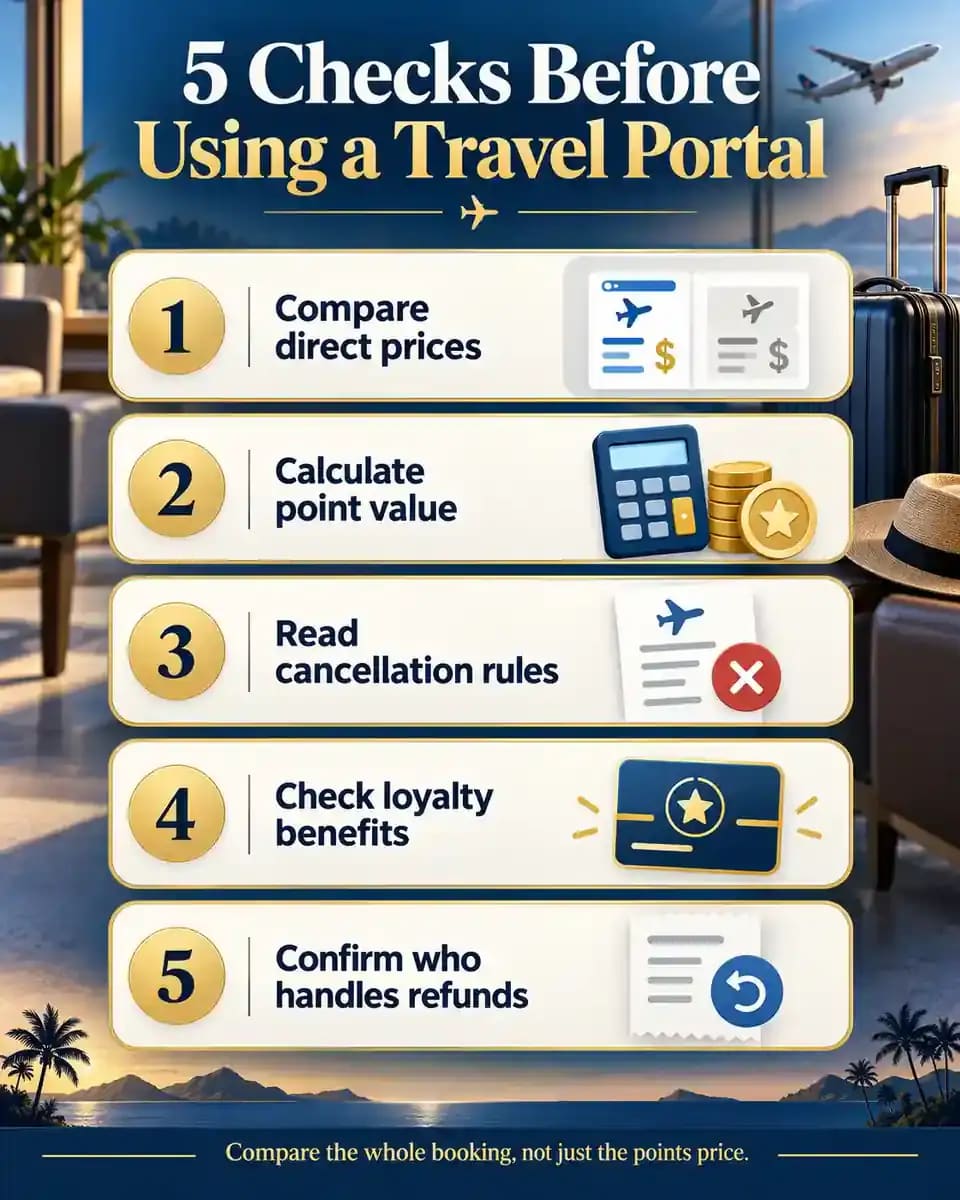
Before using points or cash, compare five things: the direct cash price, the portal cash price, the points required, the cancellation rules and the loyalty benefits you may lose. Then identify who handles changes and refunds. This takes only a few minutes for a straightforward trip and creates a much clearer picture of the portal's real value. The best redemption is not necessarily the one that uses the fewest dollars at checkout.

Choose the Booking Channel That Fits the Trip
Credit card travel portals are not inherently good or bad. Their usefulness depends on the specific redemption, the price, the trip's complexity and the conditions attached to the reservation. A portal can be attractive when it provides strong redemption value and acceptable flexibility. Direct booking can be attractive when customer service, loyalty benefits or control over changes matter more. Compare the complete transaction rather than treating rewards as free travel, and avoid letting points encourage spending or borrowing that you would not otherwise choose.

Credit card travel portals can turn a pile of points into a flight, hotel stay or rental car in just a few clicks. That convenience is real, but so is the extra layer of complexity created when a credit card issuer's booking platform sits between you and the company actually providing your trip.
The Consumer Financial Protection Bureau has highlighted recurring consumer complaints involving credit card rewards programs, including unexpected promotional conditions, reward devaluations, redemption difficulties and revoked rewards. Those problems matter because the advertised value of points is not necessarily the value you ultimately receive.
There is another issue that has nothing to do with points themselves. A portal booking may create a three-party relationship involving you, the portal and the airline, hotel or rental company. When everything works, that structure can feel invisible. When you need a refund, cancellation, rebooking or emergency change, figuring out who actually controls the reservation can become much more important.
This guide explains how credit card travel portals work, where their hidden costs can appear, how to compare portal and direct bookings, and what to document before paying with either points or cash. It provides general consumer education, not individualized financial, legal or tax advice.
Where people go wrong
Assuming the portal always has the best price. The number shown inside a rewards portal may differ from the price available directly from the airline or hotel. Compare equivalent bookings before assigning value to the redemption.
Treating points like guaranteed cash. Reward values, redemption methods and program rules can change. Points should not automatically be treated as having a fixed dollar value.
Ignoring credit card interest. Interest and fees on a revolving balance can easily exceed the economic value of points or cash back earned from spending.
Reading only the provider's rules. A portal booking may also be governed by portal-specific procedures for cancellations, changes and refunds.
Assuming the hotel can always refund you. If a third party processed the payment, hotel staff may not have direct access to the transaction even when they agree a refund is appropriate.
Forgetting about loyalty benefits. Some third-party bookings may not earn hotel points, qualifying nights or certain elite benefits. Airline mileage treatment can also depend on the fare.
Waiting to document a dispute. Save confirmations, screenshots, chats and call notes from the beginning. Reconstructing a complicated dispute later is much harder.
Escalating to the wrong agency. Airline complaints, portal business-practice complaints and hotel service complaints can fall into different channels. Identify the source of the problem first.
Questions people ask
Sometimes, but not always. Compare the portal price with the airline, hotel or rental company's direct price for the same dates and conditions. Also compare cancellation rules, baggage, loyalty benefits and other included features.
Fixed it?
Get one guide like this every Thursday.