HELOC Risks Explained: Variable Rates, Payment Shock, and How to Protect Your Home
A home equity line of credit offers flexible borrowing, but rising interest rates, payment shock, and repayment deadlines can put your finances and home at risk. Learn how HELOCs work, what can go wrong, and how to prepare.

What you’ll need
Tap to tick things off before you start.
Why HELOC Flexibility Can Become a Financial Risk
A home equity line of credit can make accessing cash feel convenient, but that flexibility comes with important financial obligations. Borrowers may become comfortable using available credit without considering how future repayment requirements will affect their finances. Once the borrowing phase ends, payments can become substantially larger and less flexible. One of the biggest HELOC risks is mistaking temporary borrowing convenience for long-term affordability. Understanding this distinction helps homeowners avoid taking on obligations their budgets cannot comfortably support.

What Is a Home Equity Line of Credit?
A home equity line of credit, commonly called a HELOC, is a revolving credit account secured by your home. Unlike a traditional home equity loan, which generally provides a lump sum at closing, a HELOC allows borrowing from an approved credit line over time. Your property serves as collateral, giving the lender a secured interest in it. The Consumer Financial Protection Bureau explains that this distinction matters because a HELOC combines credit flexibility with the responsibilities of borrowing against residential property.

How the HELOC Draw Period Works
The draw period is the initial stage of a HELOC when borrowers can access funds up to their approved credit limit. This period often lasts five to ten years, although actual terms vary by lender and agreement. During this window, withdrawals may be available through transfers, checks, or other approved methods. The draw period has a contractual ending date, so borrowing privileges are not indefinite. Reviewing that date before opening the account helps establish realistic expectations about how long access lasts.

Borrowing, Repaying, and Borrowing Again
During an active draw period, a HELOC generally allows borrowers to reuse credit as principal is repaid. For example, with a $50,000 limit, borrowing $15,000 leaves $35,000 available. Repaying $5,000 of principal could restore available credit to $40,000, assuming no restrictions or other changes. Interest payments alone do not replenish available credit because they do not reduce principal. Lenders can also restrict additional withdrawals under qualifying circumstances, so restored borrowing capacity should never be treated as guaranteed.

Why Interest-Only Payments Feel Affordable
Some HELOC agreements allow interest-only payments during the draw period. This means the required payment covers interest charges without reducing the amount borrowed. For example, a $30,000 balance at a hypothetical 8% annual rate produces approximately $200 in monthly interest, assuming a simplified calculation. That payment may appear manageable compared with payments that also reduce principal. However, the entire $30,000 remains outstanding if no principal is repaid. Lower initial payments therefore do not necessarily mean the debt is inexpensive.

The Principal Balance Does Not Disappear
Every dollar of HELOC principal that remains outstanding must eventually be repaid according to the agreement. Carrying a substantial balance toward the end of the draw period can create a difficult financial obligation, especially if repayment must occur over fewer years than expected. Borrowers sometimes underestimate this commitment because they focus on their current monthly bill instead of total outstanding debt. Regularly reviewing the principal balance, remaining loan term, and projected repayment requirements provides a clearer picture of the obligation.

Why Most HELOCs Have Variable Interest Rates
Many HELOCs use variable interest rates rather than a single fixed rate throughout the loan. A variable rate changes according to a specified benchmark and the rules established in the credit agreement. Because financial conditions fluctuate, the cost of borrowing can move upward or downward over time. This uncertainty distinguishes many HELOCs from fixed-rate home equity loans. Some lenders also offer fixed-rate conversion features, but their availability and conditions differ. Reviewing the rate structure is essential to understanding potential borrowing costs.

How the Index and Lender Margin Determine Your Rate
A variable HELOC rate is commonly calculated by adding a lender's margin to a reference index, often the U.S. prime rate. For example, an 8% index plus a 1% margin produces a 9% annual interest rate before any applicable contractual limits. The margin is established under the agreement, while the index can change. An advertised introductory rate may temporarily differ from this standard calculation. Consumer Financial Protection Bureau materials encourage reviewing both the index and margin to understand ongoing borrowing costs.

What Happens When Interest Rates Rise
When a HELOC's reference index increases, the borrowing rate may rise at the next permitted adjustment. Higher rates increase interest charges on outstanding balances. For example, a $40,000 balance at 7% generates approximately $233 in monthly interest, while 10% generates about $333, using simplified annual-rate calculations. That represents roughly $100 more each month without additional borrowing. Actual payment changes depend on the agreement, calculation method, and rate limits. Rising interest costs can reduce money available for other household expenses.

Understanding Rate Adjustments and Caps
HELOC agreements specify when variable rates may adjust and whether limits apply. A periodic cap may restrict an individual increase, while a lifetime cap limits the maximum rate over the loan's term. Some agreements also establish a minimum rate, called a floor. Promotional introductory rates may expire and produce a noticeable change. The Consumer Financial Protection Bureau recommends examining lender disclosures for adjustment rules, rate limits, and payment examples. Understanding these provisions helps borrowers recognize the range of possible interest costs.

How Variable Rates Complicate Your Household Budget
Variable HELOC rates make household budgeting more challenging because required payments can change while essential expenses remain relatively fixed. Mortgage payments, groceries, utilities, insurance, and transportation already claim portions of monthly income. When HELOC interest costs increase, less money remains for savings and unexpected expenses. Households with limited discretionary income may feel this pressure most strongly. Comparing essential expenses against different potential HELOC payment amounts can reveal whether the budget has enough flexibility to absorb borrowing cost fluctuations.

What Happens When the HELOC Draw Period Ends
When a HELOC's contractual draw period ends, borrowers generally lose the ability to make additional withdrawals. The account transitions into its repayment phase according to the agreement. Depending on the terms, outstanding debt may become payable through scheduled installments or another specified arrangement. The Federal Reserve has identified end-of-draw transitions as an important area of borrower and lender risk. Reviewing the agreement's transition date, repayment length, and required payment provisions helps clarify what happens when borrowing access expires.

How Principal and Interest Repayment Works
During a typical HELOC repayment period, monthly payments include both interest charges and repayment of the outstanding principal. This arrangement is called amortization. Interest represents the cost of borrowing, while the principal portion reduces the amount owed. Under a standard amortizing schedule with a constant rate, the interest portion generally declines as the balance decreases. Variable rates can change the payment calculation. The repayment term matters because spreading the same balance over fewer years generally requires larger monthly payments.

HELOC Payment Shock Explained
Payment shock describes a substantial increase in required monthly debt payments over a relatively short period. For HELOC borrowers, it can occur when the draw period ends and principal repayment becomes mandatory. A simultaneous interest rate increase can make the transition even more expensive. The Federal Reserve's guidance on HELOCs nearing their end-of-draw periods highlights the importance of managing repayment transitions. Payment shock is not inevitable, but borrowers who anticipate only their current payment may underestimate future obligations.

A Practical Example of a HELOC Payment Increase
Consider a hypothetical $50,000 HELOC balance with an unchanged 8% annual interest rate. During an interest-only period, the simplified monthly payment would be approximately $333. If that balance subsequently amortizes over 10 years at the same rate, the monthly payment rises to approximately $607. That is an increase of roughly $274, or 82%. These figures assume monthly interest calculations, 120 equal payments, and no additional fees. Actual payments depend on contractual terms, repayment length, and applicable rates.

What Is a HELOC Balloon Payment?
A HELOC balloon payment is a large lump-sum amount that becomes due on a date specified in the loan agreement. Instead of repaying the entire principal through regular installments, the borrower must pay the remaining required balance when the balloon comes due. Some agreements may require such a payment at the end of the draw period or loan term. Not every HELOC includes this feature. The Consumer Financial Protection Bureau encourages borrowers to understand repayment provisions before accepting credit terms.

Why a Balloon Payment Can Create a Cash Crisis
A balloon payment creates a liquidity challenge when the required lump sum exceeds the cash a household can access by its due date. Home equity does not automatically translate into spendable money, and savings may be insufficient to cover the obligation. Borrowers facing a shortfall could encounter late charges, default consequences, or difficult decisions about other assets. Understanding the payment amount and deadline well in advance provides more opportunity to evaluate available resources and discuss potential arrangements with the lender.

Why HELOC Refinancing Is Never Guaranteed
Refinancing a HELOC requires approval for new financing, which lenders evaluate using current underwriting standards. Credit history, income stability, existing debts, property equity, and prevailing interest rates can all affect eligibility and pricing. A borrower who qualified years earlier might not qualify under changed circumstances. Even an approved refinance may involve closing costs or less favorable terms. Relying exclusively on future refinancing therefore introduces uncertainty into repayment planning. Existing obligations remain enforceable unless a new arrangement is completed.

How Falling Home Values Affect HELOC Borrowers
Declining property values can reduce the equity available to secure a HELOC. For example, a home worth $400,000 with $300,000 in combined mortgage debt has $100,000 in equity. If its value falls to $330,000, that equity shrinks to $30,000, assuming debt remains unchanged. Lower equity can complicate refinancing and may support credit line restrictions when applicable legal conditions are met. Borrowers should recognize that property values fluctuate independently of their outstanding loan balances.

Why Your Home Is Collateral for the Debt
A HELOC is a secured debt because the borrower pledges residential property as collateral. The lender generally records a lien or other legally recognized security interest against the home, giving it rights connected to the property under the loan agreement and applicable law. This arrangement differs from unsecured credit cards, which ordinarily do not require a property lien. The Consumer Financial Protection Bureau emphasizes that borrowing against home equity carries significant consequences. Understanding the security agreement clarifies why repayment obligations deserve careful attention.

Can a HELOC Lead to Foreclosure?
Yes, a HELOC can lead to foreclosure if a borrower defaults and the problem remains unresolved. Because the loan is secured by the home, the lender may pursue foreclosure to recover unpaid debt, subject to the agreement and applicable state and federal laws. Foreclosure is not an automatic consequence of one missed payment, and required procedures vary. The Consumer Financial Protection Bureau emphasizes the seriousness of putting a home at risk. Early communication with the lender can help borrowers explore possible alternatives.

When a Lender Can Freeze or Reduce Your HELOC
A lender may suspend HELOC withdrawals or reduce the credit limit under circumstances permitted by the agreement and applicable law. Potential triggers include a significant decline in property value or a material change in the borrower's financial circumstances that reasonably suggests reduced repayment ability. Federal rules restrict when lenders can take these actions, so access cannot generally be withdrawn arbitrarily. A freeze affects future borrowing but does not erase existing debt. Borrowers should review lender notices and request clarification about any restrictions.

Why a HELOC Is Not a Guaranteed Emergency Fund
A HELOC can provide access to money during ordinary circumstances, but it should not be mistaken for guaranteed emergency savings. During an economic downturn, falling property values or qualifying changes in repayment ability may cause lenders to restrict withdrawals. These events can coincide with job losses or unexpected household expenses, precisely when additional cash feels most necessary. Unlike money already held in an accessible savings account, unused HELOC credit remains conditional. Maintaining independent financial reserves can reduce reliance on uncertain borrowing access.

Find Your HELOC Draw and Repayment Deadlines
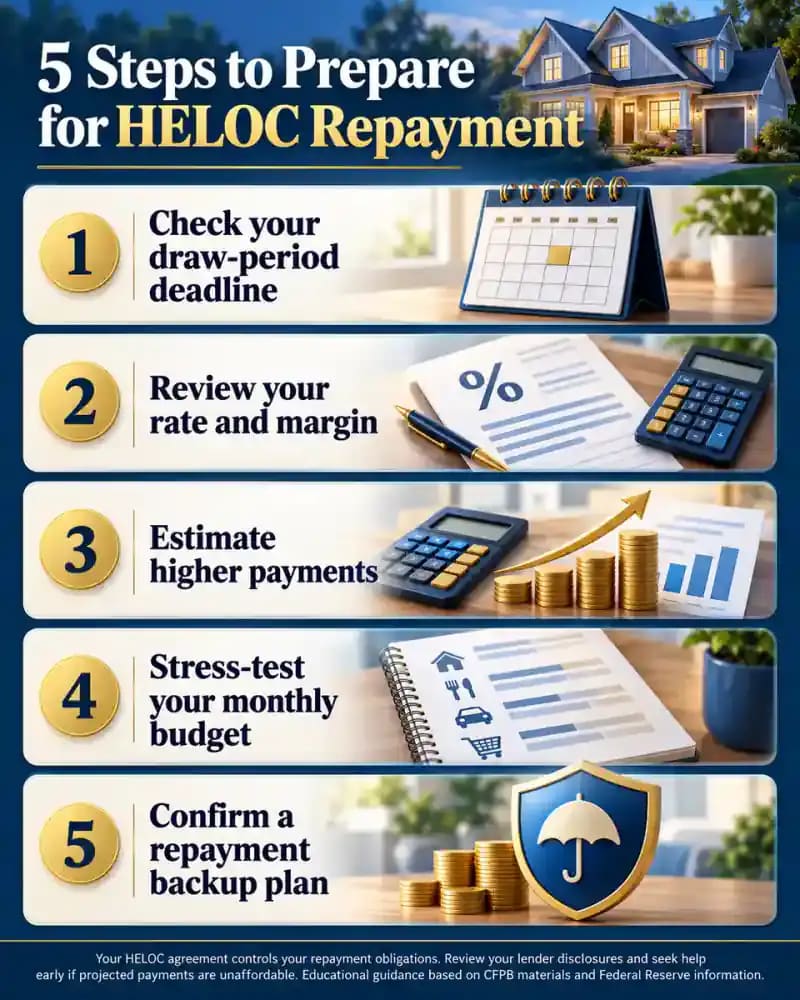
Your HELOC agreement should identify the draw-period expiration, repayment start, and final maturity date. These milestones may differ, so reviewing only the loan's overall term is insufficient. Check the original credit agreement, account statements, and any notices from your servicer. Ask the lender to confirm unclear dates in writing. The Federal Reserve's end-of-draw guidance highlights the importance of managing these transitions. Recording each deadline on a calendar provides a practical way to anticipate upcoming contractual obligations.

Ask Your Lender About Future Monthly Payments
Before the repayment period begins, request written estimates showing how your required monthly payments could change. Ask for calculations using the current outstanding balance, contractual repayment term, and applicable interest rate. For variable-rate HELOCs, request additional illustrations showing higher-rate conditions and any maximum permitted rate. The Consumer Financial Protection Bureau encourages reviewing lender disclosures to understand potential payment obligations. These illustrations are estimates rather than guarantees, but they provide a clearer basis for evaluating future affordability.

Stress-Test Your Budget Against Higher Rates
A household budget stress test compares potential HELOC payments with the money available after essential expenses. Begin with reliable monthly income, then subtract housing costs, utilities, groceries, insurance, transportation, and other required debt payments. Compare the remaining amount with projected HELOC obligations under current and higher interest rates. Consider whether emergency reserves could withstand temporary income interruptions without creating additional borrowing needs. A budget that works only under favorable interest rate assumptions may leave little room for financial setbacks.

Review the Conditions That Could Restrict Your Credit
Before relying on available HELOC funds, ask your lender which conditions permit a credit freeze or limit reduction. Review how property values and repayment ability are assessed, whether advance notice is required, and how restrictions are communicated. Also ask what documentation may be needed to request restoration of borrowing privileges after qualifying conditions improve. Restoration is not necessarily automatic. Understanding monitoring practices and dispute procedures can help borrowers recognize legitimate restrictions and respond appropriately when unexpected changes occur.

Create a HELOC Principal Repayment Plan
A practical principal repayment plan begins with the current balance, remaining repayment timeline, and expected household cash flow. Borrowers can estimate how regular principal reductions might affect the balance before mandatory repayment begins. Even modest additional principal payments may reduce future interest costs, depending on the agreement. Review whether extra payments are applied directly to principal and whether relevant fees or restrictions exist. The objective is to establish realistic repayment expectations without depending entirely on future income increases or refinancing approval.

What to Do If You Cannot Afford HELOC Payments
If upcoming HELOC payments appear unaffordable, contact the loan servicer before missing payments whenever possible. Explain the anticipated difficulty and ask whether legitimate repayment assistance, modification, or other available options exist. Request written details about eligibility, costs, and potential consequences. A housing counselor approved by the U.S. Department of Housing and Urban Development can help borrowers understand available resources and prepare for lender discussions. Avoid companies promising guaranteed foreclosure prevention or charging suspicious upfront fees for assistance.

Your HELOC Safety Checklist Before Borrowing
Before opening a HELOC, confirm six essentials: the draw-period deadline, repayment schedule, reference index and lender margin, potential payment increases, conditions restricting credit access, and consequences of pledging your home as collateral. Establish a repayment strategy based on realistic financial resources rather than guaranteed refinancing. The Consumer Financial Protection Bureau's HELOC educational materials and the Federal Reserve's end-of-draw guidance provide useful background. Reviewing these factors together helps homeowners assess HELOC risks and approach borrowing with clearer expectations.

A home equity line of credit, or HELOC, can make borrowing feel surprisingly easy. You receive access to a credit limit backed by your home, withdraw money when needed, and repay what you borrow. During the initial draw period, some lenders even allow interest-only payments, which can make the monthly bill seem manageable.
But that flexibility has an expiration date.
When the draw period ends, your ability to borrow generally stops, and your repayment obligations can change dramatically. Instead of paying only interest, you may need to pay both principal and interest. Depending on your agreement, you could face a substantial payment increase or even a balloon payment requiring a large lump sum.
Variable interest rates add another complication. Many HELOCs calculate interest using a market index plus a lender's margin. When the index rises, your borrowing costs can increase, making an already challenging repayment transition even more expensive.
And unlike an ordinary unsecured personal loan, a HELOC puts your property at risk. Because your home serves as collateral, serious repayment problems can ultimately lead to foreclosure. Lenders may also freeze or reduce access to your credit line under qualifying circumstances.
This guide explains the major HELOC risks, how the draw and repayment periods work, why payment shock happens, and which questions deserve answers before you borrow. It draws on educational materials from the Consumer Financial Protection Bureau and guidance from the Federal Reserve, helping you understand the terms, test your budget, and identify potential problems early.
Where people go wrong
Treating Interest-Only Payments as Permanent. A low payment during the draw period can create a false sense of affordability. Interest-only payments generally do not reduce principal. When principal repayment begins, the required monthly amount can increase substantially, even without an interest rate increase.
Ignoring the End-of-Draw Date. Borrowers sometimes focus on available credit while overlooking when borrowing access ends. Missing this deadline can leave little time to prepare for higher payments, arrange a budget adjustment, or address a contractual balloon payment.
Assuming the Interest Rate Cannot Rise Much. Many HELOCs carry variable rates tied to an index plus a lender margin. Ignoring adjustment provisions and rate caps can result in unrealistic payment expectations. Reviewing higher-rate scenarios helps expose potential pressure on household cash flow.
Counting on Automatic Refinancing. A future refinance or HELOC renewal is never guaranteed. Changes in income, creditworthiness, home value, lender standards, or market rates may limit available options. A repayment plan should not depend entirely on obtaining another loan.
Using the HELOC as a Guaranteed Emergency Fund. Lenders may freeze or reduce a credit line under qualifying conditions, including certain property value declines or financial changes. Depending on borrowed funds for emergencies can leave a household exposed when access disappears unexpectedly.
Underestimating the Risk to Your Home. A HELOC is secured by real property, not simply by a promise to repay. Persistent payment problems can trigger default remedies, potentially including foreclosure. Borrowers should understand this consequence before using home equity for discretionary spending.
Waiting Until Payments Are Missed. Delaying communication with the lender can narrow available options. Borrowers anticipating repayment difficulties should review their documents, calculate the shortfall, and contact their servicer early to ask about legitimate assistance or restructuring possibilities.
Questions people ask
The main HELOC risks include variable interest rates, rising monthly payments, the end of revolving borrowing access, possible balloon payments, credit line freezes, and foreclosure if repayment obligations are not met. The combination of changing rates and principal repayment can be particularly difficult for households with limited financial flexibility.
Fixed it?
Get one guide like this every Thursday.