Fixed-Rate vs. Adjustable-Rate Mortgages: Understanding ARM Risk Before You Borrow
Learn how adjustable-rate mortgages work, how indexes, margins, and rate caps affect payments, and what borrowers should understand before choosing between fixed and adjustable mortgage options.

What you’ll need
Tap to tick things off before you start.
Mortgage Rate Basics
This section introduces why mortgage structure matters before borrowing. It explains that the design of a mortgage rate affects payment stability, budgeting, and exposure to changing economic conditions. The discussion establishes the foundation for understanding adjustable-rate mortgage risk and highlights why borrowers should learn how different mortgage structures operate. The Consumer Financial Protection Bureau provides educational materials that help explain mortgage concepts and borrower considerations.

Understanding ARM Loans
This section defines adjustable-rate mortgages and explains their basic structure. It focuses on how ARMs differ from fixed-rate loans by allowing interest rates to change during the mortgage term. The explanation covers the purpose of ARM loans, their changing payment characteristics, and why understanding the loan framework is essential before borrowing. The Consumer Financial Protection Bureau provides guidance on ARM features and important borrower questions.

Fixed vs Adjustable
This section compares fixed-rate mortgages and adjustable-rate mortgages by examining their main differences. It focuses on predictable payments versus changing rates, showing how each structure affects financial planning over time. The goal is to explain the trade-offs between stability and flexibility without suggesting a universal choice. Readers learn how mortgage design influences payment consistency and exposure to future market changes.

Initial ARM Period
This section explains the introductory period of an adjustable-rate mortgage and why initial rates are often lower than comparable fixed-rate loans. It focuses on how temporary introductory pricing works and why early monthly payments may appear more affordable. The section also explains that this lower rate represents only one stage of the mortgage timeline and must be considered alongside later adjustment features.

Payment Changes
This section explains how monthly mortgage payments can change after an adjustable-rate mortgage begins adjusting. It focuses on the connection between changing interest rates and payment amounts, helping readers understand why variable payments are a defining ARM feature. The discussion emphasizes the importance of recognizing possible payment movement over time rather than focusing only on the initial monthly cost.

Adjustment Periods
This section explains when ARM interest rate changes occur and how adjustment periods determine the timing of those changes. It covers the interval between rate resets and why different ARM products may use different schedules. Understanding adjustment timing helps readers evaluate how frequently payments may be recalculated and how the mortgage structure operates beyond the introductory phase.

ARM Benefits
This section explores the potential advantages of adjustable-rate mortgages, especially during the early years of ownership. It explains how lower introductory rates may create temporary savings and provide additional cash flow flexibility. The focus is on why some borrowers consider ARMs and how these benefits are connected to the loan structure, while recognizing that outcomes depend on changing market conditions.

ARM Risks
This section examines adjustable-rate mortgage risk by focusing on future payment uncertainty and changing market conditions. It explains how rising interest rates can affect borrowers and why possible payment increases should be understood before selecting an ARM. The U.S. Securities and Exchange Commission explains that ARMs involve variable interest rates, making awareness of these risks an important part of mortgage education.

Rate Adjustment Formula
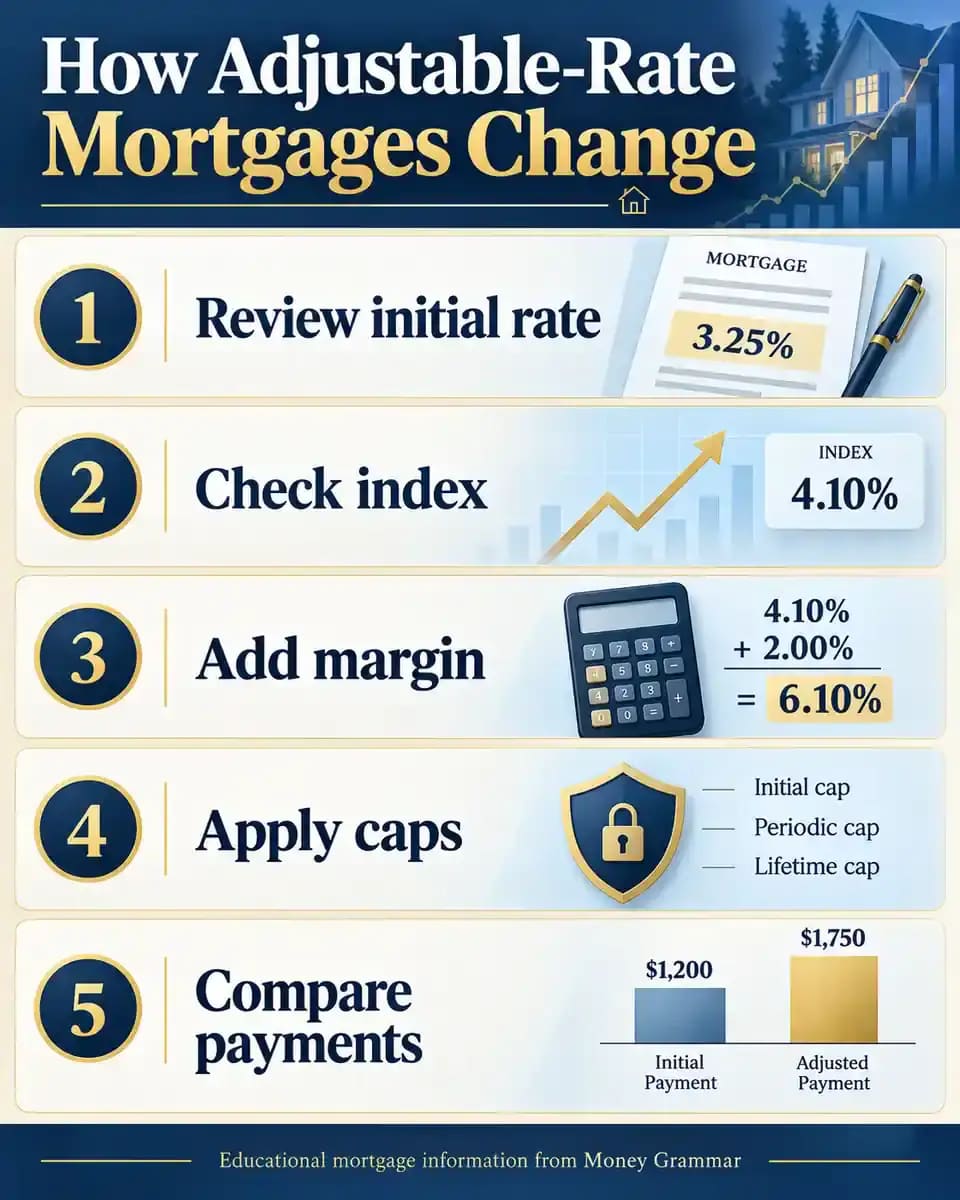
This section explains the formula used to calculate ARM interest rate adjustments through the combination of an index and a margin. It focuses on how these two components interact and why the adjustment process follows specific rules. Understanding this calculation helps readers see how market movements can influence future rates while the lender-established margin remains a consistent part of the loan agreement.

Index Explained
This section explains the role of the index in an adjustable-rate mortgage and how it reflects broader market conditions. It focuses on why benchmark rates can change and how those movements influence ARM interest rates. The discussion helps readers understand a key component of adjustable-rate mortgage risk while presenting general educational information rather than individualized financial guidance.

Margin Explained
This section explains the margin as the fixed lender component used in adjustable-rate mortgage calculations. It focuses on how this percentage is established when the loan begins and why it remains unchanged throughout the mortgage term. The Consumer Financial Protection Bureau explains that borrowers should review both the index and margin because together they determine future rate adjustments. Understanding the margin helps readers identify the lender-controlled portion of ARM pricing.

Index Plus Margin
This section shows the formula used to calculate an adjustable-rate mortgage interest rate by combining the current index value with the fixed margin. It explains that the index reflects broader market conditions while the margin stays constant. The goal is to help readers understand the mechanical relationship behind ARM adjustments rather than viewing payment changes as unpredictable events. The calculation determines the new rate before applicable caps are considered.

Market Changes
This section explores how changes in financial markets influence the index used by adjustable-rate mortgages. It explains that rising market interest rates can increase the index and potentially raise future mortgage rates, while declining conditions may reduce rates. The focus is on understanding external economic forces that affect ARM costs. The U.S. Securities and Exchange Commission notes that ARM borrowers should recognize how market movements can impact loan payments.

Interest Rate Caps
This section introduces interest rate caps as protections that limit how much an adjustable-rate mortgage can change. It explains that caps create boundaries around rate increases and decreases during different stages of the loan. The purpose is to show how these safeguards reduce uncertainty without eliminating all adjustment risk. Borrowers reviewing ARMs should understand the role of caps before comparing variable-rate and fixed-rate mortgage options.

Initial Cap
This section explains the initial adjustment cap, which controls the first interest rate change after the introductory period ends. It focuses on how this limit prevents an unlimited jump when the ARM transitions from its starting rate. Understanding this first adjustment boundary helps readers evaluate the early risks of an adjustable mortgage. The section highlights why the first reset period deserves careful attention during loan comparisons.

Periodic Cap
This section focuses on periodic adjustment caps that apply after the first ARM reset. It explains how these limits control the amount the interest rate can change during each later adjustment period. These protections create a more gradual adjustment process instead of allowing large changes at every reset date. Understanding periodic caps helps readers evaluate the ongoing behavior of an adjustable-rate mortgage over multiple years.

Lifetime Cap
This section explains the lifetime cap, which establishes the maximum possible interest rate change over the entire life of an adjustable-rate mortgage. It focuses on the overall ceiling that limits long-term exposure to rising rates. Understanding this cap helps readers assess the highest potential payment environment described in their loan documents. The Consumer Financial Protection Bureau highlights lifetime limits as an important ARM feature borrowers should review.

Managing ARM Risk
This section examines how borrowers can evaluate adjustable-rate mortgage risk by considering possible future scenarios. It focuses on reviewing loan terms, adjustment limits, and potential payment changes before making comparisons. The goal is to encourage a structured evaluation of uncertainty rather than focusing only on the initial lower payment. Understanding worst-case outcomes is an important part of responsible mortgage education.

Fixed Mortgage Stability
This section explains why fixed-rate mortgages provide predictable payments throughout the loan term. It focuses on the stability created by an interest rate that does not change with market conditions. Unlike an ARM, a fixed mortgage removes uncertainty about future rate adjustments. This predictability can make long-term budgeting easier for homeowners who prioritize consistent housing costs over potential short-term savings.

ARM Flexibility
This section explains the potential short-term advantages of adjustable-rate mortgages. It focuses on how an initial lower rate may provide payment savings during the introductory period. The section also emphasizes that this flexibility comes with future uncertainty because later adjustments depend on market conditions and loan terms. Understanding this trade-off helps readers compare ARM benefits with the stability offered by fixed-rate alternatives.

Long-Term Planning
This section focuses on matching mortgage choices with broader personal goals and future plans rather than only immediate payment benefits. It explains how borrowers can consider stability, flexibility, and changing circumstances when reviewing loan structures. The Consumer Financial Protection Bureau provides educational guidance on understanding ARM features and disclosures. This section highlights why aligning a mortgage with long-term objectives is an important part of evaluating adjustable-rate mortgage risk before borrowing decisions are made.

Ownership Timeline
This section explores how the expected ownership period affects mortgage evaluation and exposure to future adjustments. It explains why the timing of a possible move or refinance can influence how borrowers view an adjustable-rate mortgage structure. The focus remains on planning around the initial loan period and potential changes after that time ends. The SEC explains that ARMs have changing rates tied to specific loan terms and market conditions that borrowers should understand.

Refinancing Considerations
This section examines refinancing considerations as a possible future mortgage change rather than an immediate solution. It discusses how market conditions, loan terms, and borrower circumstances may affect available refinancing options over time. The goal is to explain why future flexibility depends on many factors beyond the original mortgage choice. The CFPB encourages consumers to review mortgage information carefully when considering changes to existing loan arrangements.

Questions for Lenders
This section focuses on important questions borrowers can ask lenders before selecting a mortgage product. It covers questions about indexes, margins, adjustment periods, and rate caps that influence how an ARM operates. The purpose is to encourage informed conversations and better understanding of loan mechanics. The Consumer Financial Protection Bureau highlights the value of reviewing disclosures and asking questions about adjustable-rate mortgage features before signing agreements.

Understanding Loan Terms
This section explains why reviewing mortgage contract language is essential before borrowing. It focuses on understanding specific loan terms, including adjustment rules, payment calculations, and limits that affect future changes. Clear interpretation of these details helps consumers recognize how an adjustable-rate mortgage functions throughout the loan period. The SEC provides educational information about ARM structures and the importance of understanding financial product terms.

Payment Scenarios
This section focuses on preparing for different possible payment outcomes during an adjustable-rate mortgage. It explains how changing interest rates may influence monthly obligations and why borrowers should examine multiple scenarios before choosing a loan. The discussion emphasizes awareness of potential payment variation without predicting future market movements. The CFPB provides resources that explain how ARM adjustments can affect payments after initial rate periods.

Budget Planning
This section examines how household budgeting connects with mortgage affordability and payment preparation. It focuses on evaluating regular expenses, financial flexibility, and the ability to manage changing housing costs. The discussion explains why budgeting is a key part of understanding adjustable-rate mortgage risk before borrowing. It does not provide personal recommendations but highlights general planning principles supported by consumer education resources.

Making Comparisons
This section focuses on comparing mortgage options using consistent factors instead of looking only at introductory rates. It examines differences between fixed-rate and adjustable-rate mortgages, including payment stability, flexibility, and future uncertainty. The goal is to show how borrowers can evaluate alternatives more effectively. The SEC explains that understanding the features of different loan products is an important part of informed financial decision-making.

Borrower Decision Process
This section explains how borrowers can organize information and approach mortgage decisions carefully. It focuses on reviewing goals, understanding risks, and considering loan features before making a selection. A structured decision process helps consumers evaluate adjustable-rate mortgage risk with greater awareness. The CFPB recommends that consumers understand mortgage terms, costs, and obligations before committing to a specific loan product.

Mortgage Knowledge
This section concludes by emphasizing the importance of mortgage education and informed choices. It reinforces how understanding indexes, margins, caps, and payment adjustments can improve awareness of adjustable-rate mortgage risk. The CFPB and SEC provide educational resources that help consumers learn about mortgage products. Building knowledge allows borrowers to better understand available information when comparing different financing options.

Choosing a mortgage is one of the largest financial decisions many people make, and understanding how different loan structures work can prevent expensive surprises later. A fixed-rate mortgage and an adjustable-rate mortgage may look similar at first because both help buyers purchase homes, but the way they determine future payments is very different.
A fixed-rate mortgage provides a consistent interest rate for the entire loan term. This means the principal and interest portion of the payment remains predictable, making long-term budgeting easier. An adjustable-rate mortgage, often called an ARM, works differently. It usually begins with an initial period where the interest rate may be lower, but the rate can later change based on market conditions.
The adjustment process is based on specific mechanics. An ARM typically combines an index, which reflects broader interest rate conditions, with a margin, which is set by the lender. When the adjustment period arrives, these factors determine the new interest rate, subject to limits called caps. These caps help control how much the rate can change during certain periods and over the life of the loan.
Understanding these details matters because a lower initial payment does not always mean lower long-term cost. Borrowers should know how their potential payment could change, what protections exist, and which questions to ask before selecting a mortgage product. This guide explains the core concepts behind ARM loans and compares them with fixed-rate alternatives.
Where people go wrong
Choosing only by the initial payment. Some borrowers focus only on the lower starting payment of an ARM without considering future adjustments. A mortgage should be evaluated based on possible payment changes, loan terms, and long-term affordability.
Ignoring rate caps. Rate caps define how much an adjustable mortgage can change during specific periods. Ignoring these limits makes it difficult to understand the possible range of future payments and overall loan risk.
Not understanding the index and margin. The index and margin determine how an ARM rate changes. Borrowers who do not understand these components may struggle to predict how market movements could affect their mortgage payments.
Assuming rates will always decrease. An adjustable-rate mortgage can benefit from falling rates, but rising rates can increase payments. Assuming future market conditions without considering different scenarios can create financial pressure.
Comparing mortgages without a timeline. A loan that fits someone planning a short stay may not fit someone expecting decades of ownership. The expected ownership period is an important factor when comparing mortgage options.
Questions people ask
An adjustable-rate mortgage is a home loan where the interest rate can change after an initial period. The adjustment is usually based on a market index plus a fixed margin, with caps limiting how much the rate can change.
Fixed it?
Get one guide like this every Thursday.