Federal Student Loan Consolidation vs. Private Refinancing: What's the Difference?
Federal student loan consolidation and private refinancing can both simplify repayment, but they have very different consequences. Learn how interest rates, forgiveness eligibility, and borrower protections compare before choosing.

What you’ll need
Tap to tick things off before you start.
Student Loan Consolidation vs. Refinancing: Key Differences
Student loan consolidation vs refinancing involves two fundamentally different lending arrangements. Federal consolidation combines eligible federal education loans into a new government loan, while private refinancing replaces existing loans with debt issued by a private lender. Federal consolidation generally preserves applicable government protections and follows a standardized interest rate formula. Private refinancing may offer competitive rates but depends on lender approval and contract terms. The Consumer Financial Protection Bureau emphasizes understanding these distinctions before replacing existing student debt.

How Federal Direct Loan Consolidation Works
Federal Direct Consolidation allows borrowers to combine multiple eligible federal student loans into one new Direct Consolidation Loan. Applications are available through StudentAid.gov without an application fee. Borrowers identify the loans they want included and select available repayment arrangements. After processing, the new loan pays off the selected balances. Instead of tracking multiple separate loans, borrowers receive a consolidated billing arrangement with one monthly payment. Processing takes time, so existing payment obligations should be maintained until payoff is confirmed.

How Federal Consolidation Interest Rates Are Calculated
A Direct Consolidation Loan generally receives a fixed interest rate equal to the weighted average of the included loans' rates, rounded up to the nearest one-eighth of a percentage point. Weighting means larger loan balances influence the result more heavily. For example, combining $10,000 at 4% with $20,000 at 6% produces a weighted average of approximately 5.33%, rounded up to 5.375%. Consolidation therefore does not provide an automatic interest rate discount and may slightly increase the effective rate.

When Consolidation Can Unlock Federal Loan Benefits
Certain older federal student loans, including some Federal Family Education Loan Program and Perkins loans, have different program eligibility rules from Direct Loans. Consolidating eligible loans into the Direct Loan program can expand access to specific federal repayment or forgiveness opportunities. However, eligibility is not automatic, and consolidation may change how previously earned qualifying payment credit is counted. Borrowers with existing forgiveness progress should verify current Department of Education rules before combining loans, particularly when different loans have different repayment histories.

How Private Student Loan Refinancing Works
Private student loan refinancing replaces one or more existing education loans with a new loan from a bank, credit union, or online lender. Once approved, the refinancing lender typically sends payoff funds to the original loan holders. The borrower then repays the new lender under the agreed contract. Eligible loans may include private student loans, federal student loans, or both. The replacement agreement establishes new repayment obligations, including the applicable interest structure, repayment schedule, and contractual conditions.

Qualifying for Private Refinancing and Better Rates
Private refinancing lenders evaluate borrowers through their own underwriting standards. Credit history, credit score, employment, income consistency, and debt-to-income ratio can influence approval and offered interest rates. A lower debt burden and stronger financial profile may improve available terms, although approval is never guaranteed. Some lenders accept applications with a qualified co-signer, who becomes legally responsible for repayment. Comparing eligibility requirements across lenders helps borrowers understand why advertised minimum rates may differ significantly from their personalized offers.

The Permanent Federal Benefits Lost Through Refinancing
Refinancing federal student loans with a private lender permanently removes those loans from the federal student loan system. The replacement private loan cannot qualify for federal income-driven repayment plans, Public Service Loan Forgiveness, or federal deferment and forbearance protections. Private lenders may provide separate hardship accommodations, but these depend on their contracts. The original federal loans are considered paid off, meaning borrowers cannot later convert the replacement private debt back into federal loans to restore those benefits.

How to Compare Monthly Payments and Total Loan Costs
A lower monthly payment does not necessarily mean a cheaper student loan. Extending repayment reduces immediate payment pressure but can increase total interest. Compare each option's principal balance, interest rate, repayment term, fees, and projected total payments. Fixed rates remain constant, while variable rates can change under contractual conditions. For example, a shorter repayment term may require higher monthly payments but reduce lifetime borrowing costs. Loan calculators help illustrate these trade-offs using consistent assumptions and realistic repayment scenarios.

Refinancing Disclosures, Consumer Rights, and Lender Red Flags
The Consumer Financial Protection Bureau has documented misleading practices involving student loan refinancing, including inaccurate impressions about preserving federal loan benefits. Borrowers should examine lender disclosures for interest rate adjustments, repayment obligations, fees, and hardship provisions. Warning signs include promises of guaranteed savings, pressure to sign immediately, or inconsistent explanations of federal protections. Written contract terms matter more than promotional language. Consumers can review educational resources and submit complaints through the CFPB when they encounter potentially unfair or deceptive lending practices.

How to Choose the Right Student Loan Strategy
A practical decision starts with four questions: Which loans do you hold? Could your employment qualify for federal forgiveness? How predictable is your future income? What financial improvement would refinancing actually provide? Federal borrowers expecting income fluctuations or public service careers may place substantial value on government protections. Borrowers with existing private debt may prioritize better loan terms. Comparing these considerations against personal financial goals creates a more complete framework than choosing whichever option advertises the lowest payment.

How to Identify Federal and Private Student Loans
Start by checking your federal student loan records at StudentAid.gov, which lists loans reported to the Department of Education. Federal loans may include Direct Loans, Federal Family Education Loan Program (FFEL) loans, and Perkins Loans. Private education loans generally appear in separate lender accounts and may be identified through credit reports. Record each loan's balance, interest rate, servicer, and ownership. Remember that a federally guaranteed loan can have a private holder without becoming a private student loan.

Which Student Loans Are Eligible for Federal Consolidation?
Federal Direct Consolidation generally accepts eligible Direct Loans, FFEL loans, and Perkins Loans, subject to program requirements. Private student loans cannot enter the federal consolidation program. Existing Direct Consolidation Loans usually cannot be consolidated again unless specific exceptions apply, such as including another eligible loan. Loans in default may require additional eligibility steps, while certain Parent PLUS loans have special restrictions. The Department of Education publishes current eligibility requirements and exceptions through StudentAid.gov, making official verification important before applying.

When Consolidation Can Affect Existing Forgiveness Credit
Consolidating federal loans can change how previously completed repayment periods count toward forgiveness. Under applicable federal rules, qualifying payment histories may receive weighted credit when loans with different repayment records are combined. Special historical adjustments have sometimes provided different treatment, so older examples may not reflect current requirements. Timing also matters when borrowers are approaching forgiveness eligibility. Before consolidating, compare existing payment counts and confirm the Department of Education's current credit-calculation rules through StudentAid.gov or the responsible federal loan servicer.

How Income-Driven Repayment Changes Monthly Payments
Income-driven repayment plans calculate federal student loan payments using factors such as income, family size, and the rules of the selected plan. Depending on eligibility and financial circumstances, required payments may be substantially lower than standard repayment amounts, sometimes reaching zero. Borrowers generally must provide updated financial information periodically to maintain accurate payment calculations. Different plans have distinct eligibility conditions, repayment formulas, and forgiveness timelines. Because federal repayment programs can change, current options should be verified through StudentAid.gov before enrollment.

Public Service Loan Forgiveness Requirements Explained
Public Service Loan Forgiveness (PSLF) allows eligible Direct Loan borrowers to receive forgiveness of their remaining qualifying balance after satisfying program requirements. Generally, borrowers need 120 qualifying monthly payments while working full-time for a qualifying government or nonprofit employer. Employment eligibility depends on the organization rather than the employee's job title. Payments must satisfy applicable repayment and program rules. Borrowers can use the Department of Education's PSLF resources to verify employers, document employment, and monitor qualifying payment progress.

Federal Deferment and Forbearance During Financial Hardship
Federal student loan deferment and forbearance provide different ways to temporarily reduce or suspend required payments. Deferment eligibility may depend on circumstances such as qualifying unemployment, economic hardship, or school enrollment. Forbearance covers other qualifying situations, although interest generally continues accumulating. Interest treatment during deferment depends on loan type and subsidy status. Both arrangements can increase future borrowing costs or affect forgiveness progress. Borrowers should review eligibility, interest consequences, and available alternatives with their federal loan servicer.

What Happens When You Refinance Federal and Private Loans Together?
Some private refinancing lenders allow borrowers to combine eligible federal and private student loans into one replacement private loan. Each original lender receives a separate payoff, while the borrower assumes a single new contractual obligation. However, federal loans included in that transaction permanently lose their federal status and associated benefits. Keeping federal loans outside the refinancing transaction preserves those protections for the excluded balances. The Consumer Financial Protection Bureau emphasizes understanding which specific loans are being refinanced before accepting an offer.

How a Co-signer Changes Student Loan Refinancing
A qualified co-signer may improve refinancing approval prospects when the primary borrower has limited credit history or insufficient income. However, co-signers generally accept responsibility for repayment if the borrower fails to pay, potentially affecting their own credit and borrowing capacity. Some lenders offer co-signer release after borrowers meet specific payment, income, and credit requirements. Others provide no release option. Both parties should understand the contractual obligations, default consequences, and available release provisions before entering a refinancing agreement.

How to Evaluate Student Loan Refinancing Offers
Refinancing offers should be compared using complete lender disclosures rather than advertised starting rates. Examine the annual percentage rate, whether interest is fixed or variable, available repayment periods, and any applicable fees. Autopay discounts may reduce rates but often require continued automatic payments. Also compare hardship accommodations, payment flexibility, prepayment provisions, and customer servicing arrangements. Initial estimates can differ from final approved terms, so consistent comparisons require reviewing the actual contractual conditions presented by competing lenders.

What to Verify Before Signing a Student Loan Agreement
Before finalizing consolidation or refinancing, confirm the loans included, current payoff amounts, final interest terms, repayment schedule, and lender identity. Review disclosures carefully and retain copies of signed agreements. After approval, monitor existing accounts until payoff transactions are completed and balances are accurately updated. Continue making required payments unless the servicer provides confirmed alternative instructions. Verify the new payment destination, first due date, and servicing contact information. Written payoff confirmation helps identify processing errors or unexpected remaining balances.

When Refinancing Only Private Student Loans Makes Sense
Refinancing only private student loans can reduce borrowing costs without affecting federal loans that remain outside the transaction. Borrowers with improved credit, stable income, or relatively expensive private debt may qualify for more favorable terms. Partial refinancing also allows selected private balances to be replaced while other loans remain unchanged. The Consumer Financial Protection Bureau recommends comparing actual loan costs and conditions. Potential savings depend on the new interest rate, repayment period, and remaining balance rather than refinancing alone.

How Student Loan Decisions Affect Your Credit
Student loan refinancing can affect credit reports through lender inquiries, closed accounts, and newly opened obligations. Rate shopping may involve soft inquiries initially, while formal applications can trigger hard inquiries. Paying off existing loans changes account information but does not necessarily erase their payment history. Federal consolidation also creates a replacement loan that may appear on credit reports. Score changes vary according to individual credit profiles, reporting practices, and scoring models. Consistent, timely payments remain important for maintaining credit health.

Student Loan Refinancing After Graduation
Recent graduates may find refinancing eligibility limited by short employment histories, modest starting salaries, or insufficient credit records. Some private lenders require graduation, minimum income, or established employment, while others have different standards. Refinancing during a federal loan grace period can also change when repayment begins because the replacement private loan follows its own schedule. Early-career income may fluctuate during job transitions. Reviewing anticipated earnings, living expenses, emergency savings, and repayment readiness helps clarify the practical consequences of refinancing soon after graduation.

Consolidation and Refinancing for Parent PLUS Borrowers
Federal Parent PLUS Loans belong to the borrowing parent, not the student whose education they financed. These loans have specialized repayment restrictions, including limits on income-driven repayment eligibility. Consolidating eligible Parent PLUS loans may provide access to certain repayment arrangements, depending on current federal rules and loan history. Private lenders may offer refinancing, sometimes with options to transfer responsibility to an eligible graduate. However, federal protections disappear when Parent PLUS debt is privately refinanced, making ownership and program eligibility particularly important.

What Happens if You Lose Your Job After Refinancing?
Losing employment after private student loan refinancing can make fixed monthly obligations difficult to maintain. Some lenders offer temporary forbearance, reduced payments, or other hardship accommodations, but eligibility and duration depend on the contract. Interest may continue accumulating during approved relief periods. Missed payments can trigger late charges, negative credit reporting, or eventual default. Contacting the lender before payments become overdue may reveal available options. Maintaining emergency savings can also provide a financial buffer against unexpected unemployment.

Can You Refinance Student Loans More Than Once?
Private student loans can generally be refinanced more than once if a borrower qualifies for another lender's terms. Improved credit, higher income, or declining market rates may create opportunities for additional savings. However, repeat refinancing can involve new credit inquiries, changes to repayment schedules, and different contractual protections. Lenders may impose minimum balance requirements or other eligibility restrictions. Comparing the remaining cost of an existing loan against a replacement offer helps determine whether another refinancing transaction provides meaningful financial benefits.

How Consolidation and Refinancing Affect Loan Repayment Timelines
Replacing existing student loans can change their remaining repayment schedules. Federal consolidation may offer a longer repayment period depending on the selected plan and eligibility requirements. Private refinancing establishes a new repayment term, potentially moving the final payoff date forward or backward. Longer schedules generally reduce required monthly payments but may increase accumulated interest. Shorter schedules can accelerate principal reduction while increasing payment obligations. Comparing original and replacement maturity dates helps reveal how the transaction changes the overall debt repayment timeline.

Where to Get Free, Reliable Student Loan Guidance
StudentAid.gov provides official information about federal loan balances, consolidation, repayment plans, and forgiveness eligibility. Federal loan servicers can explain account-specific requirements and available repayment options. The Consumer Financial Protection Bureau offers educational resources about consolidation, refinancing, and student loan servicing problems. Federal consolidation applications are free, and borrowers generally do not need paid assistance to access government programs. Be cautious of companies demanding upfront fees, requesting account passwords, or promising guaranteed forgiveness. Verify unfamiliar organizations through official government resources.

Real-World Student Loan Consolidation vs. Refinancing Examples
Consider three hypothetical borrowers. One has several eligible federal loans and values simpler billing, making consolidation worth examining. Another holds expensive private loans and qualifies for a lower fixed refinancing rate, potentially reducing interest expenses. A third works for a qualifying nonprofit employer and expects to pursue federal forgiveness, making preservation of federal eligibility especially important. These examples illustrate different priorities rather than guaranteed outcomes. Actual results depend on loan balances, eligibility rules, interest rates, repayment history, and individual circumstances.

Your Next Steps After Choosing a Student Loan Strategy
After selecting a student loan strategy, complete applications through the appropriate official platform or lender and retain confirmation records. Monitor processing updates, verify that selected original balances are paid off, and confirm the replacement loan appears correctly. Review the first payment due date, establish reliable payment reminders, and retain copies of disclosures and payoff statements. Periodically reassess repayment progress as income, employment, or loan conditions change. Maintaining accurate records and monitoring accounts helps prevent avoidable servicing errors and missed payments.

If you have several student loans, combining them into one monthly payment may sound like an obvious way to simplify your finances. But federal student loan consolidation and private refinancing are not interchangeable. Choosing the wrong option could cost you valuable repayment protections or increase the total interest you pay.
Federal student loan consolidation allows you to combine eligible federal education loans into a new Direct Consolidation Loan. You receive one monthly bill, and the new fixed interest rate generally reflects the weighted average of your existing rates, rounded up to the nearest one-eighth of a percentage point. Consolidation usually does not lower your interest rate, although it can help certain borrowers access federal repayment and forgiveness programs.
Private refinancing works differently. A bank, credit union, or online lender pays off your existing loans and replaces them with a new private loan. Depending on your credit, income, and the lender's terms, refinancing might reduce your interest rate and overall borrowing costs.
The biggest distinction is what happens to your federal borrower protections. Refinancing federal loans into private debt permanently eliminates eligibility for federal income-driven repayment, Public Service Loan Forgiveness, and federal deferment and forbearance options on those loans. You cannot convert the resulting private loan back into a federal student loan.
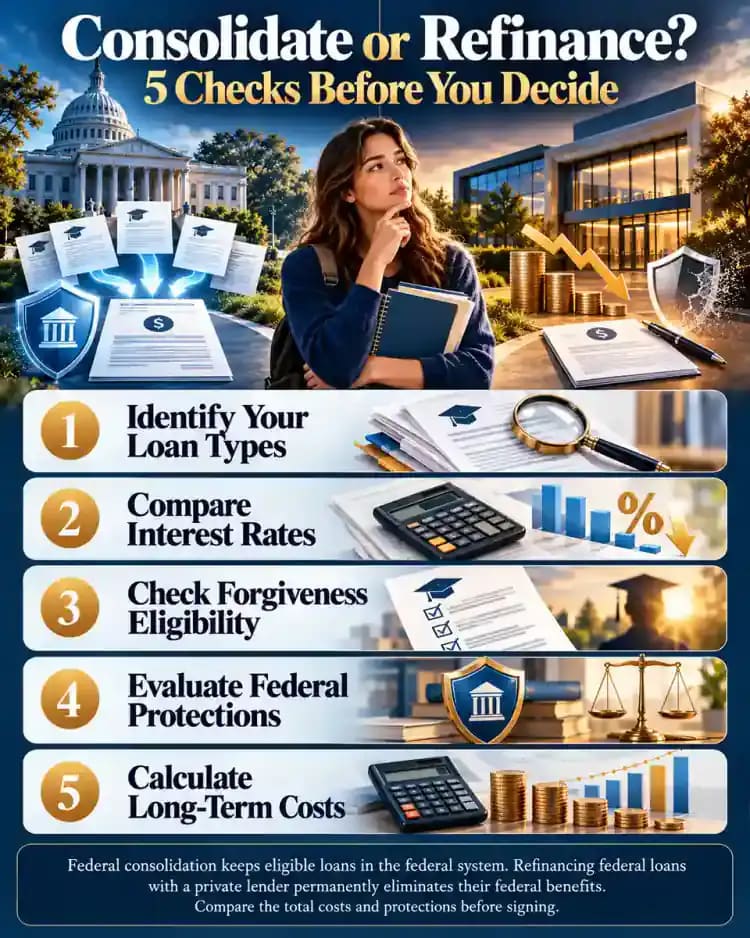
Before making a decision, identify your loan types, compare total repayment costs, and consider how your income or career could change. This guide explains the practical differences, potential savings, and risks so you can choose an approach that fits your financial circumstances.
Where people go wrong
Assuming Federal Consolidation Automatically Lowers Interest Rates. Federal Direct Consolidation Loans generally use the weighted average interest rate of the loans being combined, rounded up to the nearest one-eighth of a percentage point. Consolidation simplifies repayment but does not provide the negotiated rate reductions sometimes available through private refinancing.
Refinancing Federal Loans Without Understanding Lost Benefits. When a private lender refinances federal student loans, those federal loans are paid off and replaced with private debt. The borrower permanently loses federal repayment protections and forgiveness eligibility on those loans, even if personal finances or career plans change.
Choosing the Lowest Monthly Payment Without Comparing Total Costs. Extending a repayment term can reduce monthly payments while increasing the total interest paid. Compare the full repayment amount, interest rate, loan term, and any applicable fees before deciding whether consolidation or refinancing actually improves your financial position.
Overlooking Public Service Loan Forgiveness Eligibility. Borrowers working for qualifying government or nonprofit employers may benefit from Public Service Loan Forgiveness. Refinancing eligible federal loans privately permanently eliminates that opportunity. Check your qualifying employment, loan types, payment history, and program requirements before making an irreversible decision.
Assuming Every Federal Loan Already Qualifies for Every Repayment Program. Some older federal loans have different eligibility rules from Direct Loans. Federal consolidation may provide access to certain repayment or forgiveness programs, but it can also affect existing payment credit. Verify loan-specific consequences before consolidating.
Ignoring Variable Interest Rates and Co-signer Obligations. A variable-rate refinancing offer may start below your current rate but increase later. Adding a co-signer can also expose another person to repayment liability. Review rate adjustment terms, borrower obligations, and co-signer release provisions before signing.
Believing Private Lenders Offer Equivalent Federal Hardship Protections. Some private lenders offer temporary payment relief, but their hardship provisions depend on individual contracts and policies. These arrangements should not be assumed equivalent to federal income-driven repayment, deferment, or forbearance. Evaluate financial uncertainty before surrendering federal protections.
Trusting Promotional Claims Without Checking Official Rules. A refinancing advertisement may emphasize potential savings while giving limited attention to lost federal benefits. Request complete loan disclosures, compare actual offers, and verify federal program information independently through StudentAid.gov and the Consumer Financial Protection Bureau before committing.
Questions people ask
Federal student loan consolidation combines eligible federal loans into a new federal Direct Consolidation Loan, generally preserving access to applicable federal borrower protections. Private refinancing replaces existing federal or private loans with a new private loan. Refinancing may offer lower interest rates, but refinancing federal loans permanently eliminates their federal benefits.
Fixed it?
Get one guide like this every Thursday.