FDIC Insurance Limits Explained: How the $250,000 Rule Really Works
The FDIC generally insures eligible bank deposits up to $250,000 per depositor, per insured bank, per ownership category. Learn what counts toward the limit, which accounts are covered, how ownership categories work, and when deposits can exceed the standard insurance limit.

What you’ll need
Tap to tick things off before you start.
Start With the Actual FDIC Rule
The most important concept is the wording of the standard insurance limit. The Federal Deposit Insurance Corporation generally provides deposit insurance of up to $250,000 per depositor, per insured bank, for each ownership category.
Each part of that sentence matters. The limit is not automatically $250,000 for every checking account, every savings account, or every certificate of deposit you open. Accounts belonging to the same depositor at the same insured bank can be combined when they fall within the same ownership category.
That is why simply counting your accounts is not enough to determine your coverage.

Understand What the FDIC Does
The FDIC is an independent agency of the United States government that insures deposits at FDIC-insured banks and savings associations. Deposit insurance is designed to protect eligible depositors if an insured institution fails.
You generally do not purchase FDIC insurance separately or pay a direct premium for it as a consumer. Eligible deposits receive coverage automatically when they are held at an FDIC-insured institution and meet the applicable rules.
The FDIC's official publication Your Insured Deposits and its Deposit Insurance FAQs are useful primary sources when checking how the rules apply.

Do Not Treat $250,000 as a Per-Account Limit
One of the most common misunderstandings is assuming that each account automatically receives its own $250,000 insurance allowance.
Suppose one person has a checking account, savings account, and CD at one insured bank, all owned individually. Those accounts generally fall into the same single ownership category. Instead of insuring each account independently up to $250,000, the FDIC generally aggregates the balances when calculating coverage for that category.
This distinction becomes especially important as total cash balances rise above the standard limit.

See How a $300,000 Balance Can Exceed Coverage
Consider an educational example. You hold $50,000 in checking, $100,000 in savings, and $150,000 in a CD. All three accounts are solely in your name at the same FDIC-insured bank.
The combined balance is $300,000. Because the accounts are assumed to fall within the same single ownership category, the standard $250,000 limit applies to the combined amount. Under those assumptions, $250,000 would be insured and $50,000 would exceed the standard limit.
The calculation is based on ownership and institution, not the fact that the money is divided among three products.

Know Which Deposit Products Are Generally Insured
FDIC insurance primarily protects deposit products held at insured banks. Common examples include checking accounts, savings accounts, money market deposit accounts, and certificates of deposit.
These products represent money deposited with the institution rather than securities whose value fluctuates in financial markets.
Always distinguish a money market deposit account, which can be an insured bank deposit, from a money market mutual fund, which is an investment product and is not the same thing for FDIC insurance purposes.

Recognize Products That Are Not FDIC Deposits
Not everything sold through a bank or financial company qualifies for FDIC insurance. Stocks, bonds, mutual funds, crypto assets, and annuities are not insured bank deposits simply because they were purchased through a financial institution.
Their risks are governed by different rules. Investments can rise or fall in market value, while FDIC deposit insurance addresses the failure of an insured depository institution rather than investment losses.
Before assuming an asset is protected, identify whether you actually own a bank deposit or an investment.

Do Not Count Safe Deposit Box Contents
A safe deposit box can physically sit inside an FDIC-insured bank without its contents becoming FDIC insured. Deposit insurance protects qualifying deposits, not cash, jewelry, documents, collectibles, or other property stored inside a safe deposit box.
If you keep valuable property in a safe deposit box, protection for those items is a separate issue from federal deposit insurance. Review the bank's agreement and any applicable insurance arrangements rather than assuming the FDIC covers the contents.

Understand the Single Ownership Category
A single account generally means a deposit owned by one person without qualifying as another ownership category. If the same person owns several single accounts at the same insured bank, the FDIC generally adds those balances together when applying the insurance limit.
For example, opening a second savings account solely in your name does not normally create a second $250,000 insurance limit if both accounts remain in the same ownership category at the same bank.
The relevant question is not how many account numbers you have. It is how the accounts are legally owned.

Understand Joint Accounts Separately
Joint accounts can fall into a different FDIC ownership category from accounts owned by one person alone. That distinction can create additional insurance coverage when the FDIC's requirements for joint ownership are satisfied.
Coverage calculations for joint accounts depend on ownership interests and eligibility requirements, so avoid assuming that simply adding another person's name automatically guarantees a particular coverage result.
When balances are substantial, enter the actual ownership details into the FDIC's Electronic Deposit Insurance Estimator rather than relying on mental arithmetic.

Remember That Ownership Categories Can Provide Separate Coverage
The FDIC recognizes multiple ownership categories. Depending on the circumstances, these can include single accounts, joint accounts, certain retirement accounts, revocable trust accounts, irrevocable trust accounts, employee benefit plan accounts, corporation or partnership accounts, and certain government accounts.
Separate categories matter because qualifying deposits in different ownership categories at the same bank may receive separate insurance treatment.
However, each category has specific requirements. Do not restructure ownership solely to chase higher insurance limits without understanding the legal and practical consequences.

Treat Retirement Accounts as Their Own Rule Set
Certain retirement deposits can fall into a separate FDIC ownership category, but the term retirement account covers several structures with different characteristics.
A bank IRA containing an FDIC-insured CD is not the same as a brokerage IRA invested in mutual funds or stocks. Deposit insurance follows the nature of the asset and the applicable ownership category.
If your retirement savings include both bank deposits and investments, identify which portion is actually held as an insured deposit before estimating coverage.

Use Extra Care With Trust Accounts
Trust accounts can receive FDIC insurance under specialized rules that depend on factors such as the type of trust, the deposit arrangement, and eligible beneficiaries. These calculations can be more complicated than the simple single-owner example.
Because trust law and deposit insurance rules are separate issues, an account can require both legal analysis and an FDIC coverage calculation.
For meaningful trust balances, use current FDIC guidance and EDIE, and consider obtaining qualified legal or financial guidance if the ownership structure itself is uncertain.

Do Not Assume Different Branches Mean Different Coverage
Accounts at different branches of the same bank are generally treated as deposits at the same insured institution. Moving $150,000 to one branch and another $150,000 to a different branch of that same bank does not ordinarily create two separate single-owner insurance limits.
If both balances belong to the same depositor in the same ownership category, the FDIC generally aggregates them at the bank level.
Physical location is therefore much less important than the identity of the insured legal institution.

Understand Why Separate Banks Can Matter
Deposits held at separately chartered FDIC-insured banks are generally insured separately. That can make distributing funds among distinct institutions a straightforward way to keep large deposits within standard insurance limits.
For example, assume you hold $200,000 in single-owner deposits at one insured bank and another $200,000 at a different separately chartered insured bank. Under the assumptions in this simplified example, each balance is below the standard $250,000 limit at its respective bank.
The total $400,000 can therefore fit within the standard limits because the deposits are held at separate insured institutions.

Check the Charter, Not Just the Brand Name
A different logo, website, branch name, or banking brand does not always prove you are dealing with a separate insured bank. Financial groups can operate multiple brands, divisions, or services under one charter.
The reverse can also occur when similar branding is used by legally separate institutions.
When the distinction affects whether a large balance is insured, verify the institution using official FDIC resources. The legal bank identity is more important than marketing presentation.

Verify That the Bank Is FDIC Insured
Before calculating limits, confirm that the institution itself is FDIC insured. Banks commonly display official FDIC signage or disclosures, but large balances justify an independent check.
The FDIC provides tools for identifying insured institutions, including its BankFind resources. Verification can be particularly useful when using online banks, unfamiliar brands, banking-as-a-service arrangements, or financial apps that place deposits with partner banks.
Do not assume every company offering a bank-like interface is itself an FDIC-insured bank.

Look Through Financial Apps to the Actual Bank
Some financial technology companies are not banks themselves. They may offer accounts through one or more partner banks that hold customer deposits.
In those arrangements, the identity of the underlying insured institution can affect your total FDIC coverage, particularly if you already hold deposits directly at the same bank.
Read the account disclosures carefully and identify where the money is actually deposited. The FDIC calculation depends on the insured institution holding the deposit, not simply the name of the app you use to access it.

Review All Deposits at the Same Institution
Once you identify the actual bank, list every deposit you hold there. Include checking accounts, savings accounts, eligible money market deposit accounts, CDs, and other qualifying bank deposits.
People can overlook old CDs, secondary savings accounts, inherited deposits, or accounts opened for a specific purpose. Those balances may still affect the insurance calculation when they share an ownership category.
Use current principal and accrued amounts where applicable rather than relying on old opening balances.

Group Accounts by Ownership Category
After listing your deposits, sort them by ownership category rather than account type. A checking account and CD can still belong to the same ownership category even though the products are different.
This is the point where the basic FDIC formula becomes useful: identify the depositor, identify the insured bank, and identify the ownership category. Then determine the total deposits that belong in that combination.
For uncomplicated single-owner accounts, this process can reveal potential uninsured balances very quickly.

Add the Balances Within Each Relevant Group
For a straightforward single-owner case, add the balances of all single accounts held by the same depositor at the same bank.
If the total is $120,000, it is below the standard $250,000 limit. If the total is $250,000, it reaches the standard limit. If the total is $300,000, the simplified calculation shows $50,000 above the standard limit for that ownership category.
More complicated categories can require additional calculations, so use official FDIC tools rather than extending this simple arithmetic to structures it was not designed to cover.

Do Not Confuse Deposit Insurance With Investment Protection
FDIC insurance is not a guarantee against losing money on stocks, bonds, mutual funds, exchange-traded funds, crypto assets, or other investments.
If a mutual fund loses value because markets fall, that is an investment loss, not a bank deposit failure covered by the FDIC. Similarly, securities held through a brokerage may be subject to a different regulatory and customer protection framework, but that is not the same as FDIC deposit insurance.
Keeping these systems separate prevents a false sense of security about investment risk.

Pay Attention When a Bank Merger Occurs
Bank mergers can complicate otherwise simple coverage calculations because deposits that were previously held at separate institutions may eventually be considered deposits of the same surviving bank.
The FDIC has special rules that can provide temporary separate treatment for certain deposits after mergers, acquisitions, or assumptions, but the exact treatment depends on the circumstances and timing.
If you hold substantial balances at institutions involved in a merger, check current FDIC guidance rather than assuming your previous coverage arrangement continues indefinitely.

Monitor Balances That Naturally Grow
An account that is comfortably below the insurance limit today can move above it later because of interest, new deposits, a property sale, an inheritance, a business transaction, or temporarily parked cash.
CD renewals and accumulated interest can also change balances over time.
If your deposits regularly approach the standard limit, review coverage periodically rather than treating it as a one-time calculation. A simple annual review may be sufficient for stable accounts, while large transactions can justify an immediate check.

Use Separate Banks When Simplicity Matters
For consumers with large cash balances, using multiple separately chartered FDIC-insured banks can sometimes be easier to understand than relying on multiple ownership categories at one institution.
For example, a person holding $400,000 in straightforward single-owner cash deposits could compare keeping the full balance at one bank with dividing the money between two separate insured banks while keeping each balance within the applicable standard limit.
This is an educational illustration, not a recommendation for how any specific person should arrange cash.

Do Not Change Ownership Just for Insurance Without Understanding the Consequences
Ownership categories can affect coverage, but changing account ownership can also create legal, estate planning, creditor, tax, access, and inheritance consequences that go well beyond deposit insurance.
Adding a joint owner is not merely an administrative trick. A joint owner may gain legal rights to the money. Trust arrangements can carry additional legal implications. Retirement accounts operate under their own rules.
If you are considering structural ownership changes rather than simply moving deposits between institutions, obtain guidance appropriate to the legal and financial consequences involved.

Use the FDIC EDIE Calculator
The FDIC's Electronic Deposit Insurance Estimator, commonly called EDIE, is designed to help consumers estimate insurance coverage for accounts held at FDIC-insured banks.
EDIE is particularly helpful when you have several accounts, multiple owners, beneficiaries, or different ownership categories. Instead of relying on simplified examples, you can enter the relevant account information and review an estimate based on FDIC rules.
For privacy and accuracy, use the official FDIC tool and enter account details carefully.

Check Official FDIC Guidance When Rules Matter
Deposit insurance questions should ultimately be checked against primary sources. The FDIC publishes Your Insured Deposits, Deposit Insurance FAQs, institution lookup tools, and additional materials covering ownership categories and special circumstances.
Those resources are preferable to relying on social media posts, informal calculators, or outdated articles because regulations, interpretations, and official guidance can change.
When significant money is involved, verify the current rule directly with the FDIC.

Contact the FDIC for Complex Coverage Questions
Some deposit arrangements are too complicated for a short consumer guide. Examples can include intricate trust relationships, multiple beneficiaries, mergers, pass-through arrangements, unusual business structures, or uncertainty about the actual insured institution.
The FDIC provides consumer assistance and can explain its deposit insurance rules. For questions involving legal ownership, estate planning, taxation, or fiduciary responsibilities, you may also need an appropriately qualified professional because those issues extend beyond the FDIC's insurance calculation.
Do not rely on guesswork when a substantial uninsured balance may be at stake.

Build a Simple Deposit Coverage Review
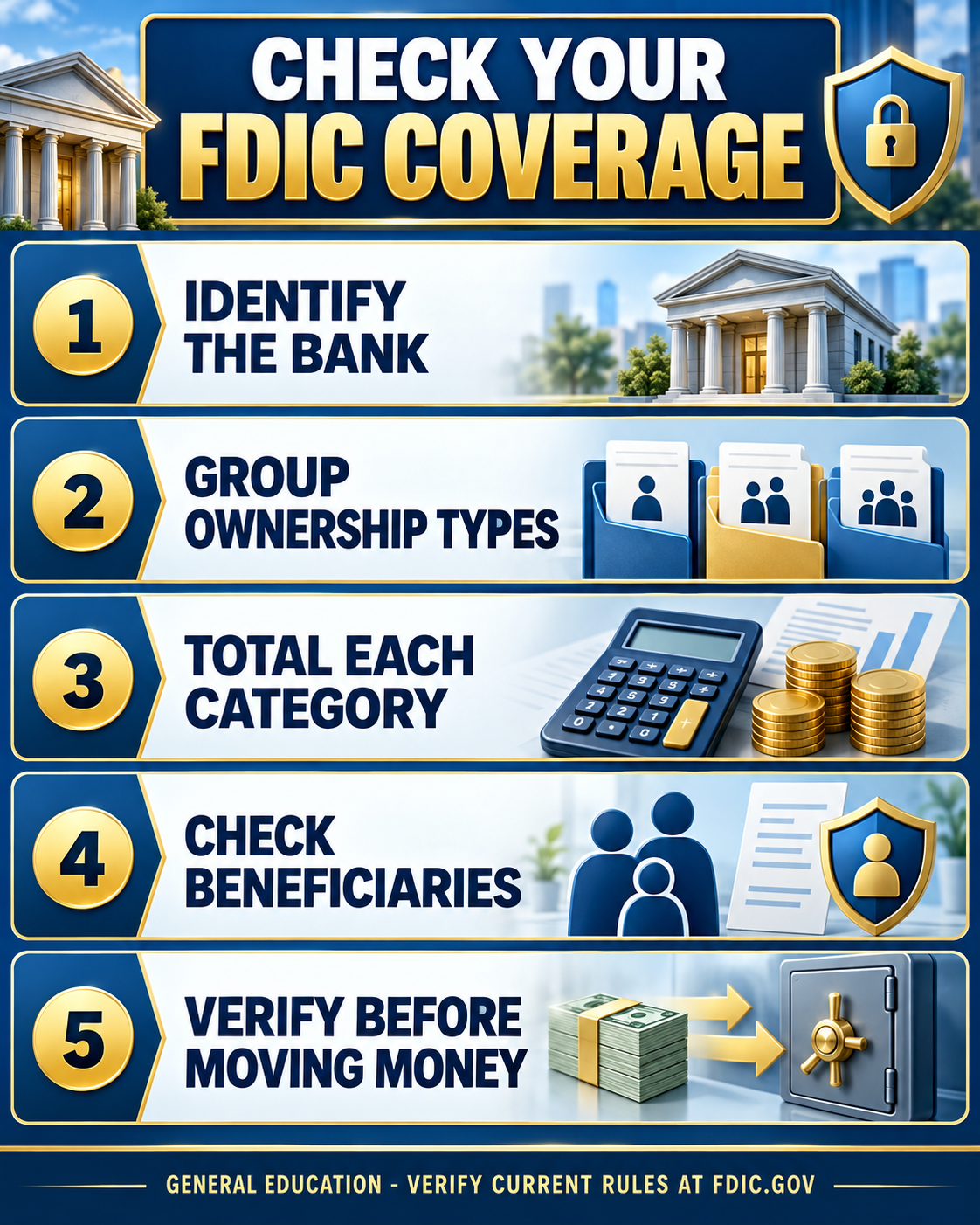
A practical review can be done in five passes. First, list each financial institution. Second, verify which institution actually holds the deposits. Third, list all deposit balances. Fourth, identify the ownership category of each account. Fifth, compare the grouped totals with the applicable FDIC rules and verify complicated cases with EDIE.
Keep the resulting worksheet with your financial records and update it after opening or closing accounts, receiving a large cash payment, changing account ownership, or learning that one of your banks is merging.
The goal is not to make your banking complicated. It is to know where an uninsured exposure may exist before a problem occurs.

Remember the Three-Part Test
When you are unsure how the FDIC insurance limit applies, return to the core formula: depositor, insured bank, ownership category.
Ask who legally owns the deposit, which insured institution actually holds it, and which FDIC ownership category applies. Then determine which balances must be grouped together.
In the simplest example, $300,000 spread across checking, savings, and CDs can still leave $50,000 above the standard limit when all of the money belongs to one depositor, sits at one insured bank, and falls within one ownership category. Multiple accounts alone do not create multiple insurance limits.
The Federal Deposit Insurance Corporation's official guidance and EDIE estimator should be your reference points whenever the answer is not obvious.

Keeping money in a bank can feel straightforward until your balance approaches the federal deposit insurance limit. The commonly quoted number is $250,000, but the rule is more specific than saying every bank account receives $250,000 of protection.
According to the Federal Deposit Insurance Corporation, the standard deposit insurance amount generally applies per depositor, per insured bank, for each ownership category. That distinction can dramatically change how much of your money is insured.
For example, imagine you have $50,000 in checking, $100,000 in savings, and $150,000 in a certificate of deposit at the same FDIC-insured bank. If all three accounts belong solely to you and fall into the same ownership category, the FDIC generally combines them. Your total is $300,000, meaning $250,000 would fall within the standard insurance limit and $50,000 would exceed it.
This guide explains how the FDIC insurance limit works, what types of deposits are protected, why opening several accounts at the same bank does not necessarily increase your coverage, and how separate banks and ownership categories can affect the calculation. It is general educational information, not individualized financial, legal, tax, trust, or estate planning advice.
Where people go wrong
Assuming Every Account Gets $250,000. The standard limit is not automatically applied separately to every checking, savings, or CD account. Accounts in the same ownership category at the same bank can be aggregated.
Opening Accounts at Different Branches of the Same Bank. Different branches generally belong to the same insured institution, so moving deposits between branches does not ordinarily create additional FDIC coverage.
Treating Investments as Insured Deposits. Stocks, bonds, mutual funds, crypto assets, and annuities are not FDIC-insured deposits simply because they were purchased through a bank or financial company.
Assuming a Financial App Is an Insured Bank. Some financial apps place deposits at partner banks. Identify the actual insured institution holding the money before calculating coverage.
Ignoring Ownership Categories. Legal ownership can materially change deposit insurance treatment. Single, joint, retirement, and trust deposits can fall under different FDIC categories.
Assuming Different Brands Mean Different Banks. A separate brand or website does not necessarily indicate a separately chartered insured institution. Verify the legal bank identity through official FDIC resources.
Forgetting About Interest and New Deposits. Balances can grow above the standard limit because of interest, CD renewals, inheritances, home-sale proceeds, payroll deposits, or other cash inflows.
Changing Account Ownership Without Considering Other Effects. Adding owners or beneficiaries can affect legal rights, estate planning, taxation, and control of funds. Deposit insurance should not be considered in isolation.
Questions people ask
Generally, no. The standard FDIC insurance amount is $250,000 per depositor, per insured bank, for each ownership category. Multiple accounts owned by the same depositor at the same bank can be combined when they fall within the same category.
Fixed it?
Get one guide like this every Thursday.