Debt Snowball vs. Debt Avalanche: The Psychology and Math of Paying Off Debt
Compare the debt snowball and debt avalanche methods, understand how interest and motivation affect repayment, and build a practical plan for directing extra money toward debt.

What you’ll need
Tap to tick things off before you start.
Understand Why Repayment Order Matters
When several balances are outstanding at the same time, the order in which you attack them can affect both the total interest you pay and how motivated you feel. High-rate revolving debt can be especially expensive because interest keeps accumulating as long as a balance remains.
A structured method prevents extra cash from being scattered randomly across several accounts. Instead, you keep every account current by making required minimum payments, then direct the rest of your available repayment money toward one chosen target.

Recognize the Cost of High Interest
An 18 percent credit card APR is not unusual in discussions about expensive consumer debt, and many real-world cards can carry rates above that level. Interest charges reduce the portion of each payment that actually lowers principal.
Investor.gov specifically warns about high-interest debt and explains that paying it off can offer a benefit that is difficult for investments to match on a risk-adjusted basis. If you eliminate a balance charging a high interest rate, you stop future interest charges on the principal you repaid.

Know What Compounding Does to a Balance
Credit card interest is generally calculated according to the cardholder agreement, often using a daily periodic rate based on the APR and account balance. When interest and fees remain unpaid, the balance that must eventually be repaid grows.
The practical effect is simple: carrying expensive debt for longer usually means paying more. Even when you make regular payments, progress may feel slow when a meaningful portion of each payment is absorbed by finance charges.

Avoid Making Minimum Payments Your Entire Strategy
Minimum payments are important because they help keep an account from becoming delinquent, but paying only the minimum can extend repayment for years depending on the balance, rate, and card terms. It can also substantially increase total interest.
The Consumer Financial Protection Bureau encourages borrowers who are reducing debt to create a deliberate repayment strategy rather than treating every balance the same. A targeted method gives every extra dollar a defined job.

Separate Required Payments From Extra Payments
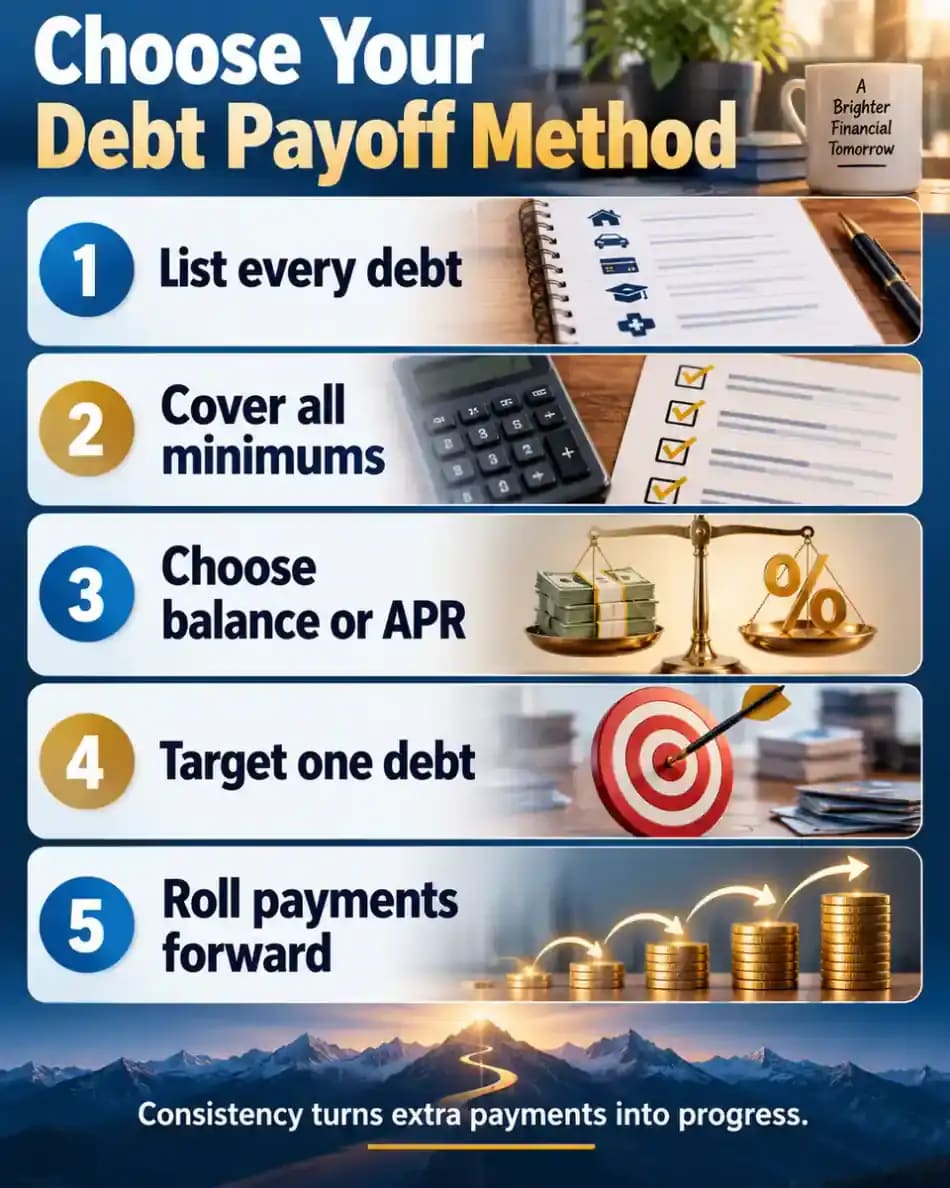
Both snowball and avalanche strategies start with the same foundation. First, make at least the required minimum payment on every included account. Then choose one priority debt and send all available extra repayment money to that account.
This distinction matters. The strategy is not about skipping one creditor to pay another. Missing required payments can trigger late fees, penalty consequences, credit damage, collection activity, or other problems depending on the account.

Build a Complete Debt Inventory
Before choosing a method, write down each debt's current balance, APR, minimum payment, due date, and any special terms. Check whether a balance has a promotional rate, deferred-interest feature, variable APR, prepayment penalty, or unusual payoff condition.
Do not rely on memory. Recent statements or creditor portals are more reliable. A complete inventory prevents a seemingly small detail, such as an expiring promotional rate, from undermining your repayment plan.

Calculate Your Sustainable Extra Payment
Subtract essential expenses, required debt payments, and other committed obligations from your take-home income. The amount left over may provide room for additional repayment, but avoid creating a plan so aggressive that you immediately need to borrow again for groceries, utilities, transportation, or emergencies.
A smaller payment you can repeat every month is often more useful than an unrealistic target that collapses after a few weeks.

Learn the Debt Snowball Method
The debt snowball ranks debts by balance from smallest to largest. Interest rates are not used to determine the repayment order. You pay minimums on every account and send all extra money to the smallest balance.
When that debt reaches zero, you redirect the full amount you had been paying on it toward the next-smallest balance. Each payoff increases the amount available for the next target, which creates the snowball effect.

Rank Snowball Debts by Balance
Suppose your balances are $600, $2,400, $5,200, and $9,000. Under the snowball method, the $600 balance becomes the first target even if another account carries a higher APR.
The method intentionally prioritizes visible progress over interest optimization. Its central idea is that eliminating an entire account can create motivation that makes the broader plan easier to follow.

Direct Every Extra Dollar to the Smallest Balance
After covering all minimum payments, send your planned extra amount to the smallest debt. Avoid splitting the extra payment across several balances unless another obligation requires it.
Concentration is what produces the first payoff quickly. If an extra $300 is available each month, the snowball method generally sends the full $300 to the smallest target in addition to that account's required payment.

Use the First Payoff as Behavioral Momentum
The strongest argument for the snowball is behavioral. A smaller balance may disappear relatively quickly, reducing the number of open obligations you are actively managing. That visible progress can make the repayment process feel more achievable.
For people who have repeatedly abandoned repayment plans, an approach that improves consistency may outperform a theoretically cheaper strategy that they do not maintain.

Roll the Old Payment Into the Next Debt
When the first debt is paid off, do not absorb that payment back into discretionary spending if debt reduction remains the goal. Add the freed payment to the amount already going toward the next-smallest debt.
For example, if you were paying a $50 minimum plus $300 extra toward the first account, that $350 can become additional repayment capacity for the next target once the first balance is gone.

Understand the Snowball Trade-Off
The snowball's weakness is mathematical. If your smallest balance has a low rate while a much larger debt carries a very high rate, prioritizing the small balance allows the expensive debt to continue accruing interest.
That can produce a higher total interest cost than an avalanche strategy using the same payment amount and repayment period assumptions. The price of motivation can therefore be measurable.

Learn the Debt Avalanche Method
The debt avalanche, also called the highest-interest-rate method, ranks debts by APR from highest to lowest. Balance size does not determine the order.
You make all required minimum payments, then send every available extra dollar to the account with the highest interest rate. After that account is eliminated, you redirect the full payment to the debt with the next-highest rate.

Rank Avalanche Debts by APR
Imagine four debts charging 27 percent, 21 percent, 12 percent, and 7 percent. The 27 percent balance comes first under the avalanche even if it is the largest balance.
This ordering attacks the costliest dollar of debt before cheaper dollars. As principal falls on the highest-rate account, the amount of future interest generated by that account also falls.

Target the Most Expensive Balance
Once minimums are covered, concentrate all extra repayment funds on the highest-rate debt. If that debt has a 24 percent APR while another account charges 8 percent, each dollar eliminated from the 24 percent balance avoids more future interest than a dollar eliminated from the 8 percent balance, all else equal.
This is the core mathematical logic behind the avalanche.

See Why the Avalanche Usually Costs Less
When debt balances, payment timing, and other assumptions are held constant, targeting the highest APR first generally minimizes interest expense. You stop more expensive interest from accumulating sooner.
That is why Investor.gov stresses the value of eliminating high-interest debt. Avoiding a 20 percent borrowing cost is economically different from seeking a 20 percent investment return because the avoided interest is tied directly to a known liability, while market returns can fluctuate and may be negative.

Roll Avalanche Payments Forward
The avalanche uses the same rollover mechanism as the snowball. When the highest-rate account reaches zero, move its entire former payment to the debt with the next-highest APR.
Your overall monthly repayment amount does not have to shrink just because one account disappears. Keeping it constant accelerates the remaining balances and preserves the momentum created by earlier payments.

Understand the Avalanche Motivation Problem
The avalanche can feel slow when the highest-rate debt also has a large balance. You may make months of financially efficient payments without eliminating a single account.
For someone motivated by visible milestones, that delay can make the plan harder to sustain. The method may be mathematically efficient while still demanding more patience than the snowball.

Compare Psychology With Mathematics
The snowball and avalanche solve different problems. Avalanche optimization asks, 'How can I minimize interest cost?' Snowball optimization asks, 'How can I create progress that keeps me engaged?'
Neither question is trivial. Personal finance plans depend on repeated behavior. A strategy that saves money only if followed consistently can fail when the user abandons it. At the same time, behavioral benefits should not obscure the real cost of leaving a high-rate balance outstanding.

Work Through a Two-Debt Example
Assume someone has a small personal loan at a relatively low rate and a much larger credit card balance at 18 percent. Also assume the person has a fixed amount of extra money each month, makes every required payment on time, and does not add new debt.
These assumptions matter because changing the payment amount, interest rate, fees, or new borrowing can change the result.

See What the Avalanche Does in the Example
Under the avalanche, extra money goes to the 18 percent credit card because it is more expensive than the personal loan. This reduces the principal that is generating the highest interest charge.
The account may take a long time to eliminate if its balance is large, but under the stated assumptions the strategy generally produces lower total interest than paying the low-rate loan first.

See What the Snowball Does in the Example
Under the snowball, extra money goes to the small personal loan because it has the lower balance. The borrower may eliminate that account much sooner and experience an early milestone.
The trade-off is that the 18 percent credit card remains larger for longer than it would under the avalanche, so additional interest can accrue during that period.

Check Whether Your Rates Are Actually Far Apart
The financial difference between methods depends partly on how different the interest rates are. If every debt has nearly the same APR, repayment order may have a relatively small effect on total interest.
If one account charges 29 percent and another charges 6 percent, the cost difference can be much more meaningful. Before choosing based on habit alone, inspect the actual numbers.

Account for Promotional and Variable Rates
A simple APR ranking can miss important account terms. A zero-percent promotional offer may expire, a variable rate may change, or a deferred-interest arrangement may create a significant charge if certain conditions are not satisfied.
Review the actual creditor agreement and current statement. If a special deadline or contractual term materially changes the economics, a rigid snowball or avalanche order may need to be adjusted.

Protect Yourself From New Debt
Both methods assume that balances are generally moving downward. If new purchases replace every dollar you repay, progress can stall even when your targeting method is sound.
Consider separating routine spending from cards you are actively paying down, pausing discretionary charges, and building enough cash buffer to handle predictable expenses. The goal is to prevent the repayment system from becoming a revolving door.

Automate the Payments You Cannot Miss
Late payments can introduce fees and other consequences that overwhelm the benefit of careful repayment ordering. Setting automatic minimum payments can reduce the risk of missing due dates, provided enough money remains in the linked account.
You can then make the targeted extra payment separately. Review automatic payments regularly because minimum amounts and account balances can change.

Measure Progress With More Than One Metric
Track total debt, target balance, monthly interest charges, number of remaining accounts, and the amount of principal eliminated. Different metrics support different motivations.
An avalanche user may not close an account quickly but can still see the high-rate balance shrinking. A snowball user can celebrate account closures while also monitoring the interest cost of balances that remain.

Know When the Standard Methods Are Not Enough
Snowball and avalanche methods are designed for borrowers who can generally make required payments and have some money available for extra repayment. They may be insufficient if you are already delinquent, facing collection lawsuits, unable to afford basic expenses, or considering bankruptcy.
The Consumer Financial Protection Bureau provides educational resources on debt reduction and dealing with creditors. Depending on the situation, assistance from a reputable nonprofit credit counselor or an appropriately licensed professional may be more relevant than choosing between two payoff orders.

Choose a Method You Can Execute Consistently
If your priority is minimizing interest and you can stay committed without early account closures, the avalanche provides a strong mathematical framework. If quick visible wins materially improve your ability to continue making extra payments, the snowball provides a structured behavioral framework.
You can also reassess over time. A borrower might begin with one small payoff to simplify the debt list, then switch to highest-rate-first repayment. What matters is understanding the cost of each choice, making every required payment, avoiding new high-cost debt where possible, and following a plan that is sustainable.
For educational reference, the Consumer Financial Protection Bureau's debt reduction guidance discusses both smallest-balance and highest-interest approaches, while Investor.gov highlights the financial importance of paying off high-interest debt. Use those principles as a framework, then evaluate your own account terms and circumstances before taking action.

Paying off several debts at once is not only a math problem. It is also a behavior problem. You may know that a high-rate credit card is expensive, yet still find it easier to stay motivated when you can eliminate a smaller balance quickly. That tension is exactly what separates the debt snowball from the debt avalanche.
The debt snowball prioritizes the smallest balance first. The debt avalanche prioritizes the highest interest rate first. Both require you to keep making at least the required minimum payments on all debts while directing extra money toward one target account at a time.
The Consumer Financial Protection Bureau describes both approaches as common debt reduction strategies. Investor.gov also emphasizes that paying off high-interest debt can be one of the most financially powerful uses of available cash because avoiding a high interest charge is a certain benefit, while investment returns are not guaranteed.
This guide explains the mechanics, trade-offs, assumptions, and practical steps behind both methods. It is educational information, not individualized financial, legal, or tax advice. Your account terms, cash flow, delinquency status, taxes, legal obligations, and eligibility for assistance can materially change what makes sense in practice.
Where people go wrong
Skipping Minimum Payments. Snowball and avalanche strategies normally require keeping every included account current while targeting one debt with extra money. Missing a required payment can create fees and other consequences.
Ranking Debts From Memory. Balances, APRs, promotional offers, and minimum payments change. Use current statements rather than estimates when building your repayment order.
Ignoring Promotional Rate Expirations. A temporarily low APR may later increase. Deferred-interest and promotional arrangements can also contain deadlines that change repayment priorities.
Using Every Dollar of Cash for Debt. An extremely aggressive payment can backfire if it leaves no money for essential expenses and forces you to borrow again.
Continuing to Add New Balances. A targeting method cannot produce meaningful progress if new charges repeatedly replace the principal you just paid down.
Splitting Extra Money Across Every Account. Sending small extra amounts everywhere weakens the main advantage of both methods, which is concentrating repayment power on one priority debt.
Choosing Avalanche but Abandoning It. A mathematically efficient method delivers no benefit if frustration causes you to stop making extra payments. Track intermediate progress if large balances take time to disappear.
Choosing Snowball Without Checking the Cost. Quick wins are valuable, but a very high-rate balance can become substantially more expensive while you focus on smaller low-rate debts. Compare the rates before deciding.
Questions people ask
The debt snowball targets the smallest balance first, while the debt avalanche targets the highest interest rate first. Both usually require minimum payments on all debts and direct extra money toward one priority account.
Fixed it?
Get one guide like this every Thursday.