Debit Card vs. Credit Card: Which Is Safer for Everyday Spending?
Debit and credit cards may look similar, but federal fraud protections work very differently. Learn how Regulation Z, Regulation E, reporting deadlines, and cash-flow risks affect everyday spending.

What you’ll need
Tap to tick things off before you start.
Start With the Real Difference
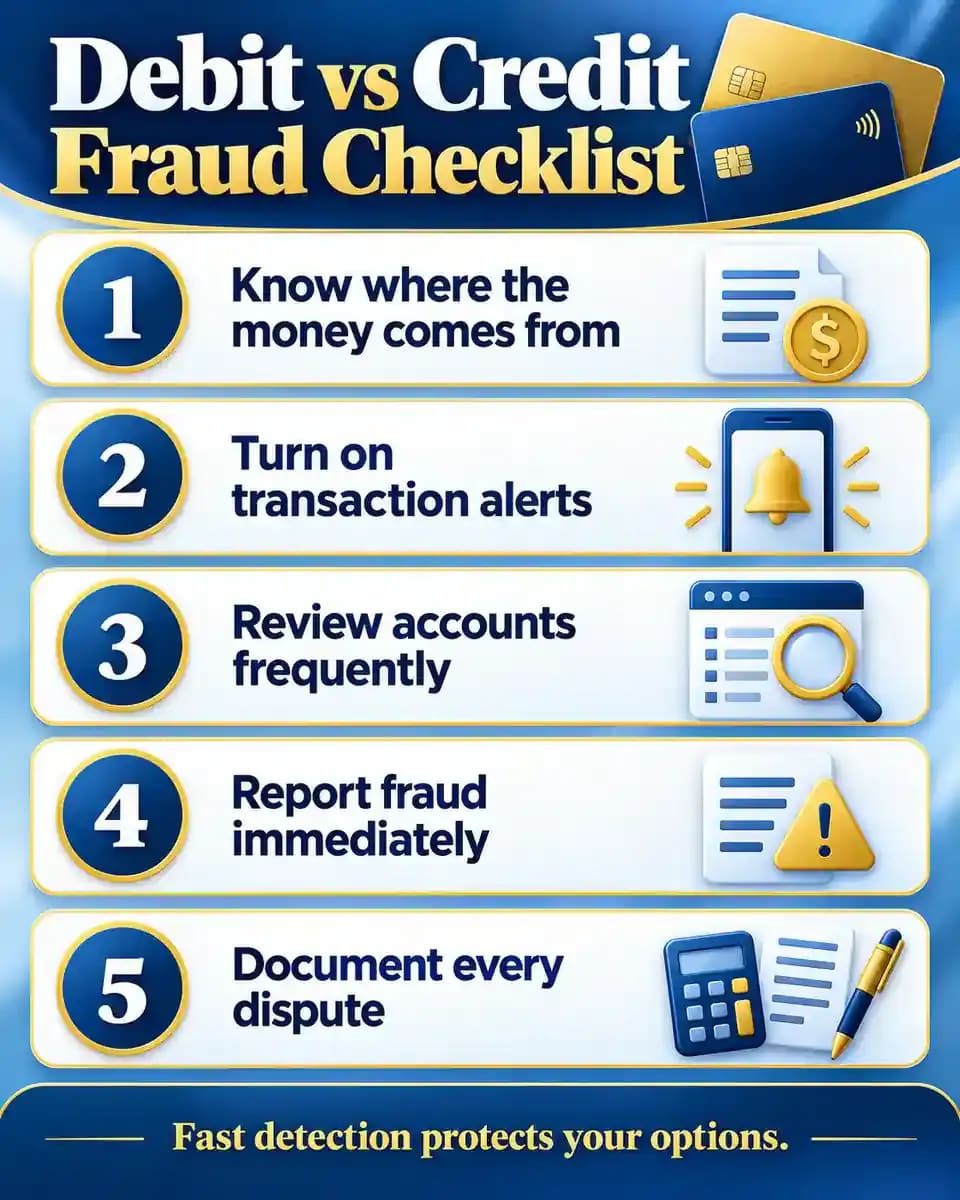
The most important difference in the debit card vs credit card comparison is not the plastic in your wallet. It is the source of the money. A debit purchase normally causes money to leave a linked deposit account. A credit card purchase uses an issuer-provided credit line that you repay later. When a legitimate transaction occurs, both systems can feel nearly identical. When an unauthorized transaction occurs, however, one may involve your deposited cash while the other initially involves the card issuer's credit. That distinction affects both legal protections and short-term financial disruption.

Understand What a Debit Purchase Does
With a typical debit card transaction, the payment is tied directly to money held in your checking or other eligible deposit account. That means a fraudulent debit transaction can reduce the cash available for rent, utilities, groceries, automatic payments, and other obligations. Even when the transaction is ultimately reversed, the temporary loss of access to those funds may matter. This is why debit card security should be evaluated not only by whether money can eventually be recovered, but also by how much disruption would occur while the financial institution investigates.

Understand What a Credit Purchase Does
A credit card transaction works differently. Instead of immediately withdrawing money from your checking account, the issuer extends credit for the purchase. You later repay the balance according to the account terms. If an unauthorized charge appears, it may consume part of the available credit line, but it does not normally remove the same amount of cash directly from your checking account. That does not make fraud harmless, and billing disputes still require attention. It does, however, create a useful separation between a compromised payment credential and the cash you rely on for daily expenses.

Recognize the Cash-Flow Consequence
Consider a hypothetical $1,200 fraudulent purchase. If it hits a debit account holding $1,500, the account holder may temporarily have only $300 available before considering any provisional credit or reimbursement. If the same unauthorized amount appears on a credit card with sufficient available credit, the person's checking balance generally remains untouched. The legal dispute still matters, but the immediate cash-flow problem can be very different. This is one reason consumers with small checking account buffers may view the direct-access nature of debit cards as an important risk factor.

Know Why Two Federal Rules Apply
Credit cards and debit cards are not simply two versions of the same legal product. Their core federal consumer protections come from different regulatory systems. Credit card unauthorized-use liability is addressed through Regulation Z under the Truth in Lending Act. Debit card and other electronic fund transfer protections are primarily addressed through Regulation E under the Electronic Fund Transfer Act. The Consumer Financial Protection Bureau maintains the regulations and official interpretations. Because the two frameworks work differently, rules you remember from a credit card dispute should not automatically be assumed to apply to debit card fraud.

Learn the Regulation Z Credit Card Rule
The Consumer Financial Protection Bureau's Regulation Z provisions limit a cardholder's liability for unauthorized use of a credit card. Under the federal rule, liability cannot exceed the lesser of $50 or the value obtained through the unauthorized use before the issuer is notified, assuming the conditions for imposing liability are met. The $50 figure is therefore a maximum federal exposure in qualifying unauthorized-use situations, not a standard fee automatically charged after fraud. Many issuers voluntarily provide policies that are even more favorable.

Put the $50 Credit Limit in Context
Suppose someone obtains a qualifying credit card and makes $3,000 in unauthorized purchases before the cardholder reports the problem. Federal Regulation Z does not generally make the cardholder responsible for the entire $3,000 simply because the fraudulent spending was large. The statutory liability ceiling for unauthorized use is substantially lower. The precise handling of a claim depends on the facts and account terms, but the key consumer protection is that unauthorized credit card use does not create an open-ended liability structure comparable to the potential later-stage exposure associated with certain debit card situations.

Report a Lost Credit Card Before It Is Used
If you realize a credit card is missing, reporting it immediately is still the sensible response. Regulation Z's structure means that if the issuer is notified before unauthorized use takes place, there is no unauthorized amount obtained before notification on which qualifying liability could be imposed. Fast reporting also allows the issuer to deactivate the card, issue replacement credentials, and reduce further fraudulent attempts. Legal limits are not a reason to delay. The operational goal should always be to shut down compromised credentials as soon as they are discovered.

Separate Federal Law From Zero-Liability Policies
Consumers often hear the phrase zero liability, but it is important to distinguish an issuer or card-network policy from the federal statutory framework. Regulation Z establishes the legal ceiling for qualifying unauthorized credit card use. An issuer may choose not to impose even that limited amount, and many major card programs advertise zero-liability protections subject to their own terms and exclusions. Those voluntary protections can be valuable, but they should be verified directly in the current cardholder agreement. Do not assume every product, transaction type, or factual situation is covered identically.

Move to the Regulation E Debit Framework
Debit card fraud is governed by a different structure. Regulation E, which implements the Electronic Fund Transfer Act, addresses consumer liability for unauthorized electronic fund transfers. Instead of relying primarily on one low ceiling like the credit card framework, debit liability can depend on what happened and when the consumer notified the financial institution. That timing component is critical. Regulation E distinguishes situations involving a lost or stolen access device from unauthorized transfers first appearing on a periodic statement, and different timing rules can apply.

Know the Two-Business-Day Window
For a lost or stolen debit card or other access device, one of the most important Regulation E deadlines is two business days after learning of the loss or theft. According to the Consumer Financial Protection Bureau's Regulation E rule, timely notice during this period can generally limit liability to no more than $50 for qualifying unauthorized transfers. This is not two calendar days. Federal rules specifically use business days in this part of the framework. The safest practical response is still to notify the institution immediately rather than trying to calculate how much time remains.

See What Happens After Two Business Days
Missing the two-business-day window can increase potential liability. Under Regulation E, when a consumer does not provide timely notice after learning that an access device was lost or stolen, potential liability can rise to as much as $500 under the applicable calculation. That does not mean every late report automatically produces a $500 loss. The actual amount depends on the unauthorized transfers and the rule's requirements. Still, the increase from a possible $50 exposure to a much larger amount is enough to make prompt reporting a serious financial priority.

Understand the 60-Day Statement Rule
Regulation E also contains an important 60-day rule connected to periodic statements. If an unauthorized transfer appears on a statement and the consumer fails to notify the financial institution within 60 days after the institution transmits that statement, the consumer may become liable for certain unauthorized transfers occurring after that 60-day period. The rule focuses on losses that could have been prevented by timely notification. This is why merely checking whether your physical debit card is still in your wallet is not enough. Your statements also need regular review.

Do Not Misread Unlimited Liability
The phrase unlimited liability is often used when describing the Regulation E 60-day rule, but it needs context. It does not mean a bank automatically confiscates an entire account after day 60. Rather, a consumer can face liability for qualifying unauthorized transfers that occur after the 60-day period when the financial institution can establish that those later transfers would not have occurred if timely notice had been provided. Depending on the account structure, substantial amounts can therefore be exposed. The practical lesson is simple: unexplained debit activity should never sit unreported for months.

Distinguish a Stolen Card From a Stolen Number
Not every unauthorized debit transaction starts with a physically missing card. Card credentials can also be compromised while the debit card remains in your possession. Regulation E rules can differ depending on whether an access device was lost or stolen and when an unauthorized electronic fund transfer appears on a periodic statement. This distinction is one reason simplistic claims such as debit fraud always costs $50 or debit fraud always costs $500 are misleading. Consumers should report the specific facts promptly and let the institution apply the appropriate regulatory framework.

Understand the Negligence Rule
A particularly useful Regulation E protection concerns consumer negligence. The Consumer Financial Protection Bureau's rule states that negligence by the consumer cannot be used as the basis for imposing greater liability than Regulation E otherwise permits. A classic example is a consumer carelessly writing a PIN on or near a debit card. That behavior is obviously poor security practice, but negligence by itself does not give a financial institution permission to disregard the regulation's liability limits. Reporting requirements still matter, so this protection should never be interpreted as permission to handle credentials carelessly.

Treat Reporting Speed as a Security Tool
Security is usually discussed in terms of passwords, chips, encryption, and fraud detection. For debit card users, reporting speed is also part of the security system. A transaction alert noticed today is more useful than an unauthorized payment discovered months later. Enable push notifications, text alerts, or email notifications where available, especially for card-not-present transactions, international purchases, cash withdrawals, and transactions above a chosen threshold. Alerts do not replace statement review, but they can dramatically reduce the time between a suspicious transaction and your response.

Review Accounts More Often Than Monthly
Monthly statement review is a useful minimum habit, but digital banking makes more frequent monitoring easy. A quick check once or twice a week can help identify unfamiliar merchants, test charges, duplicate transactions, or unexpected withdrawals before they become larger problems. Small fraudulent charges deserve attention because criminals sometimes test stolen payment credentials with modest amounts before attempting larger purchases. The purpose is not to obsess over every transaction in real time. It is to create a repeatable monitoring rhythm that makes it unlikely an unauthorized transfer will remain unnoticed for weeks.

Check Three Things on Every Statement
A useful statement review can be built around three questions. First, do you recognize every merchant or payee? Second, does each amount match what you expected to pay? Third, did you actually receive the product, service, or cash associated with the transaction? Merchant names can appear differently from the storefront name, so an unfamiliar descriptor is not automatically fraud. Search your receipts and order history first. If you still cannot identify the transaction, contact the issuer through an official channel rather than ignoring it.

Use Official Contact Channels
If you identify unauthorized activity, contact the financial institution using a trusted source such as the phone number printed on the card, the issuer's official app, or its official website. Avoid calling a number contained in an unexpected fraud-alert message until you independently verify it. Criminals use fake security notices to trick consumers into revealing passwords, one-time codes, PINs, or card information. A real fraud problem can therefore become worse if the response itself is directed through a phishing channel. Navigate directly to the institution you already know.

Document the Fraud Report
When reporting unauthorized activity, keep a basic record of what happened. Note the date and time, the transactions disputed, the amount involved, the representative or department contacted, and any confirmation or case number. Save relevant secure messages and correspondence. Documentation can help if you need to follow up or establish when notice was provided. The exact procedural requirements can vary depending on the transaction and regulation involved, so follow the institution's instructions carefully and provide written confirmation when requested or when applicable under the governing dispute process.

Ask About Provisional Credit and Investigation
A major practical issue with debit card fraud is what happens while the institution investigates. Regulation E contains error-resolution procedures that may require financial institutions to investigate reported errors and, in certain circumstances, provide provisional credit when an investigation cannot be completed within the initial regulatory period. The exact requirements depend on the circumstances. Ask the bank what timeline applies, whether provisional credit is available, and whether access to any linked accounts or payment methods should be changed. Do not assume every institution resolves every fraud claim instantly.

Consider Credit for Higher-Risk Purchases
For consumers who can use credit responsibly, a credit card can create useful separation between merchants and a primary checking account. That may be particularly attractive for online shopping, recurring subscriptions, travel reservations, unfamiliar merchants, or businesses where card credentials are stored. The point is not that every credit purchase is automatically safer in every possible respect. The advantage discussed here is narrower: fraud involving a credit line generally does not immediately remove the disputed amount from the consumer's checking balance, and Regulation Z provides strong unauthorized-use liability limits.

Do Not Ignore Credit Card Debt Risk
Fraud protection is only one part of choosing between debit and credit. Credit cards can charge substantial interest when balances are carried, and fees or overspending can erase the practical benefit of stronger fraud isolation. A consumer who routinely spends more with credit than they can repay may be better served by changing the spending system rather than focusing only on fraud rules. One common approach is to use a credit card for purchases while paying the statement balance in full by the due date, but whether that strategy is appropriate depends on individual circumstances and account terms.

Use Debit Deliberately When You Prefer It
Debit cards can still be a practical everyday payment tool. Some consumers prefer spending only money already in their account, want to avoid borrowing, or find debit simpler for budgeting. The key is to use debit with an awareness that the card is connected to actual deposited funds and that Regulation E rewards prompt detection and reporting. Transaction alerts, frequent account reviews, careful PIN security, and maintaining a separate emergency reserve can reduce the practical consequences of a compromised card. Debit is not inherently irresponsible. Unmonitored debit use is the greater concern.

Separate Spending Money From Emergency Cash
One way to reduce disruption is to avoid keeping every available dollar behind a single payment credential. Depending on banking arrangements, some households maintain a separate emergency savings account that is not used for daily debit purchases. Others use one account for bills and another for routine spending. Account structures, transfer rules, overdraft links, and deposit insurance considerations vary, so this is not a universal prescription. The broader principle is resilience: a compromised everyday payment method should not ideally make every dollar needed for essential obligations unavailable at the same time.

Review Overdraft and Linked Account Settings
A debit card may be connected to more than one source of funds. Checking accounts can have overdraft arrangements, linked savings, or other features that affect what happens when transactions exceed the available balance. Because Regulation E's late-reporting consequences can involve later unauthorized transfers that timely notice could have prevented, it is worth understanding exactly what accounts or credit features are connected to the debit card. Ask the institution how overdraft protection works and whether a compromised card could draw from linked sources. Security planning is weaker when you do not know the account architecture.

Replace Compromised Credentials
Once a card number is confirmed or reasonably suspected to be compromised, discuss replacement credentials with the issuer. Canceling or replacing a card can create follow-up work because recurring payments, mobile wallets, and stored merchant credentials may need updating. Keep a list of important subscriptions and automatic payments so nothing essential is accidentally missed. Also change online banking credentials if the compromise may extend beyond the card number itself. A stolen card number and a compromised bank login are different security events and may require different responses.

Build a Simple Daily-Spending System
A practical payment system can be uncomplicated. Choose which account or card you want exposed to routine merchants. Turn on alerts. Review activity regularly. Pay legitimate credit card balances on schedule. Keep emergency cash reserves appropriately separated. Report suspicious transactions immediately. Store issuer contact information somewhere accessible even if the physical card disappears. These habits matter more than chasing a theoretically perfect payment method. The strongest setup is one you can operate consistently, because federal protections work best when a consumer notices problems and responds within the applicable deadlines.

Choose Based on Both Law and Behavior
For fraud isolation alone, credit cards have an important structural advantage: unauthorized charges generally hit a credit line rather than immediately draining a checking account, and Regulation Z provides a strong federal liability ceiling. Debit cards remain useful, but Regulation E makes reporting timelines especially important. That does not make credit automatically superior for every consumer. Interest, debt management, budgeting behavior, fees, rewards, merchant acceptance, and personal preferences also matter. The strongest choice is the one that combines appropriate legal protections with spending behavior you can control and a monitoring routine you will actually maintain.

A debit card and a credit card can perform almost the same task at a checkout terminal, but the financial machinery behind them is very different. A debit card generally pulls money from your deposit account. A credit card generally uses a line of credit provided by the issuer. That difference matters most when something goes wrong.
Federal protections for unauthorized credit card use are primarily governed by Regulation Z, which implements the Truth in Lending Act. Unauthorized electronic fund transfers involving debit cards are generally governed by Regulation E, which implements the Electronic Fund Transfer Act. The Consumer Financial Protection Bureau publishes the operative rules for both frameworks.
The practical question is not simply which card is more convenient. It is what happens to your money while a fraudulent transaction is being investigated, how quickly you must report a problem, and how much liability federal law can place on you. Understanding those mechanics can help you build a safer everyday payment routine without assuming that every card offers identical protection.
Where people go wrong
Assuming debit and credit fraud rules are identical. They are governed by different federal frameworks. Credit card unauthorized-use liability generally falls under Regulation Z, while unauthorized debit electronic fund transfers are generally addressed under Regulation E.
Waiting to see whether suspicious debit activity continues. Delay can matter under Regulation E. Report genuinely unauthorized transactions promptly instead of waiting for another fraudulent charge to appear.
Believing debit liability is always limited to $50. The $50 limit can apply when a lost or stolen access device is reported within the relevant two-business-day period, but potential liability can increase when notification is delayed.
Ignoring monthly statements because alerts are enabled. Alerts are helpful but can fail, be disabled, or miss certain transactions. Statement review remains important, particularly because Regulation E contains a 60-day statement-related rule.
Treating zero liability as the federal rule for every credit card. Federal law establishes a maximum liability framework. Zero-liability programs are often additional issuer or network policies with their own terms.
Using links inside unexpected fraud messages. A fake bank alert can be a phishing attempt. Contact the institution through its official app, website, or the verified number on your card.
Choosing credit solely because of fraud protection. Credit cards can create interest charges and debt problems when balances are not managed responsibly. Fraud protection should be considered alongside spending behavior and account costs.
Keeping every dollar accessible through one payment method. A single compromised account can create unnecessary cash-flow disruption. Consider how your emergency reserves and essential bill money are structured and protected.
Questions people ask
For the narrow issue of unauthorized card use and immediate access to cash, credit cards have important structural advantages. Regulation Z generally caps qualifying unauthorized credit card liability at no more than $50, while fraudulent charges normally affect a credit line instead of directly removing money from checking. Debit cards can still be used safely, but Regulation E places greater importance on reporting timelines.
Fixed it?
Get one guide like this every Thursday.