Dealer Financing vs. Bank Pre-Approval: How to Get a Better Auto Loan
Learn how dealer financing compares with bank pre-approval, why dealer markups can raise your auto loan costs, and how to compare APRs, negotiate loan terms, and understand your consumer protections before buying a car.

What you’ll need
Tap to tick things off before you start.
Why Your Auto Loan Rate Matters
The price you negotiate for a vehicle is not necessarily the amount you ultimately pay. Financing adds interest expenses that accumulate throughout the repayment period. Even a small difference in your borrowing rate can substantially affect the total purchase cost, particularly with larger loans. For example, financing a $30,000 vehicle at different rates can produce hundreds or thousands of dollars in additional interest. Understanding financing costs helps you evaluate a vehicle's true affordability.

Car Price and Financing Are Separate Decisions
Buying a vehicle involves two distinct financial decisions: agreeing on its selling price and determining how to pay for it. The vehicle price reflects what the dealership charges, while financing determines the cost of borrowing money for that purchase. Discussing both together can make unfavorable terms harder to recognize. Request an itemized out-the-door price, including applicable taxes and fees, before evaluating loan offers. This separation makes the overall transaction easier to understand.

How Dealer-Arranged Financing Works
Dealer-arranged financing allows you to apply for an auto loan through the dealership instead of contacting a lender independently. The dealer acts as an intermediary, collecting your application and communicating with financial institutions that may finance your purchase. If a lender approves the transaction, the dealership presents financing terms for your consideration. This arrangement can simplify paperwork and coordinate vehicle delivery with financing. However, convenience alone does not establish whether the resulting loan is competitive.

Banks, Credit Unions, and Captive Lenders
Auto loans come from several types of financial institutions. Commercial banks offer vehicle financing through established lending programs, while credit unions serve eligible members and may provide competitive rates. Online lenders can also offer direct financing. Captive finance companies are affiliated with automobile manufacturers and frequently support dealership financing programs, including qualifying promotional offers. Each institution establishes its own eligibility standards, available terms, and lending conditions. Understanding these differences broadens the range of financing options available to consumers.

What Happens After Your Credit Application
When you submit a dealership credit application, the finance department may forward your information to several potential lenders. Those lenders assess factors such as credit history, outstanding debt, income, and the proposed vehicle purchase. Each institution independently decides whether to approve financing and what conditions to offer. Responses can differ because lenders apply different underwriting standards. Submitting an application may trigger hard credit inquiries, so understand the authorization you provide before allowing a dealership to contact lenders.

The Lender Buy Rate Explained
The buy rate is the interest rate a lender quotes to a dealership when agreeing to finance an eligible vehicle purchase. It reflects the lender's assessment of the proposed transaction, including borrower qualifications and loan characteristics. For example, a lender might approve a transaction at a 4% buy rate. That figure represents the lender's underlying pricing offered through the dealer, not necessarily the rate ultimately included in the buyer's contract. Consumers generally do not receive automatic disclosure of this underlying rate.

Why Dealers Add an Interest Rate Markup
Some dealerships earn compensation by arranging financing at a contract interest rate above the lender's buy rate. This difference is called dealer markup or dealer participation. Rather than charging a separate visible service fee, the dealer may receive compensation connected to the additional interest charged under the financing agreement. Lender agreements and applicable laws can restrict these arrangements. Markups are not universal, and some financing programs use different compensation methods. The important distinction is between the lender's underlying pricing and the customer's agreed rate.

How a Small Markup Raises Loan Costs
Consider a hypothetical $30,000 auto loan with a 60-month repayment term and monthly payments. At a 4% fixed interest rate, the payment is approximately $552, with about $3,150 in total interest. Increasing the rate to 5% raises the payment to approximately $566 and total interest to about $3,968. That one-percentage-point difference adds roughly $818 in borrowing costs. These simplified calculations assume full financing, standard amortization, no additional fees, and payments made on schedule.

Interest Rate vs. APR
An auto loan's interest rate describes the percentage used to calculate interest on the outstanding balance. The annual percentage rate, or APR, expresses borrowing costs on an annualized basis and includes certain finance charges beyond interest. Consequently, APR may exceed the stated interest rate when qualifying fees apply. The Consumer Financial Protection Bureau encourages shoppers to understand these disclosures when evaluating auto loans. Comparing APRs is most meaningful alongside the amount financed, repayment period, and other contractual conditions.

Four Essential Auto Loan Terms
Four terms form the foundation of an auto loan. Principal is the amount borrowed, excluding interest. The interest rate determines how interest accrues on the unpaid balance. APR measures annualized borrowing costs, including certain finance charges. The loan term specifies how long repayment lasts, commonly expressed in months. Together, these figures influence monthly obligations and overall financing expenses. When reviewing a loan offer, identify each figure clearly so you understand what the agreement actually requires.

How Creditworthiness Affects Your Rate
Your creditworthiness plays a major role in the auto loan rates lenders offer. Lenders typically evaluate payment history, credit scores, outstanding debts, income, and existing financial obligations. The vehicle's age, loan amount, and down payment may also influence pricing. Borrowers with stronger credit profiles often qualify for lower interest rates, although approval standards vary. Reviewing your credit reports before shopping can help identify inaccuracies or unresolved issues that might affect your financing options.

Why Getting Pre-Approved First Helps
Obtaining auto loan pre-approval before visiting a dealership gives you an independent financing reference point. Instead of relying entirely on the dealership's proposed rate, you arrive knowing what a separate lender may be willing to offer. This can strengthen your negotiating position and reduce uncertainty about your borrowing options. The Consumer Financial Protection Bureau encourages consumers to shop for financing before purchasing a vehicle. Remember that pre-approval is generally conditional and does not guarantee final loan approval.

How to Apply for Bank Pre-Approval
Applying for auto loan pre-approval typically starts with a bank, credit union, or online lender's application. You may need to provide your legal name, address, employment information, income, housing expenses, and estimated borrowing amount. The lender reviews your application and may request pay stubs or additional verification documents. Depending on its process, the application could involve a hard credit inquiry. Before submitting personal information, confirm the lender's legitimacy, application requirements, and credit inquiry policy.

What Your Pre-Approval Offer Includes
A written auto loan pre-approval typically identifies the maximum borrowing amount, available interest rate or APR, and repayment term. It may also specify an expiration date, eligible vehicle types, mileage restrictions, or minimum down payment requirements. Some offers provide a rate range rather than a guaranteed figure. Check whether the terms depend on final credit verification or vehicle approval. Understanding these conditions helps prevent surprises when you select a car and request funding.

Use Pre-Approval as Your Comparison Benchmark
An independent pre-approval establishes a practical baseline for evaluating dealership financing. For example, if your credit union conditionally offers a 6% APR over 60 months, you can use those terms to assess a competing dealership proposal. The comparison is most useful when both offers involve similar borrowing amounts and repayment periods. Your pre-approval does not establish the lowest possible market rate, but it gives you a documented alternative to accepting the dealership's initial financing proposal.

Negotiate Your Rate With the Dealer
When discussing financing with the dealership, ask whether its finance department can improve the proposed interest rate or APR. You can mention a competing offer and request updated terms in writing. Focus on the actual rate, repayment period, and borrowing conditions rather than accepting verbal assurances about affordability. A dealership may have some flexibility, but discounts are never guaranteed. Maintain a clear record of each proposal and avoid signing until the final financing terms are understandable.

Ask Dealers to Compete for Your Financing
Dealerships may work with multiple lenders, giving them opportunities to compete for your financing business. When you present an alternative lending offer, the finance department may seek more favorable lender terms or reduce its permitted dealer markup. Competition can sometimes lower your borrowing costs, although lenders and dealership agreements may limit available adjustments. Ask whether improved terms are available without requiring additional purchases. Compare every revised proposal carefully, since a lower quoted rate does not automatically mean a better overall deal.

When Dealer Financing May Be the Better Choice
Dealer financing can be attractive when a dealership offers a genuinely lower APR or manufacturer-supported promotional financing. Certain programs provide reduced rates to qualified borrowers purchasing eligible vehicles. However, promotional offers may require strong credit, specific models, shorter repayment periods, or choosing financing instead of a cash rebate. Compare the total financial effect of these conditions before deciding. A dealer's offer may be preferable when its complete costs and requirements are more favorable than available independent financing.

Keep Vehicle Price Negotiations Separate
Vehicle pricing, trade-in value, down payment, and financing terms should remain identifiable throughout dealership negotiations. Start by establishing the vehicle's out-the-door purchase price, including applicable taxes and mandatory fees. Evaluate any trade-in allowance separately, especially when an existing loan balance must be paid off. Then account for your down payment before reviewing the proposed amount financed. Keeping these figures distinct makes it easier to identify unexpected charges and prevents payment discussions from obscuring the actual purchase agreement.

Collect Multiple Written Loan Offers
Comparing financing options becomes easier when you collect written offers from several sources. Consider requesting quotes from commercial banks, credit unions, reputable online lenders, and the dealership's finance department. The Consumer Financial Protection Bureau recommends shopping around because different lenders may offer different borrowing terms. Record each lender's name, offer date, expiration date, and conditions. Keep copies of the proposals rather than relying on advertised rates or verbal estimates, which may not reflect the terms available to you.

Compare Offers on Equal Terms
A fair auto loan comparison starts with matching the amount borrowed and repayment period across competing offers. For example, compare two $25,000 loans with 60-month terms rather than comparing loans with different balances or durations. Examine each offer's APR, interest rate, required fees, monthly payment, and total repayment amount. Differences in down payments or optional products can distort the comparison. Using consistent assumptions helps reveal which financing offer actually provides more favorable borrowing terms.

Why Longer Loans Lower Monthly Payments
Extending an auto loan spreads repayment across more monthly installments, generally reducing the amount due each month. Consider a hypothetical $24,000 loan at a fixed 6% interest rate. Over 48 months, the payment is approximately $564. Extending repayment to 72 months lowers it to approximately $398. These figures assume standard monthly amortization and no additional fees. The smaller payment may improve short-term cash flow, but it also means maintaining a loan obligation for two additional years.

The Hidden Cost of Longer Repayment Terms
Longer repayment periods generally increase lifetime interest when the loan amount and interest rate remain unchanged. Using a $24,000 loan at 6%, a 48-month term produces approximately $3,055 in interest, compared with $4,638 over 72 months. Extended financing can also increase negative equity risk, meaning the outstanding loan balance exceeds the vehicle's market value. Because cars typically depreciate, borrowers with small down payments may remain underwater longer, complicating a future sale or trade-in.

Match Your Auto Loan to Your Budget
An affordable car payment is only one part of responsible vehicle budgeting. Insurance premiums, fuel, routine maintenance, unexpected repairs, registration, and applicable taxes can substantially increase monthly ownership expenses. A larger down payment may reduce the amount financed, but it also uses available savings. Consider whether recurring vehicle expenses leave sufficient room for housing, groceries, other obligations, and emergency reserves. Your overall financial circumstances matter more than whether a lender approves a particular monthly payment.

Calculate the Total Cost of Borrowing
To estimate an installment loan's total repayment, multiply the monthly payment by the number of scheduled payments, then account for any separate required charges. Subtract the amount financed to estimate the financing expense, including interest and applicable financed charges. For example, 60 payments of $500 total $30,000. If the original amount financed was $26,000, the difference is $4,000. Review the lender's disclosed finance charge and total of payments because rounding, fees, and payment structures can affect calculations.

Check Prepayment Penalties and Extra Fees
Before accepting financing, investigate charges that may not be obvious from the advertised interest rate. Some contracts include legally permitted prepayment penalties, while others allow early payoff without additional penalties. Ask about origination fees, late payment charges, and how interest is calculated when the loan ends early. Dealerships may also offer optional products such as extended warranties or guaranteed asset protection coverage. Confirm whether these products are optional, what they cost, and how financing them affects repayment.

Review Every Loan Disclosure Before Signing
A financing agreement deserves careful review before you sign. Check the annual percentage rate, finance charge, amount financed, total of payments, payment schedule, and any required disclosures under applicable law. Confirm the lender's identity, vehicle information, due dates, and whether approval is final or conditional. Compare the completed documents with the terms previously discussed. Ask for clarification when figures differ or provisions are unclear. Signing without understanding the agreement can create obligations that are difficult to reverse.

Understand CFPB Auto Loan Guidance
The Consumer Financial Protection Bureau provides educational resources to help Americans understand auto financing and compare borrowing options. Its auto loan guidance explains topics including loan shopping, financing agreements, and questions to consider during vehicle purchases. These materials can help consumers recognize common financing terminology and prepare for discussions with lenders or dealerships. CFPB resources are informational rather than individualized recommendations. They also provide a starting point for understanding consumer rights and available complaint channels.

FTC Buyers Guide and State Consumer Rules
The Federal Trade Commission's Used Car Rule generally requires covered dealers selling or offering more than five used vehicles annually to display a Buyers Guide. It identifies warranty coverage or an as-is sale where permitted. Certain vehicles and transactions are excluded, while Maine and Wisconsin operate under qualifying alternative state requirements. State laws may provide additional protections, and a general federal right to cancel dealership vehicle purchases does not exist. Review the FTC's dealer guidance and applicable state rules before purchasing.
Your Before-You-Sign Auto Financing Checklist
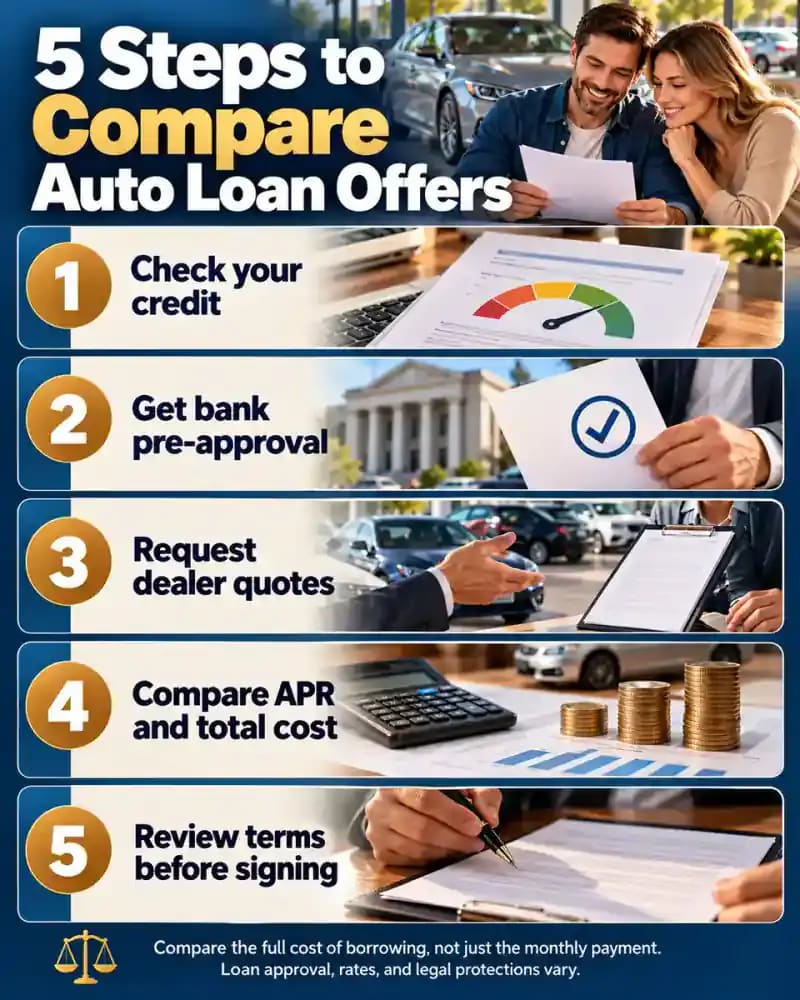
Before completing a financed vehicle purchase, confirm that your independent pre-approval remains valid and review competing dealership offers. Verify the APR, amount financed, repayment term, total payments, and applicable charges. Ensure the vehicle price, trade-in allowance, and down payment match the agreed figures. Examine final disclosures and any applicable used-car warranty information. Keep copies of the completed documents. Most importantly, take time to resolve unanswered questions rather than accepting pressure to sign an agreement you do not understand.

The price on a car's windshield is only part of what you might pay. If you finance your purchase, the interest rate, repayment period, and loan fees can add hundreds or even thousands of dollars to your overall cost. One of the most useful decisions you can make happens before you enter the dealership: deciding how to shop for financing.
Dealer financing offers convenience. The dealership collects your credit information, contacts potential lenders, and presents financing terms. But the interest rate a lender offers the dealership may be lower than the rate presented to you. That difference, called a dealer markup, can increase your borrowing costs.
Bank pre-approval provides another option. By applying directly through a bank, credit union, or online lender, you can obtain a conditional financing offer to compare against the dealer's proposal. You are not necessarily committed to that lender, and the dealership may offer more competitive terms when it knows you have another option.
This guide explains how both approaches work, what annual percentage rate (APR) reveals, why loan length matters, and how to compare financing offers without getting distracted by attractive monthly payments. You will also learn about consumer information from the Consumer Financial Protection Bureau and used-car disclosure requirements explained by the Federal Trade Commission.
The goal is straightforward: understand your borrowing options, ask better questions, and review the full cost of financing before signing. This information is educational, not individualized financial or legal advice.
Where people go wrong
Accepting the Dealer's First Interest Rate. A dealer's initial financing offer is not necessarily the lowest rate available. Dealers may add compensation to a lender's buy rate. Without independent quotes, you have little basis for comparison and could pay unnecessary interest throughout the loan.
Shopping Only by Monthly Payment. A smaller monthly payment can hide a longer repayment period and greater total interest expense. Compare the annual percentage rate, amount financed, payment schedule, and total payments rather than accepting an offer simply because its monthly amount appears affordable.
Confusing Interest Rate With APR. The stated interest rate and APR are related but not always identical. APR incorporates the interest rate and certain finance charges. Comparing nominal interest rates alone can overlook meaningful differences in borrowing costs, particularly when lenders charge different upfront fees.
Arriving Without Independent Financing Options. Entering a dealership without a bank or credit union quote can weaken your negotiating position. A pre-approval provides a useful benchmark, although its terms may remain conditional on the vehicle, application verification, and the lender's final approval.
Ignoring Fees and Early Repayment Terms. A competitive advertised rate does not automatically mean the entire loan is inexpensive or flexible. Review origination charges, optional products, late payment provisions, and any legally permitted prepayment penalties before deciding whether the financing arrangement meets your needs.
Mixing Vehicle Price With Financing Negotiations. When vehicle price, trade-in allowance, down payment, and monthly payment are discussed together, comparing alternatives becomes difficult. Request an itemized purchase agreement and examine financing separately so additional charges or unfavorable trade-in adjustments do not obscure the actual transaction.
Signing Before Reviewing Consumer Disclosures. Rushing through dealership paperwork can leave important obligations unnoticed. Examine the financing agreement, required credit disclosures, and applicable used-car Buyers Guide. Check warranty coverage, final loan terms, and vehicle details before signing documents that may create binding commitments.
Questions people ask
Neither option is automatically better. Dealer financing may be convenient and sometimes includes manufacturer-supported promotional rates. Bank or credit union pre-approval provides an independent benchmark and additional negotiating leverage. Compare the APR, loan length, amount financed, fees, and total borrowing cost before choosing between specific offers.
Fixed it?
Get one guide like this every Thursday.