CD Early Withdrawal Penalties: How Much Will You Really Pay?
Breaking a certificate of deposit before maturity can cost months of interest and even part of your principal. Learn how CD early withdrawal penalties work, how to calculate them, how the IRS treats them, and how to protect your savings.

What you’ll need
Tap to tick things off before you start.
1. Understand What a Certificate of Deposit Is
A certificate of deposit, or CD, is a deposit account that holds money under agreed terms for a specified period. Traditional bank CDs typically pay a fixed interest rate until maturity.
You select a term, deposit funds, and accept the institution's account agreement. In return for committing money, you receive a predictable interest arrangement.
Unlike a standard savings account, a traditional CD normally discourages withdrawals before maturity through financial penalties. That restriction is central to understanding whether the product matches your needs.
The SEC's Investor.gov educational materials explain the basic structure and risks of CDs.

2. Understand the Fixed-Rate Advantage
The principal attraction of a traditional fixed-rate CD is predictability. While variable-rate savings accounts can change their yields, the contractual interest rate on a conventional fixed-rate CD generally remains unchanged throughout its term.
That stability can be useful when market rates decline. Conversely, if rates rise, your existing CD may pay less than newly available accounts.
A locked rate does not guarantee the highest market return. It guarantees the agreed rate under the account's conditions.
This distinction matters because breaking a CD solely to pursue higher interest can trigger a penalty that exceeds the additional earnings.

3. Distinguish Interest Rate From APY
A CD's interest rate and annual percentage yield, or APY, are related but different measurements.
The stated interest rate describes the contractual rate used to calculate interest. APY incorporates compounding under standardized annual assumptions, making it useful for comparing savings products.
For example, a CD advertising 4.00% APY does not necessarily use exactly 4.00% as its stated interest rate.
Early withdrawal calculations may depend on the contractual interest rate rather than APY. Always inspect the penalty formula instead of multiplying the advertised yield by an assumed number of months.

4. Identify the Maturity Date
Every traditional CD has a maturity date, when the agreed deposit term ends. Common terms range from several months to multiple years, although available durations vary by institution.
At maturity, customers generally have an opportunity to withdraw their funds without the ordinary early withdrawal penalty, subject to the account's procedures.
Your maturity date is not necessarily the same as an interest crediting date or statement date.
Find the precise date in your account agreement or online banking dashboard. Even a short difference between the planned withdrawal date and maturity can determine whether a penalty applies.

5. Recognize the Commitment Behind a Time Deposit
A CD is called a time deposit because the customer agrees to a specified holding period. Banks use deposits as part of their broader funding operations, and predictable deposit terms help them manage liquidity.
In return, savers receive the account's agreed interest arrangement, which may be more attractive than certain immediately accessible alternatives.
However, CDs do not always pay more than high-yield savings accounts. Market conditions and competing offers can produce the opposite result.
The important trade-off is between predictable terms and unrestricted access, not a promise that every CD provides superior interest.

6. Learn Why Banks Charge Early Withdrawal Penalties
Early withdrawal penalties discourage customers from ending time deposits prematurely. They also help institutions manage the financial consequences of deposits leaving earlier than expected.
According to the SEC, investors generally face penalties when redeeming CDs before maturity, with details varying by the specific product.
These charges are usually established in the account agreement, not invented when a customer requests money.
However, knowing that a penalty is contractual does not mean it is affordable. Someone who expects to need cash soon should consider whether the potential interest advantage justifies accepting restricted access.

7. Examine How Penalties Are Calculated
Many banks describe CD penalties as a specified number of days or months of interest. A shorter-term account might have one penalty schedule, while a longer-term account could have another.
An illustrative simple-interest formula is:
Penalty = Principal x Annual Interest Rate x Penalty Days / 365
This assumes the institution uses simple interest and a 365-day year. Actual agreements may use different day-count conventions, compounding calculations, applicable balances, or minimum charges.
The formula is useful for estimating a possible cost, but the bank's precise agreement and payoff calculation control the actual amount.

8. Calculate a 90-Day Interest Penalty
Suppose you deposited $10,000 into a CD paying a 4.00% stated annual interest rate. Assume the agreement charges 90 days of simple interest when you withdraw early.
The estimated penalty is:
$10,000 x 0.04 x 90 / 365 = $98.63.
That amount represents interest forfeited under the example's assumptions. It is not necessarily the interest your account has actually accumulated.
A different balance, contractual rate, or calculation convention changes the result. Request an exact withdrawal quote before treating an estimate as the final charge.

9. Compare a 180-Day Interest Penalty
Now consider the same $10,000 CD with the same 4.00% stated annual interest rate, but a penalty equivalent to 180 days of simple interest.
The estimate becomes:
$10,000 x 0.04 x 180 / 365 = $197.26.
That is roughly twice the previous example despite the identical principal and interest rate.
The comparison reveals why shopping only for the highest APY can be misleading. A slightly better yield may not compensate for much harsher withdrawal conditions if your cash requirements change.

10. Determine Whether Principal Is at Risk
One important risk is that an early withdrawal penalty may exceed the interest earned since opening the CD.
Imagine an account has earned $40 but the applicable penalty is $150. If the contract allows the bank to collect the entire penalty, the difference of $110 could effectively reduce your original deposit.
A $10,000 investment might therefore yield less than $10,000 upon premature closure.
This is particularly relevant shortly after opening a CD, when relatively little interest has accumulated. Ask the bank directly whether its penalty may invade principal.

11. Understand What Deposit Insurance Does Not Cover
Eligible CDs at FDIC-insured banks generally qualify for federal deposit insurance within applicable limits and ownership categories. Standard FDIC coverage is generally $250,000 per depositor, per insured bank, per ownership category.
However, deposit insurance addresses qualifying losses resulting from bank failure. It does not reimburse ordinary contractual early withdrawal penalties.
A properly insured CD can therefore be protected against qualifying bank failure losses while still producing a smaller payout if you violate its withdrawal terms.
Separate the safety of an insured deposit from its liquidity and penalty features when evaluating an account.

12. Check Partial Withdrawal Restrictions
Some CDs permit partial early withdrawals, while others require closing the entire account. A bank may also impose minimum balance requirements or recalculate interest after a partial withdrawal.
Suppose you need $1,000 but have $20,000 deposited. Being forced to close the entire CD could have greater consequences than withdrawing only the amount required.
Ask whether partial access is available, how the penalty is assessed, and whether the remaining balance maintains its original rate and maturity date.
These details can materially affect the practical cost of solving a relatively small cash shortage.

13. Compare Penalty Policies Before Choosing a Bank
Financial institutions can charge different penalties for otherwise similar CDs. Their interest rates, account minimums, renewal procedures, and early withdrawal rules may also differ.
Compare offers using the same deposit size and hypothetical withdrawal date. Record the penalty formula, restrictions on partial withdrawals, and whether principal can be reduced.
Then calculate the estimated dollar impact under each agreement.
A bank offering a slightly lower APY but more forgiving withdrawal conditions could be preferable when flexibility is important. The appropriate comparison depends on the whole account rather than one advertised percentage.

14. Review the Account Disclosures Carefully
Before opening a CD, read the agreement covering early withdrawals, maturity, interest calculations, and automatic renewal.
Pay particular attention to whether the penalty is calculated using principal, the amount withdrawn, or another contractual balance. Check whether additional restrictions apply shortly after opening.
Confirm how the institution defines its penalty period and whether any exemptions or waivers exist.
Keep a copy of the disclosure accepted when opening the account. Written terms provide a more reliable reference than marketing materials or assumptions based on another bank's policies.

15. Consider Whether a No-Penalty CD Is Better
A no-penalty CD allows qualifying early withdrawals without the usual interest forfeiture. That flexibility can be valuable when the timing of future expenses is uncertain.
However, no-penalty products may offer different yields and can restrict withdrawals during an initial holding period. Some require withdrawing the entire balance rather than allowing multiple partial withdrawals.
Compare these conditions against traditional CDs and accessible savings accounts.
The absence of an early withdrawal penalty is attractive, but it does not automatically make the product the highest-yielding or most flexible savings option available.

16. Calculate Whether Switching CDs Makes Sense
Rising interest rates can tempt savers to break existing CDs and move into higher-yielding accounts.
Suppose an older CD pays 3.00%, while a replacement offers 4.25%. The replacement's higher rate creates an apparent opportunity, but the existing penalty must be considered.
Compare the additional expected interest over a consistent period with the withdrawal cost. Include differences in compounding, maturity dates, and access restrictions.
If the incremental earnings are less than the penalty, switching purely for the advertised increase may not make financial sense. A higher rate is only one part of the calculation.

17. Understand the Federal Tax Treatment
CD interest and early withdrawal penalties can have separate federal income tax consequences. Taxable interest generally follows applicable federal interest-income rules, while a qualifying early withdrawal penalty may be deducted as an adjustment to income.
The IRS Topic No. 456 explains the federal treatment of penalties on early withdrawals from savings arrangements.
A qualifying deduction may reduce taxable income, but it does not reverse the withdrawal or reimburse the bank's charge.
Keep the penalty amount separate from earned interest when reviewing financial records. Different treatment applies to the two amounts, even when both appear on a single tax statement.

18. Locate the Penalty on Form 1099-INT
For many conventional bank CDs, an eligible early withdrawal penalty is reported in Box 2 of Form 1099-INT.
The IRS instructions for Forms 1099-INT and 1099-OID describe how qualifying interest or principal forfeitures resulting from early withdrawals of time deposits are reported.
The bank ordinarily reports interest income separately. The penalty should not simply be subtracted from the interest amount reported in Box 1 under the applicable instructions.
Review the statement against your withdrawal records. If the information appears incorrect, contact the institution and request clarification or a corrected form when appropriate.

19. Recognize When Form 1099-OID Applies
Certain deposits and debt instruments involve original issue discount, commonly called OID, and may follow different reporting requirements.
For qualifying early withdrawal penalties reported on Form 1099-OID, the relevant location is Box 3.
Not every CD holder receives Form 1099-OID. Many ordinary bank CDs instead generate Form 1099-INT, depending on their structure and reporting circumstances.
The IRS instructions for Forms 1099-INT and 1099-OID explain the corresponding reporting rules. Check the document actually issued rather than assuming both forms are required.

20. Understand the Adjustment to Income
The IRS generally permits a qualifying early withdrawal penalty on savings to be claimed as an adjustment to income, sometimes called an above-the-line deduction.
This means the deduction can be available even to taxpayers who use the standard deduction rather than itemizing.
For example, an allowable $200 penalty adjustment generally reduces the relevant income calculation by $200. It does not directly reduce federal income tax by $200.
The proper filing treatment depends on the tax year and applicable rules. Consult IRS Topic No. 456 and the relevant Form 1040 instructions for current reporting guidance.

21. Estimate the Potential Tax Benefit
Consider a hypothetical deductible penalty of $200. Assume the entire adjustment reduces income otherwise subject to a 22% marginal federal tax rate.
Under those simplified assumptions, the federal income tax reduction would be $44, calculated as $200 x 0.22.
The remaining economic penalty would be $156 after that hypothetical tax effect, without considering other financial or tax consequences.
Actual outcomes may differ because of filing status, income levels, tax provisions, and applicable state rules.
A deductible withdrawal penalty is still a cost. Do not treat potential tax savings as a reason to incur an avoidable charge.

22. Preserve Withdrawal and Tax Records
Save the original CD agreement, final account statement, withdrawal confirmation, interest information, and penalty calculation.
When tax forms arrive, compare reported amounts with the institution's records. If the forms appear inconsistent, seek clarification rather than making unsupported adjustments.
Retain documentation according to applicable recordkeeping guidance. State income tax treatment may differ from federal rules.
A qualified tax professional can help with unusual reporting arrangements, substantial penalties, or discrepancies involving interest and principal.
Clear documentation makes it easier to explain exactly what happened to the deposit and how the amounts were reported.

23. Understand Liquidity Before Committing Savings
Liquidity means being able to access money quickly without significant costs or restrictions. A conventional savings account generally offers more immediate flexibility than a traditional CD.
Before committing money, consider when you might realistically need it. Funds reserved for next month's rent have different requirements from money saved for an expense several years away.
A slightly higher interest rate may not compensate for reduced flexibility if your financial obligations are unpredictable.
Matching deposit terms to expected cash needs is one of the simplest ways to prevent penalties before they become a problem.

24. Keep Emergency Savings Accessible
Emergency savings exist to cover unexpected essential expenses, such as urgent repairs, temporary income loss, or medical bills.
A commonly discussed planning benchmark is three to six months of essential expenses, although suitable reserves vary considerably according to individual circumstances.
Money that may be required immediately generally needs a dependable, accessible home. An appropriately insured savings account may serve that purpose better than a CD carrying significant early withdrawal penalties.
Locking every available dollar into long-term CDs can turn a manageable financial surprise into an unnecessary banking expense.

25. Avoid Depending on One Maturity Date
Placing all savings into one long-term CD concentrates access around a single maturity date.
If the account matures in three years but a major expense arrives after six months, the saver may need to accept a penalty or find another source of cash.
Dividing savings among several appropriate time horizons can reduce that mismatch.
Multiple accounts do not eliminate every risk, and deposit balances at the same insured institution remain subject to applicable insurance aggregation rules.
The benefit comes from managing access dates deliberately, not simply increasing the number of accounts.

26. Use a CD Ladder to Stagger Access
A CD ladder is a savings structure that divides money among CDs with different maturity dates.
Instead of locking everything into one account, separate deposits mature at regular intervals. Each maturity creates an opportunity to withdraw funds without the usual early withdrawal penalty.
A ladder does not eliminate penalties from the CDs that have not yet matured. It also cannot guarantee cash will be available exactly when an unexpected expense arises.
Its advantage is creating recurring access opportunities while maintaining some exposure to fixed-rate deposit products.

27. Build an Illustrative Four-Rung Ladder
Imagine dividing $12,000 into four equal CDs, assuming the bank offers suitable products:
- $3,000 maturing in three months. - $3,000 maturing in six months. - $3,000 maturing in nine months. - $3,000 maturing in twelve months.
If opened together, one account reaches maturity approximately every three months during the first year.
At that point, the saver can withdraw the matured balance or consider reinvestment. Actual rates, minimum deposits, and available terms vary by institution.
This example illustrates maturity spacing, not a guaranteed return or a recommendation to use these particular terms.

28. Review Renewal and Grace Period Rules
Many CDs automatically renew after maturity unless the customer acts during a designated grace period.
Renewal terms, interest rates, and withdrawal policies may differ from those of the original account. Missing the applicable withdrawal window can create another period of restricted access.
Before maturity, check the bank's notice and confirm the deadline for withdrawing funds or changing the account.
If using a CD ladder, track each maturity separately. Calendar reminders help ensure that periodic access remains useful rather than disappearing into automatic renewals.

29. Ask the Bank for an Exact Withdrawal Quote
If you are considering an early withdrawal, obtain a specific dollar quote from the issuing institution.
Ask for the current principal, accrued interest, penalty amount, net payout, and expected payment timing. Confirm whether a partial withdrawal is possible.
Also ask whether the penalty changes at another date and whether any contractual or legally required exceptions apply.
A quote based on your actual account is more dependable than a generalized estimate.
Keep the explanation and transaction confirmation for future reference, particularly if the withdrawal produces tax-reporting information.

30. Make Your Savings Plan More Flexible
Before opening or closing a CD, consider the complete financial trade-off: expected interest, access restrictions, penalties, and future cash requirements.
Compare alternative savings products and account terms rather than focusing exclusively on advertised APY. Maintain appropriate liquidity for expenses that cannot wait until maturity.
If you must withdraw early, verify the actual penalty and consider the tax treatment separately. If you are planning new deposits, matching maturities to future expenses or using a CD ladder may reduce avoidable charges.
A CD can be useful when its time commitment fits your goals. The expensive mistake is accepting that commitment without understanding the cost of breaking it.

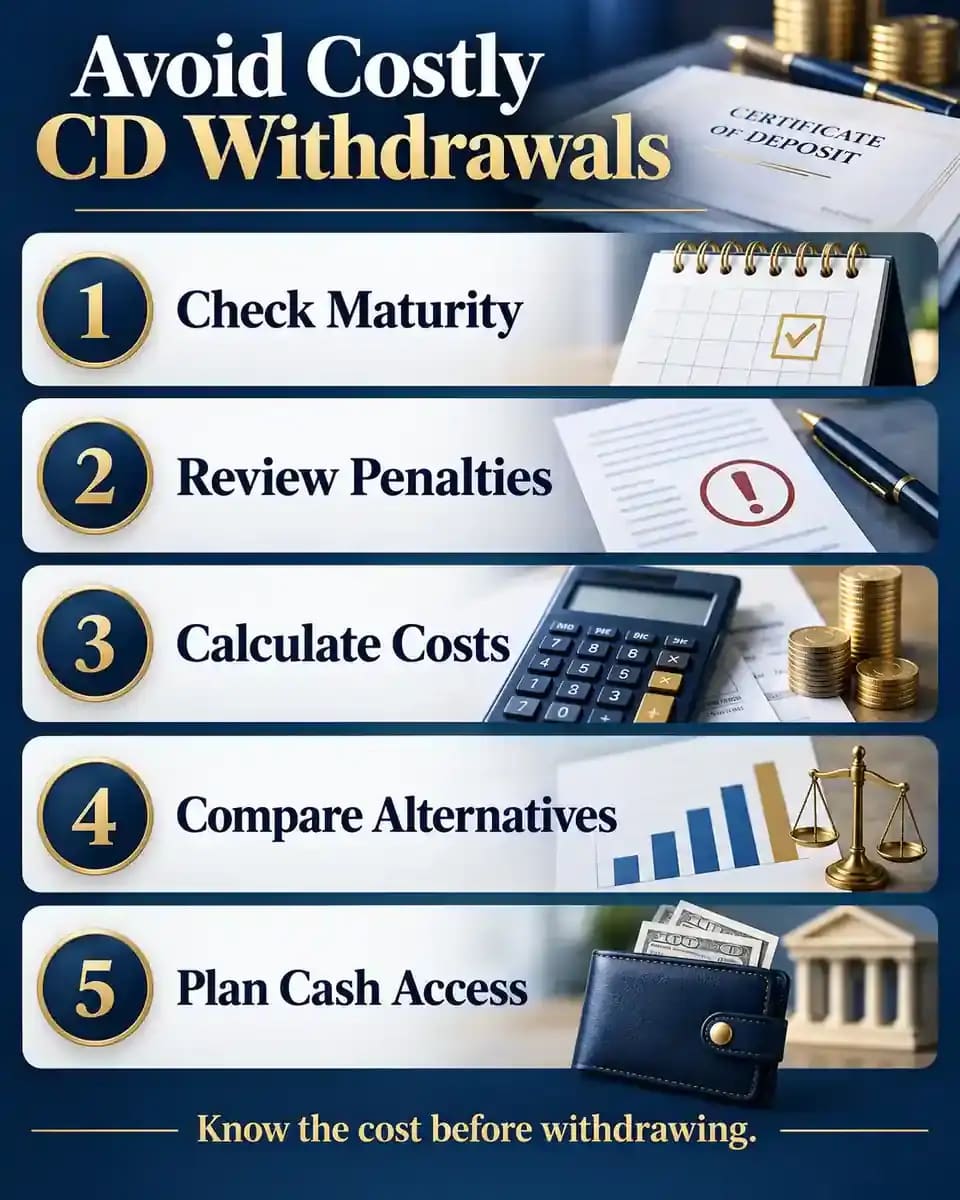
A certificate of deposit can seem like a simple deal: deposit your savings, lock in a rate, and collect interest when the account matures. But what happens when an emergency forces you to withdraw that money early?
CD early withdrawal penalties can erase months of interest. Depending on the account agreement, they can even reduce your original deposit. A CD advertising an attractive annual percentage yield might therefore produce a disappointing result if you cannot complete the term.
The U.S. Securities and Exchange Commission (SEC) explains that certificates of deposit generally offer interest over a specified period and may impose penalties for premature withdrawals. The Internal Revenue Service (IRS) also provides rules for reporting qualifying penalties and claiming an adjustment to income.
This guide explains how penalties work, provides realistic dollar examples, examines federal tax treatment, and shows how to preserve access to your savings. The goal is to understand the complete cost before making a withdrawal or opening another CD.
All dollar examples are hypothetical. This material is educational and does not constitute individualized financial, legal, or tax advice.
Where people go wrong
Choosing a CD Based Only on APY. An attractive APY does not reveal withdrawal costs. Compare the complete deposit agreement, especially penalty periods, maturity dates, and liquidity restrictions.
Assuming Penalties Cannot Reduce Principal. Some early withdrawal charges exceed accumulated interest. Depending on the agreement, the remaining penalty can reduce the original amount deposited.
Locking Away Emergency Savings. Unexpected essential expenses often require immediate cash. Keeping every dollar in long-term CDs increases the risk of expensive early withdrawals.
Assuming Every Bank Uses the Same Formula. Banks can differ in penalty periods, interest conventions, partial withdrawal permissions, and other restrictions. Always verify the specific account terms.
Treating a Tax Deduction Like a Refund. A qualifying penalty adjustment reduces income under federal rules. It does not reimburse the full charge or guarantee a particular reduction in taxes.
Switching CDs Without Calculating the Break-Even Point. A higher replacement yield may not compensate for the early withdrawal penalty. Compare expected additional interest with the total cost of switching.
Missing the Maturity Grace Period. Automatic renewal can place funds into another restricted term. Review maturity notices and take permitted action within the institution's deadline.
Ignoring Partial Withdrawal Rules. Some CDs require complete closure even when the customer needs only a small amount. Verify withdrawal flexibility before making a deposit.
Questions people ask
Many traditional CDs impose penalties measured as a specified number of days or months of interest. Actual amounts depend on the institution, term, balance, interest calculation, and account agreement. There is no single universal penalty.
Fixed it?
Get one guide like this every Thursday.