Cash Value Life Insurance vs. Term Life: Which Strategy Wins?
Should you buy term life insurance and invest the difference, or pay more for permanent coverage with cash value? Compare premiums, investment risks, policy fees, tax considerations, and long-term protection to find the right fit.

What you’ll need
Tap to tick things off before you start.
Cash Value Life Insurance vs. Term Life: Understanding the Choice
The central difference between cash value life insurance vs term life is what each policy is designed to accomplish. Term insurance provides financial protection for a limited period, while permanent insurance is intended to last much longer and often includes an accumulating cash value component. Both can provide money to beneficiaries after the insured person's death. The important question is whether your priority is affordable protection during specific years or coverage with additional long-term financial features.

How Permanent Life Insurance Works
Permanent life insurance is structured to provide extended coverage, potentially throughout the insured person's lifetime, provided contractual requirements are satisfied. Common categories include whole life, universal life, and variable life insurance. Whole life typically features scheduled premiums and contractual guarantees, while universal life generally offers greater payment flexibility. These differences affect how policies are maintained over time. Coverage can still terminate if required payments or other funding conditions are not met, so permanent does not mean unconditional.

What Cash Value Actually Means
Cash value is an internal financial component that develops within many permanent life insurance contracts. Its accumulation depends on premiums, credited growth or investment performance, and applicable policy charges. Some contracts provide guaranteed minimum values, while others rely partly on nonguaranteed assumptions. Cash value should not be confused with the death benefit. Under many policies, beneficiaries receive the specified death benefit rather than that amount plus accumulated cash value. The contract determines the actual payment structure.

Variable Life Insurance and Market Risk
Variable life insurance allows policyholders to allocate value among investment options, often resembling mutual funds. According to Investor.gov, policy performance reflects investment results alongside premiums and insurance expenses. Strong markets may increase account values, while declining markets can reduce them. Some contracts include minimum death benefit guarantees, subject to conditions, but cash value is not necessarily protected from losses. Investment selection therefore introduces uncertainty that differs from traditional guaranteed insurance features, making contract disclosures especially important.

How Term Life Insurance Works
Term life insurance provides a death benefit when the insured person dies during the covered period, assuming the policy remains active. Common terms include 10, 20, and 30 years. Because these policies generally lack cash value, initial premiums are usually lower than comparable permanent coverage. When the term ends, protection typically expires unless renewal or conversion provisions apply. Renewing can become substantially more expensive, while conversion rights depend on the policy's specific conditions and deadlines.

Buying Term and Investing the Difference
Buying term and investing the difference separates insurance protection from wealth accumulation. Instead of paying higher premiums for permanent coverage, an individual purchases less expensive term insurance and directs the savings into separate investments. For example, a hypothetical $250 monthly premium difference could become a recurring investment contribution. The strategy only works as intended when those savings are actually invested. Spending the difference eliminates the accumulation component, making consistent contributions essential to its potential success.

Compound Growth and Investment Returns
Compound growth occurs when investment earnings generate additional earnings over time. Reinvested dividends and appreciation can increase the amount participating in future growth. A diversified portfolio may spread exposure across stocks, bonds, and other assets, although diversification cannot eliminate losses. Investor.gov emphasizes that investing involves risk. Historical market averages are not guaranteed future returns, and actual results vary considerably. Time horizon, asset allocation, inflation, and market conditions all influence the purchasing power of accumulated investments.

Comparing Premiums, Fees, and Total Costs
A meaningful cost comparison starts with equivalent death benefits and consistent assumptions about the insured person's age and health. Permanent policies may include mortality charges, administrative expenses, investment management fees, and surrender penalties. Separately managed investments can involve fund expense ratios, transaction costs, and advisory fees. Initial premiums alone therefore provide an incomplete comparison. Examining cumulative payments, projected account values, and contractual expenses across the same time horizon offers a clearer picture of affordability and total costs.

Tax Benefits, Policy Loans, and Lapse Risks
Permanent life insurance cash value generally accumulates without annual federal income taxation while remaining inside a qualifying policy. Loans may also avoid immediate taxation under certain conditions, but interest accrues and outstanding balances can reduce death benefits. Modified endowment contracts receive different tax treatment. Investor.gov also warns that variable policies can lapse when account values cannot support ongoing charges. A lapse involving outstanding loans may create taxable income, making the policy's funding requirements particularly important.

Which Life Insurance Strategy Fits Your Goals?
Choosing between these approaches begins with identifying what protection must accomplish. Temporary income replacement for a household with children may favor affordable term coverage. Lifelong responsibilities, including support for a dependent with special needs, may justify examining permanent insurance. Available income, financial reserves, investment discipline, and comfort with uncertainty also matter. No strategy wins universally. A useful decision framework weighs coverage duration, beneficiary needs, affordability, and risk tolerance without assuming that insurance or investing automatically produces superior results.

How Much Life Insurance Coverage Do You Need?
Estimating life insurance coverage starts with calculating the financial gap your death could leave behind. Consider lost household income, outstanding mortgages, personal debts, childcare, education expenses, and final expenses. Next, subtract resources such as existing insurance, accessible savings, and other assets available to dependents. A common shortcut is multiplying annual income by 10, but that formula overlooks individual circumstances. A needs-based calculation provides a more meaningful estimate of how much financial protection beneficiaries might require.

Choosing the Right Term Length
The appropriate term length often corresponds to the years when household financial obligations are greatest. Someone with a 25-year mortgage might examine coverage extending through most or all of the repayment period. Parents may consider how long children will remain financially dependent, while working adults can evaluate their expected retirement timeline. Shorter terms generally cost less initially, but purchasing replacement coverage later may be more expensive. Coverage duration should reflect anticipated obligations rather than an arbitrary number.

When Lifelong Coverage Makes Sense
Some financial responsibilities continue beyond working years, making lifelong insurance protection potentially valuable. Families supporting a dependent with special needs may require funding that remains available regardless of when a caregiver dies. Permanent insurance can also provide liquidity for certain estate obligations or business arrangements. However, lifelong coverage requires sustainable funding and careful consideration of contractual guarantees. Specialized situations may involve trusts, beneficiary restrictions, or other planning considerations that warrant coordinated professional guidance.

Understanding Policy Illustrations
A permanent life insurance illustration estimates how a policy might perform under specified assumptions. It commonly displays premiums, projected cash values, death benefits, and potential policy duration. The most important distinction is between guaranteed contractual values and nonguaranteed projections based on assumptions about interest, dividends, or investment performance. Investor.gov emphasizes understanding variable insurance disclosures and expenses. An attractive projection is not a promise. Reviewing alternative assumptions helps reveal how sensitive projected outcomes are to changing conditions.

What Happens If You Stop Paying Premiums?
Missing life insurance premiums can eventually cause coverage to terminate, although consequences depend on the policy. Many contracts provide a grace period during which overdue payments can be made. Some permanent policies may use accumulated value to cover charges temporarily, while others offer reduced paid-up insurance or extended term options. Flexible-premium policies can become underfunded even after years of payments. Understanding available nonforfeiture provisions and reinstatement conditions helps clarify what happens when payments become unaffordable.

Accessing Your Money Before Retirement
Liquidity describes how easily an asset can be converted into usable money. Taxable brokerage investments can generally be sold when markets are open, although settlement periods, taxes, and market losses may affect available proceeds. Permanent insurance cash value follows contractual access rules. Withdrawals, loans, or full surrender may reduce benefits or trigger charges. Early surrender values can be substantially below premiums paid. Comparing accessible net proceeds, rather than displayed account balances, gives a clearer liquidity comparison.

How Taxes Affect Your Investment Strategy
Investment account selection influences how much accumulated wealth remains after taxes. Taxable brokerage accounts may generate taxes on dividends, interest, and realized capital gains. Traditional retirement accounts generally defer eligible taxation until distributions, while qualified Roth distributions can be tax-free when applicable requirements are met. Contribution limits, withdrawal restrictions, and eligibility rules differ. Investor.gov explains that investment decisions involve multiple financial considerations. Comparing after-tax results requires examining account structure, investment horizon, and applicable tax rules.

Comparing Realistic Financial Scenarios
A useful comparison applies the same available budget to each strategy over identical periods. For example, a hypothetical $400 monthly budget could support a $75 term premium and $325 investment contribution, or a $400 permanent policy premium. Model outcomes after 10, 20, and 30 years using several reasonable return assumptions. Include fees, taxes, coverage differences, and potential losses. These hypothetical calculations illustrate trade-offs, not guaranteed results, and should distinguish projected investment balances from insurance death benefits.

Questions to Ask Before Buying a Policy
Before purchasing life insurance, clarify exactly what the contract guarantees and what circumstances could limit benefits. Ask how underwriting affects approval, whether exclusions apply, and which premiums or benefits can change. For term coverage, investigate conversion rights and deadlines. For permanent coverage, request explanations of nonguaranteed elements and ongoing funding requirements. Also examine the insurer's financial strength and ask how the selling professional receives compensation. Clear answers make competing proposals easier to evaluate.

Making Your Final Life Insurance Decision
After comparing alternatives, the next step is documenting why a particular policy matches the identified protection objective. Review the completed application for accuracy, confirm the insurer's underwriting decision, and verify when coverage actually becomes effective. Keep policy documents and insurer contact information accessible to appropriate family members. Existing coverage generally should not be canceled before replacement protection is confirmed. Establishing a periodic review schedule helps identify future gaps as household circumstances and financial responsibilities evolve.

Whole Life vs. Universal Life Insurance
Whole life insurance typically combines scheduled premiums, a guaranteed death benefit, and contractual cash value growth when policy requirements are met. Participating policies may also pay dividends, although dividends are not guaranteed. Universal life insurance generally allows greater flexibility in premium payments and death benefit adjustments. However, flexibility introduces funding responsibility because insurance charges continue even when premiums are reduced. Understanding these structural differences helps explain why two permanent policies can behave differently over time.

How Indexed Universal Life Insurance Works
Indexed universal life insurance credits interest using a formula linked to an external market index, rather than directly investing cash value in that index. Participation rates determine how much index growth counts, while caps can limit credited gains. Floors may prevent negative index interest credits, but policy charges can still reduce cash value. Crediting terms may change within contractual limits. Advertised illustrations deserve scrutiny because strong index performance does not automatically translate into equivalent policy returns.

How Age and Health Affect Insurance Costs
Life insurance pricing reflects the insurer's assessment of mortality risk. Age is especially influential because expected mortality generally increases over time. Underwriters may also consider medical history, current health conditions, prescription medications, occupation, and tobacco use. Depending on the application, insurers might request medical records, examinations, or laboratory testing. Delaying coverage can increase premiums or affect eligibility if health changes. However, underwriting methods and pricing classifications vary substantially between insurance companies and products.

Choosing Between Level and Increasing Premiums
Level-premium policies generally maintain the same scheduled payment throughout a specified period, making household budgeting more predictable. Renewable term insurance may instead increase premiums at each renewal as the insured person ages. Flexible-premium permanent policies allow payment adjustments, but reducing contributions can create future funding shortages. A premium that appears manageable initially may therefore become insufficient or considerably more expensive later. Comparing payment schedules helps reveal potential affordability pressures across the expected coverage period.

Understanding Life Insurance Riders
Life insurance riders modify a standard policy by adding optional protections or benefits. A waiver of premium rider may suspend required payments after a qualifying disability, subject to contract conditions. Accelerated death benefit riders may permit early access to part of the death benefit following specified medical events. Other riders can provide additional coverage or specialized features. Availability, eligibility, exclusions, and charges vary. Evaluating riders requires distinguishing meaningful additional protection from features that increase premiums without addressing specific needs.

Choosing and Updating Beneficiaries
A life insurance beneficiary designation identifies who should receive policy proceeds after the insured person's death. Primary beneficiaries receive benefits first, while contingent beneficiaries may receive proceeds when primary beneficiaries cannot. Incomplete names, outdated information, or missing contingent designations can complicate payment. Beneficiary instructions may also interact with trusts, divorce orders, and other estate arrangements. Because policy designations can operate independently of a will, accurate records and coordination with applicable legal documents are important.

What Happens When Your Financial Needs Change?
Major life events can change the amount and purpose of insurance protection. Marriage may create shared financial obligations, while divorce can alter household income, debts, and dependency arrangements. Having children increases potential support needs, and career changes can affect available resources. Conversely, paying off major debts or accumulating substantial savings may reduce financial exposure. Insurance needs are therefore not necessarily static. Reassessing responsibilities after significant transitions helps identify whether existing coverage still reflects current circumstances.

Replacing or Surrendering an Existing Policy
Replacing an existing life insurance policy can involve costs beyond the new premium. An older contract may contain favorable guarantees, accumulated benefits, or underwriting terms that cannot be recovered. Surrendering permanent coverage may trigger charges and potential taxable gains. A replacement policy can also introduce new contestability or suicide exclusion periods, depending on applicable rules. Existing coverage should not terminate before replacement protection becomes effective. A complete comparison considers lost benefits, new restrictions, and potential coverage gaps.

How to Research an Insurance Company's Financial Strength
Life insurance benefits depend on an insurer's ability to honor contractual obligations, potentially decades after purchase. Independent financial strength ratings from organizations such as AM Best, S&P Global Ratings, Moody's, and Fitch can provide information about an insurer's financial condition. Rating scales differ, and ratings are opinions rather than guarantees. State insurance departments supervise insurers and provide consumer information. Reviewing financial strength alongside policy terms offers a broader perspective than choosing an insurer solely because its premiums are attractive.

Building a Long-Term Insurance Review Routine
A structured insurance review helps keep financial protection aligned with changing circumstances. Annual reviews can examine current coverage amounts, premium affordability, beneficiary records, and upcoming policy deadlines. Permanent policyholders may also monitor actual cash values against earlier illustrations and review outstanding loans or funding shortfalls. Maintaining organized statements and documenting important changes improves continuity. Additional reviews after major household events can identify emerging problems before they become difficult or expensive to address.

Choosing between cash value life insurance and term life insurance is not simply a question of which policy costs less. It is a decision about how much financial protection your family needs, how long that protection should last, and whether combining insurance with a savings or investment component makes sense for your goals.
Term life insurance provides a death benefit for a specified period, commonly 10, 20, or 30 years. It generally costs less than permanent coverage because it does not accumulate cash value. That makes it attractive for families protecting income, raising children, or paying down a mortgage.
Permanent life insurance is designed to provide longer-lasting coverage, potentially for your entire life, as long as the policy remains in force. Many permanent policies accumulate cash value, but growth, guarantees, fees, and withdrawal options depend on the contract. Variable life insurance also introduces investment risk because its cash value can fluctuate with market performance.
Another approach is to buy term life insurance and invest the premium savings separately. This strategy offers investment flexibility and the potential for compound growth, but success depends on consistent contributions, appropriate investment choices, and your ability to tolerate market losses.
The right comparison goes beyond monthly premiums. You need to examine total costs, coverage duration, surrender charges, tax consequences, investment risks, and the financial needs of your beneficiaries.
This guide explains the trade-offs, identifies common mistakes, and gives you practical questions to ask before committing to either strategy. The goal is not to declare one universal winner, but to help you make an informed decision.
Where people go wrong
Assuming Cash Value Growth Is Guaranteed. Not every permanent life insurance policy guarantees the same cash value growth. Variable policies expose cash value to investment performance, while other products have different guarantees and limitations. Always distinguish contractual guarantees from projections before comparing potential returns.
Comparing Premiums Without Comparing Coverage. A lower premium does not automatically mean better value. Term coverage generally expires after a specified period, while permanent insurance may provide lifelong protection. Compare equivalent death benefits, coverage duration, renewal provisions, and total projected costs before deciding.
Ignoring Internal Policy Fees. Permanent life insurance may include mortality charges, administrative expenses, investment management fees, and surrender charges. These costs can substantially reduce accumulated cash value. Request a detailed policy illustration showing how expenses affect both guaranteed and nonguaranteed outcomes over time.
Treating Policy Loans Like Free Money. Borrowing against cash value is not the same as withdrawing unrestricted savings. Policy loans generally accrue interest and can reduce death benefits. Excessive borrowing may cause a policy to lapse, potentially creating unexpected taxable income from previously untaxed gains.
Assuming Investing the Difference Happens Automatically. Buying inexpensive term coverage only creates an opportunity to invest the savings. If you consistently spend the difference instead, the strategy loses its wealth-building component. Establish automatic contributions and choose investments consistent with your financial goals and risk tolerance.
Using Optimistic Investment Returns as Guarantees. Historical stock market averages do not predict your actual investment performance. Markets experience losses, inflation affects purchasing power, and taxes and fees reduce net returns. Evaluate conservative scenarios rather than assuming high annual growth will continue without interruption.
Overlooking the Risk of Policy Lapse. Some permanent policies require sufficient premiums or cash value to cover continuing insurance charges. Poor investment performance, withdrawals, or unpaid loan interest can jeopardize coverage. Review lapse scenarios carefully, especially when considering variable or flexible-premium policies.
Canceling Existing Coverage Too Early. Replacing a permanent policy with term coverage can create serious problems if your health has changed or replacement coverage is unavailable. Never surrender an existing policy before confirming that new coverage is approved, affordable, appropriate, and fully effective.
Questions people ask
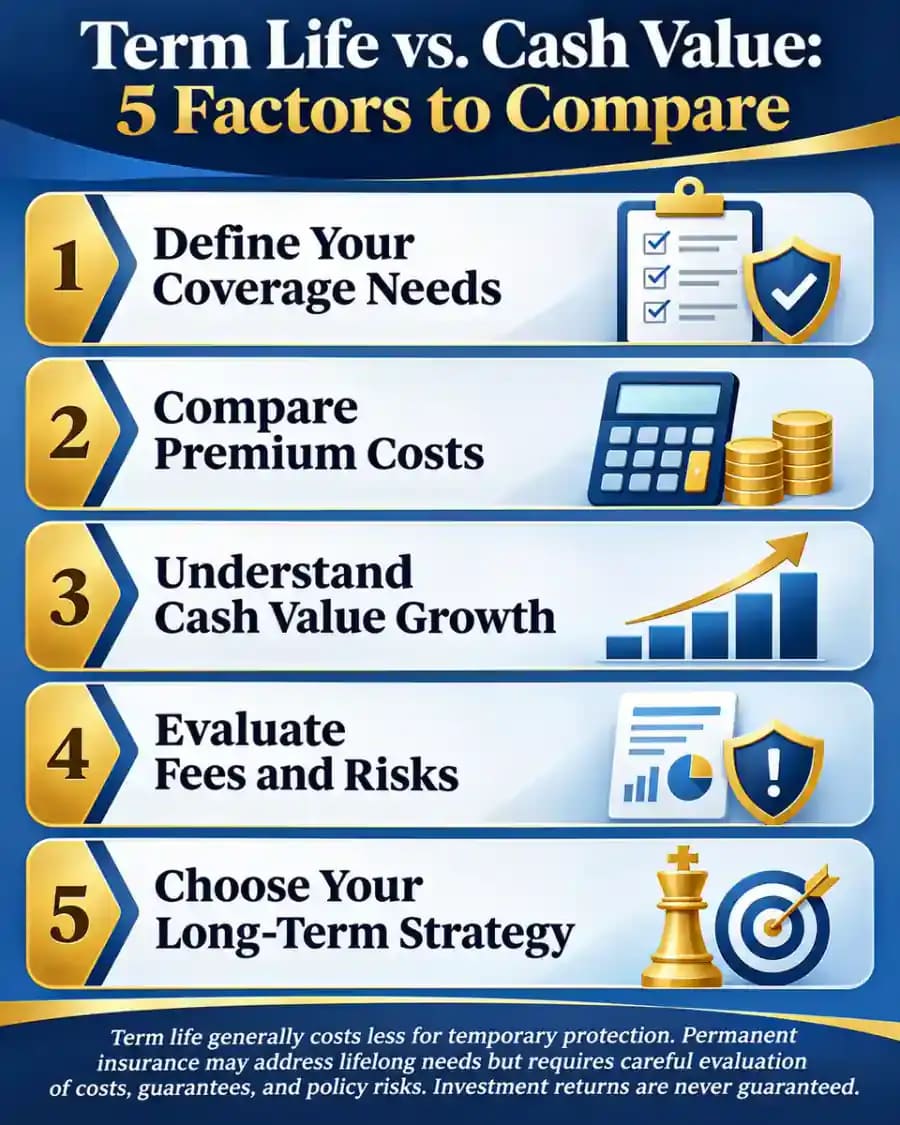
Term life insurance is often more affordable when you need protection for a specific period, such as while raising children or paying a mortgage. Permanent insurance may be appropriate for lifelong obligations or certain estate planning needs. The better choice depends on your coverage requirements, budget, financial goals, and policy terms.
Fixed it?
Get one guide like this every Thursday.