Car Depreciation and Negative Equity: How to Avoid Owing More Than Your Car Is Worth
Car depreciation can leave you owing more than your vehicle is worth. Learn how negative equity develops, what happens during a trade-in, and how to reduce the financial risk before your next auto loan.

What you’ll need
Tap to tick things off before you start.
Understand What Car Depreciation Means
Vehicle depreciation is the decline in a car's market value as it gets older, accumulates mileage, experiences wear, and competes with newer models. The important point is that depreciation concerns market value, not the amount you originally paid.
A vehicle purchased for $40,000 does not remain a $40,000 asset simply because the buyer still owes close to that amount. Used-car buyers evaluate what the vehicle is worth today based on its age, condition, history, mileage, equipment, reputation, and current demand.

Separate Purchase Price From Current Value
The price negotiated at the dealership and the vehicle's later market value are two different figures. Taxes, registration fees, optional products, dealer add-ons, and financed charges can increase the amount borrowed without increasing what another buyer would pay for the car.
That difference matters because your equity is determined by today's value compared with today's loan payoff amount, not by the original sticker price.

Know What Drives Depreciation
No universal depreciation percentage applies to every vehicle. Make, model, age, mileage, condition, accident history, reliability reputation, fuel economy, local demand, incentives on new vehicles, and broader used-car market conditions can all affect resale value.
Two cars purchased for similar prices can therefore follow very different depreciation curves. This is why generic rules such as assuming every vehicle loses an identical percentage each year should be treated as rough illustrations rather than precise forecasts.

Recognize Why New Cars Can Lose Value Quickly
New vehicles can experience an especially noticeable change in market value after entering the used market. A nearly new vehicle is no longer being sold as factory-new, even if it has very low mileage.
The exact decline varies significantly by model and market conditions, but the financial issue is straightforward: the car can lose resale value faster than a newly originated loan balance falls.

Understand How an Auto Loan Declines
Your loan does not fall at the same pace as the vehicle's value. With a typical amortizing auto loan, each scheduled payment includes interest and principal. Interest is the cost of borrowing, while principal reduction lowers the amount owed.
Early in a loan, a meaningful portion of each payment may go toward interest. The precise allocation depends on the loan terms and payment history. As a result, paying $600 each month does not mean your balance decreases by exactly $600.

Define Negative Equity Clearly
Negative equity occurs when the amount required to pay off your auto loan is greater than the vehicle's current market value. It is also commonly described as being upside down or underwater on the loan.
The Consumer Financial Protection Bureau explains negative equity in the same basic way: if you owe more than the vehicle is worth, the difference does not disappear when you decide to trade or sell the vehicle.

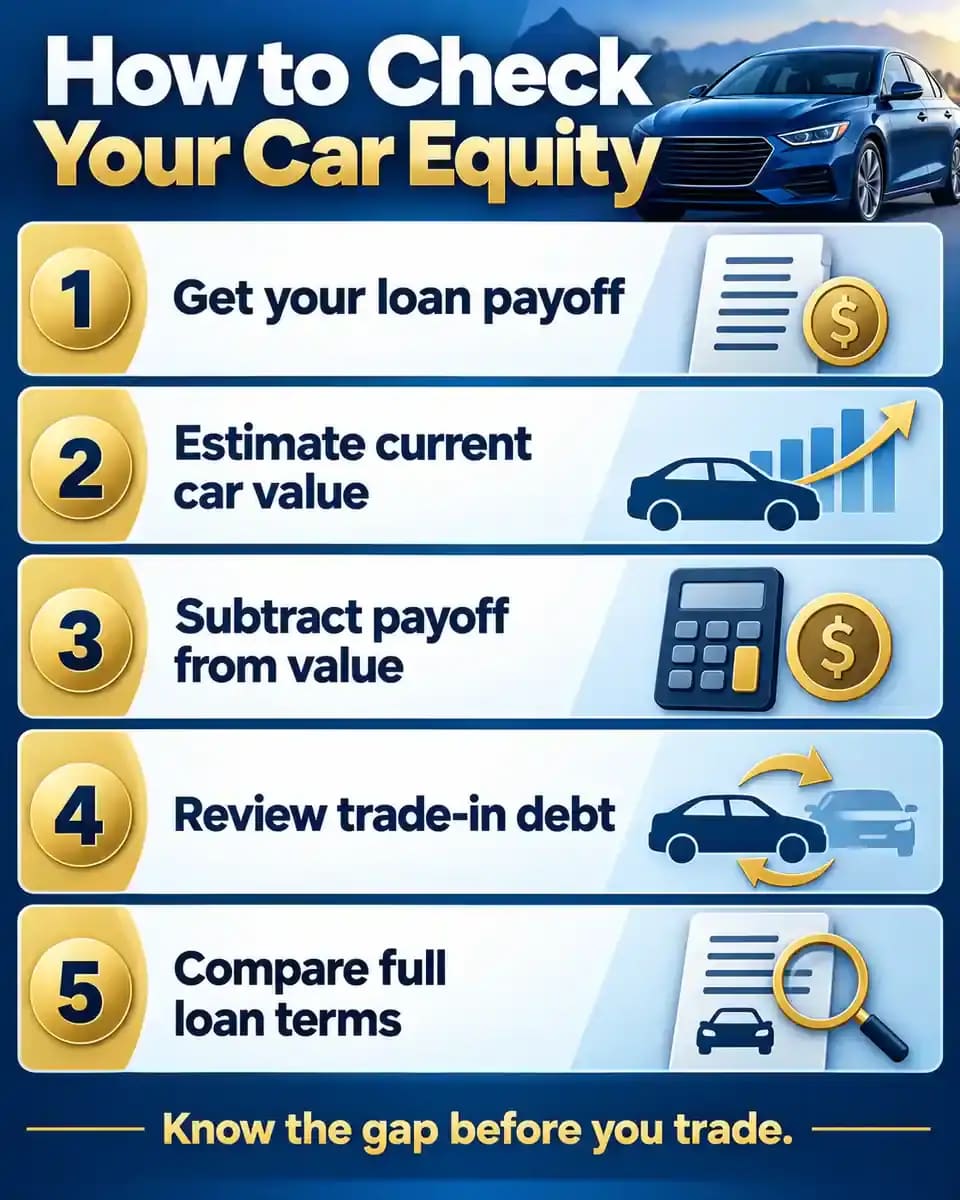
Calculate Your Equity Position
A simple calculation can provide a useful starting point:
Vehicle equity = current vehicle value - loan payoff amount
Suppose your lender says the payoff amount is $28,000 and realistic offers suggest the car is worth $24,000. Your equity would be $24,000 minus $28,000, or negative $4,000. You are approximately $4,000 underwater.
If the vehicle were worth $30,000 against a $28,000 payoff, you would instead have approximately $2,000 of positive equity.

Use the Payoff Amount, Not a Guess
Your payoff amount can differ from the principal balance displayed on a monthly statement because interest may accrue between the statement date and the planned payoff date. Depending on the contract and jurisdiction, other amounts may also affect the final figure.
If you are evaluating a sale, refinancing offer, or trade-in, request an official payoff quote from the lender and note how long that quote remains valid.

Get More Than One Vehicle Valuation
A single trade-in offer is not necessarily the definitive market value of your car. Dealer trade-in prices, instant purchase offers, wholesale-oriented bids, and private-party values can differ substantially.
Check several credible sources and actual offers where practical. Be realistic about mileage, damage, mechanical condition, tires, accident history, and cosmetic wear. Inflating the estimated value can make your equity position look safer than it really is.

See Why Small Down Payments Increase Exposure
A down payment reduces the amount financed at the beginning of the transaction. If little or nothing is paid upfront, the initial loan balance may be close to or even above the car's transaction price once financed fees and optional products are included.
If the vehicle then depreciates quickly, there is very little equity cushion available to absorb the drop. A larger down payment can reduce this exposure, although whether it is appropriate depends on the buyer's cash reserves and broader finances.

Understand the Risk of Long Loan Terms
A longer loan term can make a vehicle appear more affordable because the borrowed amount is divided across more monthly payments. But the lower payment may come with a slower decline in principal and more time for interest to accumulate.
If depreciation is moving faster than principal repayment, extending the term can leave the borrower underwater for longer. Compare loans by APR, amount financed, term, total payments, and total cost rather than monthly payment alone.

Do Not Judge Affordability by Payment Alone
Dealership discussions often focus heavily on the monthly payment because it is easy to understand. But almost any financed purchase can be made to look less expensive per month by increasing the term, changing the down payment, or adjusting what is financed.
A sound comparison requires looking at the vehicle price, trade value, outstanding old debt, amount financed, APR, term, and total of payments together.

Know When Negative Equity Becomes a Practical Problem
Being underwater does not automatically create an emergency. If the vehicle is reliable, affordable to operate, and you plan to keep it while making scheduled payments, the equity gap may shrink over time.
Negative equity becomes more consequential when you need to exit the loan before that happens. Common triggers include selling the vehicle, trading it in, replacing it unexpectedly, refinancing, or dealing with a total loss.

Understand What Happens When You Sell
If you owe $25,000 but can sell the vehicle for only $21,000, the sale proceeds alone are not enough to satisfy the lender. The remaining $4,000 generally still must be addressed before the lender releases its lien and the buyer receives clear title.
The exact transaction process depends on the lender and applicable state rules, so confirm payoff and title procedures before agreeing to a sale.

Understand the Trade-In Trap
Trading a vehicle does not erase negative equity. The dealer may arrange to pay off your existing lender, but the shortfall still has to be funded somehow.
The Consumer Financial Protection Bureau specifically advises consumers to understand how negative equity is treated in a trade-in transaction. It may be paid in cash, offset by other equity, or incorporated into the financing for the replacement vehicle.

Learn How Negative Equity Gets Rolled Over
Consider a borrower who owes $30,000 on a vehicle that receives a $24,000 trade-in allowance. The difference is $6,000.
If that $6,000 is rolled into financing for the replacement vehicle, the borrower is effectively financing part of the old car while also borrowing for the new one. The paperwork may present the transaction in several line items, so examine the amount financed carefully rather than assuming the old debt disappeared.

See Why the New Loan Can Start Deep Underwater
Suppose the replacement vehicle itself has a transaction price around $38,000 and $6,000 of old negative equity is added before considering taxes, fees, or optional products. The amount financed can quickly exceed the new vehicle's market value by a substantial margin.
The borrower may therefore begin the new loan underwater from day one, potentially by much more than before.

Avoid Repeating the Debt Cycle
Frequent vehicle replacement can create a repeating pattern: trade an underwater vehicle, roll the shortfall into the next loan, then trade again before the new loan reaches positive equity.
Each rollover can increase the amount of debt disconnected from the value of the vehicle currently securing it. Breaking that pattern may require keeping a vehicle longer, reducing the balance faster, bringing cash to a transaction, or purchasing a less expensive replacement.

Check Whether Optional Products Were Financed
Service contracts, protection products, accessories, and other optional charges may increase the initial amount financed. These products may have value to some buyers, but they do not necessarily increase the vehicle's resale value by an equal amount.
Review the purchase contract carefully so you understand exactly what was added to the loan and whether any cancellation or refund provisions apply. Those provisions vary by product and contract.

Understand the Total-Loss Problem
Negative equity can also become important if a financed vehicle is declared a total loss after an accident or other covered event. Standard auto insurance generally bases settlement on the vehicle's covered value under the policy, not simply on whatever remains on the loan.
If the insurance payment is below the loan payoff amount, a balance may remain. Some borrowers purchase guaranteed asset protection, commonly called GAP, for this risk, but coverage terms, exclusions, limits, and eligibility vary. Review the actual contract rather than assuming all GAP products work identically.

Compare Refinancing Carefully
Refinancing may change your interest rate, payment, lender, or repayment term, but it does not reverse depreciation. If you refinance while deeply underwater, the new lender must still be willing to finance the required amount relative to the vehicle's value.
A lower payment is not automatically a lower-cost result if it comes mainly from restarting or extending the repayment period. Compare the new APR, fees, remaining principal, loan term, and total projected cost.

Consider Whether Keeping the Car Is Simpler
When a vehicle still meets your needs and remains reliable, keeping it longer may allow the principal balance to fall while avoiding another round of transaction costs and rapid early depreciation on a replacement vehicle.
This is not automatically the right choice in every situation. Repair costs, reliability, safety, insurance, fuel, household needs, and cash flow also matter. The broader principle is to compare the cost of keeping the current vehicle with the full cost of replacing it, including any negative equity.

Evaluate Extra Principal Payments Correctly
If your loan permits additional principal payments without a prepayment penalty, paying principal faster can reduce the balance and may shorten the period of negative equity. Confirm with the lender how extra payments are applied because payment processing practices can vary.
Do not assume that sending extra money automatically produces the result you expect. Verify the updated principal balance after the payment is posted.

Protect the Vehicle's Resale Condition
Depreciation cannot be eliminated, but avoidable damage can make it worse. Keeping up with scheduled maintenance, addressing mechanical problems, protecting the interior, documenting service, and avoiding excessive neglect can help preserve resale appeal.
Mileage also matters, although driving is the reason most people own a car in the first place. The objective is not to obsess over every mile but to recognize that condition affects the amount you may eventually recover from the asset.

Ask the Dealer to Separate Every Number
When trading a financed vehicle, ask for the transaction to be explained as separate figures: replacement vehicle price, trade-in allowance, old loan payoff, negative equity, cash down payment, taxes and fees, optional products, amount financed, APR, term, and monthly payment.
Combining everything into one monthly payment makes it harder to see whether old debt has been carried forward.

Read the Contract Before Signing
Do not rely only on verbal explanations. Review the written financing disclosures and purchase documents. Make sure the numbers match the deal you believe you agreed to.
Pay particular attention to the amount financed, APR, finance charge, total of payments, number of payments, payment amount, trade-in credit, payoff information, and any optional products. Ask for clarification before signing if a figure is unfamiliar or inconsistent.

Understand Why Auto Debt Matters Nationally
Vehicle financing is not a niche issue. The Federal Reserve Board's Consumer Credit G.19 release tracks motor vehicle loans within nonrevolving consumer credit, alongside other installment lending.
Nonrevolving credit generally involves borrowing a specific amount with a scheduled repayment structure, unlike open-ended revolving accounts such as credit cards. The scale of auto lending means household decisions about vehicle debt collectively represent an important part of the consumer credit system.

See How Negative Equity Reduces Flexibility
An underwater car can limit your options during a financial disruption. If you need to reduce expenses quickly, selling the vehicle may not immediately produce cash because the sale proceeds might be insufficient to clear the lien.
Instead, you could need additional money just to exit the loan. That is one reason the equity position of a financed vehicle matters even when every monthly payment is currently affordable.

Build a Simple Pre-Purchase Check
Before financing another vehicle, write down five figures: the out-the-door vehicle price, your down payment, any old negative equity, the resulting amount financed, and the realistic initial market value of the vehicle.
Then review the APR and loan term. This simple exercise makes it easier to identify transactions where the debt starts dramatically above the asset value, even when the quoted monthly payment looks manageable.

Monitor Your Loan and Vehicle Value Over Time
You do not need to check your vehicle's value every week, but reviewing the relationship between the payoff balance and market value periodically can be useful, especially before a trade, sale, refinance, or major financial decision.
Track the payoff amount, realistic vehicle value, remaining term, and whether the gap is improving. The core objective is straightforward: understand the debt attached to the car before making another transaction that could carry that debt forward. The Consumer Financial Protection Bureau's consumer guidance on negative equity and the Federal Reserve Board's G.19 consumer credit data are useful starting points for understanding the issue at both household and national levels.

A car can be one of the largest purchases in a household budget, but unlike a home or a savings account, a vehicle usually loses market value as it ages. That creates an important financial tension when the car is financed: the loan balance may decline much more slowly than the vehicle's value.
When that happens, you can end up with negative equity, meaning you owe more on the auto loan than the vehicle could reasonably be sold or traded for. The Consumer Financial Protection Bureau describes this situation as being upside down on your loan and warns that negative equity can become particularly important when replacing or trading in a vehicle.
The issue is widespread enough to matter beyond individual households. The Federal Reserve Board tracks auto lending as part of its monthly Consumer Credit G.19 release, where motor vehicle loans form part of the nation's nonrevolving consumer credit market.
This guide explains how depreciation and loan amortization interact, how to calculate your equity position, why long loan terms can increase your exposure, what really happens when negative equity is rolled into another vehicle, and which practical questions can help you evaluate an auto financing offer. It is general educational information, not individualized financial, legal, or tax advice.
Where people go wrong
Looking only at the monthly payment. A lower payment can be created by extending the loan term or increasing the amount financed. Compare APR, term, amount financed, total payments, and trade-in details instead.
Assuming a trade-in erases old debt. Negative equity does not disappear when a dealer pays off the previous lender. The shortfall may be rolled into the replacement vehicle's financing.
Using the original purchase price as today's value. Equity depends on the vehicle's current market value, not what it cost when new.
Relying on one valuation. Trade-in and purchase offers vary. Compare several realistic estimates before deciding how much equity you have.
Ignoring financed add-ons. Optional products and fees can increase the loan balance without increasing resale value by an equivalent amount.
Replacing cars too frequently. Trading before the loan reaches positive equity can repeatedly carry old debt into new vehicles.
Confusing balance with payoff amount. An official payoff quote may differ from the balance shown on your latest statement, so use the lender's current figure when planning a transaction.
Assuming insurance always pays off the loan. A total-loss settlement is generally tied to covered vehicle value and may be less than the loan payoff amount.
Questions people ask
Negative equity means your auto loan payoff amount is greater than the vehicle's current market value. For example, owing $25,000 on a car worth $21,000 would represent approximately $4,000 of negative equity.
Fixed it?
Get one guide like this every Thursday.