The Myth of Buying Mortgage Points: A Mathematical Guide
Buying mortgage points can lower your interest rate, but the upfront cost may outweigh the savings. Learn how to calculate your break-even point, evaluate your loan timeline, and understand the tax implications.

What you’ll need
Tap to tick things off before you start.
What Buying Mortgage Points Actually Means
Buying mortgage points means paying an additional fee at closing in exchange for a lower interest rate. The Internal Revenue Service generally treats qualifying discount points as prepaid interest, rather than as an ordinary monthly charge. In practical terms, you move part of the borrowing cost to the beginning of the loan. The trade-off is straightforward: more cash upfront may produce a smaller principal-and-interest payment over time.

How Mortgage Points Are Priced
A mortgage discount point typically costs 1% of the original loan amount. On a $300,000 mortgage, one point would therefore cost $3,000, although the price and rate reduction offered can vary. A point does not guarantee a fixed reduction in interest rate. Lenders price rate options according to factors such as loan type, borrower qualifications, and market conditions, so compare the actual quoted figures rather than relying on a rule of thumb.

Understanding the Break-Even Formula
The basic break-even calculation estimates how long monthly payment savings take to recover the upfront cost of discount points. Divide the amount paid for points by the monthly reduction in principal and interest. The result is the number of months needed to recoup that initial expense under the calculation's assumptions. This is a screening tool, not a complete measure of total borrowing cost or investment return.

A Realistic Mortgage Points Calculation
Consider an illustrative borrower who pays $3,000 for discount points and receives a $50 reduction in the monthly principal-and-interest payment. Dividing $3,000 by $50 produces 60 months, or five years. Under these simplified assumptions, the accumulated payment savings equal the upfront charge after five years. The example is not a lender quote: actual costs and savings must come from comparable offers for the same loan amount and term.

Why Your Mortgage Timeline Changes Everything
The break-even date matters only if the borrower keeps the same mortgage long enough to reach it. Selling the property, refinancing, or paying off the loan earlier can stop the monthly savings before they recover the points paid. A planned 30-year mortgage term does not mean the original loan will remain in place for 30 years. Evaluate the expected life of the specific mortgage, not just the length printed on the paperwork.

The Opportunity Cost of Paying Points
Cash used to buy discount points cannot be used for another purpose. Keeping that money available may help cover moving costs, repairs, emergency expenses, or other financial priorities. Alternatively, it might be saved or invested, although returns are uncertain and risks differ. This is the opportunity cost: the value of the best alternative use of the upfront funds. A lower payment should therefore be weighed against the liquidity surrendered at closing.

IRS Rules for Mortgage Point Deductions
Mortgage discount points may qualify as deductible home mortgage interest, but the tax treatment depends on IRS requirements and the borrower's circumstances. In some qualifying purchases of a principal residence, points may be deductible in the year paid. In other cases, deductions generally must be spread over the mortgage term. The IRS explains the applicable rules in Topic 504 and Publication 936; eligibility should not be assumed.

Primary Homes, Refinancing, and Seller-Paid Points
The timing and treatment of a points deduction can differ for a qualifying principal-residence purchase, a second home, or a refinance. Points on many refinanced loans and second-home mortgages are generally deducted over the loan term rather than all at once. Seller-paid points can also affect the buyer's home cost basis. Because these rules depend on transaction details, consult current IRS guidance or a qualified tax professional before filing.

Questions to Ask Before Buying Mortgage Points
Ask the lender for comparable Loan Estimates showing options with zero points, one point, and any fractional-point alternative. Confirm the exact upfront charge and interest rate for each option, and ask how much the monthly principal-and-interest payment changes. Also clarify whether each fee is a discount point that reduces the rate or an origination charge for another service. Review the Loan Estimate and Closing Disclosure for consistency before closing.

How to Decide Whether Mortgage Points Are Worth It
A sound comparison brings the verified numbers together with a realistic estimate of how long the mortgage will remain in place. Check the upfront points charge, monthly principal-and-interest savings, and resulting break-even period. Then consider whether you may sell, refinance, or repay the loan sooner, and whether using the cash elsewhere matters more. No single answer fits every borrower; the decision depends on the loan terms and personal circumstances.

How Loan Amortization Affects Mortgage Savings
A mortgage payment generally combines principal repayment and interest charges. During the early years of a typical fixed-rate mortgage, a larger portion of each payment goes toward interest, while the principal balance declines gradually. As the loan matures, the interest portion decreases and more of each payment reduces principal. When comparing mortgage offers with different interest rates, use identical loan amounts, repayment periods, and payment assumptions to make the comparison meaningful.

Fixed-Rate Versus Adjustable-Rate Mortgage Points
Mortgage structure influences how predictable the benefits of discount points will be. With a fixed-rate mortgage, the contractual interest rate generally remains unchanged throughout the agreed loan term. An adjustable-rate mortgage can change after its initial fixed period according to its index, margin, and adjustment limits. Consequently, projected payment savings may change as well. Borrowers comparing these products should examine adjustment schedules and rate caps rather than assuming initial savings will continue indefinitely.

Comparing Discount Points With Lender Credits
Lender credits offer an alternative to paying discount points upfront. Instead of paying additional money to obtain a lower interest rate, a borrower may accept a higher rate in exchange for credits toward eligible closing costs. This reverses the original trade-off: less cash is required at closing, but monthly borrowing costs may increase. Compare the interest rate, credit amount, and expected loan duration to understand the financial consequences of both arrangements.

When Zero-Point Mortgages Make More Sense
A zero-point mortgage can be attractive when preserving available cash matters more than reducing monthly payments. Buyers facing substantial moving expenses, upcoming repairs, or limited emergency savings may value financial flexibility at closing. A shorter expected holding period can also make upfront discount charges harder to recover. Zero-point financing does not automatically mean a cheaper mortgage, however. Its interest rate and other fees still require comparison against alternative offers with equivalent terms.

Evaluating Partial Mortgage Points
Borrowers do not necessarily have to purchase a full discount point. Lenders may offer fractional options, such as one-half or one-quarter of a point, with corresponding upfront charges and interest rate reductions. These alternatives allow a more gradual comparison between closing costs and monthly payment changes. However, fractional pricing is lender-specific, and the savings are not necessarily proportional. Request actual quotes for each option rather than estimating the benefit through simple percentages.

Calculating Savings Beyond the Simple Break-Even Formula
The basic break-even formula treats monthly savings as equal amounts and ignores when those savings occur. A more complete comparison considers the time value of money, because cash available today has different economic value from cash received years later. It should also account for remaining mortgage balances when comparing loans at a particular future date. These additional factors help distinguish simple payment recovery from the broader financial difference between competing mortgage offers.

How Inflation and Investment Returns Affect the Decision
The economic value of money can change over time. Inflation reduces purchasing power, while savings accounts and investments may generate returns on cash that would otherwise be spent purchasing discount points. Those alternative returns are not guaranteed, and investments involve different levels of risk. A useful comparison therefore considers the potential future value of retaining the upfront money alongside the projected mortgage savings, rather than treating every dollar saved later as equivalent to a dollar spent today.

Understanding Mortgage Points at Closing
Before completing a mortgage transaction, borrowers should verify how discount points appear in their closing documentation. Review the Closing Disclosure alongside the earlier Loan Estimate and check that the agreed interest rate, point charges, and total closing costs are consistent. Pay particular attention to changes in origination charges and lender credits. If a fee is unfamiliar or differs from the agreed terms, request an explanation from the lender before signing the final documents.

Building a Personal Mortgage Points Decision Model
A comparison worksheet can make competing mortgage offers easier to evaluate. Record each option's interest rate, upfront discount charges, lender credits, monthly principal and interest payment, and total estimated closing costs. Add the calculated break-even period and several possible loan holding periods. Comparing these scenarios side by side makes differences easier to identify. Keep loan amounts and repayment terms consistent so that the results reflect pricing differences rather than unrelated changes in financing assumptions.

Making a Confident Mortgage Points Decision
The decision to purchase mortgage points should reflect the complete economics of the loan, not simply the appeal of a lower monthly payment. Consider the verified upfront charge, actual payment reduction, expected mortgage duration, and alternative uses for available cash. Review the lender's documentation and understand any assumptions behind the comparison. Discount points are neither universally beneficial nor inherently wasteful. Their value depends on the relationship between loan pricing, time, and financial flexibility.

How Mortgage Points Affect Your Total Interest Paid
A lower mortgage interest rate can reduce the total interest charged over the life of a loan, but the actual savings depend on how long the mortgage remains outstanding. Comparing two otherwise identical loans reveals how different rates affect cumulative borrowing costs. A shorter holding period may produce modest savings, while a longer period can increase the benefit. Remember that total interest savings and the upfront cost of discount points must be evaluated together.

The Difference Between Payment Savings and Real Profit
Recovering the amount spent on discount points is not the same as generating a financial profit. At the break-even point, accumulated payment reductions have simply matched the original upfront expense. Savings beyond that point represent a potential net financial benefit under the simplified calculation. However, a complete comparison should also recognize the timing of payments and other financing costs. Understanding this distinction prevents borrowers from treating every dollar of reduced monthly payments as immediate profit.

What Happens When You Pay Off Your Mortgage Early
Paying off a mortgage earlier than scheduled can change the economics of discount points. If a borrower makes additional principal payments or uses a lump sum to eliminate the balance, the original loan may end before projected monthly savings recover the upfront charge. Early repayment also changes the remaining interest that would otherwise have accumulated. Consequently, comparisons should account for the anticipated payoff date and distinguish scheduled payment savings from the actual results of accelerated repayment.

Mortgage Points and Loan Portability
Discount points are generally associated with the specific mortgage transaction for which they were purchased. They do not ordinarily transfer to a replacement mortgage simply because the borrower keeps the same property. Likewise, purchasing another home usually involves a new loan with its own interest rate and closing costs. This matters when evaluating future moves or refinancing plans. Borrowers should review the original loan agreement and ask their lender whether any unusual portability provisions apply.

Can Mortgage Points Be Included in Your Loan?
Some borrowers may consider financing discount points rather than paying the entire charge from available cash at closing. Depending on the loan structure and lender requirements, eligible costs may be included in the amount borrowed. However, financing the points increases the principal balance, which can generate additional interest over time. Loan-to-value limits and underwriting rules may also restrict this arrangement. Ask the lender to provide written comparisons showing the upfront and financed alternatives separately.

How Loan Size Changes the Cost of Discount Points
Because one discount point typically represents 1% of the original mortgage amount, its dollar cost increases with the size of the loan. For example, one point on a $200,000 mortgage costs $2,000, while one point on a $400,000 mortgage costs $4,000. The percentage is identical, but the upfront cash requirement doubles. This distinction makes it important to calculate the actual dollar expense rather than comparing point percentages alone.

Evaluating Points in Competitive Mortgage Offers
Comparing mortgage offers from different lenders requires more than looking at advertised interest rates. Request equivalent loan estimates using the same loan amount, repayment term, and borrower assumptions. Examine discount point charges, origination fees, lender credits, and estimated closing costs alongside the quoted rate. A lower advertised rate may involve substantial upfront charges, while another offer may provide a different balance of costs and payments. Consistent comparisons make these pricing differences easier to identify.

Special Considerations for Investment Properties
Mortgage points on rental and investment properties deserve separate consideration because financing terms and tax treatment can differ from those for a principal residence. Interest expenses and qualifying loan costs may be subject to specific rules governing rental income and property expenses. The IRS distinguishes personal residences from income-producing properties when applying mortgage interest provisions. Investors should maintain accurate closing records and consult current IRS guidance or a qualified tax professional before determining how points affect their tax reporting.

Mortgage Points and Changing Market Conditions
Mortgage interest rates can change as broader financial conditions evolve. If market rates decline after a borrower purchases discount points, refinancing may become attractive, potentially ending the original loan before its expected break-even date. Conversely, rising rates may make an existing fixed-rate mortgage more valuable to retain. These outcomes cannot be predicted with certainty. Evaluating discount points therefore involves recognizing that future market conditions can influence refinancing decisions and the duration of the original financing arrangement.

The Final Mortgage Points Decision Checklist
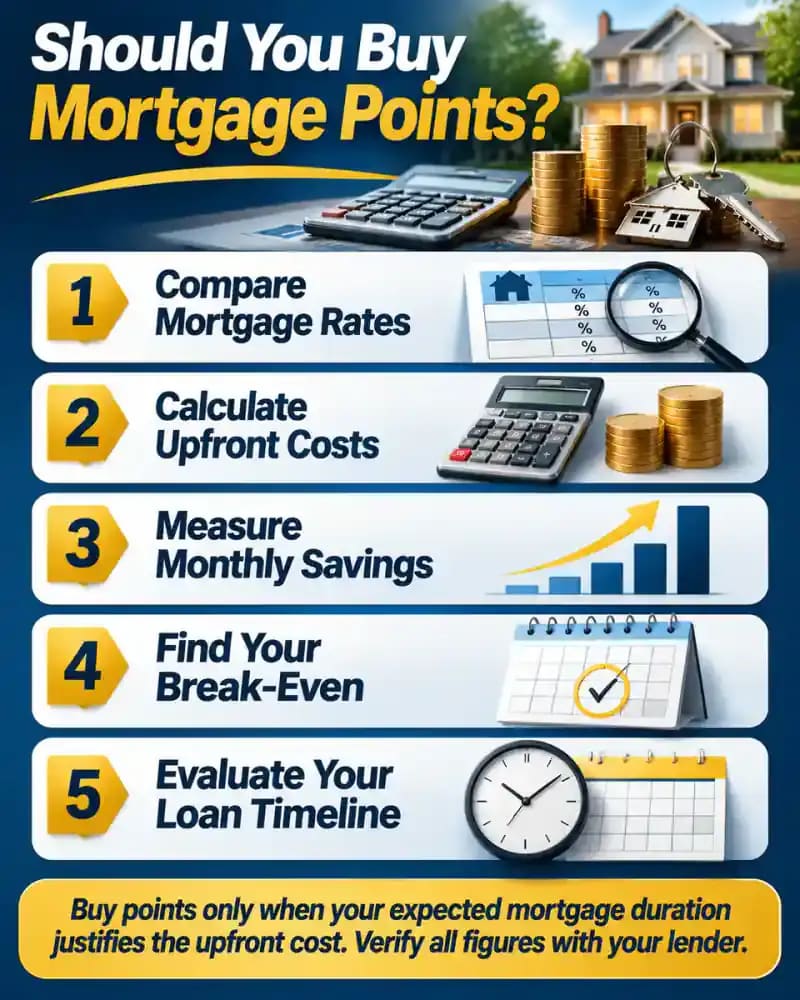
Before finalizing a mortgage offer, verify the exact cost of discount points, the resulting interest rate, and the monthly principal-and-interest payment. Calculate the estimated break-even period and compare it with the expected duration of the original mortgage. Consider available cash, alternative financing offers, and any relevant tax questions. Finally, check the Loan Estimate and Closing Disclosure for consistency. These steps create a transparent comparison based on documented figures rather than assumptions or sales claims.

When you apply for a mortgage, your lender may offer you the option to pay discount points in exchange for a lower interest rate. At first glance, the deal sounds straightforward: pay more upfront, save money every month, and reduce the total interest paid over the life of your loan. But the financial benefit is not automatic. Buying mortgage points only makes sense when the long-term savings justify the additional closing costs.
The most important number to understand is your break-even point. This tells you how many months it will take for your accumulated monthly payment savings to equal the upfront cost of purchasing points. For example, if you spend $3,000 to reduce your monthly principal and interest payment by $50, you need 60 months, or five years, to recover that expense.
However, the calculation is only useful when combined with a realistic assessment of your plans. Selling your home, refinancing, or paying off your mortgage before reaching the break-even point can eliminate the expected financial benefit. You should also consider whether keeping that cash available for emergencies, repairs, or other investments would be more valuable.
There is another factor worth examining: taxes. Mortgage discount points are generally treated as prepaid interest, and IRS deduction rules depend on the property, loan purpose, and circumstances. Understanding these rules can help you avoid incorrect assumptions about your potential tax savings.
Before agreeing to pay points, compare multiple loan estimates, verify the actual rate reduction, and calculate your break-even timeline. The right decision comes from your numbers, not the lender's sales pitch.
Where people go wrong
Assuming Every Mortgage Point Reduces the Rate by the Same Amount. One point generally costs 1% of the loan amount, but its interest rate reduction is not standardized. The discount varies by lender, loan product, market conditions, and borrower qualifications. Always request the exact rate and price.
Ignoring the Break-Even Timeline. A lower monthly payment does not automatically mean a better mortgage. Paying thousands of dollars upfront without calculating how long recovery takes can leave you financially worse off if you sell or refinance early.
Assuming You Will Keep the Mortgage for Thirty Years. Your mortgage term is not necessarily your actual holding period. Job changes, family circumstances, market conditions, and refinancing opportunities can shorten the time you keep the original loan and prevent you from recovering the upfront expense.
Comparing Monthly Payments Instead of Total Costs. Focusing exclusively on the lower payment ignores the additional cash paid at closing. Compare upfront expenses, cumulative payments, remaining loan balances, and the expected mortgage duration before deciding which offer provides better financial value.
Confusing Origination Fees With Discount Points. Not every mortgage charge described as points purchases a lower interest rate. Origination fees may compensate the lender for processing or arranging the loan. Verify which charges actually reduce your rate before signing.
Overlooking the Opportunity Cost of Cash. Money spent purchasing points cannot simultaneously fund emergency savings, home repairs, or other investments. Even when the break-even calculation looks attractive, consider whether retaining liquidity provides greater practical or financial value.
Assuming Mortgage Points Are Always Immediately Tax Deductible. IRS rules distinguish between qualifying points on a principal residence, refinance transactions, and second homes. Some points may be deductible immediately, while others must be deducted over the loan term. Verify eligibility before claiming a deduction.
Forgetting to Compare Multiple Loan Offers. Accepting the lender's recommended point package without requesting alternatives can conceal better options. Compare zero-point, one-point, and fractional-point offers using equivalent loan terms and the same assumptions about loan duration.
Questions people ask
Mortgage discount points are upfront fees paid to a lender at closing in exchange for a reduced mortgage interest rate. One discount point generally costs 1% of the loan amount. The actual rate reduction varies by lender, loan type, and market conditions.
Fixed it?
Get one guide like this every Thursday.