Balance Transfer Cards vs. Personal Loans: Which Costs Less for Debt Consolidation?
Compare balance transfer credit cards and personal loans for debt consolidation, including promotional APRs, transfer fees, origination costs, repayment terms, and long-term interest.

What you’ll need
Tap to tick things off before you start.
Understand What Debt Consolidation Actually Changes
Debt consolidation does not erase debt. It changes the structure of what you owe. Several balances may be replaced by one credit line or one installment loan, allowing you to focus on a single payment instead of several. The Consumer Financial Protection Bureau notes that consolidation may also provide a lower interest rate, but that depends entirely on the terms for which you qualify. A lower payment by itself does not prove that the new arrangement is cheaper.

Start With APR and Fees, Not the Headline Offer
A 0 percent promotion can look automatically superior to a loan charging interest, but the comparison is incomplete until fees and timing are included. A balance transfer may charge an upfront transfer fee, while a personal loan may include an origination fee or other charges. APR is useful because it incorporates important borrowing costs, but you should still read the full disclosures and understand exactly how the lender calculates charges.

List Every Debt You Want to Consolidate
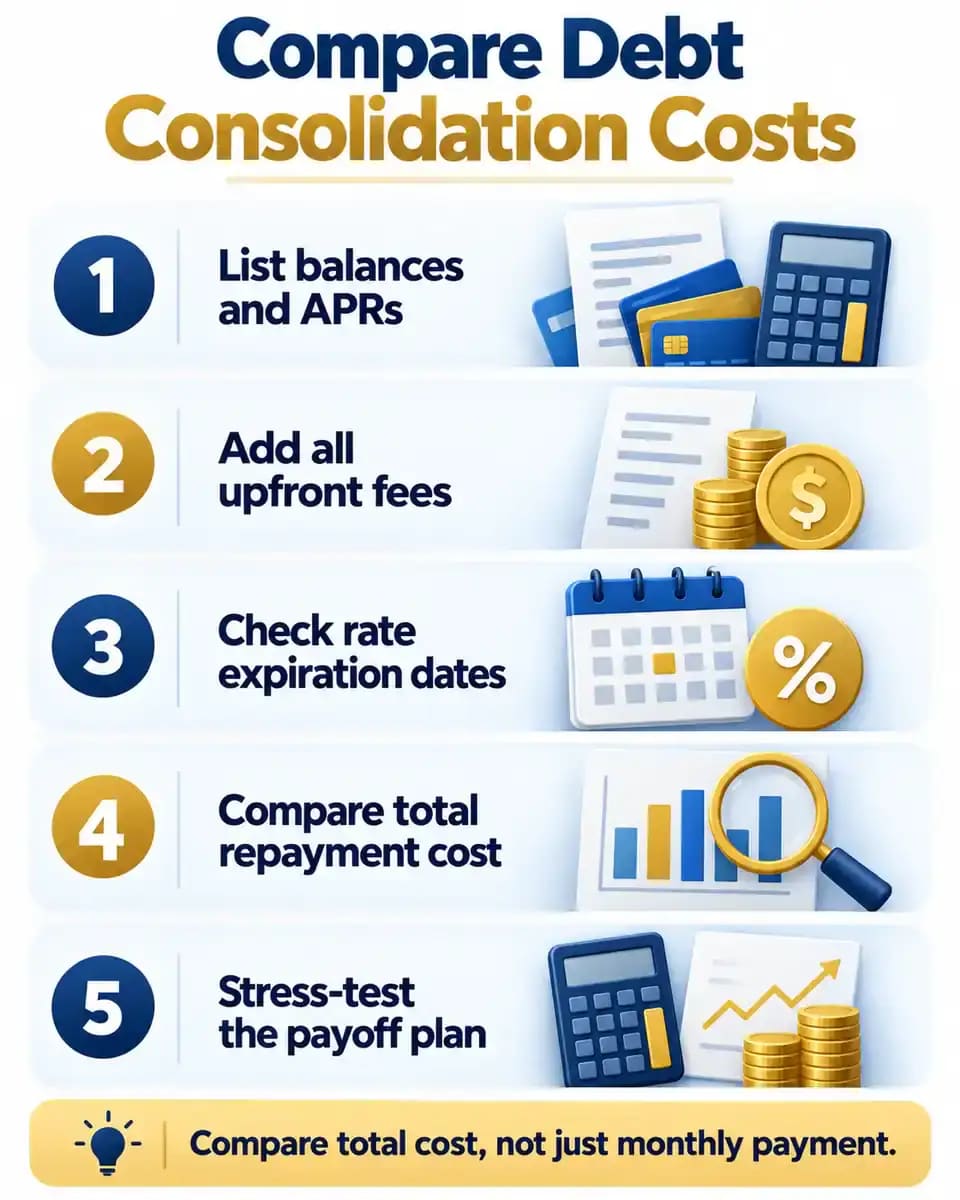
Before comparing products, create a simple inventory. Record each balance, APR, minimum payment, and due date. This establishes the cost of doing nothing and gives you a baseline against which to compare a balance transfer or personal loan. Without this starting point, it is easy to focus on a lower monthly payment while overlooking a longer repayment period or a substantial upfront fee.

Know How a Balance Transfer Works
A balance transfer moves qualifying debt from one or more existing credit cards to another credit card. The new card may offer a promotional APR that is substantially lower than the rate on the old accounts. The goal is usually to reduce interest long enough to make faster progress on principal. The transferred debt does not disappear. It simply moves to a different credit account under a new set of terms.

Treat a 0 Percent APR as a Deadline
A promotional 0 percent balance transfer APR can be valuable because interest may temporarily stop accumulating on the transferred balance. That does not make the debt cost-free. The promotional period has an expiration date, and a transfer fee may still apply. The safest way to analyze the offer is to treat the end of the promotion as a firm financial deadline rather than assuming the low rate will continue.

Calculate the Balance Transfer Fee
The CFPB explains that balance transfer fees are commonly charged as a percentage of the amount transferred or as a fixed minimum amount, depending on the card terms. If you transfer $10,000 and the fee is 3 percent, the fee would be $300. That can bring the new balance to roughly $10,300 before you make your first payment. A higher fee can still make sense if the interest savings are greater, but the fee must be included in the comparison.

Check Whether the Transfer Fee Becomes Debt Too
In many offers, the transfer fee is added directly to the new card balance. That matters because the fee consumes part of the available credit line and increases the amount you need to eliminate. If the promotional balance is not fully repaid before the low-rate period expires, the remaining amount may begin accruing interest at the applicable post-promotional rate.

Find the Exact Promotional Expiration Date
Do not rely on phrases such as 18 months or introductory period without identifying the actual expiration date. Confirm when the promotional APR begins, when it ends, and whether transfers must be completed within a separate eligibility window. Put that date into your calendar and work backward to determine how much you would need to pay each month to clear the transferred balance in time.

Estimate the Monthly Payment Needed Before the Promotion Ends
A simple planning calculation can expose whether a balance transfer is realistic. Divide the transferred balance, including applicable fees, by the number of months available in the promotional period. A $10,300 balance spread over 18 months would require about $572 per month to reach zero in that simplified example. Actual card terms and transactions can change the result, but the calculation provides a practical target.

Check the Standard APR After the Promotion
The post-promotional APR can materially change the economics of the transfer. If a large balance remains when the promotional period ends, future interest charges can reduce or even erase part of the savings achieved during the introductory period. Review the card disclosure for the applicable standard APR and whether it is variable. Do not evaluate a balance transfer as though the promotional rate were permanent.

Understand How a Personal Installment Loan Works
A personal installment loan is closed-end credit. You borrow a defined amount and repay it according to a scheduled term. Instead of revolving indefinitely like a credit card balance, the loan is designed to amortize through a fixed number of payments. Some lenders send consolidation funds directly to creditors, while others deposit the proceeds into your bank account so you can pay the balances yourself.

Compare Fixed and Variable Loan Rates
Many personal loans use fixed rates, which can make monthly payments predictable. Others may have variable rates or promotional structures. Read the loan agreement carefully rather than assuming every consolidation loan behaves the same way. If the interest rate can change, identify what triggers the change and how it could affect the monthly payment or total cost.

Look for Origination Fees
The CFPB notes that personal installment loans may include fees in addition to interest. Origination fees are among the most important because they may be deducted from the loan proceeds or added to the amount financed. If you borrow $10,000 but an upfront fee is deducted, you may receive less than $10,000 even though your repayment obligation is based on the loan's contractual terms.

Check for Other Loan Charges
Depending on the lender and product, charges can include documentation fees, late fees, returned-payment fees, or other costs allowed by the agreement and applicable law. Do not assume every lender charges all of these fees. The point is to inspect the actual disclosure for the specific offer. The CFPB emphasizes reviewing loan disclosures so consumers can understand borrowing costs before accepting a loan.

Compare the Net Loan Proceeds With the Debt You Need to Pay
If a lender deducts an origination fee before disbursing funds, make sure the net proceeds are enough to pay the debts you intend to consolidate. Borrowing $10,000 does not necessarily mean $10,000 will arrive in your bank account. If the proceeds fall short, you may be left with a remaining credit card balance plus the new loan payment.

Use APR to Compare Borrowing Costs
APR is generally more useful than looking only at the stated interest rate because APR is intended to reflect the annualized cost of credit including certain finance charges. Even so, products with radically different timelines can still be difficult to compare from APR alone. A temporary balance transfer promotion and a multi-year installment loan require you to consider both annual cost and the period over which the debt will remain outstanding.

Compare Total Dollars Paid
The most practical comparison is often total dollars paid from the day you consolidate until the debt reaches zero. Include upfront fees, interest, and any mandatory charges you can identify. A lower monthly payment can still produce a higher total cost when repayment is extended for several additional years. Conversely, a product with a noticeable upfront fee can still save money if it sharply reduces interest and the debt is repaid quickly.

Do Not Confuse a Lower Payment With a Lower Cost
Personal loans can make debt feel more affordable by stretching repayment across a longer term. The CFPB cautions that extending a loan term to obtain a lower monthly payment can result in paying more interest overall. A $300 payment is easier to fit into a budget than a $600 payment, but if the smaller payment lasts much longer, the cumulative borrowing cost may be higher.

Match the Repayment Term to Your Realistic Budget
An aggressive payoff schedule is useful only if you can actually maintain it. Compare your available monthly cash flow with the payment required under each option. If a balance transfer requires a payment that is unrealistic, the promotional rate may expire before you reach zero. If a personal loan payment leaves no room for normal expenses, missed payments can create new fees and credit problems.

Be Careful With Teaser Rates
Some loan products may advertise an attractive introductory or teaser rate that changes later. If you encounter one, identify the rate after the introductory period and whether the payment can increase. The same discipline used for balance transfer promotions applies here: understand the timeline, the future rate, and the payment consequences before relying on the initial figure.

Consider the Risk of Adding New Credit Card Debt
Consolidation solves little if paid-off cards immediately accumulate new balances. A balance transfer can create the impression that old cards are now available spending capacity. A personal loan can have the same psychological effect after it pays credit cards to zero. Before consolidating, consider how you will prevent the original balances from rebuilding while you repay the new obligation.

Avoid Treating Available Credit as Extra Income
An unused credit line is borrowing capacity, not money you have earned. If consolidation frees thousands of dollars of card capacity, using that credit for discretionary purchases can leave you with the consolidation debt plus new revolving debt. The arithmetic becomes substantially worse when new charges carry the card's normal purchase APR.

Check Whether the New Credit Limit Is Large Enough
A balance transfer card may not provide a credit limit large enough to absorb all the debt you want to move. The transfer fee can also consume part of the available limit. If only part of your debt can be transferred, calculate the cost of the remaining balances separately rather than assuming the entire debt portfolio will receive the promotional rate.

Review Every Disclosure Before Accepting an Offer
Federal consumer credit rules require important borrowing terms to be disclosed. Read the documents rather than relying only on marketing pages. For a card, identify the balance transfer APR, transfer fee, promotional duration, standard APR, and applicable conditions. For a loan, examine the APR, amount financed, fees, repayment term, payment schedule, and total payment information provided in the agreement.

Compare Offers Using the Same Debt Amount
A fair comparison requires consistent assumptions. Use the same starting debt amount and the same realistic monthly budget when modeling both options. If you compare a balance transfer paid off in 18 months with a personal loan stretched across five years, you are comparing different repayment strategies as well as different products. That may still be useful, but recognize what is driving the difference.

Run a Break-Even Comparison
Ask how much interest the new product must save to justify its upfront fee. Suppose a balance transfer charges $300 to move your debt. If avoiding interest saves substantially more than $300 during the period you expect to carry the balance, the transfer may reduce total cost. The same principle applies to a personal loan origination fee. This is a mathematical comparison, not a guarantee that a particular product is appropriate for your circumstances.

Stress-Test the Payoff Plan
Do not model only the best-case scenario. Consider what happens if you can pay less for a few months, the promotional period ends with a balance remaining, or the household budget tightens. For a loan, consider whether the required installment remains manageable throughout the full term. Stress testing helps reveal whether a theoretically inexpensive option is also practical.

Remember That Advertised Rates Are Not Guaranteed
The lowest rates shown in advertisements are generally available only to applicants who meet specific underwriting criteria. Your approved APR, credit limit, fees, and loan amount may differ from the headline offer. Compare actual offers and disclosures available to you rather than basing the decision on the best rate shown in an advertisement.

Choose Based on Repayment Mechanics, Not Product Labels
A balance transfer can be especially cost-efficient when a borrower qualifies for favorable terms and can realistically eliminate the balance during the promotional period. A fixed-rate personal loan can offer a clearer multi-year repayment structure for debt that will take longer to repay. Neither product is automatically cheaper. The correct comparison is the specific offer, total cost, repayment timeline, and your ability to follow the plan.

Build Your Decision Around the Total Payoff Cost
Bring the analysis back to four numbers: the amount being consolidated, upfront fees, expected interest, and the time required to reach a zero balance. Then consider payment stability and the risk of failing to meet the intended schedule. A promotional credit card rate can be powerful when used within its deadline, while an installment loan can provide predictable structure over a longer term. The most useful objective is not simply obtaining one payment. It is reaching zero debt at a manageable cost without creating another cycle of borrowing.

Carrying balances on several high-interest credit cards can make debt feel harder to control than the numbers alone suggest. You may be tracking multiple due dates, minimum payments, interest rates, and account balances while watching a substantial part of each payment go toward interest instead of principal.
Debt consolidation is designed to simplify that situation. The Consumer Financial Protection Bureau describes debt consolidation as combining multiple debts into a single loan or credit line. The potential benefits are straightforward: fewer payments to manage and, if you qualify for favorable terms, a lower borrowing cost.
Two of the most common consolidation tools are balance transfer credit cards and personal installment loans. They may accomplish a similar goal, but they work very differently. A balance transfer card can provide a temporary low or 0 percent promotional APR, while a personal loan typically provides a defined repayment schedule with regular installment payments.
The important question is not simply which option advertises the lowest rate. You need to compare the total cost of borrowing, including transfer fees, origination charges, the duration of promotional rates, the standard APR after promotions expire, and the length of the repayment period. This guide explains how those variables work so you can compare offers on equal terms. It is general educational information, not individualized financial, legal, or tax advice.
Where people go wrong
Looking only at the promotional APR. A 0 percent rate can still involve a transfer fee, a limited promotional period, and a much higher standard APR after the promotion expires.
Choosing the smallest monthly payment. A lower payment may simply reflect a longer repayment term, which can increase total interest paid.
Ignoring origination fees. A personal loan fee may be deducted from the proceeds or otherwise increase the effective borrowing cost.
Assuming every balance can be transferred. Credit limits, issuer rules, transfer eligibility, and fees may prevent the entire debt amount from moving to the new card.
Missing the promotional deadline. A remaining balance after the introductory period can begin accruing interest at the applicable standard APR.
Running credit cards back up. Consolidating existing balances while creating new card debt can leave you with more total debt than before.
Comparing advertised rates instead of actual offers. The lowest advertised APR may not be the rate, fee structure, or credit limit you actually receive.
Questions people ask
No. A balance transfer may be inexpensive when the promotional APR is low, the fee is reasonable, and the balance is repaid before the promotion expires. A personal loan may cost less under different APR, fee, and repayment assumptions. Compare actual offers and total dollars paid.
Fixed it?
Get one guide like this every Thursday.