The Auto Insurance Claims Process: A Step-by-Step Guide
Learn how the auto insurance claims process works, from documenting an accident and working with a claims adjuster to receiving a settlement. Understand how insurers share claims data and how to check and dispute errors in your insurance history.

What you’ll need
Tap to tick things off before you start.
What to Do Immediately After a Car Accident
Immediately after a collision, check yourself and your passengers for injuries. Call 911 if anyone needs emergency assistance or the situation presents an immediate danger. Turn on your hazard lights and avoid standing in active traffic lanes. If the vehicles can be moved safely and local law permits, relocate them to a nearby shoulder or parking area. Never attempt to move a seriously injured person unless necessary to prevent further danger. Follow responding officers' safety instructions.

How to Document the Accident and Gather Evidence
Once the scene is safe, photograph each vehicle's damage, license plates, road conditions, traffic signals, and surrounding area. Record the accident's date, time, location, and weather. Exchange names, phone numbers, insurance company names, and policy numbers with other drivers. Collect contact information from witnesses who observed the collision. If police respond, request the incident number and reporting agency's details. Preserve original photographs and notes because they may help establish what happened during the insurance investigation.

How to File an Auto Insurance Claim
Notify your insurance company promptly through its claims phone number, website, or mobile application. Provide your policy information, accident date, location, and a factual description of the collision. Upload requested documents without guessing about details you cannot confirm. Ask about notification deadlines and any additional reporting requirements under your policy. Obtain a claim number for future reference. Save confirmation emails and maintain a dated record of communications, submitted materials, and insurer requests throughout the process.

What an Auto Insurance Claims Adjuster Does
After receiving a claim, the insurer generally assigns an adjuster to investigate the circumstances and assess its responsibilities. The adjuster may review photographs, police records, repair information, and statements from drivers or witnesses. Depending on the situation, the adjuster might arrange a vehicle inspection or request additional evidence. Their findings help the insurer evaluate liability and coverage. Respond accurately to reasonable information requests, keep communication records, and ask for clarification when an investigation step is unclear.

How State Laws and Policy Coverage Affect Your Claim
Insurance payments depend on both applicable state law and the coverage purchased. Liability insurance generally addresses covered damage or injuries caused to others, while collision coverage may pay for damage to your vehicle. No-fault rules primarily affect certain injury benefits rather than automatically covering every vehicle repair. Deductibles reduce some claim payments, and policy limits cap covered amounts. Exclusions can also restrict reimbursement. Reviewing these provisions helps explain why similar accidents may produce different insurance outcomes.

How Insurers Evaluate Repairs and Total Losses
Insurers evaluate vehicle damage using inspections, photographs, and estimated repair costs. Repair facilities may identify additional damage after disassembly, requiring supplemental estimates. When repairs are economically impractical or state total-loss criteria are met, the insurer may classify the vehicle as a total loss. Compensation generally reflects its pre-accident actual cash value, subject to applicable terms. Vehicle condition, mileage, and comparable sales can influence valuations. Consumers can request supporting calculations and identify factual errors in an assessment.

Understanding Claim Decisions and Settlement Payments
After reviewing a claim, an insurer may approve payment, offer a negotiated amount, or deny some or all requested compensation. Settlement calculations can reflect covered losses, applicable deductibles, and policy restrictions. Payments may go directly to the policyholder, repair facility, or financing company, depending on circumstances. Request a written explanation of any disputed decision or deduction. If the outcome appears incorrect, insurers typically provide review procedures, while state insurance departments offer consumer complaint channels.

How Auto Insurance Claims Are Shared With Reporting Agencies
Auto insurance claims can become part of databases maintained by specialty consumer reporting agencies. The Consumer Financial Protection Bureau explains that insurers share claims information with agencies that compile insurance history reports. Records may include claim dates, types of losses, associated vehicles, and reported payment amounts. Participating insurers can request these reports for legally permitted insurance purposes. Reporting practices vary, so not every claim necessarily appears in every database. These specialty reports are distinct from standard credit reports.

How Your Claims History Can Affect Future Insurance Rates
Insurers may consider previous claims when deciding whether to offer coverage and calculating renewal or application premiums. Multiple claims, accident responsibility, loss amounts, and other underwriting factors can influence risk assessments. However, filing a claim does not guarantee a rate increase. State regulations may limit how particular accidents affect pricing, and insurers use different rating methods. Reviewing renewal notices and comparing available policies can help consumers understand changes in premiums without assuming every adjustment results from one accident.

Your Rights to Free Insurance Reports and Error Disputes
The Fair Credit Reporting Act gives consumers rights concerning specialty insurance reports. Many qualifying agencies must provide a free report upon request every 12 months. Consumers can dispute inaccurate entries, triggering applicable investigation obligations for reporting agencies and information furnishers. The Federal Trade Commission explains that insurers using consumer reports must also follow adverse action notice requirements when applicable. Such notices identify the reporting agency and explain important consumer rights. Request reports directly from the relevant agency and retain dispute documentation.

How to Record Accident Conditions and Police Report Details
Create a factual timeline while the accident details remain fresh. Record the exact time, street or highway location, direction of travel, weather, visibility, and pavement conditions. Note nearby intersections or landmarks that help identify the scene. If officers respond, record their names, badge numbers when available, department, and incident number. Ask how to obtain the official police report. Keep your personal notes separate from the report because police documentation may contain incomplete or disputed information.

What Happens After an Insurance Adjuster Is Assigned
After the insurer acknowledges your claim, an assigned adjuster typically contacts you to explain the initial review. Expect questions about the accident, vehicle location, available records, and immediate expenses. The adjuster may request additional documents or schedule follow-up conversations. Ask for their direct contact information, the next expected milestone, and any outstanding requirements. Investigation timelines depend on claim complexity and applicable regulations. Keep a record of promised updates and respond promptly to reasonable requests.

How Insurance Companies Investigate Accident Liability
Determining accident liability involves establishing what happened and whether a driver failed to exercise reasonable care. Adjusters consider traffic rules, vehicle movements, collision circumstances, and competing explanations. They may assign responsibility to one driver or divide fault between multiple parties where state law allows. A traffic citation does not automatically establish civil liability, and an insurer's determination may differ from another company's assessment. The applicable legal standard influences how responsibility affects the claim outcome and available compensation.

How Adjusters Verify Accident Reports and Witness Statements
Adjusters compare different sources of information to determine whether the reported accident circumstances are consistent. Driver statements may be checked against witness accounts, police observations, photographs, vehicle damage patterns, and available recordings. Independent witnesses can help clarify disputed movements or traffic signals, although their recollections may differ. Investigators may request additional explanations when evidence conflicts. An inconsistency does not automatically establish dishonesty. Accurate, clearly attributed information helps distinguish confirmed facts from assumptions or uncertain recollections.

Why Auto Insurance Claim Rules Differ by State
Auto insurance is regulated primarily at the state level, so claim procedures are not identical nationwide. States establish different requirements for accident reporting, mandatory insurance coverage, insurer communications, and claim handling practices. Some jurisdictions specify deadlines for acknowledging claims, completing investigations, or explaining decisions, often with exceptions. Consumer complaint procedures also differ. The state insurance department is a useful source for applicable regulations. Understanding these variations prevents reliance on deadlines or protections that apply only elsewhere.

No-Fault vs. At-Fault Insurance Claims Explained
In traditional fault-based systems, an injured person may pursue compensation from a responsible driver's liability insurer, subject to state law and coverage. No-fault states generally require qualifying drivers to use personal injury protection coverage for certain medical expenses and related losses, regardless of who caused the collision. However, no-fault rules do not necessarily determine who pays for vehicle repairs. Property damage responsibility often follows separate liability rules. Coverage requirements and restrictions on injury lawsuits vary substantially among states.

How Coverage Limits and Deductibles Determine Your Payout
A deductible is the amount deducted from certain covered claim payments. For example, with $4,000 in approved collision damage and a $500 deductible, the insurer would generally pay $3,500, assuming no other restrictions. Policy limits establish maximum payments for covered losses, while exclusions identify circumstances the policy does not cover. Expenses beyond applicable limits or outside coverage may remain your responsibility. Deductibles do not necessarily apply to payments made under another driver's liability insurance.

How Vehicle Damage Inspections Work
Vehicle inspections establish the visible damage associated with an accident. Depending on the insurer and circumstances, an adjuster may examine the car in person or evaluate photographs submitted through a digital claims system. Repair facilities can provide technical assessments of damaged components. Some problems become apparent only after panels or parts are removed, requiring additional inspection and a supplemental estimate. Documenting inspection findings, existing damage, and newly discovered problems helps clarify which repairs relate to the reported collision.

How Insurers Decide Whether Your Vehicle Can Be Repaired
Repair feasibility depends on whether a damaged vehicle can be restored safely and economically. Insurers consider structural condition, manufacturer repair procedures, replacement parts, labor requirements, and the likelihood of additional damage. Parts availability may affect the repair timeline without necessarily making the vehicle irreparable. Estimated restoration costs are compared with the vehicle's value and applicable state thresholds. Even when repairs appear technically possible, an insurer may determine that restoring the vehicle is not economically justified.

How to Review and Approve an Auto Repair Estimate
An itemized repair estimate should identify affected components, replacement parts, labor operations, paint materials, and associated charges. Review whether the estimate includes necessary work and distinguishes original equipment, aftermarket, or recycled parts where relevant. Repair shop selection rights vary by state, and insurers may have preferred networks. Confirm who authorizes work, who receives payment, and how unexpected additional repairs require approval. Keep copies of estimates and authorization records to help resolve later billing disagreements.

When an Insurance Company Declares Your Car a Total Loss
An insurer may declare a vehicle a total loss when repairing it would exceed an applicable economic threshold or when damage makes restoration impractical. State laws and insurer practices determine how those thresholds are applied. Severe structural damage can also affect the decision. After classification, the insurer typically arranges settlement and determines whether the vehicle will be transferred to a salvage buyer. Owners may have retention options, although salvage titles, deductions, and registration restrictions can apply.

How Insurers Calculate Your Car's Pre-Accident Value
Actual cash value generally represents a vehicle's market value immediately before the accident, rather than its original purchase price or replacement cost. Insurers may analyze comparable vehicle sales, mileage, model year, trim, condition, location, and installed equipment. Valuation reports sometimes include adjustments for differences between comparable vehicles. Consumers can examine those assumptions for incorrect mileage, missing options, or inaccurate condition ratings. Maintenance records, photographs, and relevant local listings may support a request for reconsideration.

How to Communicate With Your Adjuster Before Settlement
Before accepting a settlement, ask the adjuster to explain the proposed amount and identify any deductions or unresolved expenses. Request written calculations when available, especially if the offer differs from documented losses. Confirm whether additional information, signatures, or payment instructions remain outstanding. Keep dated notes of conversations and preserve relevant emails. Ask whether accepting payment includes a release of further claims. Understanding the proposed agreement helps prevent confusion about which obligations the settlement actually resolves.

What Happens to Your Insurance Data After a Claim Closes
Closing an insurance claim does not necessarily remove its information from company records. Insurers retain claim details for operational, regulatory, and historical purposes, and participating companies may transmit relevant data to external reporting systems. Later corrections or payment changes can sometimes generate updated records. Retention periods and reporting practices vary by organization and applicable law. A closed claim may therefore remain visible in insurance history databases long after repairs or payments are completed, subject to reporting restrictions.

What Specialty Insurance Reporting Agencies Collect
Specialty consumer reporting agencies maintain information used for specific decisions, including insurance underwriting. LexisNexis C.L.U.E. is one example of a database containing auto and property insurance claims history. Records may identify loss dates, claim types, payment amounts, vehicles, and associated individuals. The Consumer Financial Protection Bureau explains that insurers share claims information through these reporting services. Unlike traditional credit reports, insurance claims reports focus on loss history rather than borrowing and repayment activity. Database coverage varies.

How Insurance Claims History Influences Your Financial Profile
Insurance claims history contributes to an insurer's assessment of future loss risk. Underwriting models may consider how frequently claims occur, their severity, payment amounts, and the circumstances surrounding reported incidents. A record containing multiple losses can influence an insurer's risk classification even when individual claims were handled correctly. However, companies weigh these factors differently, and reporting a claim does not automatically produce financial consequences. Accurate records are especially important because misleading entries can distort an otherwise reliable history.

How Insurers Review Claims History When You Apply for Coverage
When consumers apply for auto insurance or renew existing coverage, insurers may request specialty consumer reports for permitted underwriting purposes. The Federal Trade Commission explains that insurance companies using consumer reports must follow Fair Credit Reporting Act requirements. Underwriters compare reported claims with application information and evaluate eligibility under company guidelines. Findings can affect available coverage options or whether an application is accepted. Insurers cannot access consumer reports without a legally permissible purpose, and applicable state restrictions may impose additional requirements.

Federal Protections Against Inaccurate Insurance Reporting
The Fair Credit Reporting Act establishes standards for consumer reporting agencies and businesses using their reports. Agencies must follow reasonable procedures designed to promote maximum possible accuracy and limit disclosures to legally permissible purposes. Insurers obtaining consumer reports must comply with applicable access and use requirements. The Federal Trade Commission provides guidance on these responsibilities. Federal protections do not guarantee that every report is error-free, but they create enforceable duties intended to reduce inaccurate reporting and improper access.

Your Consumer Rights Under the Fair Credit Reporting Act
The Fair Credit Reporting Act gives consumers rights to obtain disclosures from qualifying reporting agencies and challenge inaccurate or incomplete information. Many specialty agencies must provide a free report every 12 months upon request. When an insurer takes an adverse action based on a consumer report, applicable notice requirements identify the reporting agency and explain relevant rights. Consumers may also have access to regulatory complaints or legal remedies for violations, depending on the circumstances. These protections operate independently of ordinary claim settlement negotiations.

How the Furnisher Rule Protects Your Insurance Claims Data
Businesses that supply information to consumer reporting agencies are known as furnishers. Under the Fair Credit Reporting Act and its Furnisher Rule, covered furnishers must maintain reasonable policies concerning information accuracy and integrity. They must also investigate qualifying disputes received directly from consumers, subject to specific requirements and exceptions. Investigations may require reviewing supporting records and correcting inaccurate reporting. Not every disagreement qualifies for direct dispute procedures. The Federal Trade Commission explains these obligations in its consumer reporting guidance.

A car accident can leave you dealing with vehicle damage, unexpected expenses, and questions about who will pay. Understanding the auto insurance claims process helps you protect your finances, avoid documentation mistakes, and make informed decisions before accepting an insurance settlement.
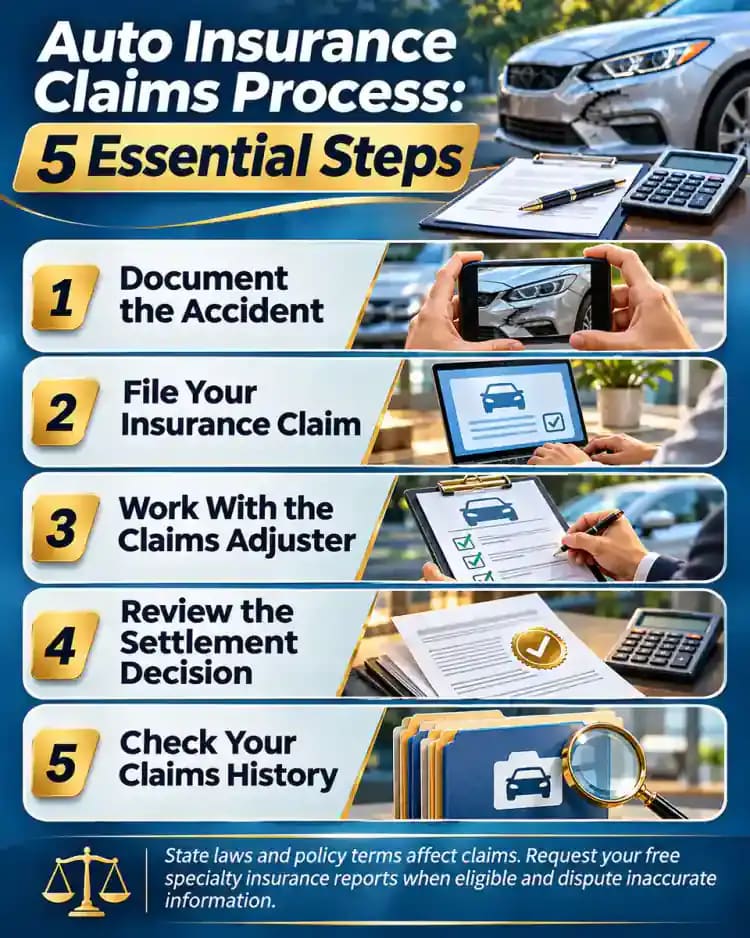
The process begins at the accident scene. After checking for injuries and moving to safety when possible, document the damage, exchange information with other drivers, and collect witness details. Report the accident to your insurer promptly, following your policy's notification requirements. Your insurance company will typically assign a claims adjuster to investigate what happened, evaluate the damage, and determine which expenses your coverage may pay.
What happens next depends on your policy and state law. Your deductible, coverage limits, responsibility for the accident, and whether the vehicle can be repaired all affect the outcome. If your car is declared a total loss, the insurer generally evaluates its pre-accident value rather than paying for repairs.
There is another important financial consequence many drivers overlook: insurance claims can become part of your specialty consumer reporting history. Insurers may use reports from agencies such as LexisNexis when evaluating future coverage applications and premiums. Under the Fair Credit Reporting Act, you have rights to access eligible reports and dispute inaccurate information.
This guide explains how to prepare your claim, communicate with the adjuster, evaluate a settlement, and check your insurance reporting history. You will also learn which common mistakes can delay payment or weaken your position during a claim.
Where people go wrong
Leaving the Accident Scene Without Documentation. Failing to photograph damage, record road conditions, or collect witness information can make disputed claims harder to resolve. Once vehicles are moved or repaired, important evidence may disappear. Prioritize safety first, then document everything reasonably possible.
Admitting Fault Before the Facts Are Established. Speculating about responsibility or making unnecessary admissions can complicate an investigation. Stick to an accurate description of what you observed, cooperate with authorities, and answer your insurer's questions truthfully. Fault ultimately depends on evidence and applicable state law.
Waiting Too Long to Report the Accident. Delaying notification can make evidence harder to obtain and may create problems under your policy's reporting requirements. Contact your insurer promptly, even when damage initially appears minor. State rules and policy provisions determine applicable deadlines and consequences.
Assuming Every Type of Damage Is Covered. A liability-only policy generally does not pay to repair your own vehicle after an accident you cause. Collision coverage, deductibles, exclusions, and coverage limits matter. Review your declarations page before assuming the insurer will reimburse every expense.
Authorizing Repairs Without Understanding Claim Approval. Starting expensive repairs before confirming the insurer's inspection and payment procedures can create reimbursement disputes. Ask whether an estimate or inspection is required, who receives payment, and how additional damage discovered during repairs will be evaluated.
Accepting a Total-Loss Valuation Without Reviewing It. A total-loss offer may depend on vehicle condition, mileage, equipment, local comparable vehicles, and applicable valuation rules. Request the valuation report and check its assumptions. If important details are incorrect, provide supporting evidence before accepting the settlement.
Ignoring Insurance Claims History Errors. Incorrect claims information in a specialty consumer report may affect future insurance prices or eligibility. Request your available reports, review accident details and claim outcomes, and dispute inaccuracies with the reporting agency and, when appropriate, the information provider.
Questions people ask
The process typically begins when you report an accident to an insurance company. A claims adjuster investigates the circumstances, reviews available evidence, evaluates damage, and determines applicable coverage. The insurer then approves, negotiates, or denies payment based on its findings. Procedures and deadlines vary by state and policy.
Fixed it?
Get one guide like this every Thursday.