The 36-Month Box on Your Credit Card Statement, Explained
Your credit card statement may show how long minimum payments could keep you in debt and what monthly payment could repay your current balance in 36 months. Here is how to read that disclosure, understand the assumptions behind it, and use it to make more informed payment decisions.

What you’ll need
Tap to tick things off before you start.
Find the repayment disclosure on your statement
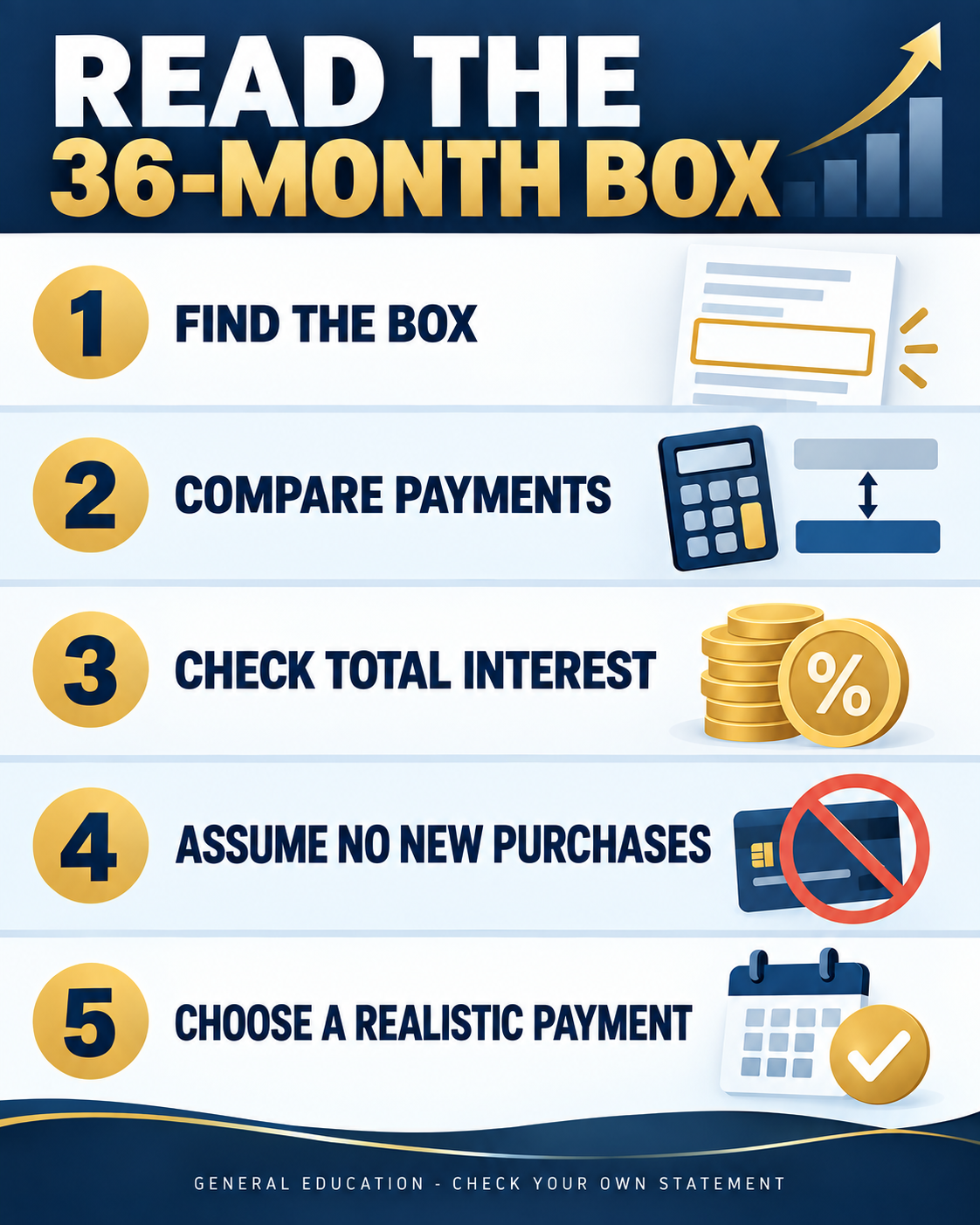
Start with your latest credit card statement and look for a section discussing minimum payments, repayment time, or the amount required to repay the balance in three years. Formatting varies by issuer, but the disclosure is commonly presented in a boxed section near the minimum payment information.
Do not confuse this with a promotional payoff calculator, an automatic payment setting, or a suggested payment generated by a budgeting app. The statement disclosure is tied to federal credit card rules and the information available for your account during that billing cycle.

Understand the two numbers the box is comparing
The disclosure is intended to help you compare two repayment paths. One shows approximately how long repayment could take if you make only minimum payments and make no additional purchases. The other identifies a monthly payment associated with paying the current balance in 36 months.
The purpose is comparison. It gives you a way to see how a larger monthly payment can affect both repayment time and total interest under the assumptions used for the disclosure.

Know why the disclosure exists
Credit card repayment disclosures are not merely optional educational features added by issuers. They are part of federal disclosure requirements designed to make the long-term cost of revolving credit easier for consumers to understand.
Appendix M1 to Regulation Z provides rules for repayment disclosures and describes how issuers calculate and present the information. The CFPB publishes Regulation Z materials and consumer explanations that help clarify how these disclosures work.

Treat the 36-month figure as a snapshot
The three-year payment amount is calculated from information available when the statement is produced. Think of it as a snapshot of the current balance, not a guarantee about where the account will be three years from now.
According to the CFPB, the estimate does not include future purchases. If you continue charging purchases to the card, the original 36-month payment figure may no longer be enough to eliminate the entire account balance within three years.

Separate the statement balance from future spending
A common misunderstanding is to assume that paying the displayed 36-month amount guarantees a zero balance after 36 months regardless of new activity. It does not.
For example, if the disclosure is based on a $5,000 balance and you later add $1,500 of new purchases, those new charges were not part of the original calculation. Interest, fees, and payment allocation rules may also affect what happens next. If your goal is to use the three-year estimate as a repayment benchmark, continuing to add debt can undermine the comparison.

Check your minimum payment due
Your minimum payment due is the smallest amount the issuer requires by the payment deadline to satisfy that month's payment obligation under the account terms. Paying at least the required minimum can help you avoid being treated as having missed that payment, but it does not mean the balance will decline quickly.
When balances are large and interest rates are high, a substantial portion of an early minimum payment may effectively be offset by finance charges, leaving comparatively little progress against principal.

Understand why minimum payment formulas vary
There is no single minimum payment formula used by every credit card issuer. Policies differ among issuers and can also differ among products from the same institution.
That is why two cards with similar balances may produce different minimum payments. Your cardholder agreement and statement are more relevant to your account than a generic formula found online.

Recognize the fixed minimum floor
Many issuers use a fixed dollar amount, often called a minimum payment floor. If the percentage-based calculation would otherwise produce a very small payment, the floor can become the required minimum instead.
In its review of credit card minimum payment practices, the CFPB reported fixed minimum amounts ranging from $15 to $50 among reviewed issuers, with $40 being the most common in that review. Those figures describe observed issuer policies, not a universal rule that applies to every card.

Understand the percentage component
A common structure identified in CFPB research uses a percentage of the balance as part of the minimum payment calculation. The CFPB reported that many issuers it reviewed used 1 percent of the statement balance as a component of the formula.
That does not mean your minimum payment simply equals 1 percent of your balance. Interest, fees, past-due amounts, and a minimum floor may also be included depending on the issuer and account terms.

Account for interest, fees, and past-due amounts
Some minimum payment formulas add finance charges, certain fees, and past-due amounts to a percentage of the balance. This can make the required payment move significantly from one statement to the next.
For example, a late fee or a previously unpaid amount can increase the next required payment even if the underlying purchase balance has not changed much. Review the detailed statement rather than assuming this month's minimum will match last month's.

Locate the APR that applies to your balance
APR stands for annual percentage rate. It is a key factor in how expensive carrying a credit card balance can become.
Check the interest charge section of your statement and identify the APR or APRs that apply. A single account can have different rates for purchases, balance transfers, cash advances, or promotional balances. The exact interest calculation is governed by your account terms, so do not assume one displayed APR applies to every dollar you owe.

See why a high APR changes the payoff timeline
When a revolving balance carries a high interest rate, interest accrues while you are trying to repay principal. The smaller your payment relative to the balance and interest charge, the slower the balance may decline.
This is why a modest difference in monthly payment can translate into a large difference in total interest over many years. The effect becomes especially visible when comparing a minimum-payment path with a fixed three-year repayment path.

Work through the $5,000 example assumptions
Consider an illustrative $5,000 starting balance with a 20 percent APR. Assume the minimum payment is the greater of $40 or 1 percent of principal plus monthly interest.
Also assume no new purchases, no additional fees, no missed payments, and no change in the interest rate. These assumptions are essential. Change them and the results change too.
This example is useful for understanding the mechanics, but it is not a prediction of what your own card will cost.

Follow the minimum-payment path
Under the stated assumptions, paying only the calculated minimum would take approximately 180 months, or 15 years, to eliminate the $5,000 balance.
Over that period, the illustrative interest total is about $6,706.87. In other words, the interest alone would exceed the original amount borrowed.
This is not evidence that every $5,000 balance at 20 percent APR will follow exactly the same path. Actual results depend on the issuer's formula, daily balance calculations, rounding, fees, payment timing, and account activity.

Follow the 36-month path
Using the same illustrative $5,000 balance and 20 percent APR, a fixed payment of approximately $185.82 per month would repay the balance over 36 months under the stated assumptions.
The estimated interest over those three years would be about $1,689.45. Because the balance is being reduced more quickly, less principal remains outstanding for interest to accumulate against over time.

Compare the total interest cost
The illustrative difference in total interest between the two repayment paths is approximately $5,017.42. That figure is the gap between about $6,706.87 of interest under the minimum-payment example and about $1,689.45 under the 36-month example.
The comparison shows why repayment speed matters. Interest does not depend only on the rate. It also depends on how long a balance remains outstanding and how quickly payments reduce it.

Do not treat the example as your personal quote
The $5,000 example is an educational illustration, not a payoff quote for your account. Your own statement may show different numbers even if your balance and APR appear similar.
Your issuer may use a different minimum payment method, different compounding or daily balance mechanics, different payment allocation rules, or different assumptions required by the applicable disclosure rules. Use the figures on your own statement as the starting point for understanding your account.

Remember that new purchases change the math
If you keep using the card while trying to follow the three-year amount, repayment can take longer than the original estimate. New purchases increase the balance and can generate additional interest depending on your grace-period status and account terms.
The CFPB specifically notes that making the stated three-year payment does not mean you will necessarily owe nothing after three years if you continue making purchases. The disclosure is based on the existing balance, not hypothetical future spending.

Understand what happens if the APR changes
Some credit card APRs are variable and may change when an underlying index changes. Other rate changes can occur under circumstances described in the account agreement and applicable law.
If the APR changes after the statement is issued, the future interest cost and repayment path can also change. That is another reason to think of the 36-month figure as an estimate based on the current statement rather than a fixed contract promising an exact payoff date.

Factor in missed or late payments
The repayment examples assume payments are made on time. A missed payment can create late fees, account delinquency, and other consequences depending on your agreement and applicable rules. It can also disrupt any payoff schedule you were following.
If you are having difficulty making the required payment, contact the issuer promptly. Waiting until several payments have been missed can reduce your options and make the situation more expensive.

Compare the minimum with the 36-month amount
Once you have located both numbers, subtract the minimum payment from the 36-month payment amount. The difference tells you how much additional monthly cash flow would be needed to follow the statement's three-year estimate at that moment.
For example, if the minimum is $110 and the three-year amount is $190, the difference is $80. That comparison does not tell you whether $190 is affordable for your household, but it gives you a concrete number to evaluate against your budget.

Check whether the larger payment fits your cash flow
Before increasing a credit card payment, review essential expenses, upcoming bills, emergency needs, and other required debt payments. Paying debt faster can reduce interest, but directing too much cash toward one bill can create problems if it leaves you unable to cover rent, utilities, insurance, groceries, or other obligations.
The useful question is not simply whether paying more is mathematically cheaper. It is whether a higher payment is sustainable within your overall financial situation.

Consider setting a fixed payment above the minimum
If your budget allows it, one practical approach is to choose a fixed monthly payment that is higher than the required minimum rather than allowing your payment to decline automatically as the minimum falls.
A fixed payment can help keep more pressure on the principal balance. The CFPB generally emphasizes that paying more than the minimum reduces the amount of interest paid and shortens repayment time, assuming other factors remain comparable.
The appropriate amount depends on your own circumstances, so the statement's three-year figure can be used as a reference point rather than an instruction.

Avoid lowering your payment simply because the minimum falls
As a revolving balance declines, the required minimum may also decline under some issuer formulas. That can make it tempting to reduce your payment each month.
If you instead continue paying the same fixed amount, a larger share can generally go toward reducing the remaining balance as the interest charge declines, assuming there are no new purchases or fees. This is one reason fixed-payment strategies can repay debt faster than continuously following a declining minimum.

Review the disclosure every billing cycle
Do not read the 36-month box once and ignore it forever. Your balance, APR, purchases, fees, and minimum payment can change from month to month.
Reviewing the disclosure regularly lets you see whether your repayment path is improving or slipping. If the estimated minimum-payment payoff period remains extremely long even while you are paying consistently, that is useful information about how slowly the balance is moving.

Verify your issuer's formula in the card agreement
If you want to understand why your minimum payment is a particular amount, consult the cardholder agreement or ask the issuer to explain the calculation.
The CFPB's Regulation Z materials state that repayment disclosures rely on the minimum payment formula applicable to the account. That is why using a generic online rule such as 'minimum payments are always 2 percent' can produce misleading results.

Separate payoff planning from credit availability
As you repay the balance, available credit may increase. That can create a psychological trap: the card may feel easier to use again even though the repayment goal has not been completed.
If your objective is to reduce revolving debt, treat newly available credit as capacity, not income. Re-borrowing what you just repaid can keep the account balance cycling without meaningful long-term progress.

Track principal progress, not just whether you paid
Making every payment on time is important, but it can be useful to monitor how the balance itself changes from statement to statement. Record the statement balance, interest charged, payment amount, and any new purchases.
That simple record can reveal whether payments are meaningfully reducing principal or whether new spending and interest are keeping the balance nearly flat. A repayment plan is easier to evaluate when you can see the trend.

Use the box as a decision tool, not a command
You do not generally have to pay the exact 36-month amount simply because it appears on the statement. The required payment is the minimum amount due, subject to the terms of your account. The three-year amount is intended to illustrate a faster repayment path.
You may choose to pay the minimum, the three-year amount, the full statement balance, or another amount above the minimum depending on your circumstances. The disclosure's value is that it makes the tradeoff in repayment time and interest easier to see.

Build your own statement-reading routine
Each month, identify the balance, minimum payment, APR, interest charged, three-year payment amount, and any new purchases or fees. Compare those figures with the previous statement and with what your budget can realistically support.
The central lesson is straightforward: minimum payments can keep a revolving balance alive for a long time, while consistently paying more can reduce both repayment time and total interest. The exact numbers depend on your account, which is why the figures printed on your own statement matter most.
For authoritative consumer guidance, review the Consumer Financial Protection Bureau's explanation of the three-year payoff disclosure, its Consumer Credit Card Market Report, and Appendix M1 to Regulation Z. Those sources explain the disclosure framework and the assumptions issuers use when presenting repayment information.

A small disclosure on your monthly credit card statement can reveal something surprisingly important: how much your payment choices may affect the time and interest required to repay your balance.
Federal credit card disclosure rules require issuers to provide repayment information showing, under stated assumptions, how long it could take to repay the current balance if you make only minimum payments and how much you would generally need to pay each month to repay that balance in 36 months. The Consumer Financial Protection Bureau, or CFPB, explains that this three-year estimate is based on the balance shown on the statement and does not account for future purchases.
That distinction matters. A minimum payment can keep an account current, but it is not designed to show the fastest or least expensive way to eliminate the balance. Depending on the balance, APR, issuer formula, fees, and future card use, making only required minimum payments can stretch repayment across many years.
This guide explains how the 36-month credit card payoff box works, why minimum payments change from month to month, what assumptions sit behind the numbers, and how to compare the disclosure with your own budget. The examples are educational and illustrative. They are not individualized financial, legal, or tax advice, and your actual card agreement and statement control the terms of your account.
Where people go wrong
Assuming the 36-month amount includes future purchases. The estimate is based on the balance used when the statement is generated. New purchases can increase the balance and extend repayment.
Believing every issuer uses the same minimum formula. Minimum payment formulas vary by issuer and product. Use your statement and cardholder agreement rather than a generic percentage rule.
Treating the minimum as an efficient payoff amount. The minimum is a required payment amount, not necessarily the payment that minimizes interest or repayment time.
Ignoring APR differences on the same account. Purchases, cash advances, balance transfers, and promotional balances can carry different rates, which can affect interest costs.
Continuing to add debt while following an old payoff estimate. A three-year payment calculated on an earlier balance can become outdated when new charges or fees are added.
Reducing payments automatically when the minimum declines. If your budget allows, maintaining a higher fixed payment can generally reduce principal faster than following a declining minimum.
Focusing only on the payment amount. Track the statement balance and interest charged as well. A payment can be made on time while the underlying balance declines very slowly.
Using an illustrative example as personalized advice. Examples help explain the mechanics, but actual repayment depends on your card terms, account activity, rates, fees, payment timing, and broader financial circumstances.
Questions people ask
It is a repayment disclosure that generally shows how long it could take to repay the current balance by making only minimum payments and the monthly amount associated with repaying that balance in 36 months, based on required assumptions.
Fixed it?
Get one guide like this every Thursday.